

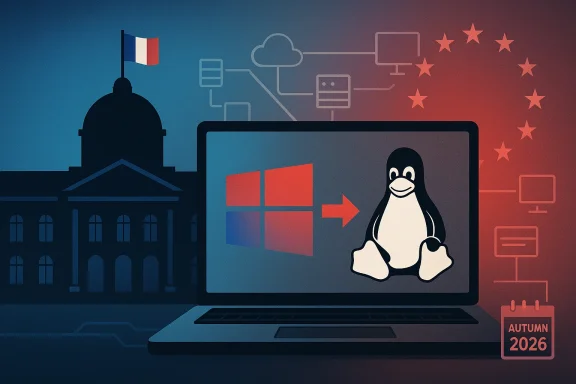
France’s latest digital-sovereignty push is bigger than a simple desktop swap. On April 8, 2026, the country’s interministerial digital directorate, DINUM, publicly framed dependence on extra-European technology as a strategic weakness and said the state will move away from Windows in favor of Linux-based workstations. That announcement sits inside a broader effort to reduce reliance on non-European platforms, services, and infrastructure across government.
The French state is not waking up to the idea of digital sovereignty for the first time. For years, European policymakers have argued that public administrations should reduce lock-in to foreign cloud platforms, productivity suites, and identity systems, especially where sensitive government data is involved. What makes the new French position notable is not the philosophy, but the scope: the government is now talking about operational migration, not just policy aspiration.
DINUM’s latest statement places Windows in the same risk category as other proprietary tools that sit outside European control. According to the official French government press material, ministries are being asked to participate in a collective effort to map dependencies and prepare exit plans for extra-European technologies. The plan specifically calls out “sortie de Windows” in favor of Linux workstations, which is a remarkably direct way for a major Western government to describe a desktop transition.
The timing matters. France’s move comes amid a wider European debate over whether governments can rely on U.S.-based vendors for core communications, productivity, cloud, and AI systems without accepting strategic exposure. Earlier in 2026, France already announced a phaseout of several U.S. video-conferencing tools for civil servants, replacing them with a domestic alternative. That makes the Windows-to-Linux effort look less like a one-off and more like a broader statecraft through procurement strategy.
There is also a practical side to this. Linux is not being chosen because it is fashionable; it is being chosen because it offers a path away from unilateral vendor control, subscription leverage, and platform dependency. But the real-world challenge is much harder than the political slogan suggests. Replacing one operating system is only the beginning; the deeper question is whether France can rebuild the whole workplace stack around open standards without creating new forms of dependency elsewhere.
At the same time, the French position is broader than desktop operating systems. DINUM’s framing links Windows migration to collaboration tools, security tools, AI platforms, databases, and network equipment. That breadth shows the state is targeting stack dependence, not merely software branding. If successful, it would be one of the more comprehensive public-sector sovereignty programs in Europe.
There is also a geopolitical layer. French officials are explicitly linking digital infrastructure to strategic autonomy, and that language has become more intense in Europe as concerns grow about transatlantic policy instability and the possibility of external pressure on critical tech systems. The point is not that U.S. vendors are inherently unreliable; it is that governments want fewer single points of political and commercial failure.
That logic extends beyond operating systems. If a state’s collaboration suite, cloud authentication, device management, and security tooling all originate outside its jurisdictional comfort zone, switching one component while leaving the rest untouched may deliver only partial sovereignty. The French government appears to understand that, which is why the Windows decision is bundled into a wider dependency-reduction program.
But choosing Linux does not automatically guarantee independence. Many Linux distributions, support firms, and enterprise tools are still global products with multinational vendor relationships. The real question for France is whether it wants sovereignty in the sense of European control or sovereignty in the more modest sense of freedom from a single proprietary choke point. Those are related, but not identical, goals.
There is also the experience issue. Linux desktops have improved a great deal, but government users are not hobbyists; they need predictable workflows, centralized support, and application compatibility. If the migration is handled badly, the political symbolism of freedom can quickly turn into user frustration and shadow IT.
That is why the European open-source ecosystem is getting renewed attention. Governments looking for alternatives want office suites, collaboration platforms, identity tools, and device management systems that can be procured with less geopolitical anxiety. The more these tools can be tied to local maintenance, local support, and local legal frameworks, the more compelling the sovereignty argument becomes.
The catch is that Europe’s software ecosystem remains fragmented. There are strong players, but not always unified product suites with the scale and polish of Microsoft’s ecosystem. So the French government may find that the most realistic path is a hybrid one: open-source foundations where possible, European-hosted services where necessary, and strict procurement rules to avoid fresh lock-in. That is less romantic than a clean break, but far more plausible.
There is also the question of procurement discipline. A sovereignty push only works if ministries stop reintroducing dependency through exceptions, procurement shortcuts, and “temporary” vendor-specific workarounds. If every department negotiates its own escape hatch, the result can be a patchwork of platforms that are more expensive to support than the original environment.
For enterprise users, though, there can be upside. Open systems can lower licensing exposure, improve auditability, and extend hardware life by making older devices viable for longer. That can be especially attractive in the public sector, where budgets are tight and replacement cycles are politically sensitive. The key is whether the savings materialize fast enough to justify the migration cost.
For ordinary users, the practical impact is indirect but real. Public services increasingly shape expectations around formats, identity systems, messaging tools, and digital access channels. If France standardizes on more open tools internally, it may nudge more citizens and contractors toward interoperable formats and open standards as a matter of everyday convenience.
This is where the cultural significance gets interesting. Open source is often framed as a technical preference, but governments are treating it as a civic philosophy: control your tools, understand your dependencies, and make exit possible. That is a powerful message in a period when software dependence is increasingly treated like infrastructure dependence.
The competitive pressure is broader than just operating systems. If France succeeds in moving ministries away from proprietary defaults, then cloud providers, productivity vendors, and endpoint-management platforms may all face more scrutiny from public buyers. That could push the market toward modular, interoperable products that are easier to replace and harder to hold hostage.
That said, incumbents have defenses. Microsoft can respond with sovereign-cloud messaging, stronger regional hosting, more flexible public-sector contracts, and deeper support for open standards. In other words, even a loss on one front can accelerate adaptation on another. The real competitive shift may be less about who wins France’s desktops and more about who can convincingly promise reversible dependency.
European digital-sovereignty debates also tend to intensify when geopolitical pressure rises. The current French push arrives alongside broader anxieties about U.S. political volatility and the risk that strategic technology ties can be weaponized or interrupted. Whether or not that risk is likely, the perception of risk is enough to alter buying behavior.
In that sense, the French move is both practical and symbolic. It is practical because governments really do need better resilience. It is symbolic because it says that dependency itself is now something the state intends to manage, measure, and reduce. That is a major philosophical shift even if the rollout takes years.
The broader European market will be watching for signs that France can keep the transition focused on outcomes instead of ideology. A successful migration would validate the idea that digital sovereignty is achievable with open-source foundations, careful procurement, and strong executive backing. A failed one would reinforce the argument that platform dependence is easier to critique than to escape.
Source: XDA France's government is ditching Windows for Linux, calling US tech dependence a strategic risk
 Overview
The French state is not waking up to the idea of digital sovereignty for the first time. For years, European policymakers have argued that public administrations should reduce lock-in to foreign cloud platforms, productivity suites, and identity systems, especially where sensitive government data is involved. What makes the new French position notable is not the philosophy, but the scope: the government is now talking about operational migration, not just policy aspiration.DINUM’s latest statement places Windows in the same risk category as other proprietary tools that sit outside European control. According to the official French government press material, ministries are being asked to participate in a collective effort to map dependencies and prepare exit plans for extra-European technologies. The plan specifically calls out “sortie de Windows” in favor of Linux workstations, which is a remarkably direct way for a major Western government to describe a desktop transition.
The timing matters. France’s move comes amid a wider European debate over whether governments can rely on U.S.-based vendors for core communications, productivity, cloud, and AI systems without accepting strategic exposure. Earlier in 2026, France already announced a phaseout of several U.S. video-conferencing tools for civil servants, replacing them with a domestic alternative. That makes the Windows-to-Linux effort look less like a one-off and more like a broader statecraft through procurement strategy.
There is also a practical side to this. Linux is not being chosen because it is fashionable; it is being chosen because it offers a path away from unilateral vendor control, subscription leverage, and platform dependency. But the real-world challenge is much harder than the political slogan suggests. Replacing one operating system is only the beginning; the deeper question is whether France can rebuild the whole workplace stack around open standards without creating new forms of dependency elsewhere.
What France Actually Announced
The clearest official statement came from DINUM’s April 8, 2026 press release, which described a coordinated government seminar on reducing extra-European digital dependencies. The release says the state is accelerating its sovereignty strategy and explicitly states that, for workstation evolution, DINUM is announcing a departure from Windows in favor of Linux. That wording is important because it turns a directional preference into an administrative objective.The significance of the wording
The phrase “sortie de Windows” is blunt by government standards. It signals that this is not just about piloting Linux in a few departments or buying some open-source software licenses; it implies an institutional move away from Microsoft’s desktop ecosystem. In government language, that usually means a long transition window, careful procurement choreography, and a lot of compatibility work behind the scenes.At the same time, the French position is broader than desktop operating systems. DINUM’s framing links Windows migration to collaboration tools, security tools, AI platforms, databases, and network equipment. That breadth shows the state is targeting stack dependence, not merely software branding. If successful, it would be one of the more comprehensive public-sector sovereignty programs in Europe.
- The move is officially tied to digital sovereignty, not just cost savings.
- Windows is being treated as part of a wider dependency map.
- The government wants ministries to plan exits by autumn 2026.
- The scope reportedly includes more than desktops: it reaches collaboration, security, AI, and infrastructure.
Why Windows Became a Strategic Risk
Microsoft Windows is still the default desktop platform in most large organizations because it is familiar, deeply integrated, and supported by a huge ecosystem. That same pervasiveness is what makes it strategically sensitive. When a government depends on a single external vendor for endpoints, management tools, updates, identity integration, and application compatibility, it creates a layered dependency that is hard to unwind quickly.Dependency is not just about the OS
The debate is not really “Windows versus Linux” in isolation. It is about who controls the cadence of change, the licensing model, the telemetry surface, the update channel, and the long-term compatibility contract. In public administration, those details matter because ministries have to preserve records, keep legacy applications working, and avoid surprise outages while still modernizing.There is also a geopolitical layer. French officials are explicitly linking digital infrastructure to strategic autonomy, and that language has become more intense in Europe as concerns grow about transatlantic policy instability and the possibility of external pressure on critical tech systems. The point is not that U.S. vendors are inherently unreliable; it is that governments want fewer single points of political and commercial failure.
That logic extends beyond operating systems. If a state’s collaboration suite, cloud authentication, device management, and security tooling all originate outside its jurisdictional comfort zone, switching one component while leaving the rest untouched may deliver only partial sovereignty. The French government appears to understand that, which is why the Windows decision is bundled into a wider dependency-reduction program.
- Vendor lock-in can become a policy vulnerability.
- A government needs control over updates, pricing, and lifecycle planning.
- OS migration is only valuable if adjacent systems also become more open.
- The more integrated the stack, the harder it is to switch piecemeal.
The Role of Linux in the Transition
Linux is the obvious landing zone for a government trying to reduce proprietary dependence without abandoning modern computing. It offers open code, diverse distribution choices, and the ability to build managed desktop images without relying on a single vendor’s roadmap. For public-sector IT, that flexibility can be a major advantage, especially when long-term maintainability matters more than consumer convenience.Why Linux fits a sovereignty agenda
Open-source desktops allow administrators to inspect behavior, harden systems, and tailor deployments to internal policy. They also make it easier to standardize on open protocols and avoid the accidental drift that often happens when proprietary suites impose their own file formats and service dependencies. In a sovereignty-first environment, that matters as much as performance or cost.But choosing Linux does not automatically guarantee independence. Many Linux distributions, support firms, and enterprise tools are still global products with multinational vendor relationships. The real question for France is whether it wants sovereignty in the sense of European control or sovereignty in the more modest sense of freedom from a single proprietary choke point. Those are related, but not identical, goals.
There is also the experience issue. Linux desktops have improved a great deal, but government users are not hobbyists; they need predictable workflows, centralized support, and application compatibility. If the migration is handled badly, the political symbolism of freedom can quickly turn into user frustration and shadow IT.
- Linux offers transparency and customization.
- It can reduce exposure to unilateral licensing changes.
- It still requires strong enterprise packaging and support.
- Migration success depends on training, not ideology.
EU-Based Alternatives and the Sovereignty Question
One of the more interesting consequences of France’s stance is that it pushes attention toward European open-source vendors and institutions. The source material cited by XDA points to options such as openSUSE and LibreOffice, but the larger point is that the government may want a toolchain that is both open-source and culturally closer to Europe’s regulatory model. That distinction matters because “open source” and “European-controlled” are not always the same thing.Open source is not automatically local
A software project can be open, auditable, and still governed from outside the EU. Conversely, a European vendor can offer proprietary services that may still reduce strategic exposure if they are hosted, contracted, and controlled in a way that aligns with public-sector requirements. France’s challenge is to decide whether the goal is code openness, data residency, jurisdictional comfort, or all three.That is why the European open-source ecosystem is getting renewed attention. Governments looking for alternatives want office suites, collaboration platforms, identity tools, and device management systems that can be procured with less geopolitical anxiety. The more these tools can be tied to local maintenance, local support, and local legal frameworks, the more compelling the sovereignty argument becomes.
The catch is that Europe’s software ecosystem remains fragmented. There are strong players, but not always unified product suites with the scale and polish of Microsoft’s ecosystem. So the French government may find that the most realistic path is a hybrid one: open-source foundations where possible, European-hosted services where necessary, and strict procurement rules to avoid fresh lock-in. That is less romantic than a clean break, but far more plausible.
- open source does not always mean EU control.
- Public buyers may prioritize jurisdiction and hosting as much as code access.
- Europe has alternatives, but they are not always one-to-one replacements.
- A hybrid sovereign stack may be the most practical outcome.
Enterprise Impact: What a Migration Really Means
For government IT teams, a Windows exit is never just a desktop swap. It forces a review of device management, authentication, document workflows, security tooling, remote access, printing, line-of-business software, and the training regime around all of it. The more legacy applications the state depends on, the more expensive and time-consuming the transition becomes.The hidden work is the hardest work
Desktop operating systems are only the visible layer of a much deeper stack. Back-end systems, database integrations, browser-based portals, and file formats all have to be tested for interoperability, and that testing is where government migrations often slow down. Even if Linux itself is stable, the surrounding ecosystem may not be ready on day one.There is also the question of procurement discipline. A sovereignty push only works if ministries stop reintroducing dependency through exceptions, procurement shortcuts, and “temporary” vendor-specific workarounds. If every department negotiates its own escape hatch, the result can be a patchwork of platforms that are more expensive to support than the original environment.
For enterprise users, though, there can be upside. Open systems can lower licensing exposure, improve auditability, and extend hardware life by making older devices viable for longer. That can be especially attractive in the public sector, where budgets are tight and replacement cycles are politically sensitive. The key is whether the savings materialize fast enough to justify the migration cost.
- Device management will likely need a rebuild, not a patch.
- Legacy apps are the main migration risk.
- Training and helpdesk readiness will determine user sentiment.
- Hardware refresh cycles may become more flexible under Linux.
Consumer and Cultural Impact
Even though this is a government decision, it has consumer symbolism. A major Western state saying it will move away from Windows sends a message that proprietary defaults are no longer politically neutral. That can influence how businesses, schools, and local governments think about their own platform choices.Signal effects matter
France is one of Europe’s largest economies, and its public-sector choices often reverberate beyond national borders. If the migration appears successful, it could strengthen the case for open-source adoption in other public administrations, especially those already worried about costs or geopolitical exposure. If it stalls, it may be used as evidence that large-scale desktop replacement is too disruptive.For ordinary users, the practical impact is indirect but real. Public services increasingly shape expectations around formats, identity systems, messaging tools, and digital access channels. If France standardizes on more open tools internally, it may nudge more citizens and contractors toward interoperable formats and open standards as a matter of everyday convenience.
This is where the cultural significance gets interesting. Open source is often framed as a technical preference, but governments are treating it as a civic philosophy: control your tools, understand your dependencies, and make exit possible. That is a powerful message in a period when software dependence is increasingly treated like infrastructure dependence.
- The move could normalize open-source-first thinking.
- It may encourage other public bodies to reassess vendor lock-in.
- Citizens may indirectly benefit from more interoperable services.
- Success or failure will become a reference point for Europe.
Competitive Implications for Microsoft and Rivals
From Microsoft’s perspective, this is not yet a commercial catastrophe, but it is a symbolic warning. Governments are among the most valuable enterprise customers precisely because they are sticky, prestigious, and difficult to dislodge. If a major state starts treating Windows as a dependency to be reduced, that could encourage other public buyers to demand better sovereignty guarantees, more flexible licensing, and stronger data-governance terms.Rivals get a bigger opening
Linux vendors and European service providers stand to gain the most obvious benefit. A high-profile migration gives credibility to firms offering managed Linux desktops, open-source office suites, secure collaboration tools, and local support contracts. Even when the software itself is free, the services around it are not, and that is where new markets can develop.The competitive pressure is broader than just operating systems. If France succeeds in moving ministries away from proprietary defaults, then cloud providers, productivity vendors, and endpoint-management platforms may all face more scrutiny from public buyers. That could push the market toward modular, interoperable products that are easier to replace and harder to hold hostage.
That said, incumbents have defenses. Microsoft can respond with sovereign-cloud messaging, stronger regional hosting, more flexible public-sector contracts, and deeper support for open standards. In other words, even a loss on one front can accelerate adaptation on another. The real competitive shift may be less about who wins France’s desktops and more about who can convincingly promise reversible dependency.
- Linux service vendors gain a credibility boost.
- Microsoft may respond with more aggressive sovereignty offerings.
- Public procurement could become more standards-focused.
- The industry may shift toward portable, modular stacks.
Historical Precedents in Europe
France is not acting in a vacuum. Across Europe, public institutions have periodically tried to break free from proprietary software, often with mixed outcomes. Some migrations have succeeded because they were narrow, well-funded, and politically protected. Others stumbled when user resistance, application incompatibility, or administrative drift diluted the original goal.What earlier attempts teach
The lesson from earlier public-sector software transitions is that the most durable wins usually come from patient standardization rather than dramatic replacement. When governments focus on document formats, browser-based workflows, and procurement rules first, they reduce the blast radius of OS change later. That may be the smarter path for France as well.European digital-sovereignty debates also tend to intensify when geopolitical pressure rises. The current French push arrives alongside broader anxieties about U.S. political volatility and the risk that strategic technology ties can be weaponized or interrupted. Whether or not that risk is likely, the perception of risk is enough to alter buying behavior.
In that sense, the French move is both practical and symbolic. It is practical because governments really do need better resilience. It is symbolic because it says that dependency itself is now something the state intends to manage, measure, and reduce. That is a major philosophical shift even if the rollout takes years.
- Successful migrations tend to start with standards, not slogans.
- Political pressure accelerates sovereignty debates.
- Administrative patience matters more than media drama.
- The biggest lesson is that exit capability is itself a security asset.
Strengths and Opportunities
France’s strategy has several advantages if it is executed with discipline. It aligns procurement, security, and industrial policy under one umbrella, and that can create a more coherent public-sector technology posture than isolated modernization efforts. It also gives European vendors a clearer demand signal, which can stimulate local capability rather than leaving the market to default to U.S. hyperscalers and software giants.- Strategic autonomy becomes a concrete operating principle, not just rhetoric.
- Linux can reduce licensing lock-in and extend hardware life.
- Open standards may improve long-term data portability.
- European suppliers gain a clearer procurement pathway.
- Ministries may be forced to rationalize duplicated systems.
- Security reviews may uncover hidden legacy dependencies.
- The move could encourage a broader market for sovereign services.
Risks and Concerns
The risks are equally real. A rushed migration could disrupt day-to-day administration, create user frustration, and produce expensive parallel systems that weaken the sovereignty goal. There is also a danger that “European independence” turns into a branding exercise if the state merely replaces one set of external dependencies with another.- Legacy software compatibility may break or require costly rewrites.
- Staff retraining could be larger and slower than expected.
- Procurement fragmentation could undermine standardization.
- EU-based alternatives may not cover every use case.
- Political pressure might outrun technical readiness.
- Support ecosystems could lag behind the ambition.
- There is a risk of replacing proprietary lock-in with vendor substitution rather than true openness.
Looking Ahead
The next few months will be about planning, not celebration. DINUM says ministries have until autumn 2026 to draw up their exit plans, and that means the most important phase is still ahead: inventory, classification, testing, and sequencing. If those plans are serious, they will reveal how deeply Windows is embedded in French state operations.The broader European market will be watching for signs that France can keep the transition focused on outcomes instead of ideology. A successful migration would validate the idea that digital sovereignty is achievable with open-source foundations, careful procurement, and strong executive backing. A failed one would reinforce the argument that platform dependence is easier to critique than to escape.
- Ministries must submit workable transition plans by autumn 2026.
- The real test will be whether critical applications remain usable.
- Success may depend on how well France handles document and identity workflows.
- Other EU governments will study the results closely.
- Microsoft’s response will matter almost as much as the migration itself.
Source: XDA France's government is ditching Windows for Linux, calling US tech dependence a strategic risk
