

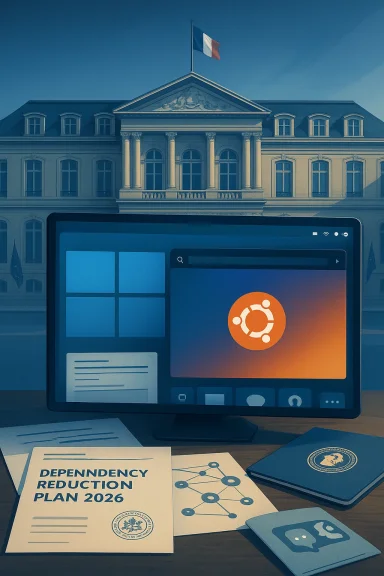
France’s April 8, 2026 decision to move its government desktop estate away from Windows and toward Linux is bigger than a routine software refresh. It is a statement about sovereignty, procurement power, and the willingness of a major Western state to build its own digital operating model rather than rent one from Silicon Valley. The move is also far more credible than it would have been a decade ago, because France has already spent years proving that Linux can work at public-sector scale, especially through the GendBuntu desktop used by the national gendarmerie. (numerique.gouv.fr)
At the same time, the reporting around the transition needs a careful read. The official French communiqué says DINUM is exiting Windows for Linux workstations and that every ministry must submit a dependency-reduction plan by autumn 2026, but it does not, in the text I could verify, spell out every desktop component in the way some commentary does. The broad direction is real; the exact stack is partly an informed extrapolation built on France’s existing open-source programs, procurement roadmap, and the Gendarmerie’s long-running Ubuntu deployment. (numerique.gouv.fr)
France did not arrive at this point overnight. The country has been steadily building a public-sector open-source ecosystem for years, and the 2026 announcement simply pulls those efforts into one more ambitious, more coordinated program. The official April 8 seminar brought together DINUM, DGE, ANSSI, and DAE to accelerate a reduction in extra-European dependencies, and the ministry-level directive is explicit: each ministry must produce its own roadmap covering workstations, collaboration tools, antivirus, AI, databases, virtualization, and network equipment. (numerique.gouv.fr)
That framing matters because it shows France is not merely chasing a different operating system. It is trying to redesign the government stack from the endpoint up, with the desktop as one layer in a wider sovereignty agenda. The same communiqué references earlier moves toward Visio for government video conferencing and the migration of the national health insurance agency’s 80,000 staff to the “socle numérique interministériel,” which includes Tchap, Visio, and FranceTransfert. (numerique.gouv.fr)
The strongest historical precedent is the Gendarmerie nationale. Interoperable Europe’s documentation says the force used open source across servers, databases, and tens of thousands of desktops, and that its workstation fleet relied on GendBuntu, a tailored Ubuntu variant. Other sources describe the project as an example of central management, rolling upgrades, and large-scale desktop transition that was completed over years rather than weeks. That experience gives France something most governments lack: an operational memory of how to move an entire institution off Windows without collapsing daily work.
The broader political mood is equally important. Europe has become more suspicious of overdependence on U.S. cloud and software vendors, especially for sensitive public-sector workloads. France’s move follows the same logic that has already driven replacement of Teams and Zoom with domestic alternatives, and it aligns with a regional push for interoperable, sovereign tooling rather than an endless patchwork of foreign subscriptions. AP noted that this “digital sovereignty” impulse is spreading across Europe as governments reassess the security, continuity, and geopolitical risk of U.S.-based services.
That means the state is not merely replacing one logo with another. It is attempting to build an accountable migration framework with deadlines, dependency mapping, and public-sector coalition building. The communiqué also says the government wants those plans to inform the industrial ecosystem through procurement, signaling that sovereignty is being linked to domestic market formation rather than isolated IT cutovers. (numerique.gouv.fr)
In practical terms, that is far harder than swapping out an OS image. It requires new identity systems, new support procedures, new packaging pipelines, and new training for administrators and end users. It also requires ministries to agree on a common set of tools rather than creating a thousand local exceptions that eventually reintroduce proprietary lock-in. (numerique.gouv.fr)
That rhetoric will resonate with European software vendors and systems integrators. It tells them that future public contracts may increasingly reward open standards, local hosting, and supportable source-code access rather than glossy branding or vendor convenience. It also warns U.S. vendors that the French government sees dependency reduction as a strategic, not merely economic, priority. (numerique.gouv.fr)
This matters because it turns a politically charged policy idea into an operational case study. A police force cannot afford a desktop project that breaks authentication, slows officers down, or creates support chaos during upgrades. The fact that the Gendarmerie kept the fleet online over many years makes it a strong argument that Linux can work when the organization controls the process.
It also shows how software policy and training policy intertwine. The Gendarmerie did not simply install Ubuntu and declare victory; it built operating procedures around the change. That is the difference between a desktop transformation and a one-time image swap.
So GendBuntu is a blueprint, not a guarantee. The civil service transition will require a higher degree of migration tooling, compatibility testing, and support escalation than a police fleet. But the existence of GendBuntu means France is not taking a blind leap; it is expanding a familiar model into a larger administrative universe. (numerique.gouv.fr)
The likely appeal of this approach is obvious. Ubuntu gives France an LTS-style support model, broad hardware compatibility, and a familiar enterprise packaging ecosystem. GNOME gives the user interface a clean, modern default that can be standardized across ministries, reducing the visual and operational fragmentation that often kills desktop projects.
That combination also plays well with government interoperability. LibreOffice and open document formats reduce dependence on proprietary file structures, while Firefox ESR and Thunderbird ESR provide a controlled support cadence. For a state trying to reduce risk, that stability is a feature, not a limitation.
Still, the underlying pattern is reasonable. Government desktop transitions usually favor whatever version line is current, secure, and supportable when the rollout begins, and they often trail upstream distributions by a modest amount. France’s plan is likely to follow that familiar enterprise rhythm. (numerique.gouv.fr)
The reason it matters is that a desktop migration fails if users are forced back into Microsoft 365 or Google Workspace for every real task. France’s answer is not just “use Linux”; it is “use Linux with an integrated collaboration suite that already handles messaging, conferencing, documents, spreadsheets, storage, transfer, email, and calendars.” That is the sort of end-to-end stack that can actually displace proprietary office ecosystems.
What makes the suite strategically important is not just the feature list, but the integration model. The apps share identity, design language, and hosting policy, and they are intended to work together rather than compete as standalone products. That gives France an opportunity to standardize user experience at scale, which is often the difference between adoption and quiet resistance.
There is also a reputational effect. Once a large government proves it can run on open source, vendors serving schools, cities, hospitals, and regulated industries may face more pressure to explain why they still need expensive proprietary defaults. That kind of pressure can reshape a domestic tech market even if the public plan itself is limited to government workstations.
This is where many Linux transitions historically stumbled. Organizations would replace Windows but leave users stranded in a fragmented patchwork of local tools, file repositories, and login systems. France appears to be doing the opposite: it is building a coherent service layer and then plugging the desktop into it.
The broader strategic implication is that the French state wants to own more of the trust stack. That means controlling authentication, reducing overseas dependencies, and ensuring that data paths stay inside a policy perimeter the government can audit and enforce. In a world of subscription software and cloud-mediated collaboration, that is a serious shift in power. (numerique.gouv.fr)
That distinction should reassure practical IT managers. The goal is not to cut French civil servants off from the outside world; it is to make sure the state’s core operations are not hostage to foreign platforms. In policy terms, that is a much more durable target than pure self-sufficiency. (numerique.gouv.fr)
For Canonical, the opportunity is obvious but so are the constraints. A French government migration would showcase the value of Ubuntu’s enterprise support model, but the public-sector world will also scrutinize whether Canonical’s ecosystem can carry the burden of large-scale lifecycle management across many ministries. Success here would strengthen Ubuntu as the default serious Linux desktop in regulated environments.
That is why the French plan matters beyond France. It normalizes the idea that open source is not just a cost-saving back-office tactic, but an industrial strategy. Once that idea takes hold, vendors that were once “alternatives” start to look like infrastructure. (numerique.gouv.fr)
Still, the market response will not be uniform. Some organizations will copy France, some will do the minimum to appease policy goals, and some will quietly continue paying for proprietary tools where compatibility is too painful to surrender. That mix is exactly what tends to happen when a policy signal is strong but the ecosystem is still uneven. (numerique.gouv.fr)
There is also a communications risk. If the government or commentators oversell the migration as a total overnight switch, critics will seize on inevitable partial rollouts, edge cases, and exceptions. A measured rollout narrative will serve France better than revolutionary rhetoric. (numerique.gouv.fr)
The second thing to watch is whether La Suite Numérique continues to mature into a truly mainstream administrative platform. If adoption grows beyond early champions and becomes the default collaboration layer for daily work, the Linux desktop transition becomes much easier. If not, the state may end up with Linux endpoints and persistent pressure to fall back to proprietary tools.
That is why this story is bigger than a desktop operating system. It is about whether governments can reclaim agency in the software layer of the state. If France pulls it off, the conversation around public-sector computing in Europe will not be about whether Linux belongs on the desktop. It will be about how quickly the rest of the continent wants to follow. (numerique.gouv.fr)
France has chosen a path that is difficult, politically charged, and operationally demanding, but it is also one of the few paths that can produce lasting leverage over technology dependence. The transition will test the state’s discipline more than its ideology, and that may be the right test to impose. If the ministries execute well, the payoff will be more than a new desktop image; it will be a new public-sector operating philosophy built around control, interoperability, and resilience.
Source: ZDNET France is replacing 2.5 million Windows desktops with Linux - and I mapped out its new stack
At the same time, the reporting around the transition needs a careful read. The official French communiqué says DINUM is exiting Windows for Linux workstations and that every ministry must submit a dependency-reduction plan by autumn 2026, but it does not, in the text I could verify, spell out every desktop component in the way some commentary does. The broad direction is real; the exact stack is partly an informed extrapolation built on France’s existing open-source programs, procurement roadmap, and the Gendarmerie’s long-running Ubuntu deployment. (numerique.gouv.fr)
 Background
France did not arrive at this point overnight. The country has been steadily building a public-sector open-source ecosystem for years, and the 2026 announcement simply pulls those efforts into one more ambitious, more coordinated program. The official April 8 seminar brought together DINUM, DGE, ANSSI, and DAE to accelerate a reduction in extra-European dependencies, and the ministry-level directive is explicit: each ministry must produce its own roadmap covering workstations, collaboration tools, antivirus, AI, databases, virtualization, and network equipment. (numerique.gouv.fr)That framing matters because it shows France is not merely chasing a different operating system. It is trying to redesign the government stack from the endpoint up, with the desktop as one layer in a wider sovereignty agenda. The same communiqué references earlier moves toward Visio for government video conferencing and the migration of the national health insurance agency’s 80,000 staff to the “socle numérique interministériel,” which includes Tchap, Visio, and FranceTransfert. (numerique.gouv.fr)
The strongest historical precedent is the Gendarmerie nationale. Interoperable Europe’s documentation says the force used open source across servers, databases, and tens of thousands of desktops, and that its workstation fleet relied on GendBuntu, a tailored Ubuntu variant. Other sources describe the project as an example of central management, rolling upgrades, and large-scale desktop transition that was completed over years rather than weeks. That experience gives France something most governments lack: an operational memory of how to move an entire institution off Windows without collapsing daily work.
The broader political mood is equally important. Europe has become more suspicious of overdependence on U.S. cloud and software vendors, especially for sensitive public-sector workloads. France’s move follows the same logic that has already driven replacement of Teams and Zoom with domestic alternatives, and it aligns with a regional push for interoperable, sovereign tooling rather than an endless patchwork of foreign subscriptions. AP noted that this “digital sovereignty” impulse is spreading across Europe as governments reassess the security, continuity, and geopolitical risk of U.S.-based services.
Why this matters now
The timing is not accidental. Windows 10 end-of-support pressure, rising licensing costs, and the maturity of Linux desktops have all made the migration conversation easier. So has the fact that modern Linux distributions are far less brittle on hardware than they once were, while office suites, browsers, and collaboration tools have become good enough for mainstream public administration use.- France is not starting from zero; it is scaling a model it already proved in policing.
- The state is treating desktop migration as part of a larger sovereignty program.
- The official plan covers more than operating systems.
- The political rationale is as important as the technical one.
The Official Mandate
The core official fact is simple: DINUM has announced the exit from Windows in favor of Linux workstations. The communiqué says that, following the April 8 seminar, each ministry and its operators must formalize a dependency-reduction plan by autumn 2026. This is a governance move as much as a technical one, because it forces every ministry to inventory where foreign technology sits in its daily operations. (numerique.gouv.fr)That means the state is not merely replacing one logo with another. It is attempting to build an accountable migration framework with deadlines, dependency mapping, and public-sector coalition building. The communiqué also says the government wants those plans to inform the industrial ecosystem through procurement, signaling that sovereignty is being linked to domestic market formation rather than isolated IT cutovers. (numerique.gouv.fr)
The scope is broader than Windows
This is where many observers miss the real story. The Linux desktop is the visible headline, but the French state is also targeting collaborative software, antivirus, AI, databases, virtualization, and network gear. In other words, the endpoint is only the front door to a wider reduction in dependency on non-European vendors. (numerique.gouv.fr)In practical terms, that is far harder than swapping out an OS image. It requires new identity systems, new support procedures, new packaging pipelines, and new training for administrators and end users. It also requires ministries to agree on a common set of tools rather than creating a thousand local exceptions that eventually reintroduce proprietary lock-in. (numerique.gouv.fr)
- Windows is the headline, but not the whole program.
- France is mapping dependencies across the full workplace stack.
- Ministry plans are due by autumn 2026.
- The government is using procurement as a policy lever.
A political signal to industry
The language from David Amiel and Anne Le Hénanff is unmistakably forceful. Both statements frame digital sovereignty as a necessity, not a preference, and the communiqué argues that the state can no longer accept tools whose rules, prices, and evolution are controlled elsewhere. That is a notable escalation from the more cautious language governments often use when talking about open source. (numerique.gouv.fr)That rhetoric will resonate with European software vendors and systems integrators. It tells them that future public contracts may increasingly reward open standards, local hosting, and supportable source-code access rather than glossy branding or vendor convenience. It also warns U.S. vendors that the French government sees dependency reduction as a strategic, not merely economic, priority. (numerique.gouv.fr)
GendBuntu as the Blueprint
The most persuasive reason the French Linux plan is believable is that France already has a working template. The Gendarmerie’s Ubuntu-based workstation project, GendBuntu, is one of the most durable large-scale Linux desktop deployments in government anywhere. Interoperable Europe says the force uses GendBuntu on workstations and Debian GNU/Linux on many servers, with centrally managed infrastructure across a very large national footprint.This matters because it turns a politically charged policy idea into an operational case study. A police force cannot afford a desktop project that breaks authentication, slows officers down, or creates support chaos during upgrades. The fact that the Gendarmerie kept the fleet online over many years makes it a strong argument that Linux can work when the organization controls the process.
What GendBuntu proves
The Gendarmerie example demonstrates three things. First, Linux can be standardized enough for mass deployment. Second, open-source office tools and browsers can support a public agency’s routine workflows. Third, centralized packaging and update discipline matter more than brand loyalty. Those are not glamorous lessons, but they are the ones that determine whether a migration succeeds or becomes a pilot project that never leaves the lab.It also shows how software policy and training policy intertwine. The Gendarmerie did not simply install Ubuntu and declare victory; it built operating procedures around the change. That is the difference between a desktop transformation and a one-time image swap.
- GendBuntu gives France a real-world precedent, not a theory.
- The Gendarmerie’s success depends on centralized management.
- Linux adoption worked because the organization matched tools to tasks.
- Long-term support is more important than novelty.
Why police are different from ministries
There is still a cautionary distinction. A police force has specialized workflows, but it is also more centralized than a sprawling civil-service apparatus spread across ministries, agencies, and regional offices. That makes the gendarmerie easier to standardize than a heterogeneous bureaucracy with more vendor diversity, more document exchange, and more interministerial interoperability issues. (numerique.gouv.fr)So GendBuntu is a blueprint, not a guarantee. The civil service transition will require a higher degree of migration tooling, compatibility testing, and support escalation than a police fleet. But the existence of GendBuntu means France is not taking a blind leap; it is expanding a familiar model into a larger administrative universe. (numerique.gouv.fr)
What the New Desktop Likely Looks Like
ZDNET’s mapped stack is useful as a working hypothesis, but readers should treat some of its precise version numbers as projections rather than confirmed facts. What is much more solid is the shape of the stack: Ubuntu-based Linux at the foundation, GNOME as the desktop environment, and a suite of open-source workplace applications on top. That architecture matches both the Gendarmerie precedent and the current direction of Ubuntu and GNOME development.The likely appeal of this approach is obvious. Ubuntu gives France an LTS-style support model, broad hardware compatibility, and a familiar enterprise packaging ecosystem. GNOME gives the user interface a clean, modern default that can be standardized across ministries, reducing the visual and operational fragmentation that often kills desktop projects.
The software layer
On the application side, the most plausible core tools are the ones already associated with La Suite Numérique and related public-sector deployments: LibreOffice for documents, Firefox ESR for browsing, Thunderbird for mail, and GIMP for image work. Those are not exciting choices, but they are battle-tested choices, and government tends to value predictable maintenance over innovation theater.That combination also plays well with government interoperability. LibreOffice and open document formats reduce dependence on proprietary file structures, while Firefox ESR and Thunderbird ESR provide a controlled support cadence. For a state trying to reduce risk, that stability is a feature, not a limitation.
- Ubuntu LTS is the logical foundation.
- GNOME is the most likely default desktop shell.
- LibreOffice, Firefox ESR, Thunderbird ESR, and GIMP fit the public-sector use case.
- The priority is supportability, not novelty.
Version claims need caution
The article’s more specific claims about Ubuntu 26.04, Linux kernel 7.0, GNOME 50, and other release numbers are forward-looking guesses, not confirmed elements of the French government plan. They may prove directionally right, but they should not be treated as official architecture until DINUM or an implementation partner says so. That distinction matters, especially in a migration that will likely roll out in phases. (numerique.gouv.fr)Still, the underlying pattern is reasonable. Government desktop transitions usually favor whatever version line is current, secure, and supportable when the rollout begins, and they often trail upstream distributions by a modest amount. France’s plan is likely to follow that familiar enterprise rhythm. (numerique.gouv.fr)
La Suite Numérique as the Productivity Backbone
If Linux is the foundation, La Suite Numérique is the productivity layer that makes the move administratively viable. The official LaSuite site describes it as a secure, France-hosted collaborative environment built from open-source components and reserved for public servants and invited partners through ProConnect. That alone makes it central to the sovereignty story.The reason it matters is that a desktop migration fails if users are forced back into Microsoft 365 or Google Workspace for every real task. France’s answer is not just “use Linux”; it is “use Linux with an integrated collaboration suite that already handles messaging, conferencing, documents, spreadsheets, storage, transfer, email, and calendars.” That is the sort of end-to-end stack that can actually displace proprietary office ecosystems.
The seven tools in context
The public sources around La Suite show a growing ecosystem rather than a one-off app. Tchap serves secure instant messaging; Visio serves video meetings; Docs handles collaborative documents; Grist powers structured data and spreadsheet-like workflows; Fichiers provides secure storage; Messagerie covers email, contacts, and calendar; and FranceTransfert handles larger file transfers. These are the practical equivalents of the tools civil servants already use every day.What makes the suite strategically important is not just the feature list, but the integration model. The apps share identity, design language, and hosting policy, and they are intended to work together rather than compete as standalone products. That gives France an opportunity to standardize user experience at scale, which is often the difference between adoption and quiet resistance.
- Tchap reduces reliance on consumer messaging apps.
- Visio replaces foreign conferencing platforms.
- Docs and Grist reduce dependence on office-suite lock-in.
- Fichiers and FranceTransfert keep documents within controlled jurisdiction.
Enterprise vs consumer impact
For enterprises, the lesson is that sovereign productivity is becoming a procurement strategy, not just an ideological preference. For consumers, the impact is indirect but real: public-sector services often set expectations for interoperability, data handling, and identity standards that eventually spill into the wider market. France’s choices may therefore influence vendors far beyond ministries and agencies.There is also a reputational effect. Once a large government proves it can run on open source, vendors serving schools, cities, hospitals, and regulated industries may face more pressure to explain why they still need expensive proprietary defaults. That kind of pressure can reshape a domestic tech market even if the public plan itself is limited to government workstations.
Collaboration, Identity, and the End of Siloed Government IT
A government desktop is never just a desktop. It is the frontend to identity management, document handling, meeting infrastructure, policy workflows, and support channels. France’s approach recognizes that reality by tying Linux migration to ProConnect, shared design patterns, and cross-tool switching that tries to reduce friction between apps.This is where many Linux transitions historically stumbled. Organizations would replace Windows but leave users stranded in a fragmented patchwork of local tools, file repositories, and login systems. France appears to be doing the opposite: it is building a coherent service layer and then plugging the desktop into it.
Identity is the real battlefield
If the identity system works, users barely notice the operating system. If it fails, every app feels broken, no matter how polished the desktop looks. France’s decision to anchor access in a public-sector identity framework is therefore as important as the Linux switch itself.The broader strategic implication is that the French state wants to own more of the trust stack. That means controlling authentication, reducing overseas dependencies, and ensuring that data paths stay inside a policy perimeter the government can audit and enforce. In a world of subscription software and cloud-mediated collaboration, that is a serious shift in power. (numerique.gouv.fr)
- Identity control is central to the migration.
- Cross-app integration reduces user resistance.
- Government-wide standardization is the main goal.
- The trust stack is as important as the OS stack.
Interoperability with outsiders still matters
France is not isolating itself completely. The official framing and the broader La Suite ecosystem still emphasize interoperability with external tools when needed, because ministries must collaborate with vendors, partners, and foreign bodies. That is an important nuance: sovereignty here means control, not autarky. (numerique.gouv.fr)That distinction should reassure practical IT managers. The goal is not to cut French civil servants off from the outside world; it is to make sure the state’s core operations are not hostage to foreign platforms. In policy terms, that is a much more durable target than pure self-sufficiency. (numerique.gouv.fr)
Competitive and Market Implications
For Microsoft, this is not an isolated embarrassment; it is part of a larger erosion of default status in public-sector computing. Governments do not abandon Windows lightly, and when they do, the symbolic damage often exceeds the raw seat count. A state as prominent as France openly migrating away from Windows tells other buyers that alternatives are no longer fringe. (numerique.gouv.fr)For Canonical, the opportunity is obvious but so are the constraints. A French government migration would showcase the value of Ubuntu’s enterprise support model, but the public-sector world will also scrutinize whether Canonical’s ecosystem can carry the burden of large-scale lifecycle management across many ministries. Success here would strengthen Ubuntu as the default serious Linux desktop in regulated environments.
The open-source market widens
The real winner may be the European open-source ecosystem more broadly. Tools like Matrix, Nextcloud, Grist, and collaborative document systems benefit when a large state buys in at scale, because large deployments harden the software, fund support, and create downstream demand for consulting and hosting. Public procurement can act like venture capital with a policy mandate.That is why the French plan matters beyond France. It normalizes the idea that open source is not just a cost-saving back-office tactic, but an industrial strategy. Once that idea takes hold, vendors that were once “alternatives” start to look like infrastructure. (numerique.gouv.fr)
- Microsoft loses default status in a major public sector.
- Canonical gains a high-profile enterprise showcase.
- Open-source vendors gain validation and procurement momentum.
- European sovereign-tech projects get a powerful reference customer.
A challenge to the service economy
This is also a challenge to the cloud-service economy that has grown around Microsoft 365, Teams, Zoom, and related subscriptions. If France proves it can run a large public-sector office on open-source software and sovereign hosting, then integrators will be asked harder questions about recurring licensing, data residency, and vendor lock-in. That pressure can force a lot of uncomfortable but healthy redesign. (numerique.gouv.fr)Still, the market response will not be uniform. Some organizations will copy France, some will do the minimum to appease policy goals, and some will quietly continue paying for proprietary tools where compatibility is too painful to surrender. That mix is exactly what tends to happen when a policy signal is strong but the ecosystem is still uneven. (numerique.gouv.fr)
Strengths and Opportunities
France’s plan has genuine strengths because it pairs political will with working precedents. The state is not betting on an untested desktop religion; it is extending existing public-sector open-source infrastructure into a more comprehensive model. That creates room for real savings, stronger data control, and a healthier domestic software ecosystem. (numerique.gouv.fr)- Proven precedent: GendBuntu shows that Linux desktops can survive at scale in a security-sensitive agency.
- Policy clarity: The official communiqué gives ministries a deadline and concrete dependency categories.
- Cost control: Fewer proprietary licenses can mean lower recurring spending over time.
- Sovereignty: Data, identity, and hosting can stay under French or EU governance.
- Interoperability: Open formats and shared standards can reduce lock-in and improve resilience.
- Ecosystem growth: Domestic suppliers and open-source vendors gain a clearer public-market path.
- Operational resilience: A standardised stack may simplify patching, support, and incident response.
Why this can work
The key opportunity is that France is combining architecture with policy. By aligning desktop migration, collaboration tools, and procurement, it has a better chance of avoiding the “pilot purgatory” that traps many public IT initiatives. That whole-stack approach is the strongest reason to believe this transition can endure. (numerique.gouv.fr)Risks and Concerns
The plan is ambitious enough that execution risks are unavoidable. A ministry can declare sovereignty, but it still has to keep payroll running, citizens served, and files exchanged with partners who may remain on Microsoft and Google ecosystems for years. In that sense, the hardest work begins after the announcement. (numerique.gouv.fr)- Compatibility gaps: Some legacy applications and workflows may not translate cleanly.
- User training burden: Civil servants will need support, not just a new desktop image.
- Migration sprawl: Different ministries could invent incompatible local exceptions.
- Vendor dependence shifts: Replacing Microsoft with a new central stack can still create lock-in if governance is weak.
- Project fatigue: Multi-year migration programs often lose momentum once the headlines fade.
- Security trade-offs: Open source improves auditability, but misconfiguration can still create risk.
- Overpromising: If the public narrative outruns implementation, confidence will erode fast.
The biggest hidden risk
The most serious danger is not that Linux itself fails. It is that the state succeeds in replacing Windows but recreates old dependencies in new forms through cloud services, proprietary plugins, or custom portals that only one supplier can maintain. That would look like sovereignty on paper while preserving the same strategic fragility underneath. (numerique.gouv.fr)There is also a communications risk. If the government or commentators oversell the migration as a total overnight switch, critics will seize on inevitable partial rollouts, edge cases, and exceptions. A measured rollout narrative will serve France better than revolutionary rhetoric. (numerique.gouv.fr)
What to Watch Next
The next phase will tell us whether France is serious about structural change or merely making a symbolic statement. The clearest sign will be how ministries translate the autumn 2026 deadline into concrete migration roadmaps, including which hardware, apps, and support models they choose. Another major indicator will be whether DINUM standardizes on a small number of reference builds or tolerates local divergence. (numerique.gouv.fr)The second thing to watch is whether La Suite Numérique continues to mature into a truly mainstream administrative platform. If adoption grows beyond early champions and becomes the default collaboration layer for daily work, the Linux desktop transition becomes much easier. If not, the state may end up with Linux endpoints and persistent pressure to fall back to proprietary tools.
Key milestones ahead
- Ministry migration plans due by autumn 2026.
- June 2026 industrial digital meetings and alliance-building.
- Expansion of Visio, Tchap, and FranceTransfert across agencies.
- Evidence of consistent desktop support and training at scale.
- Signs that procurement is shifting toward sovereign and interoperable tools.
Why the broader EU will care
France is not acting in a vacuum. The country is already collaborating with European partners on sovereign tooling and interoperable public-sector frameworks, and its decisions will be watched closely in Germany, the Netherlands, and beyond. If France can prove that a major state can operate on Linux and open-source productivity tools without losing administrative efficiency, it will strengthen the case for similar moves elsewhere in Europe.That is why this story is bigger than a desktop operating system. It is about whether governments can reclaim agency in the software layer of the state. If France pulls it off, the conversation around public-sector computing in Europe will not be about whether Linux belongs on the desktop. It will be about how quickly the rest of the continent wants to follow. (numerique.gouv.fr)
France has chosen a path that is difficult, politically charged, and operationally demanding, but it is also one of the few paths that can produce lasting leverage over technology dependence. The transition will test the state’s discipline more than its ideology, and that may be the right test to impose. If the ministries execute well, the payoff will be more than a new desktop image; it will be a new public-sector operating philosophy built around control, interoperability, and resilience.
Source: ZDNET France is replacing 2.5 million Windows desktops with Linux - and I mapped out its new stack
