

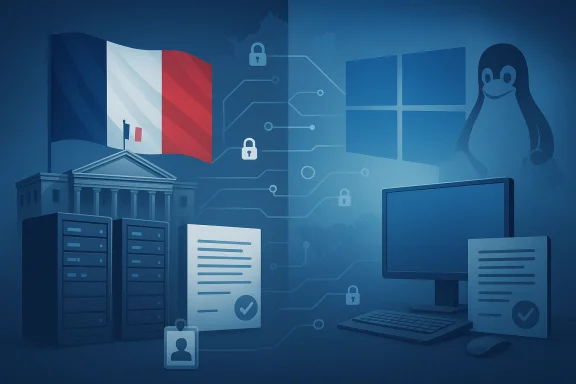
Europe’s digital-sovereignty debate has just moved from theory to infrastructure, and that is why the French government’s reported shift from Windows to Linux matters far beyond Paris. If the plan is carried through at national scale, it would affect millions of public-sector machines, reshape procurement habits, and send a blunt message to Microsoft: trust is now a competitive variable, not just a branding slogan. The timing is especially awkward for Windows 11, because the platform is already under pressure from users who feel the product is too buggy, too disruptive, and too focused on AI rather than stability.
For years, Linux migration stories in government circles have tended to follow the same arc: a regional authority announces a pilot, a ministry starts evaluating open-source alternatives, and then the whole effort settles into slow, incremental change. That is why so many observers initially treat these announcements as symbolic rather than transformational. The French case feels different because it sits inside a broader national push for digital sovereignty, and because it reportedly extends beyond a handful of departments into a formal migration expectation across ministries.
France has not arrived here overnight. The country has spent years building an ecosystem of sovereign digital tools and open-source-friendly public infrastructure, including long-running Linux deployments in parts of the state. The Gendarmerie’s GendBuntu project is the best-known example, and it has been in place for well over a decade. The significance of that history is simple: this is not an experiment in whether Linux can work in government, but a test of whether France can scale what already works.
The motivation is also broader than operating-system taste. European governments increasingly see dependency on a small number of US technology vendors as a strategic risk, especially when it comes to pricing power, product direction, cloud coupling, and geopolitical exposure. That concern became more visible after years of cloud-first lock-in, collaboration-suite consolidation, and the growing use of AI features that arrive bundled inside core productivity software. In that context, Windows is no longer just a desktop OS; it is part of a dependency stack.
Microsoft, for its part, has been trying to frame Windows 11 as a more secure, more resilient, and more carefully validated platform. The company’s recent messaging has emphasized quality, testing, and a more deliberate approach to shipping new features. Those are the right words, but the credibility of that promise depends on execution. If governments begin making large-scale exit plans at the same time consumers are publicly venting frustration, the optics become hard to ignore.
The tech press has a tendency to overread every Linux migration as the beginning of a mass exodus from Windows. That habit is usually premature. Still, the French move is notable because it is not just about desktops, but about policy, procurement, interoperability, and long-term operational independence. In other words, this is not a sentimental rebellion; it is institutional risk management.
What makes France especially important is the combination of size, centralization, and geopolitical ambition. A large European state shifting away from proprietary US desktop tooling is not just a procurement event. It is a policy signal to other governments that want sovereignty without having to invent the operating model from scratch.
It also means the toughest problems are often the boring ones. Printing, scanning, macros, line-of-business apps, VPN clients, and certificate handling can derail enthusiasm faster than any ideological debate. Governments learn quickly that desktop migration is really workflow migration.
For governments, control is not abstract. It influences auditability, data retention, long-term budgeting, and emergency continuity. That is why sovereign tooling has become such a powerful phrase in Europe: it wraps technology choice inside statecraft.
Microsoft knows this. Its recent messaging around Windows quality makes clear that the company is trying to acknowledge user frustration instead of dismissing it. That is a welcome change in tone. The problem is that tone does not patch bugs.
The tension is even sharper in enterprise environments. Businesses do not object to innovation in principle. They object when innovation creates support tickets, retraining costs, and hidden downtime.
Once people stop expecting updates to improve the system, every new patch becomes a risk event. That is a serious problem for any operating system, and especially for one that dominates the desktop market. Trust, once dented, is hard to rebuild.
There is, however, a difference between promising a better process and proving that the process has changed. The public blog posts are readable, but they remain high-level. If the company wants to restore trust, it may need to show more of the internal mechanics behind the improvement effort.
The challenge is that real-world testing is expensive and time-consuming. It requires discipline, tooling, telemetry interpretation, and the willingness to delay features if they are not ready. That can be hard in a product culture that also wants to ship visible innovation regularly.
The concern is that the company has talked much more about community feedback than about internal engineering reform. Community listening is good. Yet community listening without stronger internal quality control becomes a feedback loop, not a fix.
That is why the conversation keeps spreading from Windows to Teams, Zoom, collaborative tools, and cloud-adjacent services. Desktop operating systems are only one layer in a much larger stack. Once a government starts mapping dependencies, it quickly discovers how much of public administration runs through foreign software defaults.
It also explains why a Linux desktop can be part of a cloud-sovereignty strategy instead of a separate effort. If the workstation is open and the collaboration layer is sovereign, the state owns more of the operational path from keyboard to archive.
A successful public migration usually depends on a few repeatable conditions:
This matters because governments do not need perfection. They need acceptable fit, lower dependency risk, and long-term control. If Linux can now deliver those things with enough polish, then the case becomes far stronger than it used to be.
That is why managed distribution strategy matters so much. A government does not merely “switch to Linux.” It chooses a standard image, desktop policy, update discipline, application catalog, and support model. In that sense, the distro is almost the least interesting part.
That doesn’t mean every employee will become enthusiastic. It does mean the old argument that Linux is fundamentally too rough around the edges is much weaker than it once was.
That said, those are manageable problems if the political will is strong enough. The biggest question is not technical feasibility; it is organizational patience.
This is especially important because governments tend to move slowly until they suddenly move decisively. Long planning horizons can make a vendor feel safe right up to the point where the contract assumptions change all at once.
That is why the current moment is dangerous for Microsoft. If customers conclude that switching costs are worth paying, the monopoly moat starts to look less like security and more like inertia. The French move suggests that some public institutions are prepared to absorb the pain if it buys autonomy.
The message should be obvious inside Redmond: less surprise, more confidence. Fewer abrupt shifts, fewer regressions, fewer assumptions that users will accept inconvenience because the roadmap looks exciting. In the long run, reliability is a feature.
This dynamic is important because the contest is not just about operating systems. It is about who owns the default environment for work, communication, and document creation. Once that default becomes contestable, adjacent vendors gain leverage.
For public bodies, Apple is usually more of a selective option than a wholesale answer. For consumers, it can become the simplest escape hatch.
The flywheel works like this:
Microsoft will also face a test of discipline. If Windows 11 quality improves in a visible, sustained way through 2026, the company may blunt some of the momentum behind defections. If bugs keep piling up and updates keep feeling risky, then the French story will matter less as an isolated event and more as proof that alternatives are becoming politically and technically respectable.
Source: TechRadar https://www.techradar.com/computing...illions-more-could-follow-by-the-end-of-2026/
 Background
For years, Linux migration stories in government circles have tended to follow the same arc: a regional authority announces a pilot, a ministry starts evaluating open-source alternatives, and then the whole effort settles into slow, incremental change. That is why so many observers initially treat these announcements as symbolic rather than transformational. The French case feels different because it sits inside a broader national push for digital sovereignty, and because it reportedly extends beyond a handful of departments into a formal migration expectation across ministries.France has not arrived here overnight. The country has spent years building an ecosystem of sovereign digital tools and open-source-friendly public infrastructure, including long-running Linux deployments in parts of the state. The Gendarmerie’s GendBuntu project is the best-known example, and it has been in place for well over a decade. The significance of that history is simple: this is not an experiment in whether Linux can work in government, but a test of whether France can scale what already works.
The motivation is also broader than operating-system taste. European governments increasingly see dependency on a small number of US technology vendors as a strategic risk, especially when it comes to pricing power, product direction, cloud coupling, and geopolitical exposure. That concern became more visible after years of cloud-first lock-in, collaboration-suite consolidation, and the growing use of AI features that arrive bundled inside core productivity software. In that context, Windows is no longer just a desktop OS; it is part of a dependency stack.
Microsoft, for its part, has been trying to frame Windows 11 as a more secure, more resilient, and more carefully validated platform. The company’s recent messaging has emphasized quality, testing, and a more deliberate approach to shipping new features. Those are the right words, but the credibility of that promise depends on execution. If governments begin making large-scale exit plans at the same time consumers are publicly venting frustration, the optics become hard to ignore.
The tech press has a tendency to overread every Linux migration as the beginning of a mass exodus from Windows. That habit is usually premature. Still, the French move is notable because it is not just about desktops, but about policy, procurement, interoperability, and long-term operational independence. In other words, this is not a sentimental rebellion; it is institutional risk management.
Why France Matters More Than a Typical Linux Migration
A French national migration is not comparable to a university replacing a few hundred machines or a state ministry rolling out a pilot. Scale changes everything, from application compatibility testing to end-user support and security governance. If the numbers reported in current coverage are accurate, this is a project that can influence vendors, integrators, and neighboring governments simply by existing.What makes France especially important is the combination of size, centralization, and geopolitical ambition. A large European state shifting away from proprietary US desktop tooling is not just a procurement event. It is a policy signal to other governments that want sovereignty without having to invent the operating model from scratch.
The symbolism is powerful, but the mechanics matter more
The symbolism gets the headlines, yet the real work happens in identity systems, document workflows, legacy applications, and user support. A migration of this kind only succeeds if the organization can preserve day-to-day productivity while changing the underlying platform. That means package management, directory integration, device management, and application delivery become far more important than the OS branding itself.It also means the toughest problems are often the boring ones. Printing, scanning, macros, line-of-business apps, VPN clients, and certificate handling can derail enthusiasm faster than any ideological debate. Governments learn quickly that desktop migration is really workflow migration.
- National-scale change affects policy, procurement, and staffing.
- Compatibility work becomes more important than OS preference.
- Success depends on supportability, not just ideology.
- Legacy applications are the real obstacle, not the installer.
- The migration creates a market signal for the rest of Europe.
Why ministries care about control
Public-sector buyers increasingly want to control release cadence, support terms, and product direction. Proprietary software can be excellent, but it also means the vendor decides when the rules change. That tradeoff becomes harder to accept when the software sits inside critical administrative systems.For governments, control is not abstract. It influences auditability, data retention, long-term budgeting, and emergency continuity. That is why sovereign tooling has become such a powerful phrase in Europe: it wraps technology choice inside statecraft.
Windows 11’s Reputation Problem
The French decision lands at a time when Windows 11 is already facing a credibility challenge among power users and enterprise admins. Many of the complaints are familiar: interface inconsistency, feature churn, performance regressions, and update-induced instability. None of those issues are fatal on their own, but together they create a sense that the platform is always being repaired rather than confidently evolved.Microsoft knows this. Its recent messaging around Windows quality makes clear that the company is trying to acknowledge user frustration instead of dismissing it. That is a welcome change in tone. The problem is that tone does not patch bugs.
Why the AI push became a flashpoint
One reason the reaction has been so intense is that many users believe Microsoft has been prioritizing AI features and product differentiation over day-to-day reliability. That perception may be unfair in places, but perception still shapes adoption. Users can tolerate ambition; they are much less forgiving when ambitious features arrive before basic stability feels settled.The tension is even sharper in enterprise environments. Businesses do not object to innovation in principle. They object when innovation creates support tickets, retraining costs, and hidden downtime.
- Users want fewer regressions, not more showcase features.
- Enterprises care more about predictability than novelty.
- AI additions can feel like distraction if core issues remain.
- Frequent UI change creates trust erosion over time.
- Reputation damage compounds faster than technical fixes.
The update cycle has become part of the complaint
A normal patch cycle should inspire confidence. In Windows 11 discussions, it often does the opposite, because each update seems to trigger another round of forum posts, workaround threads, and rollback advice. That pattern matters because it changes user behavior from passive acceptance to active suspicion.Once people stop expecting updates to improve the system, every new patch becomes a risk event. That is a serious problem for any operating system, and especially for one that dominates the desktop market. Trust, once dented, is hard to rebuild.
Microsoft’s Quality Promise
Microsoft’s public response has been to talk more openly about Windows quality, deeper validation, broader real-world testing, and a more intentional feature rollout model. That is encouraging, and it is not the language of a company that believes the current approach is sufficient. The company is clearly trying to persuade users that it has heard the criticism.There is, however, a difference between promising a better process and proving that the process has changed. The public blog posts are readable, but they remain high-level. If the company wants to restore trust, it may need to show more of the internal mechanics behind the improvement effort.
Validation is only meaningful if it is broad enough
The phrase real-world hardware and usage scenarios sounds exactly right, because Windows is still a platform defined by fragmentation. A build that performs well on reference systems can fail in messy, everyday environments with mixed peripherals, unusual drivers, and older enterprise images. That is why broader testing matters so much.The challenge is that real-world testing is expensive and time-consuming. It requires discipline, tooling, telemetry interpretation, and the willingness to delay features if they are not ready. That can be hard in a product culture that also wants to ship visible innovation regularly.
Internal QA is the invisible battleground
If Microsoft is serious about turning Windows quality around, the most important changes may never be user-facing. Better test coverage, stricter release gates, stronger regression analysis, and more conservative feature flags can do more for stability than any new UI polish. Those are not glamorous improvements, but they are the ones that determine whether a platform feels dependable.The concern is that the company has talked much more about community feedback than about internal engineering reform. Community listening is good. Yet community listening without stronger internal quality control becomes a feedback loop, not a fix.
- Better validation can reduce regressions before release.
- More conservative rollout logic can limit blast radius.
- Stronger QA tooling can catch cross-device problems earlier.
- Release discipline matters as much as feature ambition.
- The company must prove it is changing how Windows is built.
The French Sovereignty Playbook
France’s reported Linux move makes more sense when viewed alongside its broader digital sovereignty agenda. The point is not simply to replace one desktop OS with another. The point is to reduce dependence on foreign platforms that mediate collaboration, identity, storage, communications, and workflow.That is why the conversation keeps spreading from Windows to Teams, Zoom, collaborative tools, and cloud-adjacent services. Desktop operating systems are only one layer in a much larger stack. Once a government starts mapping dependencies, it quickly discovers how much of public administration runs through foreign software defaults.
More than desktops: the full stack is under review
A genuine sovereignty strategy looks at email, conferencing, office suites, identity providers, document formats, remote access, and data hosting. It also examines whether public-sector data can be kept in environments where national or European governance rules are clearer. That broader scope is what makes the French effort politically meaningful.It also explains why a Linux desktop can be part of a cloud-sovereignty strategy instead of a separate effort. If the workstation is open and the collaboration layer is sovereign, the state owns more of the operational path from keyboard to archive.
Lessons from previous French deployments
France already has a working template in the public sector through the Gendarmerie’s GendBuntu environment. That matters because it demonstrates that user support, lifecycle management, and operational reliability are not theoretical problems. They have been solved, at least in one major institutional context.A successful public migration usually depends on a few repeatable conditions:
- A stable base distribution.
- Strong internal support teams.
- Compatibility planning for critical apps.
- Training for front-line users.
- A gradual rollout that avoids big-bang disruption.
Linux’s Maturity Has Changed the Equation
The idea that Linux is too niche for mainstream public administration is increasingly outdated. Modern Linux desktops are much better packaged, easier to manage, and more familiar in appearance than the open-source stacks of a decade ago. That does not mean they are effortless, but it does mean the usability gap has narrowed substantially.This matters because governments do not need perfection. They need acceptable fit, lower dependency risk, and long-term control. If Linux can now deliver those things with enough polish, then the case becomes far stronger than it used to be.
Why modern distros are no longer an experiment
Distributions such as Ubuntu and Debian-based variants have deep enterprise footprints, broad hardware support, and mature security tooling. On the desktop, the user experience is familiar enough for most administrative work, especially where browser-based workflows dominate. The real question is not whether Linux can look modern; it is whether the surrounding ecosystem can support the organization.That is why managed distribution strategy matters so much. A government does not merely “switch to Linux.” It chooses a standard image, desktop policy, update discipline, application catalog, and support model. In that sense, the distro is almost the least interesting part.
Gaming and consumer perception spill over
Consumer perceptions are changing too, and that indirectly strengthens the public-sector case. Improvements in gaming support, better hardware compatibility, and projects that simplify the desktop experience have helped Linux shed some of its old reputation as a specialist’s toy. When users see a more polished ecosystem, organizational skepticism softens a little.That doesn’t mean every employee will become enthusiastic. It does mean the old argument that Linux is fundamentally too rough around the edges is much weaker than it once was.
- Modern Linux is more usable than its reputation suggests.
- Enterprise support has matured across major distros.
- Browser-first workflows reduce app friction.
- Managed imaging is key to success.
- Better consumer familiarity helps public adoption.
Where Linux still struggles
Linux still faces real obstacles in public administration. Some vendors do not prioritize desktop Linux support, and some legacy workflows remain stubbornly Windows-centric. Specialized peripherals and certain enterprise tools can create expensive exceptions, which is why migration teams need exception plans as much as base images.That said, those are manageable problems if the political will is strong enough. The biggest question is not technical feasibility; it is organizational patience.
What This Means for Microsoft
Microsoft should not panic, but it should pay close attention. The French case is a reminder that public-sector buyers are no longer assuming that Windows is their default destiny. If the company underestimates how much user trust has eroded, it may discover that migration programs are easier to start than to reverse.This is especially important because governments tend to move slowly until they suddenly move decisively. Long planning horizons can make a vendor feel safe right up to the point where the contract assumptions change all at once.
Enterprise lock-in is not the same as enterprise loyalty
For years, Microsoft benefited from an ecosystem that made Windows the safest practical choice. Compatibility, administration tools, user familiarity, and vendor support all reinforced the same decision. But lock-in is not the same thing as affection, and governments that feel trapped eventually start looking for exits.That is why the current moment is dangerous for Microsoft. If customers conclude that switching costs are worth paying, the monopoly moat starts to look less like security and more like inertia. The French move suggests that some public institutions are prepared to absorb the pain if it buys autonomy.
The company has to win on trust, not just features
Microsoft can still defend its position, but the defense cannot rely on simply adding more services to Windows 11. It has to prove that the platform is stable, predictable, and respectful of user control. That is the real competitive battle now.The message should be obvious inside Redmond: less surprise, more confidence. Fewer abrupt shifts, fewer regressions, fewer assumptions that users will accept inconvenience because the roadmap looks exciting. In the long run, reliability is a feature.
- Trust can be lost faster than it is rebuilt.
- Governments respond to control and continuity.
- Feature growth without stability is a liability.
- Microsoft needs stronger evidence, not softer messaging.
- The platform’s future depends on boring excellence.
Competitive Pressure Beyond Microsoft
The French announcement also creates spillover pressure across the broader desktop ecosystem. Apple benefits whenever frustrated Windows users decide to buy a MacBook instead of waiting for a better Windows build. Linux benefits when public institutions normalize it as a serious option rather than a hobbyist preference. Everyone else gets to claim a little more credibility when Microsoft appears distracted.This dynamic is important because the contest is not just about operating systems. It is about who owns the default environment for work, communication, and document creation. Once that default becomes contestable, adjacent vendors gain leverage.
Apple’s quiet opportunity
Macs remain expensive compared with much of the PC market, but Apple has long benefited from simplicity and consistency. When a user becomes tired of troubleshooting, the appeal of a more controlled ecosystem rises quickly. That is one reason Microsoft’s reliability issues can indirectly strengthen Apple’s position even when the broader desktop share barely changes.For public bodies, Apple is usually more of a selective option than a wholesale answer. For consumers, it can become the simplest escape hatch.
Linux’s credibility flywheel
Linux gains in a different way. Every credible public migration makes the platform look more normal to new users, IT leaders, and procurement teams. That normalizing effect is subtle but powerful. The more Linux is seen in serious institutions, the less it feels like a fringe choice.The flywheel works like this:
- A government adopts Linux in one area.
- Support tooling and procedures mature.
- Additional agencies feel safer following.
- Vendors begin offering better Linux support.
- The ecosystem becomes easier for the next adopter.
Strengths and Opportunities
The French decision, if implemented at scale, could become one of the strongest European signals yet that public institutions want more control over their software destiny. It also gives Microsoft a clear warning shot that user frustration now carries procurement consequences. For Linux vendors, systems integrators, and open-source advocates, the opportunity is substantial.- Digital sovereignty is becoming a practical procurement criterion.
- Large-scale migration creates demand for support, training, and integration.
- Linux can gain legitimacy through visible public-sector use.
- Microsoft has a chance to improve Windows quality if it takes the warning seriously.
- Open standards become more attractive when lock-in feels costly.
- Public trust may shift toward platforms that feel more controllable.
- European tech ecosystems can benefit from domestic replacement spending.
Risks and Concerns
A migration of this size can fail in many ways even if the strategic logic is sound. The biggest danger is not ideological pushback, but operational drift: half-finished rollouts, inconsistent support, application exceptions, and user frustration that turns the project into a political liability. France will need discipline, money, and patience in equal measure.- Compatibility gaps could slow or derail specific departments.
- Training burden may be heavier than decision-makers expect.
- Legacy applications may require expensive redevelopment or virtualization.
- User dissatisfaction could rise if support is under-resourced.
- Vendors may respond with pricing or contract tactics to retain accounts.
- The public may misunderstand the migration as a simple “install Linux” exercise.
- Microsoft could overcorrect with more features instead of better stability.
Looking Ahead
The next year will reveal whether this is a symbolic sovereignty statement or the beginning of a durable administrative reset. The key dates to watch are not launch dates, but internal deadlines, procurement milestones, and the quality of migration plans submitted by ministries. If those plans are detailed, realistic, and funded, the project is serious. If they are vague, the headline will age faster than the implementation.Microsoft will also face a test of discipline. If Windows 11 quality improves in a visible, sustained way through 2026, the company may blunt some of the momentum behind defections. If bugs keep piling up and updates keep feeling risky, then the French story will matter less as an isolated event and more as proof that alternatives are becoming politically and technically respectable.
- Ministry migration plans due by autumn 2026.
- Support tooling and collaboration replacements will matter as much as the OS.
- Windows 11 quality improvements must become visible in real releases.
- Linux public-sector success elsewhere will encourage copycat strategies.
- Consumer sentiment could shift if stability continues to disappoint.
- The sovereignty debate will expand from desktops to cloud and identity.
- Microsoft’s response will shape whether this becomes a trend or a footnote.
Source: TechRadar https://www.techradar.com/computing...illions-more-could-follow-by-the-end-of-2026/
Last edited:
