

The UK government’s promise to make free AI training available to every adult is a headline-grabbing commitment that mixes genuine public benefit with significant questions about scope, quality and implementation — and it deserves careful scrutiny before it becomes a policy soundbite rather than a meaningful national programme.
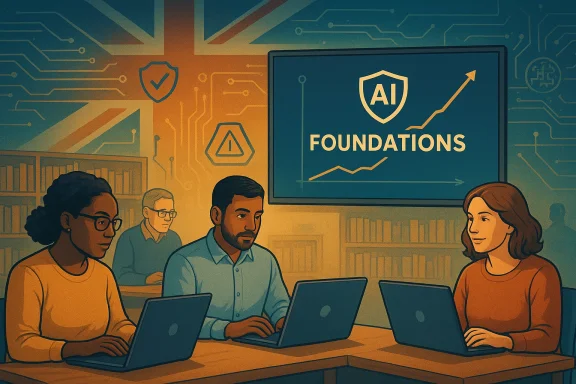
A recent regional news report and commentary summarised an apparent commitment by the Department for Science, Innovation and Technology (DSIT) to roll out a set of short AI courses — many described as taking less than 20 minutes — that would teach workers how to use simple AI tools in the workplace and award participants a “virtual AI foundations badge” on completion. The announcement was framed as part of a broader drive to make Britain the fastest adopter of AI in the G7 and to free workers from routine tasks while creating higher-skilled roles.
The claim has been echoed in regional plans and public statements: local combined authorities have already launched ambitious programmes that promise free AI training for adults within their geographies (the West Midlands’ £10 million plan, for example), and national-level commitments to large-scale skills drives have been in public circulation since 2024–2025. But a close read of the public record shows a gap between political ambition and verifiable, centralised, nationally guaranteed entitlements — especially where the details of duration, accreditation and funding are concerned.
But the devil is in the details. Headlines that promise sub‑20‑minute modules and universal badges should not obscure the practical necessities of competence: hands-on practice, work-product assessment, verification skills, and accessible delivery for digitally excluded groups. Until DSIT publishes the operational plan, budgets and assessment frameworks, the “every adult” claim should be treated as an ambitious policy direction rather than a confirmed, fully specified entitlement. Policymakers, unions, training providers and employers must insist on standards and accountability if this promise is to become a credible national achievement rather than a wave of ceremonial badges with little lasting value.
Source: whtimes.co.uk Free AI training to be offered to every adult in the UK
 Background: what was announced and where the claim came from
A recent regional news report and commentary summarised an apparent commitment by the Department for Science, Innovation and Technology (DSIT) to roll out a set of short AI courses — many described as taking less than 20 minutes — that would teach workers how to use simple AI tools in the workplace and award participants a “virtual AI foundations badge” on completion. The announcement was framed as part of a broader drive to make Britain the fastest adopter of AI in the G7 and to free workers from routine tasks while creating higher-skilled roles.The claim has been echoed in regional plans and public statements: local combined authorities have already launched ambitious programmes that promise free AI training for adults within their geographies (the West Midlands’ £10 million plan, for example), and national-level commitments to large-scale skills drives have been in public circulation since 2024–2025. But a close read of the public record shows a gap between political ambition and verifiable, centralised, nationally guaranteed entitlements — especially where the details of duration, accreditation and funding are concerned.
Why this matters: opportunity and risk in mass AI training
Short, accessible training that raises baseline AI literacy can deliver real value for workers, employers and the public sector. Properly designed, the programme could:- Increase productivity by helping employees automate repetitive tasks.
- Reduce digital exclusion if targeted at those without prior AI exposure.
- Improve safety outcomes by teaching verification, bias recognition and escalation pathways.
- Create a layered talent pipeline from awareness to technical specialisation.
- Credential inflation — awarding badges for minimal effort weakens the labour-market signal.
- Superficial safety — short, awareness-only modules can create a false sense of competence that increases rather than reduces risk.
- Vendor capture — over-reliance on platform-specific training pushes proprietary workflows rather than neutral, transferable skills.
- Digital divide — online-only rollouts ignore access barriers (devices, broadband, literacy) faced by the most vulnerable groups.
Dissecting the headline claims
“Free AI training for every adult in the UK”
There is clear evidence of national ambition: the UK government and DSIT have repeatedly signalled large-scale skills programmes and partnered with industry to expand AI training capacity. Several public-private initiatives and regional academies are already underway. But the specific promise that DSIT will deliver a centrally-funded, nationally-recognised course available to every adult in the UK — with guaranteed delivery details — is not fully substantiated in the public record we can verify. Local programmes have made strong region-specific pledges, but a nationally guaranteed entitlement with published operational details (eligibility, delivery model, funding basis) is not yet evident. Readers should treat the “every adult” claim as aspirational until DSIT publishes the operational plan and budgets.“Courses taking less than 20 minutes to complete”
Micro-modules and quick explainer videos already exist in abundance: vendor micro-courses, platform primers and short awareness units are common and useful as introductory material. But reputable foundations and accredited programmes tend to require more time: established courses cited in recent roundups range from several hours to 20+ hours for substantive foundations. A 20-minute module can be a helpful introduction, but it cannot substitute for hands-on practice, assessment, and work‑product generation that employers value. Treat sub-20-minute modules as awareness boosters, not as complete skill certification.“A virtual AI foundations badge”
Digital badges and micro-credentials are standard practice among major platforms and training providers. It is technically plausible and even likely that completed modules would be accompanied by some form of digital credential. What remains unclear and important to verify is the meaning of that badge: who issues it, what competency checklist underpins it, whether there is independent assessment, and how employers and professional bodies will treat it. A badge without defined standards risks being another line on a CV with little evidence of real ability.The safety flashpoints: hallucinations, deepfakes and misuse
Public concern about AI safety is not hypothetical. Two recent, high-profile episodes show how rapidly AI errors and misuse can inflict real-world harm:- A police report that informed the banning of Maccabi Tel Aviv fans from an Aston Villa match referenced a non-existent match between Tel Aviv and West Ham — an instance traced to an “AI hallucination” produced by Microsoft Copilot. That hallucination materially contributed to an operational decision with reputational consequences.
- The UK Government publicly criticised the Grok AI chatbot (associated with Elon Musk) for being able to generate sexual deepfake images without consent, highlighting the urgent need for platform safeguards and legal redress mechanisms. These incidents underline that training must include not just how to use AI tools, but how to verify, respond to errors, and protect people’s rights.
A practical framework for a credible national programme
If ministers genuinely want a programme that delivers long-term gains, the following design principles should be mandatory parts of the rollout:1. Tiered learning pathways
- Awareness modules (20 minutes or less) — reach large audiences, introduce basic terminology, ethics and safe-use heuristics.
- Practical primers (3–10 hours) — job-function-specific training that produces a demonstrable artifact (prompt libraries, mini-automation, a RAG demo).
- Accredited foundations (20+ hours) — assessed credentials with independent verification for higher-value roles and public-sector applicability.
2. Clear credential definitions
- Every badge must come with a competency checklist: minimum learning hours, assessment format, sample artifacts required for verification.
- Use independent or multi-stakeholder assessment panels for higher-tier credentials to avoid purely vendor-issued “proofs of completion.”
3. Safety, verification and ethics embedded everywhere
- Make verification exercises mandatory — e.g., identify hallucinations, check provenance, and correct AI outputs.
- Use sector-specific case studies (healthcare, policing, finance) to show consequences of AI errors.
- Train workers in escalation pathways: how to report suspected harms, document incidents, and involve governance teams.
4. Local delivery and digital inclusion
- Fund local delivery through colleges, libraries and combined authorities to provide in-person and blended learning.
- Support device loan schemes, subsidised connectivity and assisted learning for digitally excluded populations. Regional trials (West Midlands and similar hubs) demonstrate the effectiveness of locally anchored delivery.
5. Independent evaluation and outcomes measurement
- Track real workplace outcomes — not just completions. Measure time saved, automation reliability, incidents avoided and jobs transitioned.
- Require post-course artifacts (e.g., prompt portfolios) as part of assessment to demonstrate applied competence.
What this means for workers, employers and unions
For workers
- Treat micro-modules as the beginning of a learning journey, not a completed qualification.
- Build a portfolio of applied work: prompt libraries, automation demos and case studies that show real impact.
- Demand clarity on what any badge means and whether independent assessment is involved.
For employers
- Require practical evidence of capability from training you fund: artifacts, case studies and in-work demonstrations.
- Avoid hiring solely on badge counts; insist on work products that map to your workflows and data policies.
- Engage with local providers to ensure training aligns with governance and compliance requirements.
For trade unions and policymakers
- Negotiate clear workplace governance for AI deployment: joint oversight, protections for jobs affected by automation and transparent escalation procedures for harms.
- Insist that training content includes worker rights, redress options and mechanisms to prevent misuse.
Strengths and weaknesses of the current proposal
Strengths
- Political will and momentum: There is real traction across national and local governments to expand AI skills at scale, and industry appetite for contributing training resources.
- Low-friction entry points: Short modules increase reach and can quickly raise baseline literacy among large numbers of workers.
- Existing vendor and academic ecosystems: A broad ecosystem of micro-courses and deeper university offerings exists and can be leveraged to build tiered pathways.
Weaknesses and risks
- Lack of confirmed national mechanics: The central claim that DSIT will provide a nationwide, centrally funded entitlement for every adult is not yet verifiable in public documents; regional pledges are not the same as a national delivery guarantee. This gap poses fiscal, operational and accountability questions.
- Badge value ambiguity: Without published standards and assessment, badges risk becoming ceremonial rather than meaningful.
- Safety and governance gaps: Real incidents (Copilot hallucinations, Grok deepfake concerns) illustrate how poorly governed AI use can lead to harm; training must prioritise verification and ethical response, not only tool fluency.
How to judge success: recommended KPIs
A credible programme should be evaluated with transparent KPIs that go beyond completion numbers:- Percentage of participants who produce a verified work artifact (prompt portfolio, automation demo).
- Reduction in reported AI-related incidents in participating organisations (after adjusting for reporting rates).
- Employment outcomes: transitions to higher-skilled roles or demonstrable productivity gains tied to AI use.
- Reach among digitally excluded groups: device access, in-person uptake rates and completion rates for supported learners.
- Employer satisfaction: percentage of employers who rate graduates’ practical competence as “job-ready” for specific tasks.
What to watch next
- Public release of DSIT’s operational plan and budgets: look for published learning standards, assessment frameworks and funding commitments that move the initiative from aspiration to accountable programme.
- Clarification on the badge issuer and assessment mechanism: whether the credential is advisory, vendor-issued, or independently accredited matters for market value.
- Sector pilots and regional rollouts: early local programmes (West Midlands and similar hubs) will reveal whether blended delivery, local partnerships and device support achieve higher-quality outcomes.
- Regulatory responses to known harms: how regulators and government respond to incidents like hallucination-driven operational errors and deepfake generation will shape the governance and content of any training.
Conclusion: an optimistic but cautious verdict
The idea of free AI training for every adult is politically attractive and potentially transformative. If executed with rigour — clear credentialing, tiered learning pathways, local delivery, enforced safety content, and independent assessment — such a programme could close critical skills gaps and help workers harness AI productively and safely.But the devil is in the details. Headlines that promise sub‑20‑minute modules and universal badges should not obscure the practical necessities of competence: hands-on practice, work-product assessment, verification skills, and accessible delivery for digitally excluded groups. Until DSIT publishes the operational plan, budgets and assessment frameworks, the “every adult” claim should be treated as an ambitious policy direction rather than a confirmed, fully specified entitlement. Policymakers, unions, training providers and employers must insist on standards and accountability if this promise is to become a credible national achievement rather than a wave of ceremonial badges with little lasting value.
Source: whtimes.co.uk Free AI training to be offered to every adult in the UK
