

Satya Nadella’s short, blunt year‑end essay on his new personal blog positions 2026 as a tipping point for AI — not because models will suddenly get smarter, but because product discipline, systems engineering, and societal choice must now turn capability into dependable, measurable impact. In a compact set of prescriptions Nadella argues we’re in a “model overhang” where raw capability outpaces useful outcomes, that AI should be thought of as scaffolding for human potential rather than a substitute, and that the industry must migrate from isolated models to engineered systems that orchestrate models, memory, entitlements and safe tool use.
Satya Nadella published the essay “Looking Ahead to 2026” on December 29, 2025, on his sn scratchpad personal blog. The post is short, deliberately polemical, and aimed squarely at the product and engineering layers that take models out of the lab and into everyday work. Nadella frames three priorities: a renewed product philosophy that treats AI as a cognitive amplifier, an engineering shift from models to systems, and a socio‑technical discipline over where and how scarce compute, energy, and talent are applied so that AI earns societal permission through measurable outcomes. The timing and tone matter. The word “slop” — shorthand for low‑value, mass‑produced AI output that dominated much of 2025’s discourse — was Merriam‑Webster’s 2025 Word of the Year, and Nadella explicitly calls on the industry to move beyond the spectacle-versus‑substance debate that “slop” symbolizes. That cultural settling‑point creates the exact environment where Nadella’s insistence on product and systems engineering carries strategic weight: customers, regulators and CIOs are no longer content with demos; they want reproducible, auditable gains.
Satya Nadella’s message is less a product roadmap than a call for discipline: build AI that augments people, stitch models into orchestrated systems, choose where to apply scarce resources, and measure real outcomes. Microsoft’s product moves show the company intends to operationalize that thesis — but the proof will be in conservative rollout, third‑party measurement and real user trust. If 2026 is the year the industry separates spectacle from substance, the practical winners will be those who convert promise into predictable, governed, and measurable progress.
Source: digit.in Satya Nadella on AI in 2026: We will evolve from models to systems
 Background / Overview
Satya Nadella published the essay “Looking Ahead to 2026” on December 29, 2025, on his sn scratchpad personal blog. The post is short, deliberately polemical, and aimed squarely at the product and engineering layers that take models out of the lab and into everyday work. Nadella frames three priorities: a renewed product philosophy that treats AI as a cognitive amplifier, an engineering shift from models to systems, and a socio‑technical discipline over where and how scarce compute, energy, and talent are applied so that AI earns societal permission through measurable outcomes. The timing and tone matter. The word “slop” — shorthand for low‑value, mass‑produced AI output that dominated much of 2025’s discourse — was Merriam‑Webster’s 2025 Word of the Year, and Nadella explicitly calls on the industry to move beyond the spectacle-versus‑substance debate that “slop” symbolizes. That cultural settling‑point creates the exact environment where Nadella’s insistence on product and systems engineering carries strategic weight: customers, regulators and CIOs are no longer content with demos; they want reproducible, auditable gains. What Nadella Actually Said — The Core Takeaways
AI as scaffolding for human potential
Nadella recasts the old “bicycle for the mind” metaphor into a modern product creed: AI should be designed as a scaffolding that amplifies human capabilities, not as a replacement. The implication is straightforward — product decisions must prioritize augmentation, explainability, and the user’s agency in workflows, not pure novelty or benchmark dominance. This is a deliberate nudge away from model‑first marketing toward design that privileges predictable, repeatable outcomes.From models to systems
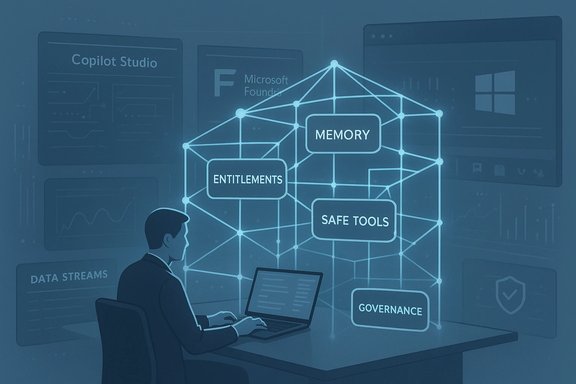
The phrase “we will evolve from models to systems” is the essay’s engineering thesis. Nadella argues that the next wave is not simply bigger or newer generative models but systems — integrative platforms that orchestrate multiple models and agents, embed memory, enforce entitlements and permissions, and mediate tool use safely. In practice this means richer scaffolds (platforms, control planes, observability) that close the gap between laboratory capability and production utility.Societal permission and resource triage
Finally, Nadella frames an ethical and strategic constraint: AI must “earn” societal permission by producing measurable real‑world impact, and we must make deliberate choices about where to expend limited energy, compute and talent. That call elevates measurement, governance and prioritization to first‑class concerns in any enterprise AI program.Microsoft’s Response: Products, Factories, and the Agent Stack
Nadella’s prescriptions map nearly one‑to‑one onto Microsoft’s product road map announced across 2025: Copilot Studio for low‑code agent and workflow creation, Microsoft Foundry (formerly Azure AI Foundry) as an “AI app and agent factory” for developers, and OS‑level agent runtime work in Windows that treats Copilot as a persistent, visible intelligence layer. These efforts show Microsoft is trying to operationalize Nadella’s model‑to‑system transition.- Copilot Studio: A graphical, low‑code environment where makers can assemble agents and agent flows, connect to data sources, and publish agents into Microsoft 365 Copilot and Teams. Agent flows are reusable, deterministic automation sequences that agents can call to complete multi‑step tasks. Copilot Studio emphasizes reuse, connectorized integrations and governance built into agent publishing workflows.
- Microsoft Foundry (Azure AI Foundry → Microsoft Foundry): Positioned as the developer and operational control plane — a modular platform that provides model choice, orchestration, memory, observability, hosted agents, and tool catalogs — Foundry is explicitly billed as an “AI app and agent factory.” It aims to give enterprises a path from prototype to fleet management with built‑in observability, safety controls and policy plumbing.
- Windows as an agent launcher: Windows 11 and the Copilot taskbar are being reimagined as the user‑facing control surface for agents. Live agent icons on the taskbar, an Ask Copilot composer, an Agent Workspace sandbox, and connectors that grant scoped access to files/settings with explicit consent are all elements of this vision. The OS is intended to make agents visible, controllable, and auditable at the desktop level.
Why this shift matters: Strengths in Nadella’s argument
1) Product discipline beats model vanity
There is growing evidence that customers care more about reliability and measurable productivity than raw model capability. Enterprises pay CIOs and procurement teams for repeatable ROI; flashy demos do not translate into long procurement cycles, audited deployments, or scaled adoption. Nadella’s focus on product design and orchestration speaks to the commercial reality of enterprise AI.2) Platform-level governance reduces risk
Building systems — not point models — enables centralized observability, policy enforcement, and identity boundaries. Platforms like Microsoft Foundry and the agent control planes promise centralized logs, per‑agent identities, revocation paths and telemetry. These are the practical controls enterprises need to manage compliance, safety, and incident response at scale.3) Visibility and consent in the OS lowers the user friction barrier
Making agent activity visible in the taskbar and confining its execution to an Agent Workspace reduces the black‑box syndrome that plagues many automations. Explicit consent prompts for folder and settings access and hoverable progress cards are sensible UX moves to preserve user agency while offering automation. When users can see, pause, and audit agents, trust becomes tractable.4) Resource triage is realistic stewardship
Nadella’s point about scarce compute, energy and talent reframes AI as not just a technical exercise but a resource allocation problem. For enterprises and cloud providers this is a pragmatic nudge toward sustainability metrics, cost accounting, and prioritized road maps that deliver measurable business outcomes instead of unconstrained model experimentation.The risks and open questions: What Nadella’s essay does not solve
1) The “model overhang” is real — and multi‑vector
Capability outpacing impact is not only a product problem; it’s an economic, social and systems engineering problem. Models still hallucinate, connectors still leak sensitive data in experiments, and integrating models into complex, regulated workflows remains brittle. The existence of a platform does not eliminate the need for domain expertise, human‑in‑the‑loop checks, or conservative fallbacks. Evidence of privacy and correctness concerns around early OS features and recall‑style capabilities underscores this. These are engineering problems that are solvable but require rigorous verification and conservative rollout strategies.2) New attack surfaces and governance gaps
Making agents first‑class OS principals introduces fresh security and supply‑chain risks: compromised connectors, malicious third‑party agents, or poorly scoped agent privileges could lead to significant data exfiltration and lateral movement. Microsoft’s proposed mitigations (signing, allow‑lists, audit logs) are necessary but insufficient without mature vetting, rapid revocation and strong telemetry. Enterprises will need to adapt endpoint management, EDR policies and least‑privilege defaults for an agentic OS world.3) Cognitive overload and UX friction
The promise of always‑on agents and a living taskbar can easily tip into noise and user anxiety. If every workflow provides a recommended agent, users will face decision fatigue and potential over‑automation. The default opt‑in vs opt‑out settings, sensible throttling, and clear mental models for when the system should intervene are design challenges that will determine whether Copilot becomes helpful or intrusive.4) Measurement and accountability remain under‑defined
Nadella calls for quantifiable “real‑world impact,” but he offers no operational definition. How will organizations measure productivity gains attributable to agents versus normal variance? What are the auditing standards, statistical benchmarks, or accepted methodologies for ascribing ROI to agent fleets? Without clear measurement frameworks and third‑party auditability, “societal permission” will remain aspirational rather than enforceable.5) Unverified or contested internal reports
Several outlets have reported internal friction and engineering shortfalls around Copilot integrations and desktop features. Some of these claims come from paywalled reporting or hearsay and have not been fully corroborated by Microsoft. Where reporting is behind paywalls or lacks primary evidence, those claims should be treated cautiously: they may be accurate snapshots of internal candid feedback, or they may be selective interpretations. Public discourse around “slop” and product teething problems matters; however, it is important to separate verifiable product limitations from speculative internal narratives. These contested reports are notable but not definitive without full corroboration.What enterprises should do next: Practical playbook for IT leaders
Organizations that want to move beyond experiments to production-grade agent systems should adopt a staged, engineering‑driven program:- Start with measured pilots
- Define 2–3 high‑value, low‑risk workflows (e.g., summarization of internal docs, HR onboarding automation) where ROI is easy to measure.
- Instrument baseline KPIs and success criteria before agent deployment.
- Build an observability and governance baseline
- Require agents be auditable, signed and subject to runtime telemetry.
- Integrate agent logs into SIEM and APM systems; set up automated alerts for anomalous agent behavior.
- Enforce least privilege by design
- Use per‑operation consent and granular connector scopes.
- Default to read‑only in user data stores and require explicit elevation for writebacks.
- Emphasize human‑in‑the‑loop for high‑risk decisions
- Keep humans in supervisory roles where auditability or legal liability exists (finance, legal, healthcare).
- Use agents to prepare options and prepopulated drafts, not to finalize critical outputs without signoff.
- Standardize metrics and impact audits
- Adopt reproducible measurement frameworks for agent impact (time saved, error reduction, throughput).
- Consider third‑party audits for safety‑critical deployments.
- Educate users and manage expectations
- Train staff on agent affordances, consent flows, and how to interpret agent previews and summaries.
- Roll out opt‑in capabilities and collect systematic usability feedback.
Where Microsoft’s stack succeeds — and where competitors are watching
Microsoft’s strategy is coherent: it links productivity surfaces (Microsoft 365), developer and ops platforms (Microsoft Foundry/Copilot Studio), and OS‑level runtime (Windows agent workspaces). That end‑to‑end story is compelling for enterprises that already host data in Microsoft ecosystems because it reduces integration friction and allows administrators to apply centralized policy. The company’s emphasis on connectors, agent publishing and an Agent Store are pragmatic moves to turn newer capabilities into controllable features. Competitors will focus on three battlegrounds:- Model choice and specialization: offering verticalized models or specialized toolchains for regulated industries.
- Interoperability and standards: promoting open interchange protocols so agents and tools can operate across clouds and OSes without vendor lock‑in.
- Trust & explainability: providing independent verification of safety and impact with third‑party attestations.
A cautious conclusion: systems engineering is necessary but not sufficient
Satya Nadella’s call to move “from models to systems” is a necessary reframing for 2026. The industry now needs orchestration, governance, measurement, and product rigor if AI is to deliver the societal and enterprise returns it promises. Microsoft’s roadmap — Copilot Studio for makers, Microsoft Foundry for developers and operations, and Windows‑level agent runtime for end users — already embodies many of these ideas and gives the company a plausible path to realize Nadella’s vision. That said, platform plumbing and product launches will not magically resolve fundamental trust, safety and measurement questions. Enterprises must demand robust observability, conservative defaults, rigorous audits, and clear ROI frameworks before enabling agent fleets at scale. Regulators and civil society will watch closely as the next phase of diffusion unfolds; “societal permission” is neither automatic nor permanent. The winners in 2026 will not be the labs with the loudest models, but the platforms and customers who convert messy capability into dependable systems that measurably improve outcomes while containing risk.Quick checklist for CISOs and IT decision makers (operational summary)
- Require agent signing, allow‑lists and per‑operation consent by default.
- Instrument every agent with immutable audit logs and integrate with SIEM.
- Pilot with narrowly scoped workflows and measure pre/post KPIs.
- Apply human‑in‑the‑loop gates for high‑impact actions and writebacks.
- Capacity‑plan for compute and energy costs; tag agent workloads with cost centers.
- Prepare rollback and revocation playbooks for compromised agents or connectors.
Satya Nadella’s message is less a product roadmap than a call for discipline: build AI that augments people, stitch models into orchestrated systems, choose where to apply scarce resources, and measure real outcomes. Microsoft’s product moves show the company intends to operationalize that thesis — but the proof will be in conservative rollout, third‑party measurement and real user trust. If 2026 is the year the industry separates spectacle from substance, the practical winners will be those who convert promise into predictable, governed, and measurable progress.
Source: digit.in Satya Nadella on AI in 2026: We will evolve from models to systems
