

Most organisations that say they “use AI” still struggle to convert experiments into measurable business outcomes — and the practical lessons from Sigma Software Group underline why the gap is organisational, not just technical.
The rush to deploy generative AI (GenAI) and copilots has created a common pattern: rapid tool adoption, a flurry of proof‑of‑concepts, and a much smaller set of sustained, value‑creating deployments. The reality across sectors is that technology availability no longer separates winners from laggards; instead, structure, governance, and people do. This has been observed repeatedly in practitioner communities and industry playbooks that frame “AI‑ready” as a holistic condition requiring data readiness, architectural choices, disciplined MLOps, governance, and sustained skill building.
Sigma Software Group’s account of its internal AI journey distils four repeatable principles — start with people, apply AI to core processes, share experience, and run controlled experiments — and positions AI adoption as a transformational program rather than a system integration. This article summarises those lessons, tests them against broader enterprise practice, and synthesises a practical roadmap Windows‑focused IT leaders can apply when moving from pilots to production.
People-first programs produce three immediate benefits:
Sigma’s internal numbers — reported savings of around 16.8% developer time and a 27.5% acceptance rate for generated code — are typical of carefully measured pilots, although all such percentages should be validated with logged telemetry and peer benchmarking before being generalised. When measured rigorously, these metrics let organisations move from anecdotes to a quantified business case. Treat any specific percentage as an experimental baseline rather than an immutable claim.
Two practical partnership models deliver outsized returns:
Key governance controls for experiments:
If you are responsible for a Windows estate or enterprise IT portfolio, adopt Sigma’s core principle: treat AI adoption as a transformational program. Start with people, harden core processes, share learnings, and run disciplined pilots with meaningful decision gates. Do this and the promise of GenAI — real productivity gains, better customer outcomes, and new product opportunities — becomes achievable and sustainable.
Source: The AI Journal Building an AI-Ready Organisation: Lessons from Sigma Software Group | The AI Journal
 Background / Overview
The rush to deploy generative AI (GenAI) and copilots has created a common pattern: rapid tool adoption, a flurry of proof‑of‑concepts, and a much smaller set of sustained, value‑creating deployments. The reality across sectors is that technology availability no longer separates winners from laggards; instead, structure, governance, and people do. This has been observed repeatedly in practitioner communities and industry playbooks that frame “AI‑ready” as a holistic condition requiring data readiness, architectural choices, disciplined MLOps, governance, and sustained skill building.Sigma Software Group’s account of its internal AI journey distils four repeatable principles — start with people, apply AI to core processes, share experience, and run controlled experiments — and positions AI adoption as a transformational program rather than a system integration. This article summarises those lessons, tests them against broader enterprise practice, and synthesises a practical roadmap Windows‑focused IT leaders can apply when moving from pilots to production.
Why “AI adoption” is failing at scale
Many firms confuse access to models with organisational readiness. Tools alone do not create reliable outcomes; the missing ingredients are:- Operational design: production‑grade data pipelines, model lifecycle controls and observability.
- Governance and policy: provenance, DLP for prompts, human‑in‑the‑loop (HITL) gates and an audit trail for model decisions.
- People and culture: role redesign, mandatory learning, and change champions who spread practices across teams.
Lesson 1 — Start with people, not tools
Why people-first matters
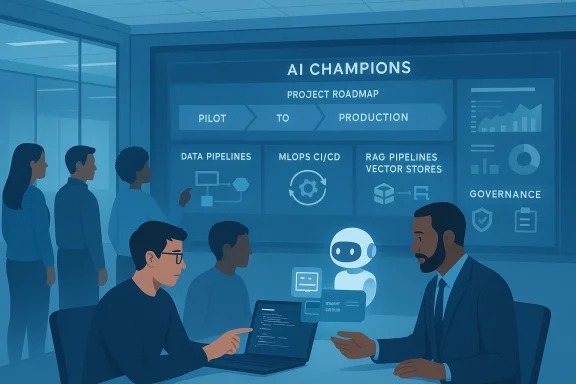
Sigma’s first move was training and an AI Champions program: not to enforce every automation, but to create a shared understanding of capabilities and limits, and to seed trusted experimenters across units. That approach turned tools from novelty into practical assistants and established a baseline competence for subsequent automation. This mirrors advice from multiple enterprise playbooks that frame internal champions and role‑specific learning as core to adoption.People-first programs produce three immediate benefits:
- Faster, safer uptake because users learn failure modes and verification practices.
- Lower governance friction: trained teams are better at documenting data used in prompts and invoking escalation gates.
- A pipeline of practical use cases: champions run bounded experiments and publish templates that others reuse.
How to operationalise an AI Champions program
- Nominate one or two champions per business unit with protected time to experiment.
- Run a short, hands‑on bootcamp (3 days is a good cadence) focused on doing: prompt design, agent flows, prompt sanitization and sandboxed publishing.
- Provide a managed sandbox and a catalogue of templates so champions can run repeatable pilots without creating shadow AI services.
Lesson 2 — Apply AI in core processes, then scale
Focus on high‑frequency, high‑value workflows
Sigma began with the software development lifecycle — a natural starting place for a software firm — piloting code generation tools and instrumenting impact. That discipline matters: pick core processes where small percentage gains compound into real outcomes (developer productivity, claims triage, AP automation, etc.). Practitioner frameworks advise categorising use cases into three buckets: personal productivity, functional automation, and industry‑specific applications to match investment size, risk and speed to value.Sigma’s internal numbers — reported savings of around 16.8% developer time and a 27.5% acceptance rate for generated code — are typical of carefully measured pilots, although all such percentages should be validated with logged telemetry and peer benchmarking before being generalised. When measured rigorously, these metrics let organisations move from anecdotes to a quantified business case. Treat any specific percentage as an experimental baseline rather than an immutable claim.
Build complementary automation where the models fall short
The most mature adopters avoid treating base models as silver bullets. Where hallucinations, brittle outputs, or integration gaps appear, successful teams build targeted tooling:- Autonomous unit‑test generation and regression impact analysis to reduce verification overhead.
- Project assistants that ingest repo history, docs and ticket context to support onboarding and triage.
- RAG (retrieval‑augmented generation) pipelines with curated vector stores and metadata to ground answers and reduce hallucination risk.
Lesson 3 — Share experience and partner strategically
Partnerships accelerate learning
Sigma’s collaborative approach — co‑building pilots with clients and sharing learnings — is an effective multiplier. Industry evidence shows organisations that partner with experienced technology firms get to production faster than those attempting to re‑invent complex stacks in‑house. Strategic partners bring templates, prebuilt governance primitives, and lessons learned from other deployments.Two practical partnership models deliver outsized returns:
- Vendor as enabler: adopt a managed GenAI platform (managed foundation model providers or cloud vendor services) to reduce operational overhead. Ensure contract clauses protect data confidentiality and define training/non‑retrain commitments.
- Co‑development: jointly develop a vertical use case (document processing, claims triage, code assistants) so knowledge and assets are reusable across similar clients. Sigma’s document processing example is a classic template you can replicate as a reference architecture.
Share internally and externally
Publishing internal patterns, guardrails and prompt templates prevents duplication and speeds adoption. Conversely, external collaborations surface sector nuances that are difficult to foresee internally. Active sharing should be a formal part of your AI program: regular showcases, internal hackathons, and cross‑client demos that use sanitized data to illustrate outcomes.Lesson 4 — Run controlled experiments with governance
Structure is not bureaucracy — it’s leverage
Many companies run numerous PoCs without a path to scale. Sigma’s response was to require each pilot to have a clear objective, KPI set and decision gate. This disciplined experimentation model prevents resource waste and supports rapid learning cycles. Enterprise playbooks endorse the same practice: limit pilots to defined compute or calendar budgets and define stop/iterate/scale decision gates.Key governance controls for experiments:
- A central registry of pilots with owners, objectives and last audit date.
- Minimum viability metrics (e.g., time saved, error rate reduction, verification load).
- Escalation rules and publishing approval before extending agents beyond the pilot cohort.
Allocate R&D and productise successful pilots
Don’t treat R&D as an afterthought. Dedicate resources to convert promising experiments into hardened tooling — automated test generators, onboarding assistants, or marketable assistants like Sigma’s SIMA. This is how pilots become platforms rather than disappearing into operational debt.Governance, architecture and the AI‑ready stack
What “AI‑ready” actually requires
Being AI‑ready means you can reliably convert data and compute into outcomes with acceptable cost, risk and traceability. That requires investment across five converging capabilities:- Data readiness — discoverable, governed datasets suitable for training and inference.
- Architectural readiness — infrastructure for high‑throughput inference, low‑latency access and secure model hosting.
- Operational readiness (GenAI/MLOps) — CI/CD for models, drift monitoring and retraining pipelines.
- Governance and compliance — provenance metadata, DLP, HITL checkpoints and contractual protections.
- Cultural and skills readiness — champions, mandatory training and role redesign to verify and supervise outputs.
Cloud, hybrid or on‑prem: tradeoffs to evaluate
There’s no single correct infrastructure choice; pick based on control, cost, latency and regulatory needs. Managed GenAI platforms shorten time‑to‑value but introduce vendor control considerations; on‑prem GPU appliances give control but increase ops complexity and capital expense. The right call depends on the use case and risk profile. Practitioners frequently adopt a hybrid design: sovereign or sensitive data stays on-prem or in a sovereign cloud while less sensitive workloads run in managed services.Practical governance checklist
- Enforce an AI charter and an agent registry with owners and risk ratings.
- Apply prompt sanitization and output moderation layers where outputs feed downstream systems.
- Log all model calls with identity, model version and prompt hash to support audit.
- Use API gateways or GenAI gateways to standardise routing, cost controls and telemetry.
Measuring value and managing risk
Redefine ROI for GenAI
Traditional ROI measures must be extended to include risk‑adjusted value:- Direct productivity gains (time saved, faster throughput).
- Risk and compliance costs (governance, audits, remediation).
- Strategic uplift (new products, faster delivery cycles, improved customer retention) rather than purely headcount reduction.
Most common risks and mitigations
- Hallucinations and incorrect outputs: mitigate with grounding (RAG), verification steps and HITL for decisions that matter.
- Data exfiltration and compliance failures: enforce tenant‑grounded Copilot deployments, DLP for prompts and contractual protections with model vendors.
- Runaway cost and governance debt: centralize policy, enable FinOps for model calls and set pilot budgets.
- Agentic automation risks: register agents, audit decision logs and assign clear ownership for actioning and rollback.
A practical roadmap: 90‑day sprint to AI‑readiness
Use a short, focused program to convert awareness into capability. Below is a recommended sprint with concrete steps.Phase 1 (Weeks 1–2): Baseline and prioritise
- Inventory tools, data sources and embedded AI features across the estate.
- Identify one high‑frequency, low‑risk use case to pilot (meeting summarisation, AP invoice capture, code review automation).
Phase 2 (Weeks 3–6): Pilot with structure
- Appoint champions and run a 3‑day bootcamp.
- Run the pilot in “shadow mode” while humans verify outputs. Track time‑saved, verification edits and error rates.
- Limit compute and calendar budgets and publish a decision gate at the end of six weeks.
Phase 3 (Weeks 7–12): Harden and scale
- If KPIs are met, harden the solution: add RAG, logging, role‑based access and a release process.
- Publish templates, register the agent, and create a playbook for replication.
- Allocate R&D to productise common patterns (test generation, onboarding assistants).
Critical analysis — strengths and blind spots in Sigma’s approach
What works well
- People‑centric design: Investing in champions and mandatory competency directly addresses the most common failure mode: uneven adoption. This is a pragmatic, low‑cost lever with outsized effects.
- Process focus: Applying GenAI to core workflows (e.g., software development) yields measurable, repeatable gains when measured properly. Sigma’s disciplined measurement mindset is a model for other teams.
- Productising internal outputs: Turning internal assistants into marketable products (SIMA‑style) demonstrates the virtuous cycle between internal capability and external offerings.
Risks and areas needing more attention
- Overreliance on vendor stacks without contractual safeguards: Using managed model services accelerates time to value but requires explicit contractual protections (non‑training/no‑retrain clauses, data residency). The tactic is common in the field, but contracts must be reviewed rigorously.
- Measurement transparency: Single‑vendor or single‑team reporting (e.g., productivity percentages) must be validated with independent telemetry and, where possible, replicated across teams. Treat single numbers as directional until peer‑validated.
- Agent governance scale: As organisations register agent fleets, they face new risk classes (agent identity, prompt injection, cross‑agent escalation). Early governance must evolve to lifecycle management, not just pilot gates.
Practical checklist for Windows IT leaders
- Appoint an AI program lead who sits between CTO and business units.
- Launch an AI Champions program and mandatory role‑specific microlearning.
- Start pilots in the functional or productivity buckets; instrument outcomes and require decision gates.
- Build a GenAI gateway or use API management to centralise routing, telemetry and cost attribution.
- Register agents, maintain an owner list and schedule audits.
- Protect sensitive data with hybrid deployment patterns and contractual clauses with vendors.
Conclusion
Sigma Software Group’s experience is not unique; it echoes a consistent pattern across the enterprise landscape: small, measurable wins come from disciplined experiments that are people‑led, process‑focused and governed. The secret is not more models, but better scaffolding — training, governance, MLOps and measurement — so that AI becomes an engine for repeatable outcomes rather than a parade of isolated demos.If you are responsible for a Windows estate or enterprise IT portfolio, adopt Sigma’s core principle: treat AI adoption as a transformational program. Start with people, harden core processes, share learnings, and run disciplined pilots with meaningful decision gates. Do this and the promise of GenAI — real productivity gains, better customer outcomes, and new product opportunities — becomes achievable and sustainable.
Source: The AI Journal Building an AI-Ready Organisation: Lessons from Sigma Software Group | The AI Journal
