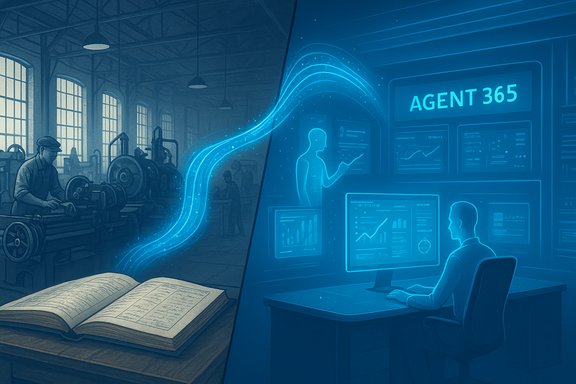
Microsoft’s latest customer showcase — a November 20 Microsoft Cloud blog post — frames a clear message: century-old brands are not relics; they’re becoming some of the most visible examples of enterprise AI at scale. The post argues that “Frontier Firms” — organizations that bake AI into workflows, products, and operating models — are delivering materially larger returns than cautious adopters, and highlights Kraft Heinz, Levi Strauss & Co., Wells Fargo, and Land O’Lakes as centennial companies pairing deep institutional knowledge with Microsoft AI to accelerate reinvention. The piece also rests on a commissioned IDC InfoBrief that Microsoft says shows Frontier Firms getting three times the return on AI investments, and ties that story to Microsoft Ignite 2025’s product push for agents, Copilots, and a new control plane called Agent 365. This feature drills into the reality behind those claims, verifies the most consequential technical and business assertions where possible, highlights independent reporting on the customer examples, and surfaces the practical opportunities and risks IT teams must weigh when moving from pilots to production-grade, agentic AI systems.
Microsoft’s Frontier Firm narrative is simultaneously strategic and productized: it’s a management thesis supported by a stack of new product features — Work IQ, Copilot Studio, Agent 365, Microsoft Foundry / Azure AI Foundry, and deep integrations with Azure OpenAI and third-party models — plus an industry study that claims measurable multipliers for firms that adopt AI across many business functions. The company has also launched a Frontier Firm AI Initiative with Harvard’s Digital Data Design Institute to study human–AI collaboration and help scale operating playbooks for leaders. Why this matters to IT and Windows-focused teams: vendor narratives shape procurement and architecture. If Microsoft’s framing takes hold, enterprise roadmaps will prioritize agent orchestration, model governance, Copilot integration, and an operating model that treats AI agents like first-class managed services rather than ad‑hoc scripts. That requires changes to identity, security posture, telemetry, and lifecycle management — core responsibilities for Windows admins and enterprise architects.
Mitigation:
Mitigation:
Mitigation:
Mitigation:
Mitigation:
Conclusion
Microsoft’s “From legacy to Frontier” story is an important case study in how legacy expertise and modern AI platforms can combine to accelerate transformation. The customer examples and Ignite product announcements show practical paths for enterprises to embed agents into work and operations. Yet the most significant claims — notably the IDC‑reported 3x returns and some customer usage figures — are tied to vendor-sponsored research or company-sourced metrics and should be validated before they drive major procurement or architectural decisions. The pragmatic path for IT teams is disciplined experimentation, rigorous measurement, and governance-first scaling. The payoff: agents that preserve institutional knowledge, amplify expertise, and unlock new forms of productivity — while keeping humans squarely in the loop.
Source: Microsoft From legacy to Frontier: How 100-year brands are leading AI innovation | The Microsoft Cloud Blog
 Background / Overview
Microsoft’s Frontier Firm narrative is simultaneously strategic and productized: it’s a management thesis supported by a stack of new product features — Work IQ, Copilot Studio, Agent 365, Microsoft Foundry / Azure AI Foundry, and deep integrations with Azure OpenAI and third-party models — plus an industry study that claims measurable multipliers for firms that adopt AI across many business functions. The company has also launched a Frontier Firm AI Initiative with Harvard’s Digital Data Design Institute to study human–AI collaboration and help scale operating playbooks for leaders. Why this matters to IT and Windows-focused teams: vendor narratives shape procurement and architecture. If Microsoft’s framing takes hold, enterprise roadmaps will prioritize agent orchestration, model governance, Copilot integration, and an operating model that treats AI agents like first-class managed services rather than ad‑hoc scripts. That requires changes to identity, security posture, telemetry, and lifecycle management — core responsibilities for Windows admins and enterprise architects. What Microsoft and IDC are claiming — and what’s verified
The headline: Frontier Firms see 3x returns
Microsoft cites an IDC InfoBrief (sponsored by Microsoft) reporting that the top cohort called Frontier Firms achieve returns three times higher than slow adopters, and that those firms use AI across an average of seven business functions. Microsoft has amplified that claim across its blogs and Ignite announcements. The IDC study referenced is an InfoBrief published for Microsoft (IDC #US53838325). Verification and caveats:- The figure originates in an IDC brief commissioned and sponsored by Microsoft. IDC is a reputable analyst, but sponsored InfoBriefs are designed to address a vendor’s target audience and framing; they remain useful directional data but are not the same as independent peer-reviewed research. Treat the 3x claim as a vendor‑sponsored headline that signals directional advantage rather than a universal, unqualified guarantee.
- Multiple news outlets and industry blogs republished Microsoft’s summary of the IDC findings, which corroborates that Microsoft’s messaging reflects the brief’s conclusions, but independent academic or third-party replication of the 3x ROI figure is not publicly available at scale. When procurement decisions depend on this claim, request the full IDC methodology and sampling frame before modeling ROI across your organization.
The product story: agents, Copilot, Work IQ, Agent 365
Microsoft used Ignite 2025 to position agents and Copilots as the new operating layer and introduced product constructs — Work IQ (an intelligence/memory layer for Copilot), Agent 365 (a control plane for agents), expanded Agent Modes in Office apps, and new agent orchestration services in Copilot Studio / Microsoft Foundry. These features are documented in Microsoft’s Microsoft 365 blog and Ignite Book of News. The company also points to IDC estimates (1.3 billion agents by 2028) in support of the urgency to govern agent sprawl. Verification and caveats:- The product announcements are official and documented on Microsoft blogs; these are real features and programs IT teams should plan for. However, the 1.3 billion agents projection comes from an IDC Info Snapshot sponsored by Microsoft — useful for scenario planning, but it should be treated as a market projection rather than an operational inevitability. Independent forecasting may vary.
Deep dive: Four centennial case studies and what independent reporting shows
1) Kraft Heinz — The Cookbook (ketchup-focused agent)
What Microsoft says: Kraft Heinz built The Cookbook, an internal agent on Azure OpenAI that captures 150 years of Heinz ketchup expertise to help workers query production specifics — from viscosity to color and process efficiency. Microsoft frames it as a knowledge-preservation and quality-control tool, and says Kraft Heinz plans to scale the approach to other products. Independent verification:- Food Dive, CIO Dive, Consumer Goods Technology, and other trade outlets reported on Kraft Heinz’s pilot, confirming The Cookbook’s existence, Azure OpenAI as the platform, and that it began as a limited pilot at a U.S. ketchup plant. These articles cite Kraft Heinz spokespeople describing the prototype timeline (idea to prototype in under three months) and pilot scope; Food Dive specifically reported that the company declined to disclose the exact pilot headcount. That independent coverage substantiates Microsoft’s customer example.
- Domain grounding matters. Building an internal agent that references curated, validated manufacturing records reduces hallucination risk and turns generative AI into a high-value knowledge retrieval system.
- Data governance is essential. Production recipes and process controls are sensitive IP and regulated data. Any integration must enforce access controls, data lineage, and audit logging.
2) Levi Strauss & Co. — a “superagent” orchestrator
What Microsoft says: Levi Strauss & Co. is building a “superagent” — an Azure-native orchestrator embedded in Teams that routes a user’s prompt to appropriate subagents and services. The company migrated significant workloads to Azure and is adopting Surface Copilot+ PCs and GitHub Copilot to accelerate developer productivity. Independent verification:- Microsoft’s press release and PR Newswire coverage confirm the collaboration and the orchestrator concept; multiple trade outlets republished those details. The Levi announcement and PR materials make clear the superagent is an orchestrator pattern — a practical, in‑house engineering approach rather than a single monolithic AI product.
- Agent orchestration is integration-heavy. Orchestrators need identity, fine-grained access control, observable behavior, and rollback capabilities.
- Developer workflows change. Expect increased reliance on DevOps pipelines for model versioning, telemetry, and retraining orchestration.
3) Land O’Lakes — Oz, the agronomy copilot
What Microsoft says: Land O’Lakes built a custom copilot called Oz (using Azure AI Foundry and enterprise Copilot tuning) to deliver agronomic recommendations drawn from a proprietary Crop Protection Guide and years of data. Microsoft and Land O’Lakes say Oz is in beta with plans to expand. Independent verification:- Land O’Lakes issued a formal press release on November 12, 2025 describing the strategic alliance with Microsoft and the Oz assistant; the release details migration to Azure and the intent to beta with retail agronomists. That press release is a primary source confirming the program specifics.
- Field-offline and edge needs. Agricultural users often operate in low-connectivity environments; architecture must handle offline flows and sync.
- Explainability and liability. Agronomic recommendations have real-world consequences. Systems must surface provenance (why an agent recommended a specific treatment), include human agronomist sign-off, and document decision provenance for compliance.
4) Wells Fargo — broad Copilot adoption claim (caution)
What Microsoft says: Wells Fargo’s Ken Meyer (CIO for Enterprise Functions) is quoted saying more than 30,000 employees have used Microsoft 365 Copilot since a June 2025 rollout — with a 92% active usage rate for enabled employees. Microsoft uses that data point to demonstrate enterprise adoption velocity. Independent verification and caution:- The Wells Fargo statistic appears in Microsoft’s customer story and in the blog excerpt quoting Ken Meyer. At the time of reporting, there was no independent Wells Fargo press release or third-party article publicly corroborating the specific 30,000-user number and 92% active usage figure. External validation of these exact figures could not be found in Wells Fargo’s newsroom or major press coverage at the time of this review. Therefore, treat the Wells Fargo usage numbers as claims published by Microsoft quoting a Wells Fargo executive; request direct confirmation from Wells Fargo if exact metrics are material to decision-making.
Strengths of the Microsoft + centennial brand approach
- Domain-first agents shorten time-to-value. Demonstrations like The Cookbook and Oz show that when agents are trained and constrained on proprietary, high-quality domain data, they can materially speed knowledge retrieval and decision-making.
- Platform integration reduces friction. Microsoft’s strength is product integration across identity (Entra), productivity (Microsoft 365 Copilot), cloud (Azure), and security (Defender/Purview). That end‑to‑end stack simplifies enterprise governance compared with stitching together smaller vendors.
- Operational playbooks are emerging. Microsoft is pairing product releases with research (the Harvard D^3 Frontier Firm Initiative) and an IDC InfoBrief to articulate playbooks for scaling from pilots to firm-wide adoption. This combination of tooling and management guidance can accelerate organizational alignment.
Major risks and practical guardrails for Windows/enterprise teams
AI agents are powerful — but they change the attack surface and operational model. These are the top hazards and recommended mitigations.1) Data leakage and overbroad privileges
Risk: Agents may need access to internal systems to be useful; without least-privilege controls they can exfiltrate sensitive data or perform unsafe actions.Mitigation:
- Treat agents like service principals: apply least privilege, just-in-time elevation, and granular resource scopes.
- Use enforcement points (Purview sensitivity labels, DLP rules) to gate outputs and prevent unauthorised sharing.
2) Hallucination and liability in domain-critical advice
Risk: Generative outputs can be plausible but incorrect. In manufacturing, finance, agriculture or healthcare, that’s dangerous.Mitigation:
- Ground agents on curated canonical datasets; embed provenance metadata in agent responses.
- Define risk categories (informational vs. decision-making vs. transactional) and require human sign-off for high-risk outputs.
- Implement model performance telemetry and drift alerts.
3) Observability and agent sprawl
Risk: Hundreds or thousands of custom agents across the enterprise create governance complexity.Mitigation:
- Use a registry/control plane (Agent 365 or equivalent) to inventory agents, manage versions, enforce policies, and capture logs.
- Establish an agent governance council with IT, security, legal, and LOB representation.
4) Cost and resource management
Risk: Custom models, fine-tuning, and agent orchestration drive cloud compute and storage costs that can escalate rapidly.Mitigation:
- Tag agent workloads, monitor consumption, set budgets and autoscaling limits, and require cost‑benefit signoff for high-consumption agents.
- Consider mixed model strategies: use smaller, cheaper models for low-risk tasks and reserve high-cost frontier models for high-value use cases.
5) Vendor signals vs. independent verification
Risk: Vendor-sponsored studies and customer PR highlight successes but may omit methodology details or negative outcomes.Mitigation:
- When evaluating claims (e.g., the IDC‑reported 3x returns), request the underlying methodology, sample frame, and measurement period.
- Pilot with reproducible KPIs, maintain pre-deployment baselines, and run controlled A/B experiments where feasible.
A practical roadmap for Windows enterprise teams to become a Frontier Firm (practical next steps)
- Map high‑value workflows across functions (sales, support, R&D, plant operations). Prioritize compound workflows that benefit from agent orchestration.
- Create canonical data layers (one source of truth for product specs, SOPs, contracts). Apply sensitivity labeling and access policies.
- Start with an agent pilot: define objective metrics, baseline measurements, and human-in-the-loop checkpoints. Run 3–9 month confined pilots with audit logging.
- Standardize observability: deploy agent registries, logging, and drift monitoring. Integrate with SIEM and APM. Treat agents as production services.
- Build governance: federation model with executive sponsorship, legal/compliance signoffs, security baselines, and operational playbooks.
- Optimize costs: implement tagging, quotas, and model routing to balance performance and price.
- Institutionalize: update org KPIs, hiring, and training for agent operations and model lifecycle management.
How to read the marketing and which claims to verify first
- If a vendor cites a commissioned analyst brief (like IDC) with headline ROI numbers, ask for the brief and study the methodology before extrapolating those numbers to your P&L. Microsoft’s Frontier claim is rooted in a sponsored IDC InfoBrief; it’s useful and directional, but procure the full brief for board-level modeling.
- Customer stories are proof‑points, not blueprints. Cases such as Kraft Heinz’s The Cookbook and Land O’Lakes’ Oz are credible — they are corroborated by independent press coverage and company releases — but they are bounded pilots with domain constraints that enabled success. Use them as design patterns, not one‑size‑fits‑all recipes.
- Metrics cited in vendor blog posts (e.g., Wells Fargo’s 30,000 Copilot users) may be accurate — but if you need them for benchmarking or procurement justification, request independent confirmation or raw usage telemetry from the customer. At the time of reporting, that specific Wells Fargo metric was published by Microsoft quoting a Wells Fargo executive without a separate Wells Fargo press release visible in the public record. Flag such figures for follow-up.
Final assessment: Opportunity, restraint, and the path forward
The Microsoft narrative — that centennial brands can pair deep domain expertise with agentic AI to become Frontier Firms — is compelling and supported by credible customer examples and practical product tooling. Independent reporting confirms several of the highlighted projects (Kraft Heinz’s The Cookbook, Land O’Lakes’ Oz, Levi’s superagent orchestrator), and Microsoft’s Ignite roadmap gives enterprises a coherent set of tools to manage agent scale and governance. But organizations and IT leaders must distinguish vendor narrative from verified, reproducible outcomes. Key claims in the IDC InfoBrief are vendor‑sponsored and deserve additional scrutiny; specific customer metrics quoted in collateral should be confirmed when they drive budgetary decisions. Operationalizing agentic AI shifts responsibilities for Windows and enterprise teams — identity, telemetry, policy enforcement, and cost control become as central as deployment automation. For WindowsForum readers responsible for enterprise deployments, the practical imperative is clear: treat agents as production services. Start with high-value, domain-bound pilots anchored to measurable KPIs; require reproducible baselines; instrument for drift and safety; and build federated governance. Those who combine disciplined engineering, operational controls, and human-in-the-loop design will capture the most durable value from AI — and that combination is exactly what the centennial brands Microsoft spotlights are building today.Conclusion
Microsoft’s “From legacy to Frontier” story is an important case study in how legacy expertise and modern AI platforms can combine to accelerate transformation. The customer examples and Ignite product announcements show practical paths for enterprises to embed agents into work and operations. Yet the most significant claims — notably the IDC‑reported 3x returns and some customer usage figures — are tied to vendor-sponsored research or company-sourced metrics and should be validated before they drive major procurement or architectural decisions. The pragmatic path for IT teams is disciplined experimentation, rigorous measurement, and governance-first scaling. The payoff: agents that preserve institutional knowledge, amplify expertise, and unlock new forms of productivity — while keeping humans squarely in the loop.
Source: Microsoft From legacy to Frontier: How 100-year brands are leading AI innovation | The Microsoft Cloud Blog