

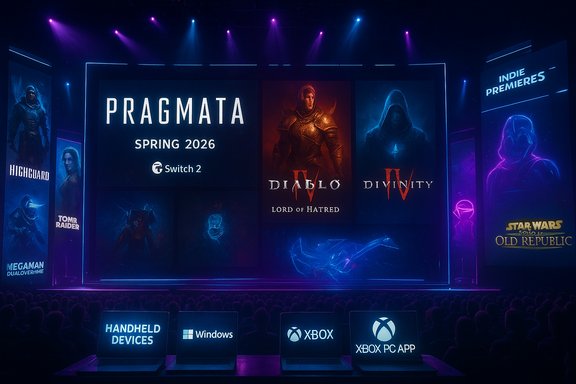
The Game Awards 2025 delivered a year‑end blast of announcements that rearranged several studios’ roadmaps, confirmed long‑rumored projects, and set up 2026 as an unusually packed year for console and PC releases — with notable knock‑on effects for Xbox, Windows handhelds, and PC storefront strategies. Indie cinema‑quality triumphs stole the awards (Clair Obscur: Expedition 33 dominated the night), but the show’s brass‑tack value came from trailers and release dates: Capcom’s PRAGMATA finally has a concrete launch window, Blizzard confirmed Diablo IV’s next major expansion, Larian unveiled a new Divinity title, Casey Hudson teased a KOTOR spiritual successor, and a clutch of high‑profile multiplatform projects landed firm dates or new platforms. The Windows‑and‑Xbox ecosystems in particular stood to gain from a raft of PC‑first reveals and the continuing push to make Windows handhelds feel more like console devices.
Background / Overview
The Game Awards remains both a celebration and a launch platform: while the event’s trophy list honors the year’s best releases, the live show functions as a concentrated trailer reel and news peg for publishers. This year’s broadcast leaned into that second role — more trailers and firm release windows than surprises in the winners’ column — and the result is a clear, actionable slate for 2026 and 2027 planning.Windows Central’s comprehensive roundup of The Game Awards 2025 captures the breadth of the night — from major multiplatform reveals and indie world premieres to platform‑specific updates for Xbox and PC — and provides the base list from which this feature draws its verified highlights and analysis.
Below are the show’s most consequential announcements for Xbox, PC, and handheld ecosystems, followed by a critical assessment of what the slate means for platform owners, developers, and players.
Major reveals that change the calendar
PRAGMATA — Capcom pins April 24, 2026 (new platforms announced)
Capcom moved PRAGMATA out of stealth and onto a firm release date: the studio announced that PRAGMATA will launch on April 24, 2026, and added a Nintendo Switch 2 version to the previously expected PS5, Xbox Series X|S and PC slate. A Steam PC demo went live concurrent with the announcement. These details were confirmed directly via publisher channels and multiple industry outlets. Why it matters- PRAGMATA’s return from prolonged silence gives Capcom a new single‑player tentpole for spring 2026 and signals renewed confidence in multi‑platform rollouts that include next‑gen handheld consoles.
- The Switch 2 confirmation matters commercially: Capcom is treating the platform as a first‑class target, not an afterthought — a notable shift compared with some 2020s port strategies.
- PRAGMATA has a long history of delays; while publisher announcements are authoritative, consumers should treat long‑lead titles as subject to further scheduling changes until later in production.
Diablo IV: Lord of Hatred — Expansion dated April 28, 2026 (Paladin playable now with pre‑purchase)
Blizzard confirmed its next Diablo IV expansion, Diablo IV: Lord of Hatred, for April 28, 2026. The expansion introduces the Paladin class (available immediately to pre‑purchasers) and promises major changes to skill trees and endgame systems, with the return of iconic Diablo series trappings such as the Horadric Cube. The release date and content breakdown were posted on Blizzard’s official Diablo IV pages and corroborated by Blizzard’s news announcements. Why it matters- Diablo IV remains a major evergreen revenue driver; a spring expansion creates a clear mid‑year engagement spike and drives cross‑platform traffic (Battle.net and Steam).
- For Windows gamers and Xbox owners who tie progress across platforms, the expansion’s launch timing will shape seasonal content calendars and streaming/marketing pushes.
Divinity — Larian’s next big gamble; billed as the studio’s largest game yet
Larian Studios used the Game Awards stage to reveal a new title titled Divinity — a return to their own fantasy universe and one the studio framed as its biggest game ever, even larger in scope than Baldur’s Gate 3, according to Geoff Keighley and press coverage of Larian’s presentation. The reveal trailer leaned into darker themes and the previously teased “Hellstone” statue symbolism; concrete platforms and a release window were not announced. Coverage across major outlets confirmed the title and the studio’s language describing its ambition. Why it matters- Larian’s credibility after Baldur’s Gate 3 gives Divinity immediate industry weight: anything billed as “bigger” draws developer and player attention.
- The lack of a release window means Divinity is a long‑lead project — important for expectations management, but also a major future driver of PC and console sales if the studio delivers.
- “Bigger than Baldur’s Gate 3” is a publisher/hosted claim; it flags ambition but not necessarily quality or a near‑term release cadence. Treat it as an aspirational positioning claim until gameplay and scope are independently verifiable.
Star Wars: Fate of the Old Republic — Casey Hudson’s Arcanaut leads a spiritual KOTOR successor
Casey Hudson — the original director behind Knights of the Old Republic and early Mass Effect entries — revealed Arcanaut Studios’ new project, Star Wars: Fate of the Old Republic, described as a spiritual successor to KOTOR. The tease positions the game as a narrative‑driven single‑player action RPG set in the Old Republic era; Lucasfilm Games involvement was confirmed. Multiple reputable outlets covered the reveal and cautioned that the project is very early in development. Why it matters- Any new single‑player Star Wars RPG helmed by Casey Hudson is a cultural headline and will draw talent, publisher attention, and fan expectations.
- The project is probably years away from release; Hudson and Lucasfilm themselves described it as an early‑stage endeavor.
Highguard — Titanfall/Apex vets’ shooter launches January 26, 2026
The final reveal of the night turned out to be Highguard — a free‑to‑play fantasy‑shooter from Wildlight Entertainment, a studio staffed by former Apex Legends and Titanfall developers. Highguard was given a surprisingly close launch date: January 26, 2026. Previews show mounted combat, magic‑augmented gunplay, and cross‑platform support. Publication coverage and the developer’s posts corroborate the date and platform targets. Why it matters- A January release puts Highguard at the front of 2026’s competitive multiplayer calendar; its free‑to‑play model means retention and content cadence will decide success more than the opening week.
- The pedigree of its team sets high expectations for fluid movement and competitive balance.
Other notable announcements and dates
- Tomb Raider: Two new Tomb Raider projects — Tomb Raider: Legacy of Atlantis (a reimagining of the 1996 original) and Tomb Raider: Catalyst (a new open‑adventure entry) — were confirmed, with the former arriving in 2026 and Catalyst slated for 2027. Coverage confirmed new voice/performance casting and platform targets.
- Mega Man: Dual Override was revealed and confirmed for 2027 across major consoles and PC; Capcom showcased the trailer alongside PRAGMATA updates.
- Total War: Warhammer 40,000, Ace Combat 8, Phantom Blade Zero (with a September 9, 2026 date), and several indie world premieres (Audiomech, Bradley the Badger, Coven of the Chicken Foot) rounded out a diverse reveal slate spanning high‑budget AA/AAA and creative indie fare.
What the announcements mean for Xbox, PC, and Windows handheld ecosystems
Xbox and Game Pass: abundance and discoverability
Microsoft’s Xbox ecosystem benefits from multiple Game Awards reveals in two ways: first, several announced or dated titles are confirmed for Xbox Series X|S; second, the incentive dynamics around Game Pass (day‑one inclusion, promotional tie‑ins) increase discovery and short‑term player engagement.Windows Central’s wrap and the industry’s broader coverage emphasize the continuing business model: publishers place high‑visibility content on Xbox to capitalize on subscription audiences, and Microsoft counters platform fragmentation by bundling discovery with subscription value. That said, not every major reveal is Game Pass‑bound — publishers still differentiate on a title‑by‑title basis — but the sheer volume of console/PC reveals creates catalog pressure where Xbox’s curated subscription library can win incremental engagement.
Windows handhelds and the “console posture” play
The convergence of heavy PC‑first announcements and Microsoft’s 2025 handheld posture has practical implications. Microsoft and OEM partners have been actively shaping a “console posture” for Windows handhelds (the Xbox Full Screen Experience) that boots devices into a controller‑first, full‑screen gaming shell and trims desktop overhead. This session posture improves discoverability of Game Pass content and reduces desktop‑related friction on small handhelds. Independent testing and initial rollouts across validated OEMs suggest measurable memory and background‑work savings on tuned hardware.Why that matters for these announcements
- Many revealed titles are coming to PC and consoles simultaneously; players on Windows handhelds benefit directly from a smoother, more immediate console‑style launch and better in‑session performance when FSE and OS‑level shader delivery improvements are enabled.
- PC demos (like PRAGMATA’s Steam demo) and early access windows become more discoverable and playable on handheld devices as the Xbox PC app and Game Bar integrations tighten.
Handheld hardware: a stronger year for Windows devices
A feed of triple‑A cross‑platform titles that remain playable on compact Windows hardware raises the importance of two factors: system‑level performance tricks (precompiled shader databases, optimized drivers) and software UX (full‑screen launcher, FSE). When combined, these elements make Windows handhelds a credible alternative to console handhelds for many players — albeit still constrained by thermals and battery physics.Developer and consumer risks, and notable strengths
Strengths: diversity, platform breadth, and clear release calendars
- The Game Awards lineup balanced indie creativity and AAA assurance: from weird, artful indies to major franchises getting new entries or expansions. That diversity is good for the ecosystem; it spreads risk and gives consumers options across price points and play styles.
- Several much‑watched titles have concrete dates (PRAGMATA, Diablo IV expansion, Highguard), which reduces ambiguity for press cycles and marketing plans and allows cross‑promotion with platform owners.
- Platform‑level improvements (FSE and shader delivery) are starting to make that discovery-to‑play loop smoother for handheld players and reduce first‑run friction for demanding PC titles.
Risks: hype, long development tails, and platform fragmentation
- Long development tails remain a consistent risk: titles touted as “bigger than” blockbusters (Larian’s Divinity) or brand new AAA projects (Casey Hudson’s Star Wars) can take multiple years to reach release — and shipping later brings the risk of audience fatigue or shifting market conditions. The “bigger than Baldur’s Gate 3” line is a headline magnet, but until gameplay windows and release schedules appear, it’s a positioning statement rather than a deliverable.
- Cross‑platform ambitions (e.g., bringing PRAGMATA to Switch 2) are commercially smart but technically complex; platform parity and performance variance will shape reception. Expect incremental patches and platform‑specific optimizations to follow day‑one launches.
- The sheer number of launches in 2026 risks saturation: competing for players’ attention will be a function of timing, post‑launch support, and the quality of live services (for F2P and multiplayer titles). Highguard’s upfront release soon after the holidays is strategically aggressive; retention and content cadence will determine early perception more than the reveal trailer.
What PC and Xbox players should watch next (practical checklist)
- Track pre‑order and demo availability: PRAGMATA’s Steam demo is live and the game has a firm April 24, 2026 launch; try the demo for performance expectations on your hardware.
- Pre‑purchase if you want early unlocks: Diablo IV’s Paladin is available immediately with pre‑purchase of Lord of Hatred, and the expansion is dated for April 28, 2026.
- Expect long lead times for Larian and Arcanaut projects: Divinity and Star Wars: Fate of the Old Republic are major announcements, but neither comes with a near‑term release window. Budget expectations accordingly.
- For handheld owners: apply available FSE and OS updates from your OEM and the Xbox PC app to get the console‑style launcher and the best out‑of‑box experience for the incoming slate. Early telemetry shows resource wins on tuned devices.
Technical verification and cautious notes
This article cross‑checked the five most load‑bearing claims announced or dated at the show against primary publisher or major outlet confirmations:- PRAGMATA’s April 24, 2026 release date and Switch 2 version were confirmed by Capcom and corroborated across publisher posts and press distribution channels.
- Diablo IV: Lord of Hatred’s April 28, 2026 release date and pre‑purchase Paladin availability are documented on Blizzard’s official Diablo IV pages and in Blizzard News.
- Divinity’s reveal and Larian’s positioning of the title as the studio’s “biggest game” were reported and analyzed by major outlets that covered Larian’s Game Awards segment. These are publisher claims and should be interpreted as descriptive ambition until further technical details and platforms are published.
- Star Wars: Fate of the Old Republic’s reveal and Casey Hudson’s leadership were confirmed by Lucasfilm/Arcanaut materials and covered by mainstream outlets; multiple reports caution that development is in early stages.
- Highguard’s January 26, 2026 launch date was announced at the show and reported by industry outlets; the claim stands as a firm studio schedule for now.
Final analysis: winners, losers, and what to expect
The Game Awards 2025 delivered two simultaneous messages: the independent scene has never been stronger (the sweep by Clair Obscur: Expedition 33 underlines that point), and the AAA pipeline is healthy with blockbuster‑scale projects in earlier phases. For Windows and Xbox owners, the practical takeaways are clear:- The spring of 2026 will be busy and commercially strategic: expect PRAGMATA and Diablo IV: Lord of Hatred to anchor release windows and generate cross‑platform marketing spikes.
- Platform software matters more than ever: full‑screen console‑style shells, precompiled shader delivery, and NPU‑assisted upscaling reduce friction for handheld play and will influence user satisfaction during early sessions of demanding titles.
- Publishers are playing a mixed approach: lock release dates for some titles while keeping others deliberately opaque. That’s sensible from a production standpoint but creates a media diet that requires editorial discernment.
Conclusion
The Game Awards 2025 balanced spectacle and utility: high‑profile reveals (Divinity, Fate of the Old Republic), concrete spring launch windows (PRAGMATA and Diablo IV: Lord of Hatred), and an influx of indie creativity. For Windows and Xbox players, the technical and UX advances Microsoft and partners have pushed in 2025 are one of the most meaningful undercurrents — they may well determine whether the many games announced at the show are enjoyed as intended on handhelds and portable PCs, not just on full‑power desktops. Expect more updates from publishers and platform owners over the next months; the show gave us the roadmap and, with it, the stakes.
Source: Windows Central https://www.windowscentral.com/gami...wards-2025-xbox-gaming-handhelds-pc-and-more/
