
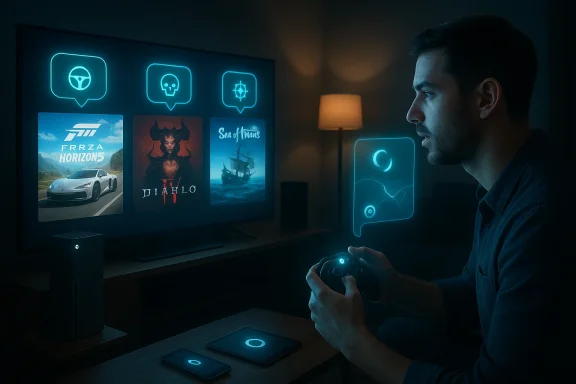
Microsoft’s Gaming Copilot is moving from a curious side project into a more ambitious part of the Xbox experience, and the latest demonstration suggests the feature will be deeply integrated when it reaches Xbox Series X|S later in 2026. The footage shown around GDC points to a voice-first, context-aware assistant that can help stuck players in games like Forza Horizon 5, Diablo IV, and Sea of Thieves, while Microsoft’s own Xbox Wire updates confirm the service is already live on Windows PC, mobile, and ROG Xbox Ally devices and is headed to consoles in the near future. That combination makes this more than a novelty demo: it is a clear signal that Microsoft wants AI to become a native layer in the living-room Xbox experience.
Microsoft’s push into gaming AI did not appear overnight. The company has spent the last several years pushing the Copilot brand across productivity, search, devices, and development tools, and Gaming Copilot is the game-specific version of that broader strategy. Xbox first framed the assistant as a “personal gaming sidekick” in 2025, then expanded it through Game Bar on Windows 11, the Xbox mobile app, and selected handhelds, with Xbox Wire explicitly saying the company would continue to explore features and optimize the experience for the ROG Xbox Ally family and, eventually, Xbox consoles.
That sequencing matters. Microsoft did not begin with console hardware, which is where the company’s most loyal audience is most likely to scrutinize the experience. Instead, it used PC and mobile as controlled environments to test usage patterns, input methods, and user tolerance for an always-available AI layer. The company’s June and August 2025 updates made clear that the assistant was being treated as a product in active development, not a one-off feature, and that the early goal was to make it useful without becoming intrusive.
By late 2025, Microsoft was already hinting at a wider rollout. Its Xbox Wire posts stated that Gaming Copilot would arrive on Xbox consoles in the near future, and the company emphasized age gating, regional restrictions, and feedback loops. The assistant is currently limited to players aged 18 and older, is not available in mainland China, and is designed to adapt based on what the player is doing in real time. Those are not minor details; they reveal a product being built under stricter operational and policy constraints than many casual AI demos.
The GDC 2026 timing also fits Microsoft’s broader hardware and platform story. The company used the same conference window to talk about the next generation of Xbox, including Project Helix, and to push a broader vision of tighter integration across console, PC, handheld, and cloud experiences. In other words, Gaming Copilot is not arriving in isolation. It is being introduced alongside a larger attempt to unify Xbox’s identity across device categories.
One of the most interesting aspects of the current rollout is that it takes Microsoft from assistant as companion to assistant as infrastructure. The feature has already been tested in environments where Microsoft can observe how people ask questions, what kinds of help they seek, and how often they engage for non-essential reasons. Xbox’s own reporting says in-game help accounted for 30% of usage in early testing, while store recommendations were 25% and casual conversation with Copilot represented 19% of interactions. That last figure is the most revealing. It suggests Microsoft may be building not just a problem-solving tool, but a persistent interface layer players will talk to even when they do not need help.
That spread is important. Racing games, live-service pirate adventures, and action RPGs all generate different types of friction, and Microsoft seems to be using that diversity to show that Gaming Copilot is not genre-specific. A player might ask for route advice in Forza, quest guidance in Diablo, or systems help in Sea of Thieves, and Copilot is being positioned as a universal interface for those requests. If it works as advertised, it could reduce reliance on external guides, YouTube tutorials, and search engine detours.
There is also a subtle strategic benefit here. On console, Microsoft controls the hardware, the operating system, the account layer, and the storefront. That means it can make Copilot part of the platform rather than an app players have to install, configure, or remember to use. The assistant can be woven into the Xbox identity itself, which gives Microsoft more control over adoption and over how the feature is perceived.
The challenge is that console players tend to be less forgiving of anything that slows down gameplay or adds noise. A helpful assistant can become one more prompt if it is not tuned carefully. Microsoft’s demo therefore has to do more than impress; it has to reassure skeptical players that the feature will be optional, fast, and genuinely useful.
That matters because the strongest AI use cases in games are usually not the most dramatic ones. They are the small moments of friction that interrupt fun: “Where do I go next?” “What does this item do?” “How do I beat this boss?” Those are precisely the kinds of questions a good assistant can answer without requiring the player to alt-tab or reach for another device. Microsoft seems to understand that the best console AI will feel invisible until needed.
That said, the success of the feature will depend heavily on answer quality. Players will not forgive vague, inaccurate, or overconfident guidance, especially in games where timing and precision matter. If Copilot’s advice is merely acceptable, it will be ignored. If it is consistently accurate, it could become habit-forming.
The early usage data suggests Microsoft is already seeing some of this behavior. In-game help led usage at 30%, but a significant share of people also used the assistant for store recommendations and casual experimentation. That tells us the audience is not just looking for rescue; it is testing the boundaries of what a gaming companion can do. Microsoft will need to decide whether to optimize for utility, entertainment, or both.
The reason is obvious: gaming guidance is already a creator economy. Walkthroughs, build guides, achievement help, strategy videos, and wiki pages are a massive layer of the modern gaming ecosystem. If Copilot can surface useful information distilled from that material, then Microsoft is effectively standing on a supply chain of editorial labor. The question becomes whether the company can do that fairly, transparently, and at scale.
That is especially important because guide creators are not just content providers; they are part of how players learn games. They have an economic stake in traffic, subscriptions, affiliate links, ad inventory, and community status. If Copilot reduces visits to those sources without compensating them, Microsoft risks alienating a category of creators the broader Xbox ecosystem still needs.
At the same time, licensing can become expensive and operationally messy. The company would need rules for what counts as licensed guide content, how revenue is shared, what happens when guidance is synthesized from multiple sources, and whether creators can opt out. A messy implementation could turn a promising feature into a legal and PR headache.
Sony and Nintendo have traditionally taken different approaches to platform features, emphasizing curation, simplicity, and first-party identity over experimental AI layers. Microsoft, by contrast, has shown a willingness to treat Xbox as a living service ecosystem that can absorb new software features over time. Gaming Copilot fits that model perfectly because it can be expanded gradually, tuned through telemetry, and adapted across devices.
The company’s companion update around Xbox Mode for Windows 11 further strengthens the picture. Microsoft is trying to make PCs feel more console-like while making consoles feel more connected to the wider Windows gaming ecosystem. Gaming Copilot sits neatly in that strategy because it is one of the few features that can cross those boundaries without feeling out of place.
The competitive risk for Microsoft is not that rivals will copy the feature overnight. It is that they will respond by emphasizing the things AI cannot easily replicate: simpler UI, stronger first-party exclusives, and fewer concerns about data capture. If Xbox leans too hard into AI as a differentiator, it may unintentionally make simplicity itself a competitive selling point for others.
That does not make it inherently bad. In fact, if handled well, it could reduce friction and help players find games they genuinely want. But it does mean Microsoft will need to be careful about the line between assistance and commerce. A helpful recommendation engine can quickly start to feel like a monetization funnel if players sense that it is nudging them toward spending rather than solving their problem.
The console is often the family-friendly device in a home, which means Microsoft has to think beyond the individual hardcore user. Who can use the feature, what data it remembers, and how visible it is in the interface all matter. The assistant may be limited to adults for now, but the long-term design has to account for shared living-room environments where multiple people interact with the same account or hardware.
For developers and publishers, the question is even broader. If Gaming Copilot starts influencing discovery and engagement, it could become a new distribution layer within Xbox. That creates opportunities, but it also adds another platform gatekeeper that studios must optimize around.
Gaming Copilot can do that if it remains fast, optional, and genuinely useful. But if it feels like a layer the player must constantly dismiss, it risks becoming an annoyance. That is especially true for Series X|S owners who may already be wary of platform changes that seem designed more for Microsoft’s roadmap than for their own habits.
It also has to respect moments when players do not want help. That means the ideal assistant is one that can wait quietly until called, then disappear as soon as the task is done. Anything else risks becoming the kind of feature that exists mostly in marketing decks and not in actual usage.
This is where Xbox’s early testing data is encouraging. The fact that a sizable share of people used the assistant just “for the hell of it,” as the reporting put it, suggests the interaction model has some novelty value. Novelty, however, is not the same as retention. Microsoft still has to turn curiosity into routine use.
The next several months should also reveal whether Microsoft is serious about creator licensing, how much of the assistant is actually context-aware on console, and whether the feature remains tightly scoped to help content or expands into broader recommendations. The answers to those questions will determine whether Gaming Copilot becomes a useful Xbox companion or just another headline-grabbing experiment.
Source: Pure Xbox https://www.purexbox.com/news/2026/...ion-hints-at-how-itll-work-on-your-series-xs/
 Background
Microsoft’s push into gaming AI did not appear overnight. The company has spent the last several years pushing the Copilot brand across productivity, search, devices, and development tools, and Gaming Copilot is the game-specific version of that broader strategy. Xbox first framed the assistant as a “personal gaming sidekick” in 2025, then expanded it through Game Bar on Windows 11, the Xbox mobile app, and selected handhelds, with Xbox Wire explicitly saying the company would continue to explore features and optimize the experience for the ROG Xbox Ally family and, eventually, Xbox consoles.That sequencing matters. Microsoft did not begin with console hardware, which is where the company’s most loyal audience is most likely to scrutinize the experience. Instead, it used PC and mobile as controlled environments to test usage patterns, input methods, and user tolerance for an always-available AI layer. The company’s June and August 2025 updates made clear that the assistant was being treated as a product in active development, not a one-off feature, and that the early goal was to make it useful without becoming intrusive.
By late 2025, Microsoft was already hinting at a wider rollout. Its Xbox Wire posts stated that Gaming Copilot would arrive on Xbox consoles in the near future, and the company emphasized age gating, regional restrictions, and feedback loops. The assistant is currently limited to players aged 18 and older, is not available in mainland China, and is designed to adapt based on what the player is doing in real time. Those are not minor details; they reveal a product being built under stricter operational and policy constraints than many casual AI demos.
The GDC 2026 timing also fits Microsoft’s broader hardware and platform story. The company used the same conference window to talk about the next generation of Xbox, including Project Helix, and to push a broader vision of tighter integration across console, PC, handheld, and cloud experiences. In other words, Gaming Copilot is not arriving in isolation. It is being introduced alongside a larger attempt to unify Xbox’s identity across device categories.
One of the most interesting aspects of the current rollout is that it takes Microsoft from assistant as companion to assistant as infrastructure. The feature has already been tested in environments where Microsoft can observe how people ask questions, what kinds of help they seek, and how often they engage for non-essential reasons. Xbox’s own reporting says in-game help accounted for 30% of usage in early testing, while store recommendations were 25% and casual conversation with Copilot represented 19% of interactions. That last figure is the most revealing. It suggests Microsoft may be building not just a problem-solving tool, but a persistent interface layer players will talk to even when they do not need help.
What the Demonstration Tells Us
The demo shared around GDC gives the clearest glimpse yet into how Gaming Copilot may behave on Xbox Series X|S. Rather than acting like a static help menu, it appears designed to answer conversational prompts in context, with the examples focusing on practical, in-game support. The demo reportedly showed assistance for players stuck in Forza Horizon 5, Sea of Thieves, and Diablo IV, which are smart choices because they represent three very different gameplay styles and player expectations.That spread is important. Racing games, live-service pirate adventures, and action RPGs all generate different types of friction, and Microsoft seems to be using that diversity to show that Gaming Copilot is not genre-specific. A player might ask for route advice in Forza, quest guidance in Diablo, or systems help in Sea of Thieves, and Copilot is being positioned as a universal interface for those requests. If it works as advertised, it could reduce reliance on external guides, YouTube tutorials, and search engine detours.
A more conversational console UI
The demo hints that Microsoft wants the assistant to feel less like a support channel and more like a natural extension of play. That implies a UI that can stay out of the way until summoned, then respond quickly enough to be useful during a live session. Xbox’s earlier messaging about a second-screen experience on mobile and an overlay in Game Bar suggests the console version may preserve that light-touch design philosophy rather than forcing players into a full-screen AI environment.There is also a subtle strategic benefit here. On console, Microsoft controls the hardware, the operating system, the account layer, and the storefront. That means it can make Copilot part of the platform rather than an app players have to install, configure, or remember to use. The assistant can be woven into the Xbox identity itself, which gives Microsoft more control over adoption and over how the feature is perceived.
The challenge is that console players tend to be less forgiving of anything that slows down gameplay or adds noise. A helpful assistant can become one more prompt if it is not tuned carefully. Microsoft’s demo therefore has to do more than impress; it has to reassure skeptical players that the feature will be optional, fast, and genuinely useful.
- The demo emphasized contextual help, not abstract AI chatter.
- It showcased multiple genres to suggest broad applicability.
- It reinforced Microsoft’s goal of making Copilot a platform feature, not a separate app.
- It raised expectations that the assistant will work naturally during active play.
Why the Game Examples Matter
Microsoft chose the right games for the pitch because each one highlights a different use case. Forza Horizon 5 is about exploration, collectability, and route optimization. Sea of Thieves has sandbox systems, event coordination, and player-driven unpredictability. Diablo IV involves build decisions, item comparisons, and progression complexity. Together, they paint Gaming Copilot as a tool for navigation, strategy, and information retrieval rather than simply a chat bot attached to Xbox.That matters because the strongest AI use cases in games are usually not the most dramatic ones. They are the small moments of friction that interrupt fun: “Where do I go next?” “What does this item do?” “How do I beat this boss?” Those are precisely the kinds of questions a good assistant can answer without requiring the player to alt-tab or reach for another device. Microsoft seems to understand that the best console AI will feel invisible until needed.
Practical help over speculative AI
The most promising part of the demonstration is its emphasis on specificity. Gaming Copilot appears to be tied to what the player is doing, which should make it more useful than a generic language model answering broad gaming questions. If the assistant knows the current game, recent achievements, and likely context, it can provide shorter, more actionable suggestions.That said, the success of the feature will depend heavily on answer quality. Players will not forgive vague, inaccurate, or overconfident guidance, especially in games where timing and precision matter. If Copilot’s advice is merely acceptable, it will be ignored. If it is consistently accurate, it could become habit-forming.
The early usage data suggests Microsoft is already seeing some of this behavior. In-game help led usage at 30%, but a significant share of people also used the assistant for store recommendations and casual experimentation. That tells us the audience is not just looking for rescue; it is testing the boundaries of what a gaming companion can do. Microsoft will need to decide whether to optimize for utility, entertainment, or both.
- Forza Horizon 5 highlights navigation and route guidance.
- Sea of Thieves stresses live, shared-world decision support.
- Diablo IV underscores build and progression complexity.
- The mixed examples suggest Microsoft wants one assistant for many genres.
Creator Economics and Content Licensing
Perhaps the most intriguing part of the GDC reporting is not the demo itself, but the implication that Microsoft is thinking about how to pay or credit the people whose guides and tips may train or inform Gaming Copilot. According to Kotaku’s report from the session, Microsoft is exploring ways to license gaming content from creators used by the assistant to improve the player experience. That is a significant admission, even if it remains exploratory.The reason is obvious: gaming guidance is already a creator economy. Walkthroughs, build guides, achievement help, strategy videos, and wiki pages are a massive layer of the modern gaming ecosystem. If Copilot can surface useful information distilled from that material, then Microsoft is effectively standing on a supply chain of editorial labor. The question becomes whether the company can do that fairly, transparently, and at scale.
A test case for AI attribution
If Microsoft wants Gaming Copilot to feel legitimate, it may need to solve attribution better than many AI products currently do. Licensing guide content from creators could create a cleaner model than invisible scraping or fuzzy citation. It would also give Xbox a way to reassure the people who make gaming knowledge valuable in the first place.That is especially important because guide creators are not just content providers; they are part of how players learn games. They have an economic stake in traffic, subscriptions, affiliate links, ad inventory, and community status. If Copilot reduces visits to those sources without compensating them, Microsoft risks alienating a category of creators the broader Xbox ecosystem still needs.
At the same time, licensing can become expensive and operationally messy. The company would need rules for what counts as licensed guide content, how revenue is shared, what happens when guidance is synthesized from multiple sources, and whether creators can opt out. A messy implementation could turn a promising feature into a legal and PR headache.
- Microsoft is reportedly exploring content licensing for creator-made guides.
- Attribution could become a major differentiator if done well.
- Creator compensation will likely matter as much as technical performance.
- Poor policy here could trigger backlash from the very communities Xbox depends on.
Competitive Positioning Against Rivals
Gaming Copilot is not arriving into a vacuum. The broader console market already has a long history of on-screen tips, help systems, community integration, and search features. What Microsoft is proposing is different because it wants AI to become a live conversation layer built into the Xbox platform. That is a more ambitious proposition than a standard help menu, and it could influence how rivals think about support and discovery.Sony and Nintendo have traditionally taken different approaches to platform features, emphasizing curation, simplicity, and first-party identity over experimental AI layers. Microsoft, by contrast, has shown a willingness to treat Xbox as a living service ecosystem that can absorb new software features over time. Gaming Copilot fits that model perfectly because it can be expanded gradually, tuned through telemetry, and adapted across devices.
Why Microsoft can move faster here
Microsoft also has the advantage of an unusually broad platform footprint. Gaming Copilot has already been deployed on Game Bar, mobile, and handhelds, and Xbox Wire says console support is coming soon. That means Microsoft can iterate on one assistant across multiple surfaces and gather data from each before scaling to the most sensitive one: the living-room console.The company’s companion update around Xbox Mode for Windows 11 further strengthens the picture. Microsoft is trying to make PCs feel more console-like while making consoles feel more connected to the wider Windows gaming ecosystem. Gaming Copilot sits neatly in that strategy because it is one of the few features that can cross those boundaries without feeling out of place.
The competitive risk for Microsoft is not that rivals will copy the feature overnight. It is that they will respond by emphasizing the things AI cannot easily replicate: simpler UI, stronger first-party exclusives, and fewer concerns about data capture. If Xbox leans too hard into AI as a differentiator, it may unintentionally make simplicity itself a competitive selling point for others.
- Microsoft is using a cross-device rollout as a testing ground.
- Console rivals may respond by emphasizing simplicity over AI.
- Xbox’s broader Windows integration gives it a structural advantage.
- The real competition may be for trust, not just features.
Enterprise, Platform, and Data Implications
Behind the consumer-facing pitch sits a very platform-oriented story. Gaming Copilot is not just a user feature; it is also a data product, a discovery mechanism, and potentially a new layer of engagement for Xbox’s ecosystem. The assistant can surface recommendations, help players discover content, and maybe even steer them toward purchases in ways that are more conversational than a traditional storefront.That does not make it inherently bad. In fact, if handled well, it could reduce friction and help players find games they genuinely want. But it does mean Microsoft will need to be careful about the line between assistance and commerce. A helpful recommendation engine can quickly start to feel like a monetization funnel if players sense that it is nudging them toward spending rather than solving their problem.
Telemetry, personalization, and the trust equation
Microsoft’s own reporting on early testing suggests the company is already studying how people use the feature, which is unsurprising for a product like this. The more context Copilot has, the more personalized and responsive it can become. Yet that same advantage raises the stakes around privacy, permissions, and data governance.The console is often the family-friendly device in a home, which means Microsoft has to think beyond the individual hardcore user. Who can use the feature, what data it remembers, and how visible it is in the interface all matter. The assistant may be limited to adults for now, but the long-term design has to account for shared living-room environments where multiple people interact with the same account or hardware.
For developers and publishers, the question is even broader. If Gaming Copilot starts influencing discovery and engagement, it could become a new distribution layer within Xbox. That creates opportunities, but it also adds another platform gatekeeper that studios must optimize around.
- Gaming Copilot may affect discovery and purchase behavior.
- Telemetry will likely improve the assistant, but also heighten trust concerns.
- Shared-home console usage complicates privacy and consent.
- Developers may eventually need to think about Copilot visibility as part of platform strategy.
The User Experience Problem
The biggest issue for Microsoft may not be technical at all. It may be whether players feel that AI belongs on a console in the first place. Console gaming has always been partly about frictionless simplicity: turn it on, select a game, start playing. Any new system feature that interrupts that flow has to justify itself immediately.Gaming Copilot can do that if it remains fast, optional, and genuinely useful. But if it feels like a layer the player must constantly dismiss, it risks becoming an annoyance. That is especially true for Series X|S owners who may already be wary of platform changes that seem designed more for Microsoft’s roadmap than for their own habits.
Why the “always there” model cuts both ways
An always-available assistant is only valuable if it can answer questions with minimal ceremony. Microsoft’s demo suggests the company wants voice interaction and rapid contextual responses, which is the right direction. Still, the more visible Copilot becomes, the more it must prove that it understands the rhythm of console play.It also has to respect moments when players do not want help. That means the ideal assistant is one that can wait quietly until called, then disappear as soon as the task is done. Anything else risks becoming the kind of feature that exists mostly in marketing decks and not in actual usage.
This is where Xbox’s early testing data is encouraging. The fact that a sizable share of people used the assistant just “for the hell of it,” as the reporting put it, suggests the interaction model has some novelty value. Novelty, however, is not the same as retention. Microsoft still has to turn curiosity into routine use.
- The assistant must be optional, not intrusive.
- Voice and speed are likely to determine real-world adoption.
- Console players will judge the feature by whether it interrupts gameplay.
- Early novelty may not translate into long-term habit.
Strengths and Opportunities
Microsoft has several clear advantages here, and they explain why Gaming Copilot is worth watching closely. The company can iterate across PC, mobile, handheld, and console while using one brand and one account system. That gives Xbox a scale advantage that smaller platforms simply cannot match.- Cross-platform reach gives Microsoft more data and faster iteration.
- The assistant can help reduce reliance on third-party guides.
- It may improve game discovery inside the Xbox ecosystem.
- Voice-first assistance could make some games easier for new or returning players.
- Microsoft can build tighter integration than an external chatbot ever could.
- Content licensing could create a more ethical model for guide creators.
- The feature may strengthen Xbox’s identity as a living service rather than a static box.
Risks and Concerns
The downside is just as real. AI in games can easily become a trust problem if the experience feels pushy, inaccurate, or overly commercial. Microsoft will also have to navigate creator backlash, privacy expectations, and the possibility that players simply do not want a conversational assistant in their console workflow.- Poor answers could damage confidence quickly.
- Creator licensing is promising, but legally and operationally complex.
- A visible AI layer may feel intrusive to some players.
- Discovery features could be perceived as monetization prompts.
- Privacy and household sharing create extra complications.
- Regional limitations and age gating may limit the feature’s reach.
- If the assistant becomes a distraction, it could hurt rather than help the Xbox experience.
Looking Ahead
The key thing to watch is not just whether Gaming Copilot ships on Xbox Series X|S, but how Microsoft frames the experience when it does. If the company presents it as a quiet utility, it may earn cautious acceptance. If it presents it as a must-have revolution, it risks a backlash from players who still value a clean, traditional console interface.The next several months should also reveal whether Microsoft is serious about creator licensing, how much of the assistant is actually context-aware on console, and whether the feature remains tightly scoped to help content or expands into broader recommendations. The answers to those questions will determine whether Gaming Copilot becomes a useful Xbox companion or just another headline-grabbing experiment.
- Watch for a concrete console release window.
- Watch for details on voice input and UI placement.
- Watch for creator licensing or attribution announcements.
- Watch for privacy and age-policy clarifications.
- Watch for how deeply the assistant integrates with achievements, library history, and store recommendations.
Source: Pure Xbox https://www.purexbox.com/news/2026/...ion-hints-at-how-itll-work-on-your-series-xs/
