

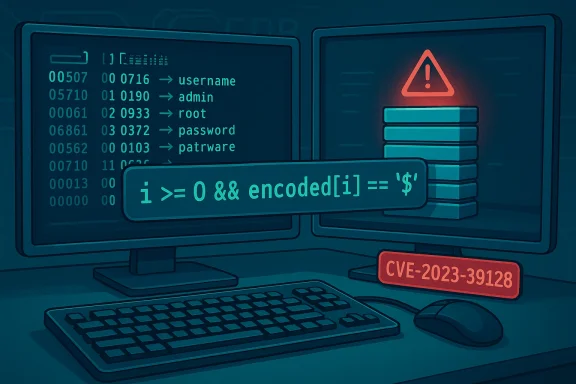
A stack-buffer overflow in GDB’s Ada name-decoding routine — tracked as CVE-2023-39128 — quietly exposed a fragile surface in one of the most widely used debugging tools: a bug in the function ada_decode (file gdb/ada-lang.c) that could crash the debugger and force denial-of-service on development, build and CI hosts that run untrusted or crafted inputs through GDB. The flaw is local in scope, tied to how GDB processes Ada-encoded symbol names, but it is real, reproducible, and has already been patched upstream and by major Linux distributors.
GDB (the GNU Debugger) is an essential tool for developers and operations teams who need to inspect program state, control execution, and diagnose problems across languages including C, C++, and Ada. Like any complex, native C/C++ codebase, it contains language-specific front-ends and decoders — in this case, an Ada symbol-decoding path — that manipulate strings and metadata parsed from object files and debugging information.
CVE-2023-39128 was published in July 2023 after an AddressSanitizer report and subsequent analysis revealed a dynamic stack buffer overflow in the Ada decoding routine. The vulnerability occurs while ada_decode strips and transforms encoded names; specific input patterns (notably strings containing only digits and certain suffix patterns) can push the routine outside its intended bounds and cause an out-of-bounds write on the stack. The result is an immediate crash of the GDB process — a loss of availability for the running debug session or any tooling that invokes GDB on crafted files.
Multiple vulnerability trackers and distribution advisories list the issue and record its practical effect: a crash in a command-line, local tool. Distributions assessed the security impact as low-to-medium because exploitation requires local access and user interaction; nevertheless, the operational impact is clear in contexts where GDB is run on untrusted inputs (for example, automated binary-analysis pipelines, CI that consumes artifacts from external sources, or developer machines handling third-party object files).
Two pieces of public evidence support this:
Upstream patching and distributor backports mean that fixed package versions are available across mainstream Linux distributions; distro advisories list the fixed package releases and the update paths.
Two operational notes:
At the same time, this CVE highlights structural risks that persist across toolchains:
Source: MSRC Security Update Guide - Microsoft Security Response Center*
 Background / Overview
GDB (the GNU Debugger) is an essential tool for developers and operations teams who need to inspect program state, control execution, and diagnose problems across languages including C, C++, and Ada. Like any complex, native C/C++ codebase, it contains language-specific front-ends and decoders — in this case, an Ada symbol-decoding path — that manipulate strings and metadata parsed from object files and debugging information.CVE-2023-39128 was published in July 2023 after an AddressSanitizer report and subsequent analysis revealed a dynamic stack buffer overflow in the Ada decoding routine. The vulnerability occurs while ada_decode strips and transforms encoded names; specific input patterns (notably strings containing only digits and certain suffix patterns) can push the routine outside its intended bounds and cause an out-of-bounds write on the stack. The result is an immediate crash of the GDB process — a loss of availability for the running debug session or any tooling that invokes GDB on crafted files.
Multiple vulnerability trackers and distribution advisories list the issue and record its practical effect: a crash in a command-line, local tool. Distributions assessed the security impact as low-to-medium because exploitation requires local access and user interaction; nevertheless, the operational impact is clear in contexts where GDB is run on untrusted inputs (for example, automated binary-analysis pipelines, CI that consumes artifacts from external sources, or developer machines handling third-party object files).
What went wrong: technical anatomy of the bug
The Ada name-decoding path
GDB’s Ada support implements a decoder that reverses compiler-produced name encodings to present readable identifiers to users. The ada_decode routine performs multiple string manipulations:- Strips known suffixes and markers inserted by GNAT and other Ada toolchains.
- Removes trailing numeric decorations used to disambiguate overloaded names.
- Performs conditional truncation when special markers appear (for example “___X” sequences and TKB/TB tags).
The immediate fault
The bug arises in the code path that removes trailing digits: when the function iterates backward over the input to strip a sequence of trailing numerals, it fails to maintain correct lower-bound checks in at least one branch, which allows the index to underflow and become negative (interpreted as a large unsigned value when mixed with size_t/pointer arithmetic), leading to a write outside the allocated stack buffer. AddressSanitizer reports captured in public advisories indicate the overflow reported on an exact source line in ada-lang.c, confirming a dynamic stack overflow rather than a heap corruption or logic error. Several vulnerability databases and distro trackers reproduce this finding in their technical notes.Why this matters beyond a crash
A debugger runs with the privileges of the user invoking it and is often trusted by operational scripts and toolchains. While a crash-only bug does not equate to immediate remote code execution in this case, the memory corruption class (CWE-787) inherently raises the specter of more severe outcomes in different contexts — for example, if an attacker can influence adjacent memory layout or if an instance of GDB is run with elevated privileges or exposed via appliance-like tooling. The practical and immediate consequence is denial-of-service for the affected process or workflow.The upstream fix: what changed in the code
When the issue was triaged, maintainers applied a small, targeted patch to the Ada decode routine that hardens the boundary checks used when scanning back over encoded names. The patches introduced explicit lower-bound guards (for example, checking that the index variable is non-negative before dereferencing) and added a lightweight self-test that exercises the formerly-crashing path to prevent regression.Two pieces of public evidence support this:
- A downstream backport patch (used by several embedded and distro maintainers) shows the exact edit: replacing an unsafe conditional that referenced encoded without verifying the index with a guarded expression such as
i >= 0 && encoded[/I] == '$'. This is the minimum safe change needed to prevent the underflow and out-of-bounds access.
[*]Repository snapshots and third-party source archives include the GDB_SELF_TEST* registration and a tiny test harness that callsada_decode("44")as a regression-probe — a pragmatic test added specifically to catch the previously crashing input. This confirms that the maintainers not only patched the logic but also added a unit-style check.
Upstream patching and distributor backports mean that fixed package versions are available across mainstream Linux distributions; distro advisories list the fixed package releases and the update paths.
Who is affected — threat model and exposure
- Developers and engineers running interactive GDB sessions on local desktops are exposed if they open crafted object files or symbol tables from untrusted sources. The attacker must either supply a crafted file or trick the user into opening it; no network vector is generally required.
- Automated build systems, CI jobs and binary-analysis pipelines that invoke GDB on artifacts fetched from external repositories can be disrupted, potentially at scale, if attackers can inject crafted artifacts into those feeds.
- Hosted service providers or multi-tenant systems that provide debugging-as-a-service or allow user-supplied binaries to be analyzed by automated GDB-driven tooling are higher-risk; a single exploit could crash per-tenant processes or interrupt services.
- Appliances or integrated tools that bundle GDB (for example, forensic or reverse-engineering kits) may carry vulnerable GDB binaries; vendors who ship prebuilt GDB should confirm versions and push updates.
Practical mitigations and recommended actions
If your environment uses GDB in any automated or semi-automated capacity, treat this as an actionable patch-and-verify item. Below are concrete steps to mitigate the immediate risk and harden operations:- Patch first
- Update GDB to the fixed package release provided by your distribution vendor (Ubuntu, Debian, Amazon Linux, Red Hat and others have released backports). Verify the package version against your vendor advisory before trusting it. For Ubuntu and similar distributions, the security notice lists the fixed versions for supported LTS releases.
- Isolate the tool
- Run GDB inside restricted environments where possible: sandboxed containers, ephemeral VMs, or dedicated debug hosts. Avoid giving unprivileged development workstations access to sensitive networks when they process third-party artifacts.
- Restrict untrusted inputs
- Treat external object files, shared libraries or core dumps as untrusted payloads. Validate artifact provenance before feeding into automated GDB-driven workflows.
- Apply defense-in-depth
- Use AddressSanitizer or similar memory-safety sanitizers during internal testing and CI to discover regressions. Consider compile-time hardening options (stack-protector, fortify_source) when building debugging toolchains.
- Audit and inventory
- Scan your fleets for installations of GDB and identify which services and pipelines call it. Prioritize patching hosts that perform bulk analysis or that expose file upload functionality to users.
- Backport and vendor coordination
- If you operate long-lived appliance builds and do not track rapid upstream updates, schedule a maintenance window to apply vendor-provided patches; many embedded and OS vendors have already issued ALAS or SRPMs to address CVE-2023-39128.
Detection, forensics and hunting guidance
Because the vulnerability causes a deterministic crash, detection is straightforward in many environments:- Monitor system logs and orchestration dashboards for repeated GDB process crashes tied to specific job IDs or inputs.
- Look in CI logs for sudden aborts during build or test steps that invoke GDB (for example, post-link symbolic analysis phases).
- If you use AddressSanitizer or run system-level crash reporters (ABRT, Apport, systemd-coredump), search crash reports for stack traces that reference gdb/ada-lang.c or the ada_decode symbol.
- Create a quick internal test harness: feed a small set of known edge-case encoded names into GDB in a controlled environment; if the patched package is in place, the test should not crash and the selftest should pass when compiled with GDB_SELF_TEST enabled (the upstream patch added a simple self-test).
The vendor and distribution response
Major distributions reacted by either shipping backported fixes or marking packages as updated in their security trackers. Ubuntu published a security advisory and a USN that lists the fixed package versions across supported LTS releases; Debian’s security tracker shows the issue and the state for each release; Amazon Linux and other vendors also released ALAS advisories and fixed package builds for their runtimes. For organizations that consume vendor-built images (containers, appliances), those vendor advisories are the right place to obtain curated fixed packages and verified backports.Two operational notes:
- Some distribution trackers classify this as low priority because of the local, crash-only nature of the flaw. That does not mean it can be ignored in shared or automated environments.
- For embedded or minimal Linux distributions with long release cycles, maintainers often publish backports or recommend disabling certain language frontends if they are unused; weigh that option if you cannot immediately patch.
Why a debugger bug deserves attention
Debuggers occupy a special position in a system’s security posture: they are trusted developer tools that manipulate program state, symbol tables, and object metadata — all places where parsing and decoding logic is complex and brittle. That makes even low-severity memory-safety faults worth tracking because:- They break availability in developer workflows, potentially stalling engineering velocity.
- They can be triggered at scale if an automated pipeline processes attacker-controlled artifacts.
- Memory corruption in a privileged or incorrectly sandboxed context can escalate: while CVE-2023-39128 is crash-only as reported, the underlying weakness class could produce more severe outcomes in different builds or with different compiler optimizations enabled.
Hardening recommendations for maintainers and vendors
- Ship GDB builds with maximum practical hardening flags enabled (stack protectors, ASLR-enabling link options and compiler mitigations).
- Include targeted self-tests for formerly-exploitable paths; the upstream addition of a self-check around ada_decode is a simple but effective regression control.
- For vendor appliances that include GDB for diagnostic or support tasks, minimize the attack surface by isolating the debugging subsystem from customer-facing ingestion points and by ensuring rapid patch deployment channels.
- Consider enabling runtime sanitizers in CI for the debugger itself and for any code that parses user-supplied binary metadata.
When to treat this as urgent
Prioritization depends on your environment:- Immediate/High priority: hosted analysis services, multi-tenant CI systems, or any environment where untrusted users can submit binaries that will be processed automatically by GDB.
- Medium priority: developer fleets that occasionally handle external binaries or third-party object files; apply patching in a normal maintenance cycle but restrict untrusted inputs immediately.
- Lower priority: isolated development machines that only operate on internal, verified artifacts and where the risk of encountering the triggering pattern is negligible.
Final analysis — strengths, residual risks, and lessons learned
CVE-2023-39128 illustrates a disciplined and effective response pattern: discovery (AddressSanitizer output), triage, minimal, well-scoped patching with an accompanying regression test, and distribution backports. That workflow reduced the window of exposure and limited collateral complexity in the fix. The maintainers’ decision to add a targeted selftest is a positive signal: it prevents regressions in an area that is hard to exercise in unit tests.At the same time, this CVE highlights structural risks that persist across toolchains:
- Native C/C++ tooling that performs string and symbol decoding remains vulnerable to boundary errors; systematic adoption of safer languages or memory-safe wrappers for parsing logic would reduce this class of defects.
- Supply-chain and automation contexts increase the blast radius of local-only bugs; a crash in an “unsafe” utility used by CI can cascade and create operational downtime.
- Not all distributions or vendor stacks update at the same cadence; visibility and inventory of vulnerable package versions remain essential for effective remediation.
Conclusion
CVE-2023-39128 is not a dramatic remote-execution exploit, but it is the kind of memory-safety fault that undermines reliability and trust in toolchains. The Ada decode routine contained an off-by-boundary weakness that allowed a dynamic stack buffer overflow and deterministic crashes. Upstream fixes and distribution backports are available, and maintainers added lightweight self-tests to avoid regressions. Administrators should patch affected hosts, isolate GDB where feasible, and treat automations that consume third-party binaries as higher-priority remediation targets. The incident is a reminder that even developer-facing tools deserve production-grade security hygiene: careful parsing, rigorous bounds checking, and fast, transparent patching.Source: MSRC Security Update Guide - Microsoft Security Response Center*
