

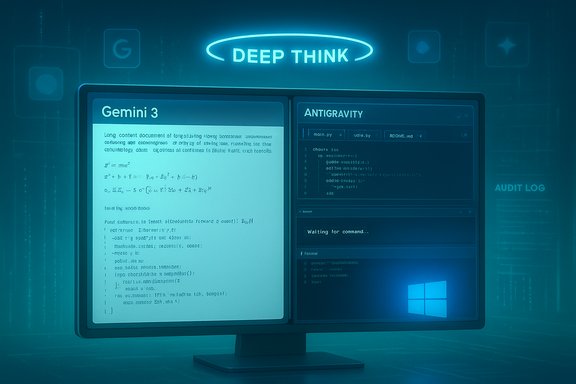
Google’s rollout of Gemini 3 — a multimodal, agentic-focused model Google positions as its new flagship — has reignited the tech industry’s AI arms race, combining headline-grabbing benchmark wins with broad product integration that promises immediate impact on search, productivity, and developer tooling. The launch brings a new “Deep Think” variant for extended reasoning, an agentic IDE called Antigravity for autonomous coding workflows, and vendor-reported scores that place Gemini 3 at or near the top of several reasoning and multimodal leaderboards; simultaneously, market-share and web-traffic metrics show ChatGPT still dominates public usage and referrals, underscoring a gap between raw capability and real-world adoption.
Gemini 3’s debut rewrites expectations about what an LLM can do in multimodal and agentic contexts, and Google’s product footprint gives it an immediate runway for impact. The meaningful differences today are technical leadership versus market entrenchment: Gemini 3 aims to close the capability gap and win through integration, but widespread adoption will depend on reproducible results, hardened governance, and demonstrable business ROI. For Windows users, developers and IT teams, the sensible path is cautious experimentation: validate claims on your inputs, harden agent controls, and measure outcomes — only then convert pilot wins into broader deployments.
Source: The Nation (Pakistan) Google’s new Gemini 3 version rekindles AI race
 Background
Where Gemini 3 fits into the landscape
Gemini 3 is the latest in Google’s multi‑variant Gemini family, intended to scale from on‑device Nano models to cloud-hosted Pro/Ultra tiers. Google has emphasized three capabilities as the model’s differentiators: deeper multi-step reasoning, expanded multimodal understanding (text, images, audio, video, code), and agentic functionality — the ability for a model to orchestrate multi-step workflows, call tools, and act inside developer environments. The company’s distribution strategy ties Gemini 3 into the Gemini app, AI Mode in Google Search, and enterprise surfaces including Vertex AI / Gemini Enterprise.The vendor narrative vs. independent scrutiny
Google’s launch materials present striking improvements across benchmarks and describe a 1,000,000‑token context horizon for some variants, plus a new “Deep Think” mode that trades latency for deeper reasoning. These claims were accompanied by demonstration integrations (Search AI Mode and Antigravity) that show Google moving from standalone models to platform‑level automation. However, most performance numbers published at launch are vendor- or partner‑reported; independent third‑party replications typically lag major releases and should be considered the necessary next step for any critical procurement or security decision.What Google announced and what it actually means
The product mix: Pro, Deep Think, Antigravity and distribution
- Gemini 3 Pro — the headline model for cloud-based multimodal tasks, available in the Gemini app and cloud APIs for paying customers.
- Gemini 3 Deep Think — a staged, safety‑reviewed mode optimized for longer, higher‑fidelity reasoning sessions (higher latency, stronger chain-of-thought). Google frames this variant for high‑value scientific, legal and research tasks.
- Antigravity — an agentic IDE that lets multiple AI agents interact with code editors, terminals, and browsers while producing “artifacts” (logs, screenshots and recordings) to document agent actions — a design that aims to lower the barrier from “assistant” to “autonomous collaborator.”
Notable technical claims (and caveats)
Google’s materials claim very large context windows and strong benchmark results across reasoning and multimodal suites. Specific numbers circulating in launch coverage include top-line Humanity’s Last Exam scores, very high GPQA Diamond results, and strong Video‑MMMU/MathArena performance — figures that, if independently verified, represent a real step forward in multi‑step reasoning and multimodal comprehension. But those figures are, for now, largely vendor‑reported; independent labs and academics will need to reproduce them under transparent test harnesses before treating them as definitive.Benchmarks: what the headline numbers say — and what they don’t
Humanity’s Last Exam (HLE)
Gemini 3 Pro is reported to have achieved roughly 37–37.5% on the Humanity’s Last Exam benchmark in vendor materials, with Deep Think pushing that result to the low‑40s in some reports. HLE is a 2,500‑question, expert‑level benchmark designed to test deep reasoning across math, science and humanities. A single benchmark is a useful indicator, but not a definitive measure of real‑world reliability: HLE emphasizes problem solving under constrained conditions, which differs from day‑to‑day user tasks where grounding, up‑to‑date retrieval and tool execution matter. Multiple news outlets summarized Google’s HLE results at launch; independent verification is pending.GPQA Diamond and ARC-AGI-2
Vendor figures circulated at launch show GPQA Diamond scores in the high 80s–low 90s for Pro, and rising to ~93.8% in Deep Think for particularly challenging graduate‑level science problems. ARC‑AGI‑2, used to measure generalization on novel reasoning tasks, reportedly hit ~45.1% under Deep Think with code execution enabled — a substantial jump over prior frontier models. These are impressive relative advances, but they also reflect specific task designs; any organization using a model for safety‑critical or compliance‑sensitive tasks should validate the exact subtask distribution and test harness for their use cases.Benchmarks vs. live deployments
Benchmarks are syntactic and narrow by design; production behavior depends on grounding, retrieval quality, tool integration, and prompt engineering. Models that top leaderboards can still hallucinate or misattribute when faced with noisy web retrieval or adversarial prompts. Treat vendor leaderboard supremacy as a signal of capability, not a guarantee of flawless behavior in your product.Market position and traffic: capability vs. adoption
ChatGPT remains the dominant public-facing AI destination
Even as Gemini 3 claims benchmark leadership, ChatGPT retains a commanding lead in public usage and referral traffic, with platforms like Semrush and Similarweb reporting monthly visit figures around ~5.2–5.3 billion for ChatGPT domain traffic (placing it among the top global web properties), while Google Search and YouTube unsurprisingly continue to dominate overall web visits. Statcounter and other traffic‑analytics summaries show ChatGPT accounting for a large majority of AI referral traffic globally (commonly cited figures ~79–81% depending on the period), with Perplexity, Microsoft Copilot/Bing AI and Google Gemini comprising much smaller shares. These numbers underscore the practical reality: distribution and habit matter as much as raw capability.Why a capability lead does not equal immediate market share
Several factors explain why an advanced model like Gemini 3 may not instantly unseat incumbents:- User habit and discoverability — users (and enterprises) already trained on ChatGPT and integrated workflows take time to migrate.
- Product looseness vs. governance — enterprises favor stable, auditable interfaces; a new deep‑reasoning mode requires governance validation.
- Referral ecosystem — ChatGPT’s referral behavior and SEO/GEO impact differ from a model embedded into Search, which may generate fewer outbound clicks even while providing value inside the platform.
Practical implications for Windows users, developers and IT managers
For power users and creators
Gemini 3’s multimodal and long‑context capabilities promise faster content creation, better handling of images and video, and improved code prototyping inside cloud IDEs. Integration into Chrome (AI Mode) and a redesigned Gemini app will make these capabilities available to Windows desktop users who rely on browser‑based workflows. Expect:- Faster slide and document generation from prompts and uploaded content.
- Improved image editing and multimodal summaries for recordings and meeting footage.
- Deeper code synthesis and debugging when using cloud IDEs connected to Gemini.
For developers and integrators
Antigravity and agentic SDKs change the integration model: agents can now orchestrate multi‑step tasks across tools and systems. This increases potential productivity but also requires careful engineering around:- Credential scoping and least privilege.
- Sandboxing agent actions and ensuring auditable artifacts.
- Testing for prompt‑injection, cross‑prompt attacks and automated escalation paths.
For IT admins and security teams
Agentic models expand the attack surface. The risk profile includes automated privilege misuse, exfiltration via chained agent actions, and supply‑chain-style vulnerabilities if agents operate across third‑party connectors. Administrators should:- Lock down defaults and require admin approval for agent creation.
- Configure retention and DLP rules that prevent inadvertent data exposure to cloud models.
- Add runtime isolation, audit logs and human approval gates for actions that change production systems.
Strengths: where Gemini 3 genuinely advances the field
- Multimodal depth — the model’s stronger video and image understanding (Video‑MMMU and MMMU‑Pro gains) open real use cases in learning, monitoring and content analysis that previous models struggled with.
- Longer-context workflows — very large token windows enable coherent handling of long documents, full codebases or hour‑long transcripts without constant state juggling.
- Agentic tooling — Antigravity and agent orchestration make it practical to automate multi-step developer and business workflows, shifting AI from assistant to executioner under controlled conditions.
Risks and caveats: where to be cautious
- Vendor‑reported benchmarks require independent replication. Many of the splashy numbers come from vendor spokes or partner blogs; independent labs and peer‑reviewed test harnesses are necessary for robust validation. Treat vendor scorecards as promising, not definitive.
- Agentic automation increases security exposure. Allowing models to act (open terminals, call APIs, alter documents) can automate attacks unless strict runtime and human‑approval controls are in place.
- Traffic and market-share dynamics favor incumbents. Even best-in-class models need time and product integration to convert capability into user reach; search embedding can reduce outbound referrals, changing the web economics for publishers.
- Regulatory and compliance ambiguity. Data residency, model training guarantees and vendor contractual terms (non‑training clauses, retention) must be clarified for enterprise adoption; public materials sometimes lack the contractual granularity IT teams need.
How to evaluate Gemini 3 in your environment — a pragmatic checklist
- Confirm the exact model variant and access tier you’ll get (Pro vs. Deep Think vs. Ultra).
- Replicate vendor benchmark claims on your own data and prompts; create a tight test harness that mirrors production inputs.
- Run agentic workflows in a sandbox with full logging and artifact capture; review for unexpected actions.
- Validate contractual terms: non‑training commitments, retention policies, and regionally compliant data controls.
- Start with low‑risk, high‑value pilots (document summarization, image annotation, dev automation) before authorizing agents to act across production systems.
Broader market and economic context
Two big, independent industry findings put this launch into perspective. McKinsey’s June 2023 analysis estimated generative AI could add roughly $2.6–$4.4 trillion annually across 63 use cases — a useful lens on the macroeconomic potential of these technologies. Gartner and other analyst surveys project steep enterprise uptake over the next 24 months, with summaries commonly reporting that over 80% of businesses will adopt generative AI in some form by 2026. These projections reinforce why companies are racing to productize agentic capabilities and tie them into enterprise workflows, even as governance and reproducibility questions persist. Note: some analyst findings (Gartner) are provided through proprietary surveys and summarized widely in press reports; consult the original analyst reports for contract-level planning.What WindowsForum readers should do next
- For enthusiasts: test the Gemini app and Chrome AI Mode in a non‑production profile and compare outputs on tasks you care about (code snippets, long‑document summaries, multimodal tasks). Record failures and prompt patterns.
- For developers: sign up for Vertex AI previews and evaluate Antigravity in sandbox mode. Benchmark latency, consistency of code generation, and artifact reproducibility.
- For IT/security teams: update threat models to include automated agent abuse, require admin gating for agent deployment, and expand DLP rules to catch sensitive data leaving endpoints. Prepare an incident response plan that covers model-driven anomalies.
Final assessment: a capability leap with measured adoption risk
Gemini 3 is a significant technical step: its multimodal strength, longer contexts, and agentic tooling create genuinely new product opportunities. Vendor‑reported benchmark scores and new features such as Antigravity support the claim that Google has advanced the frontier of reasoning-oriented LLMs. At the same time, the real world separates capability from adoption: ChatGPT’s traffic dominance, the need for independent benchmark replication, and the non‑trivial governance and security risks of agentic automation mean the race is far from decided. Enterprises and power users should be excited but disciplined — pilot pragmatically, require auditable trails for agent actions, and insist on contractual clarity before adopting agentic features at scale. ConclusionGemini 3’s debut rewrites expectations about what an LLM can do in multimodal and agentic contexts, and Google’s product footprint gives it an immediate runway for impact. The meaningful differences today are technical leadership versus market entrenchment: Gemini 3 aims to close the capability gap and win through integration, but widespread adoption will depend on reproducible results, hardened governance, and demonstrable business ROI. For Windows users, developers and IT teams, the sensible path is cautious experimentation: validate claims on your inputs, harden agent controls, and measure outcomes — only then convert pilot wins into broader deployments.
Source: The Nation (Pakistan) Google’s new Gemini 3 version rekindles AI race
