

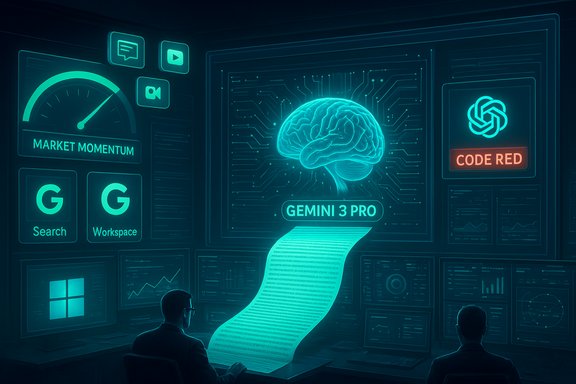
Google’s Gemini 3 arrival has forced an unmistakable shift in the AI battleground: industry analysts and major outlets report that OpenAI has declared an internal “code red,” redirecting resources to shore up ChatGPT as Google’s new multimodal flagship posts headline benchmark wins and broad product rollouts. The story is both technical and strategic — it’s about model architecture and context windows, but also about distribution, economics, and the practical decisions IT teams must make when a platform-level competitor redefines expectations for reasoning, multimodality and enterprise integration. This feature unpacks what Gemini 3 delivers, why it matters to Windows users and IT professionals, and what enterprises and administrators should do now to manage risk and seize opportunity.
Gemini 3 is Google DeepMind’s newest flagship in the Gemini family, announced in mid-November and rolled into the Gemini app, Search AI Mode, Google AI Studio / Vertex AI and broader developer surfaces. Google frames Gemini 3 as its most capable multimodal and reasoning model to date, with a new “Deep Think” mode for higher-latency, higher-fidelity reasoning tasks and upgraded image-generation tooling under the Nano Banana Pro name. Google’s product post describes improved benchmark performance and explicitly calls out a very large context capability that lets the model work across long, multimodal inputs. The market reaction has been fast. Multiple news organizations report that OpenAI’s CEO Sam Altman issued an internal memo declaring a “code red,” pausing or deprioritizing several non-core initiatives so engineering focus can return to improving ChatGPT’s day-to-day performance — specifically speed, reliability, personalization, and coverage. The memo and follow-on coverage underscore that leading-edge model scores now trigger immediate strategic shifts at rival firms. WindowsForum community threads and internal analysis captured these shifts as well, noting that Gemini 3’s combination of technical claims and product distribution — Search, Workspace, the Gemini app and developer tooling — is a structural threat to competitors who lack the same product reach. Those internal community summaries emphasize that a model’s leaderboard wins do not automatically translate to market dominance, but distribution and integration can quickly compound usage advantages.
Windows users and administrators sit at the intersection of two trends: the arrival of radically more capable assistants, and the operational imperative to govern them responsibly. The winners in this era won’t be the fastest model in a benchmark chart — they’ll be the teams and vendors that combine credible capability, predictable economics, clear governance and seamless integration into daily workflows.
For Windows users and IT professionals, the immediate obligation is practical and disciplined: test these new capabilities on representative workloads, insist on multi-model flexibility, enforce governance and logging, and design for predictable costs. The race between Gemini 3 and ChatGPT will continue; success for organizations will come from thoughtful experimentation tempered by robust operational controls. The AI era that promised dramatic productivity gains is here — but it will reward those who pair capability with disciplined, governance‑aware engineering and procurement.
Source: Anadolu Ajansı Gemini 3 puts OpenAI on high alert as biggest contender to ChatGPT
 Background / Overview
Gemini 3 is Google DeepMind’s newest flagship in the Gemini family, announced in mid-November and rolled into the Gemini app, Search AI Mode, Google AI Studio / Vertex AI and broader developer surfaces. Google frames Gemini 3 as its most capable multimodal and reasoning model to date, with a new “Deep Think” mode for higher-latency, higher-fidelity reasoning tasks and upgraded image-generation tooling under the Nano Banana Pro name. Google’s product post describes improved benchmark performance and explicitly calls out a very large context capability that lets the model work across long, multimodal inputs. The market reaction has been fast. Multiple news organizations report that OpenAI’s CEO Sam Altman issued an internal memo declaring a “code red,” pausing or deprioritizing several non-core initiatives so engineering focus can return to improving ChatGPT’s day-to-day performance — specifically speed, reliability, personalization, and coverage. The memo and follow-on coverage underscore that leading-edge model scores now trigger immediate strategic shifts at rival firms. WindowsForum community threads and internal analysis captured these shifts as well, noting that Gemini 3’s combination of technical claims and product distribution — Search, Workspace, the Gemini app and developer tooling — is a structural threat to competitors who lack the same product reach. Those internal community summaries emphasize that a model’s leaderboard wins do not automatically translate to market dominance, but distribution and integration can quickly compound usage advantages.What Gemini 3 actually ships: features and technical claims
Key product elements at launch
- Gemini 3 Pro: Google’s cloud model for multimodal reasoning and agentic workflows, available in the Gemini app, AI Mode in Search (for subscribers), Google AI Studio and Vertex AI.
- Gemini 3 Deep Think: A safety-reviewed, higher-latency reasoning mode that trades speed for deeper chain-of-thought style reasoning; being staged to safety testers and premium subscribers.
- Nano Banana Pro: The Gemini 3 Pro image-generation/editing model (an evolution of the earlier Nano Banana), optimized for legible text in images, infographics and brand-consistent renders; integrated across Gemini, Ads and AI Studio. Google’s product blog and DeepMind pages describe the model and use cases.
Notable technical claims
- Large context window (1,000,000 tokens): Google’s announcement and multiple industry summaries present Gemini 3 as supporting a context horizon in the order of one million tokens, making it practical to feed very large documents, codebases or multimedia transcripts into a single session. This is a game-changer for “single-shot” analysis of complex material — legal documents, long code repositories, or multi-hour lecture transcripts. Google’s release messaging explicitly mentions the million‑token context window.
- Benchmark leadership on selected tests: Google publicizes LMArena Elo leaderboard placement and scores on specialized tests (Humanity’s Last Exam, GPQA Diamond, MathArena Apex, multimodal MMMU-Pro and Video-MMMU). Public reporting and independent summaries widely repeat headline numbers such as a 1,501 Elo score on LMArena and 37.5% on Humanity’s Last Exam for the Pro mode — with further gains when Deep Think is applied. These numbers come from Google’s model announcements and widely circulated independent write-ups; however, they are subject to the usual caveats around benchmark methodology and versioning.
- Agentic tooling and IDE integrations: Google announced new developer-facing capabilities (Google Antigravity and integrations with IDEs, third-party platforms and the Gemini CLI) that emphasize agentic coding, “vibe coding” experiences and automated workflows that can orchestrate multi-step tasks across Google services. These product hooks are central to turning raw model improvements into practical developer productivity gains.
What’s been throttled or limited after launch
- High demand has forced Google to throttle free-tier access to heavy multimodal features: usage caps and tier gating on Gemini 3 Pro and Nano Banana Pro appear in user reports and product-support changes. This is a typical scaling response for GPU‑heavy offerings and a reminder that real-world availability matters as much as raw capability.
How credible are the benchmark and context claims?
There are three distinct threads to test credibility: vendor disclosure, independent verification and real‑world behavior.- Vendor disclosure — Google’s official product post and DeepMind model pages provide primary technical claims (context window, benchmark numbers and product integration plans). These are the authoritative technical announcements and give a clear picture of Google’s intended capabilities and rollout strategy. Those documents explicitly list scores, the 1M‑token context horizon, and Deep Think mode details.
- Independent reporting — Major outlets and industry aggregators corroborate the broad outlines (Gemini 3 launch date, Nano Banana Pro, large context window and benchmark placements), and several independent test aggregators and AI-industry analysts reproduced or summarized the benchmarks. Yet independent, reproducible third‑party tests that use identical datasets and evaluation protocols typically lag vendor announcements by days to weeks. This is a normal cadence — vendors publish model cards and internal evaluations first, and outside researchers follow with replication attempts. Multiple outlets have highlighted that vendor-reported numbers are directional; they should inform, not decide, procurement.
- Real‑world signals — Adoption, integration and usage quotas and telemetry are the ultimate test. Google’s distribution — Search, Workspace, the Gemini app and Pixel/Android surfaces — means Gemini gains a different kind of momentum (micro-interactions across billions of users) that’s not captured by benchmark leaderboards alone. The rapid gating of free tiers and the product placements into Search and Ads show that Google is converting model improvements into experiential features quickly, which matters for practical adoption.
Why GitHub‑style benchmarks and LMArena scores aren’t the whole story
Benchmarks measure specific skills under specific conditions. They are invaluable for comparative signal, but they don’t capture:- Latency and throughput under production loads. A top Elo score doesn’t mean the model will be cost-effective or performant at scale for a given workload.
- Failure modes in the wild. Hallucination behavior, prompt-injection vulnerabilities and API semantics show up differently in closed tests versus messy production inputs.
- Operational economics. Very long context windows are computationally expensive; if costs per request are high, vendors will gate or limit access, affecting adoption.
- Ecosystem and governance integration. Enterprises choose based on connectors, admin controls, logging and audit trails — not leaderboard points alone.
Business and strategic impact: why OpenAI’s “code red” matters
OpenAI’s internal redirection is meaningful for three reasons:- Signal of competition intensity. A “code red” memo indicates management perceives an immediate threat to user engagement and long‑term economics. Multiple outlets reported that Altman ordered a reallocation of engineering resources to prioritize ChatGPT’s core experience and delayed other projects.
- Product roadmap implications. Pausing monetization experiments (ads, certain agents, product pivots) indicates OpenAI believes product quality and retention must be fixed before monetization is expanded. That choice affects partners and resellers who had anticipated integration timelines.
- Procurement and vendor decisions. For enterprise buyers, a code red can signal instability in product roadmaps or a recommitment to core quality — both lead organizations to re-evaluate short‑term vendor choices and hedge with multi‑model strategies. WindowsForum enterprise threads recommend staging pilots and building model-agnostic abstraction layers to retain flexibility.
What this means for Windows users, IT managers and developers
Practical takeaways for sysadmins and IT procurement teams
- Pilot, measure and compare. Run Gemini 3 and your incumbent models on representative enterprise tasks (document summarization, code review, customer support triage) and measure fidelity, latency, cost and failure cases under realistic loads.
- Adopt a multi-model strategy. Use an abstraction layer or orchestration platform that lets you route requests to the model that best fits the workload (cost-sensitive vs. high-fidelity reasoning vs. multimodal analysis). This reduces lock-in risk when vendor performance cycles shift.
- Pin model versions and log everything. For auditability and reproducibility, pin the specific model variant and capture request and response logs. Long context windows make it even more important to record inputs for compliance and debugging.
- Enforce access and memory controls. Multimodal agents may require careful connector governance (Drive, Exchange, CRM). Use strict scopes and immutable audit trails to ensure sensitive data isn’t inadvertently included in training or external retrieval.
Desktop and developer implications (Windows focus)
- Expect faster iteration on multimodal tools that can accept screenshots, code, audio, and video in a single session — enabling desktop automation, enhanced troubleshooting assistants, and smarter developer copilots.
- Agents that can operate across calendar, mail and file systems mean new integration surface area for Windows apps — but also new attack surfaces (prompt injection, data leakage). Treat agentic behavior like any other privileged automation: limit capabilities, require human approval for critical actions and build robust rollback paths.
- For Windows-centric deployments (VDI, on-premise-sensitive environments), investigate hybrid hosting options and enforce tenant isolation; model API usage should be subject to rate limits and throttles to avoid cost spikes.
Strengths, risks and the balance of power
Strengths in Gemini 3’s favor
- Distribution: Google’s ability to put Gemini into Search, Workspace and Android is a distribution multiplier that competitors find hard to match.
- Multimodality and long context windows: Native handling of text+image+video+audio with a million-token context changes the class of feasible automation tasks.
- Developer toolchain: Agentic IDE integrations and third-party connectors accelerate real productization of model capabilities.
Real risks and open questions
- Operational cost and gating: The computational cost of frontier multimodality and extreme context may lead to aggressive throttling and commercial gating (which we’re already seeing in usage caps). That affects predictability.
- Benchmark vs. reality gaps: Vendor-reported benchmark leadership should be weighed against independent replication and production stress tests. Replication and diverse test sets matter.
- Privacy, compliance and sovereignty: Embedding agents into cloud productivity surfaces raises contractual and data residency questions — especially for regulated industries.
- Single‑vendor lock-in risk: Deep integration with Google’s ecosystem is beneficial — until you want to move. Enterprises must insist on contractual controls (non-training clauses, data residency, SOC/ISO artifacts) and design for portability.
Recommended steps for WindowsForum readers (practical checklist)
- Run a controlled pilot that includes a stress test: long documents, video transcripts and codebases fed into each model you’re evaluating. Capture latency, token costs and failure modes.
- Build an API wrapper that can route tasks by policy (e.g., route sensitive data to on-premises or contractually-guaranteed models; route creative tasks to Gemini 3 Pro).
- Demand contractual safety guarantees for enterprise-grade deployments (non-training promises, vulnerability disclosure SLAs, predictable pricing).
- Harden desktop and agent integrations: enforce least privilege, require multi-step human approvals for systems changes, and enable full logging and alerts for suspicious agent activity.
- Maintain a model change playbook: pin versions for critical workflows and have tested rollback paths if a model update materially changes outputs.
The broader picture: competition as an accelerant and an enforcer
This inflection — Gemini 3’s launch followed by OpenAI’s resource reallocation — is the textbook case of competition accelerating product maturity. Rival vendors are now moving from a phase of experimentation to one of productization, governance and enterprise readiness. That’s good for users: competition forces improvements in accuracy, utility and pricing. It’s also uncomfortable — the resulting rapid product churn requires IT teams to be more disciplined about pilots, auditing and escape hatches.Windows users and administrators sit at the intersection of two trends: the arrival of radically more capable assistants, and the operational imperative to govern them responsibly. The winners in this era won’t be the fastest model in a benchmark chart — they’ll be the teams and vendors that combine credible capability, predictable economics, clear governance and seamless integration into daily workflows.
Conclusion
Gemini 3 is more than a benchmark story: the combination of multimodal reasoning, a massive context horizon and aggressive product integration into Search, Workspace and developer tooling changes what organizations can ask of AI in a single session. Google’s rollout and Nano Banana Pro show how model progress translates quickly into user-facing features, and OpenAI’s reported internal “code red” underscores that incumbents treat those gains as existentially important.For Windows users and IT professionals, the immediate obligation is practical and disciplined: test these new capabilities on representative workloads, insist on multi-model flexibility, enforce governance and logging, and design for predictable costs. The race between Gemini 3 and ChatGPT will continue; success for organizations will come from thoughtful experimentation tempered by robust operational controls. The AI era that promised dramatic productivity gains is here — but it will reward those who pair capability with disciplined, governance‑aware engineering and procurement.
Source: Anadolu Ajansı Gemini 3 puts OpenAI on high alert as biggest contender to ChatGPT
