

SEO Image’s December announcement positions the agency as an early mover in what the industry now calls Generative Engine Optimization (GEO) — a set of tactics intended to earn visibility inside AI-driven answer surfaces such as Google AI Overviews, ChatGPT, and Microsoft Copilot — while reaffirming the firm’s long-running focus on online reputation management and premium search engine optimization (SEO) services.
Generative Engine Optimization (GEO) and the closely related term Answer Engine Optimization (AEO) describe a practical shift in discovery: brands now aim not only to rank in traditional search engine results pages (SERPs) but to be accurately cited and surfaced by generative systems that synthesize answers from many sources. These systems include Google’s AI Overviews and chat-based search modes, Microsoft’s Copilot integrations, and external assistants like ChatGPT and Perplexity. Google’s AI Overviews have expanded aggressively across markets, reshaped how many queries return, and changed the composition of clicks and referrals for publishers. SEO Image’s press release, distributed via EIN Presswire and republished across syndication outlets, frames the company as a leader in this emerging discipline. The announcement emphasizes the agency’s proprietary processes for creating machine‑readable authority signals, structured content for AI comprehension, and long-term work in reputation management — all presented from the company’s Manhattan headquarters at 535 Fifth Ave, 4th Fl, New York, NY 10017.
Source: The National Law Review SEO Image Positioned as an Authority in Generative Engine Optimization, Online Reputation Management & SEO Services
 Background / Overview
Generative Engine Optimization (GEO) and the closely related term Answer Engine Optimization (AEO) describe a practical shift in discovery: brands now aim not only to rank in traditional search engine results pages (SERPs) but to be accurately cited and surfaced by generative systems that synthesize answers from many sources. These systems include Google’s AI Overviews and chat-based search modes, Microsoft’s Copilot integrations, and external assistants like ChatGPT and Perplexity. Google’s AI Overviews have expanded aggressively across markets, reshaped how many queries return, and changed the composition of clicks and referrals for publishers. SEO Image’s press release, distributed via EIN Presswire and republished across syndication outlets, frames the company as a leader in this emerging discipline. The announcement emphasizes the agency’s proprietary processes for creating machine‑readable authority signals, structured content for AI comprehension, and long-term work in reputation management — all presented from the company’s Manhattan headquarters at 535 Fifth Ave, 4th Fl, New York, NY 10017. What SEO Image Announced
Key claims in the release
- SEO Image brands itself as one of the top agencies in Generative Engine Optimization (AI SEO), Online Reputation Management (ORM), and Search Engine Optimization.
- The company said it has expanded initiatives to help clients appear confidently inside both traditional and generative search surfaces.
- The agency repeats its long-running credentials — more than 23 years in the industry — and points to an established New York headquarters.
How the release frames the problem and the solution
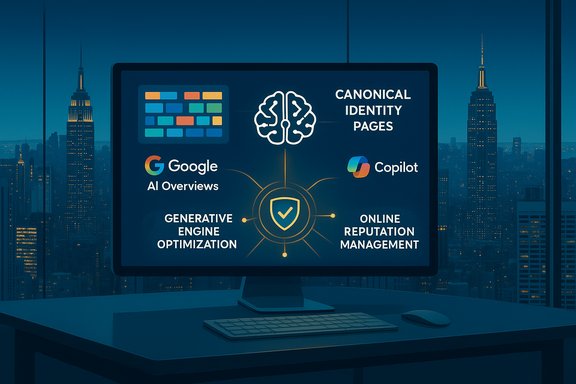
The release argues that “search no longer stops at the first page of Google,” noting that AI-generated answers now summarize, interpret and deliver information instantly — meaning brands must be machine‑readable as well as human‑readable. SEO Image positions its services as a bridge between legacy SEO practices and the technical hygiene required for generative engines: canonical identity pages, structured schema, and citation-ready content. The company also highlights continued leadership in reputation repair and proactive reputation management, areas where credibility in AI-generated responses can be particularly consequential.Verification: What the public record shows
A responsible readers’ checklist must separate verifiable facts from marketing language. Three concrete, verifiable points from public sources:- Headquarters and contact details: SEO Image lists offices in Manhattan and Long Island; the New York address at 535 5th Ave, 4th Fl is confirmed on the company website and in multiple agency directories.
- Company founding and experience claim: SEO Image’s marketing and third‑party profiles list a founding year around 2002, which aligns with the company’s “over 23 years” claim in the release (2002 → 2025 = 23 years). Independent agency directories also record a 2002 founding date.
- The press release distribution itself: the text is publicly available via EIN Presswire and was syndicated for amplification; the spokesperson quotes and positioning appear in that distributed copy.
Plausibility and context: Why GEO makes sense as a service offering
Generative engines increasingly synthesize answers from many sources and often surface short, summarised recommendations before a user ever clicks through to a website. Recent platform developments confirm this structural shift:- Google’s AI Overviews and conversational AI features have been widely expanded, altering how many queries are handled and how often AI summaries appear at the top of results. That trend increases the strategic importance of being cited within those generated responses.
- Search providers have adjusted the mechanics and sourcing policies for AI summaries over time, and research shows the overlap between organic top‑ranked pages and AI‑generated citations has changed in recent updates — underscoring that systems are evolving and that being visible to an AI assistant is not identical to traditional ranking.
Critical analysis: strengths of SEO Image’s positioning
- Longevity and practical SEO experience. The agency’s long track record (founded 2002 per public profiles) gives it institutional knowledge across multiple ranking regimes and platform evolutions. That historical perspective is valuable when advising clients on long-term reputation and discoverability strategies.
- Combination of ORM and AI SEO. Online reputation management and AI‑aware discoverability are complementary: if an AI assistant synthesizes answers with inaccurate or harmful content high in its signal set, the reputational consequences are magnified. An agency that combines ORM with GEO tactics can coordinate both content suppression/remediation and positive signal amplification.
- Practical, machine‑readable deliverables. Schema implementation, canonical identity pages, and verifiable press placements are technical outputs that materially help both crawlers and knowledge‑graph assemblers. These are not mere marketing buzzwords; they’re measurable outputs.
Critical analysis: where the press claims need caution
While SEO Image’s core services are technically plausible and useful, several elements of the press release should be read as marketing claims rather than independently verified statements.- “One of the earliest agencies to invest in Generative Engine Optimization” — this is difficult to prove objectively. Many agencies and platform vendors experimented with AI visibility tactics in 2022–2024; early‑mover status is often a positioning claim rather than a verifiable credential. Treat it as a branding claim unless the vendor can produce dated, reproducible evidence.
- “Best SEO and Generative SEO Company for 2026” — superlatives in press releases reflect marketing positioning. Independent rankings and awards should be shown to substantiate such labels; absent named awarding bodies, these claims should be understood as promotional.
- The risk of conflating observed assistant outputs with platform endorsement. Industry analyses from recent days have repeatedly warned that a transient assistant response or a promotional screenshot is not equivalent to a durable platform‑level certification or a formal "authority" designation from major AI providers. Independent reviewers advise requiring reproducible, timestamped logs or third‑party audits before treating such claims as fact. Those concerns surfaced strongly during analyses of similar announcements in December 2025 and are worth applying here as well.
Practical verification checklist for buyers and procurement teams
When a vendor claims AI visibility leadership or cross‑assistant recognition, prudent procurement teams should request and verify the following items:- Time‑stamped assistant outputs showing the query, full prompt, and rendered answer (preferably captured with console/API logs).
- Documentation of the indexing window or the query conditions under which the assistant produced the output.
- GA4 export or server log exports that corroborate traffic claims (if the claim references specific analytics figures).
- Third‑party traffic corroboration (SimilarWeb, Cloudflare Radar, or an independent auditor) where large audience numbers are cited.
- A clear labeling of syndicated press content versus earned editorial coverage (press release syndication is not the same as independent journalism).
- Legal and privacy attestations when the vendor plans to surface or canonicalize personal profiles and creator content.
Ethical and platform‑policy risks
- Signal manipulation vs. editorial trust. AEO/GEO strategies that rely on repeated syndicated placements, low‑quality backlinking, or automated content seeding can trigger platform countermeasures. Search and AI providers are actively tuning ingestion rules to detect manipulation, and examples of system adjustments are well documented. Ethical strategies emphasize provenance and quality; manipulative tactics risk removal or demotion.
- Transparency and provenance. As generative interfaces become a default discovery layer, provenance and traceability matter. If AI answers do not clearly label sources, users may treat marketing claims as neutral summaries. Buyers should favor vendors that prioritize provenance tagging, signed metadata, and clear attributions. Public policy movements — including calls for provenance standards and transparency frameworks — are accelerating in parallel with these technical changes.
- Creator economics and monetization claims. Vendors promising creator-first revenue models or “100% revenue retention” must provide transparent payout histories and contractual clarity. Without verifiable payout data, such claims remain promotional. Procurement must insist on case studies and verifiable payment records.
Tactical recommendations for IT leaders, communications teams, and Windows-focused practitioners
- Prioritize canonical identity and content hygiene: ensure organization and personnel pages are canonicalized, use stable URLs, and include robust schema.org markup. This low-cost work materially improves odds of correct inclusion in knowledge graphs and AI summaries.
- Combine reputation management with GEO tactics: reputation and discovery are now intertwined. A negative result that an assistant cites will amplify reputational harm; coordinate remediation and proactive content seeding.
- Capture auditable logs: if a vendor claims your brand shows up in ChatGPT, Copilot, or Google Overviews, require timestamped screenshots, API logs, and a reproducible test plan as part of the deliverables. This is how claims move from marketing copy into verifiable performance metrics.
- Test for durability: run periodic checks across multiple prompts and regional/locale variants. Assistant outputs can vary by prompt framing and recency windows; durable inclusion should be reproducible in multiple contexts.
- Monitor platform changes: Google and other vendors update how and when AI summaries trigger; allocate team time to track these product changes and adjust strategies accordingly. Recent platform-level changes have already altered citation dynamics for AI Overviews and will continue to do so.
What SEO Image should publish to increase credibility (and what buyers should ask for)
To make promotional claims auditable and reduce skepticism, a vendor should publish the following (redacted as needed for privacy and NDAs):- A reproducible test matrix showing specific queries and the exact assistant responses (with date/timestamp and full prompt context).
- A third‑party traffic corroboration report when citing GA4 figures or large audience metrics.
- Examples of earned editorial coverage (not just republished releases) with links to the original hosting domain.
- Clear case studies documenting creator payouts or monetization flows under contract terms.
- A short technical spec describing the schema and canonicalization work completed (what types were implemented, where, and how they map to knowledge graph entities).
Bottom line: measured optimism, careful procurement
SEO Image’s press release is a credible signal that a seasoned SEO and reputation agency is packaging GEO/AEO tactics for clients — and the vendor’s long history and existing ORM capabilities make that offering plausible. The technical levers described (structured data, canonical identity pages, targeted coverage) are genuine tools that increase the probability of accurate AI‑driven citations. At the same time, several of the press statements are promotional framing rather than independently verifiable facts. Buyers should insist on reproducible evidence, timestamped logs, and third‑party corroboration for audience or authority claims. The industry debates that followed similar announcements in December 2025 are instructive: observed assistant output is a signal, not the same as a platform certification. Procurement that treats assistant screenshots as proof risks paying for ephemeral or narrowly engineered visibility that may evaporate after a platform policy tweak.Final assessment and recommended next steps for readers
- If your organization is evaluating GEO or AEO vendors, start with technical hygiene: canonical pages, entity schema, and verifiable identity assets are high-impact, low-risk investments.
- Require auditable deliverables: timestamped assistant outputs, GA4 exports, or third‑party telemetry before paying for “AI recognition” claims.
- Treat press release superlatives as marketing copy unless accompanied by independent awards, third‑party audits, or named industry validators.
- Watch platform product changes closely: Google, Microsoft and other vendors are actively tuning AI Overviews and Copilot features; strategies that work today may need rapid adjustment tomorrow.
Source: The National Law Review SEO Image Positioned as an Authority in Generative Engine Optimization, Online Reputation Management & SEO Services
