

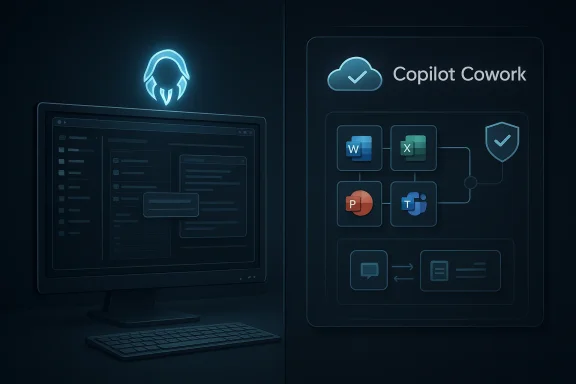
Genspark’s Workspace 4.0 is not just another AI feature drop; it is a direct challenge to the way Microsoft has spent years organizing productivity software. By pushing Claw for Desktop into the local machine and embedding AI agents inside Word, Excel, and PowerPoint, Genspark is trying to move from chatbot convenience to workflow control at the exact moment enterprise AI is becoming more agentic. Microsoft, meanwhile, is answering with its own step-up to Copilot Cowork, which is built to take real actions across Microsoft 365 and keep those actions inside its security and governance boundaries. ps://www.microsoft.com/en-us/microsoft-365/blog/2026/03/09/copilot-cowork-a-new-way-of-getting-work-done/))
The strategic fight here is bigger than two product launches. It is about who owns the primary work surface where people spend their day, and therefore who owns the most valuable context in AI. Microsoft’s latest Copilot messaging makes that case explicitly: the company says the next stage is not just answering questions or drafting emails, but “taking action” and turning intent into completed work across Microsoft 365. Genspark is making a remarkably similar argument, but with a different entry point: the desktop itself. (microsoft.com)
That matters because the AI market has moved rapidly from passive assistant experiences to active agentic workflows. Open the hood on either company’s story and the direction is the same: fewer handoffs, less app switching, more persistent context, and more background execution. Genspark says Workspace 4.0 is built around the idea that the AI emplver you are,” while Microsoft says Copilot Cowork grounds tasks in emails, meetings, messages, files, and data, then executes them in the background with checkpoints. (microsoft.com)
The timing is no accident. Microsoft has spent the last two years embedding Copilot deeper into Windows, Microsoft 365, Teams, and the broader enterprise stack, trying to make AI feel unavoidable in the tsthe opposite route: rather than being a feature inside a suite, it is trying to become the AI layer that sits on top of the suite, the browser, and the local desktop. That inversion is what makes the move strategically interesting.
There is also a broader industry pattern at work. The market is no longer impressed by isolated demos of text generation. Buyers want systems that can plan, execute, and return finished work. They also want enough governance, reliability, and auditability to trust those systems with real business output. Microsoft’s pitch is that it can deliver those controls at enterprise scale. Genspark’s pitch is that its native desktop and Office integration can eliminate friction faster than a suite vendor can. (microsoft.com)
The most important detail is that this is not merely a browser-based assistant with a new coat of paint. Genspark’s desktop client explicitly extends into the local machine, which is where serious work still happens for many users. The company frames Computer Use as a way to handle mechanical tasks like renaming files and extracting spreadsheet data, while Browser Use automates research, form filling, and page monitoring. Those capabilities are closer to a junior operator than a conversational helper. (genspark.ai)
Microsoft’s own response shows how quickly this category is converging. Copilot Cowork is designed to turn requests into plans, keep work progressing in the background, and let users approve recommended changes before they are applied. In other words, Microsoft is trying to make Copilot safe enough, governable enough, and persistent enough that it can act like an employee without becoming a liability. That is a very different packaging philosophy, but the end goal is converging fast. (microsoft.com)
That is why Genspark’s push deserves attention. By moving into the desktop, it is not just chasing convenience. It is chasing habit formation. If users leave the assistant open all day and begin trusting it to handle repeatable workflows, the product becomes sticky in a way that a chat tab rarely does.
At the same time, incumbency can slow the experience down. Genspark can move aggressively on integration and UX without carrying the burden of legacy architecture or backward compatibility. That creates an opening if the company can make the desktop experience feel fast, reliable, and genuinely helpful.
The opportunity is obvious. Repetitive work is still a huge tax on knowledge workers, and much of it is mechanical rather than intellectual. If the agent can reliably handle the low-value tasks, the user gets more time for judgment and review. That is the promise Genspark is selling.
But the risk is equally obvious. The more control an agent has over the desktop, the more damage it can do when it fails. Reliability is not optional here; it is the entire product. A tool that occasionally makes the right move but o, or overreaches will quickly lose trust.
This also positions the browser as more than a destination. It becomes an orchestration layer, a place where the AI can observe context and act on websites. That is strategically important because it turns the browser into a bridge between passive information retrieval and active task completion.
If Genspark can get that right, Claw for Desktop could become a meaningful wedge into productivity software. If it cannot, the product risks becoming a power user toy: exciting to watch, less exciting to trust with daily work. That is the difference between a showcase and infrastructure.
That is also why Microsoft has been emphasizing its own app-native approach. Copilot Cowork is designed to act inside Microsoft 365, grounded in Outlook, Teams, Excel, and related data, and it runs within Microsoft’s governance model. The competition is not about whether AI belongs in Office anymore. It is about whose AI feels more native, more trustworthy, and more useful. (microsoft.com)
The business implication is straightforward: whoever owns the in-app AI layer can shape how work gets done, not just assist with it. That creates enormous leverage over retention, monetization, and enterprise standardization. It also means the battle is shifting from model quality to workflow ownership.
Microsoft obviously understands this. Its own Copilot examples now include producing a briefing document, a deck, and supporting analysis from a single workflow, all saved back into Microsoft 365. That is exactly the kind of connected output Genspark wants to claim as well. ([microsoft.com](https://www.microsoft.com/en-us/mic.../09/copilot-cowork-a-new-way-of-getting-woint is about synthesis and persuasion.
Genspark’s challenge is to prove that convenience can coexist with safety. If it can, it may attract users who are frustrated by heavier corporate software. If it cannot, the company may still win attention without winning procurement. That distinction matters more than most startups admit.
Genspark is effectively arguing that the underlying execution layer can make the difference between a toy assistant and a practical one. That is a credible claim in principle. It is also the sort of claim that needs repeated proof in the field, because the market has become cynical about AI demos that overpromise and underdeliver.
But there is an unavoidable traorchestration often means more hidden complexity. If the system is too opaque, users may not know why something failed or where the agent got stuck. That can erode confidence even when the output is technically good.
If the execution layer holds up, Genspark can keep layering on more agentic experiences without rebuilding the stack from scratch. That gives it a plausible path to durability. If it does not, the whole story collapses into a familiar pattern: a promising interface searching for an engine strong enough to support it.
That advantage is difficult for a startup to replicate. Even a technically impressive desktop agent has to earn trust, install itself, and prove that it can work inside the messy realities of individual environments. Microsoft starts with a major head start in identity, admin tooling, and procurement familiarity.
Genspark can match some of the convenience, but it will have a harder time matching the governance story. That is where Microsoft can blunt the appeal of a more nimble competitor. In enterprise software, trust often beats novelty.
The strategic significance of funding is that it buys time to convert novelty into habit. If users are still experimenting when the next wave of products arrives, the company with more cash can keep improving until switching costs rise. That is how infrastructure plays defend themselves.
But capital also raises the bar. Once you have the money, users expect the product to behave like infrastructure, not an experiment. That means support, uptime, latency, and predictable behavior all become part of the brand. The balance sheet can enable the strategy, but it cannot substitute for the experience.
Still, speed is not the same as staying power. The enterprise market rewards the vendor that can keep the lights on, pass audits, and fit into existing admin models. That is where Microsoft’s deeper moat becomes visible. (microsoft.com)
That is bad news for products that rely on novelty alone. It is better news for companies that can build ecosystems around their AI layer. Microsoft obviously fits that description better than most. Genspark’s challenge is to become more than a feature competitor before the market starts treating these capabilities as table stakes.
The opportunity is especially strong if users are frustrated by app switching and by tools that feel like add-ons rather than partners. If Genspark can reduce friction while producing useful, finished work, it can convert curiosity into habit. That is the path to retention and, eventually, platform value.
There is also a strategic risk in competing directly with Microsoft on Microsoft’s home turf. Microsoft has more distribution, more procurement leverage, and a much stronger enterprise governance story. A startup can surprise an incumbent, but it usually cannot out-Microsoft Microsoft in the long run without an exceptional product gap. (microsoft.com)
Microsoft will be the key reference point throughout that process. Copilot Cowork already shows that Redmond intends to occupy the same territory, but with stronger controls and a much deeper enterprise footprint. That makes the market less about whether agentic AI will arrive and more about which vendor will own the trust relationship when it does. (microsoft.com)
Source: Bitget Genspark’s Desktop AI Agent Push Challenges Microsoft’s Copilot for Productivity Stack Dominance | Bitget News
 Background
The strategic fight here is bigger than two product launches. It is about who owns the primary work surface where people spend their day, and therefore who owns the most valuable context in AI. Microsoft’s latest Copilot messaging makes that case explicitly: the company says the next stage is not just answering questions or drafting emails, but “taking action” and turning intent into completed work across Microsoft 365. Genspark is making a remarkably similar argument, but with a different entry point: the desktop itself. (microsoft.com)That matters because the AI market has moved rapidly from passive assistant experiences to active agentic workflows. Open the hood on either company’s story and the direction is the same: fewer handoffs, less app switching, more persistent context, and more background execution. Genspark says Workspace 4.0 is built around the idea that the AI emplver you are,” while Microsoft says Copilot Cowork grounds tasks in emails, meetings, messages, files, and data, then executes them in the background with checkpoints. (microsoft.com)
The timing is no accident. Microsoft has spent the last two years embedding Copilot deeper into Windows, Microsoft 365, Teams, and the broader enterprise stack, trying to make AI feel unavoidable in the tsthe opposite route: rather than being a feature inside a suite, it is trying to become the AI layer that sits on top of the suite, the browser, and the local desktop. That inversion is what makes the move strategically interesting.
There is also a broader industry pattern at work. The market is no longer impressed by isolated demos of text generation. Buyers want systems that can plan, execute, and return finished work. They also want enough governance, reliability, and auditability to trust those systems with real business output. Microsoft’s pitch is that it can deliver those controls at enterprise scale. Genspark’s pitch is that its native desktop and Office integration can eliminate friction faster than a suite vendor can. (microsoft.com)
Overview
At a high level, Workspace 4.0 is Genspark’s attempt to make AI feel native rather than optional. The company says Claw for Desktop can see and operate files, applications, and the screen itself, while its Office plugins let AI work inside PowerPoint, Excel, and Word without forcing the user to leave the workflow. That is the essence of the product strategy: bring the agent to the work, not the work to the agent. (genspark.ai)The most important detail is that this is not merely a browser-based assistant with a new coat of paint. Genspark’s desktop client explicitly extends into the local machine, which is where serious work still happens for many users. The company frames Computer Use as a way to handle mechanical tasks like renaming files and extracting spreadsheet data, while Browser Use automates research, form filling, and page monitoring. Those capabilities are closer to a junior operator than a conversational helper. (genspark.ai)
Microsoft’s own response shows how quickly this category is converging. Copilot Cowork is designed to turn requests into plans, keep work progressing in the background, and let users approve recommended changes before they are applied. In other words, Microsoft is trying to make Copilot safe enough, governable enough, and persistent enough that it can act like an employee without becoming a liability. That is a very different packaging philosophy, but the end goal is converging fast. (microsoft.com)
Why desktop still matters
Desktop remains the most strategically important environment for AI because it is where documents, spreadsheets, meeting tools, local files, and businese. Browser-only AI tools can be useful, but they often stop short of true execution. A desktop-native agent can cross that boundary, which makes it more valuable—and more risky. (microsoft.com)That is why Genspark’s push deserves attention. By moving into the desktop, it is not just chasing convenience. It is chasing habit formation. If users leave the assistant open all day and begin trusting it to handle repeatable workflows, the product becomes sticky in a way that a chat tab rarely does.
Why Microsoft is the benchmark
Microsoft is the natural benchmark because it already owns the stack Genspark wants to penetrate. It controls Windows, Office, and a huge amount of enterprise identity, administration, and compliance infrastructure. That gives Copilot distribution and trust that startups simply cannot replicate quickly. (microsoft.com)At the same time, incumbency can slow the experience down. Genspark can move aggressively on integration and UX without carrying the burden of legacy architecture or backward compatibility. That creates an opening if the company can make the desktop experience feel fast, reliable, and genuinely helpful.
- Desktop-native AI is about control, not novelty.
- Office embedding reduces context switching.
- Agentic workflows increase session time and retention.
- Governance and reliability will decide enterprise adoption.
- The winner is likely to own the first stop for knowledge work.
Claw for Desktop
The most striking part of Genspark’s launch is the claim that Claw for Desktop can directly see and operate the local environment. That is a material step beyond conventional chat interfaces because it gives the agent access to the same surfaces a human uses: files, apps, windows, and screens. It can rename files, extract spreadsheet data, or move content around without requiring thuttle between windows. (genspark.ai)From assistant to operator
This matters because it changes the software’s job description. A normal assistant helps you think; a desktop agent helps you do. That distinction is subtle in marketing croduct design, because execution requires far more trust than suggestion. (genspark.ai)The opportunity is obvious. Repetitive work is still a huge tax on knowledge workers, and much of it is mechanical rather than intellectual. If the agent can reliably handle the low-value tasks, the user gets more time for judgment and review. That is the promise Genspark is selling.
But the risk is equally obvious. The more control an agent has over the desktop, the more damage it can do when it fails. Reliability is not optional here; it is the entire product. A tool that occasionally makes the right move but o, or overreaches will quickly lose trust.
The browser as action layer
Browser Use is the other half of the equation. Genspark says the agent can research a topic, fill out forms, monitor pages, and pull data from multiple sites while the user focuses on what the results mean. That is a classic agentic workflow: the machine handles the clicking, while the human handles the intent. (genspark.ai)This also positions the browser as more than a destination. It becomes an orchestration layer, a place where the AI can observe context and act on websites. That is strategically important because it turns the browser into a bridge between passive information retrieval and active task completion.
- Computer Use expands the scope of automation.
- Browser Use lowers the friction of research and form filling.
- Desktop access raises both capability and security stakes.
- Trust will depend on consistent first it feels like “tinkering,” mainstream users will hesitate.
Reliability versus power
The engineering challenge is not whether the system can do impressive things in demos. The real question is whether it can do boring things repeatedly without breaking flow. That is where many agent products stumble. They show flashes of brilliance, then collapse under edge cases, state drift, or brittle assumptions.If Genspark can get that right, Claw for Desktop could become a meaningful wedge into productivity software. If it cannot, the product risks becoming a power user toy: exciting to watch, less exciting to trust with daily work. That is the difference between a showcase and infrastructure.
Office Integration
Genspark’s Office plugins may be the most commercially dangerous part of the launch, precisely because they are so ordinary on the surface. By embedding AI agents directly into PowerPoint, Excel, and Word, the company is attacking the most valuable territory in workplace software: the place where people already spend their time. (genspark.ai)Inside the workflow, not beside it
The product logic is simple. Users should not have to leave Word to improve a document, leave Excel to analyze data, or leave PowerPoint to research and build a deck. Genspark says the AI comes to the user, not the other way around, which is a strong adoption argument because it minimizes context switching. (genspark.ai)That is also why Microsoft has been emphasizing its own app-native approach. Copilot Cowork is designed to act inside Microsoft 365, grounded in Outlook, Teams, Excel, and related data, and it runs within Microsoft’s governance model. The competition is not about whether AI belongs in Office anymore. It is about whose AI feels more native, more trustworthy, and more useful. (microsoft.com)
The business implication is straightforward: whoever owns the in-app AI layer can shape how work gets done, not just assist with it. That creates enormous leverage over retention, monetization, and enterprise standardization. It also means the battle is shifting from model quality to workflow ownership.
PowerPoint, Excel, and Word as battlegrounds
PowerPoint is where narrative becomes artifact, Excel is where analysis becomes decision-making, and Word is where the organization’s written memory is formalized. Embedding agents in all three gives Genspark a chance to sit at the center of the office workflow rather than at the edge of it. That is a clever and aggressive positioning move. (genspark.ai)Microsoft obviously understands this. Its own Copilot examples now include producing a briefing document, a deck, and supporting analysis from a single workflow, all saved back into Microsoft 365. That is exactly the kind of connected output Genspark wants to claim as well. ([microsoft.com](https://www.microsoft.com/en-us/mic.../09/copilot-cowork-a-new-way-of-getting-woint is about synthesis and persuasion.
- Excel is about structured analysis and decision support.
- Word is about context, editing, and organizational memory.
- Native plugins lower the activation energy for adoption.
- The first vendor to make in-app AI feel indispensable wins durable mindshare.
Consumer convenience versus enterprise control
For consumers and SMBs, embedded Office AI may simply feel convenient. For enterprises, the decision is more complicated because permissions, auditability, and security boundaries matter just as much as output quality. That is where Microsoft’s argument gets stronger, because its tooling is designed around the enterprise estate it already controls. (microsoft.com)Genspark’s challenge is to prove that convenience can coexist with safety. If it can, it may attract users who are frustrated by heavier corporate software. If it cannot, the company may still win attention without winning procurement. That distinction matters more than most startups admit.
OpenCode and Execution
If Claw is the face of the product, OpenCode is the engine underneath it. Genspark says its advanced workflows run on OpenCode, a faster execution engine that handles more complex, multi-step automation with better branching logic and fewer waits. That makes OpenCode the real moat candidate, not just the UI. (genspark.ai)Why the engine matters
Agent products live or die on orchestration. The user does not care whether the system is pretty if it cannot execute a sequence of tasks reliably. The engine has to manage state, branching, interruptions, and error recovery while still producing coherent results. That is harder than generating text and much closer to infrastructure.Genspark is effectively arguing that the underlying execution layer can make the difference between a toy assistant and a practical one. That is a credible claim in principle. It is also the sort of claim that needs repeated proof in the field, because the market has become cynical about AI demos that overpromise and underdeliver.
Reliability, latency, and branching logic
The company specifically says OpenCode handles edge cases and branching logic more reliably. That is a subtle but important claim, because real workflows rarely follow one straight line. They fork, fail, pause, and resume. If an agent can survive that complexity, it becomes much more useful. (genspark.ai)But there is an unavoidable traorchestration often means more hidden complexity. If the system is too opaque, users may not know why something failed or where the agent got stuck. That can erode confidence even when the output is technically good.
- Execution engines matter more than chat wrappers.
- Branching logic is essential for real workflows.
- Faster is useful only if it is also explainable.
- The more hidden the orchestration, the harder trust becomes.
- Reliability becomes the product’s clearest moat—or its biggest weakness.
A platform, not a feature
The long-term ambition is obvious: OpenCode is not meant to be a standalone function. It is meant to be the infrastructure layer that lets Genspark expand into more workflows over time. That is how products become platforms.If the execution layer holds up, Genspark can keep layering on more agentic experiences without rebuilding the stack from scratch. That gives it a plausible path to durability. If it does not, the whole story collapses into a familiar pattern: a promising interface searching for an engine strong enough to support it.
The Microsoft Cot is not standing still, and it would be a mistake to treat Genspark’s launch as if it lands in a vacuum. Microsoft has already been moving Copilot toward execution, not just assistance, and its March 2026 messaging makes the shift explicit. Copilot Cowork turns natural-language requests into background plans and actions, while keeping identity, permissions, and compliance in place by default. (microsoft.com)
Distribution is Microsoft’s superpower
The biggest structural advantage Microsoft has is distribution. It already lives in Windows, Office, Teams, and a wide range of enterprise environments. That means Copilot does not need to win users from scratch; it can attach to systems they already depend on. (microsoft.com)That advantage is difficult for a startup to replicate. Even a technically impressive desktop agent has to earn trust, install itself, and prove that it can work inside the messy realities of individual environments. Microsoft starts with a major head start in identity, admin tooling, and procurement familiarity.
The governance argument
Microsoft’s Copilot pitch emphasizes that actions are auditable and run within a sandboxed cloud environment. That is not just a compliance talking point; it is a sales weapon. Enterprises are increasingly willing to pay for AI that can act, but they want to know where the actions happen and who can rt.com](Copilot Cowork: A new way of getting work done | Microsoft 365 Blog))Genspark can match some of the convenience, but it will have a harder time matching the governance story. That is where Microsoft can blunt the appeal of a more nimble competitor. In enterprise software, trust often beats novelty.
- Microsoft owns the default workplace stack.
- Copilot is becoming mor time Genspark is.
- Governance is an enterprise purchase criterion, not a footnote.
- Distribution and trust are as important as model quality.
- The more sensitive the workflow, the more Microsoft benefits.
Copilot as a moving target
The most important nuance is that Microsoft’s product is also evolving quickly, which means Genspark is chasing a movindifferentiated today may feel ordinary six months from now if Microsoft continues to expand Copilot’s execution capabilities. That creates a race condition in the market. ([microsoft.com](Copilot Cowork: A new way of getting work done | Microsoft 365 Blog- terms, Genspark’s window may be narrow. It needs to show users something meaningfully better before Microsoft closes the gap further. If it does, it may carve out a niche. If not, it risks being framed as an interesting alternative to the dominant platform rather than a true challenger.Financial Fuel
Genspark’s strategic bet would be much harder to sustain without money, and the company appears to have it. The source material says Genspark reached strong revenue growth in 2025 and later closed a sizeable Series B extension, which gives it the capital to keep scaling cloud infrastructure and product development. That matters because agensive to build and expensive to run.Capital as a competitive weapon
In AI, money is not just runway; it is product velocity. More capital means more infrastructure, more engineering, more model orchestration, and more room to iterate before the market catches up. That is especially true for a company trying to build a desktop client, Office plugins, and background workflows all at once.The strategic significance of funding is that it buys time to convert novelty into habit. If users are still experimenting when the next wave of products arrives, the company with more cash can keep improving until switching costs rise. That is how infrastructure plays defend themselves.
Why investors care
Investors are not just betting on Genspark’s product; they are betting on the broader shift from chat to action. If the AI employee concept becomes sticky, the company could own a slice of the workflow layer that is more durable than a simple chatbot subscription. That is the prize.But capital also raises the bar. Once you have the money, users expect the product to behave like infrastructure, not an experiment. That means support, uptime, latency, and predictable behavior all become part of the brand. The balance sheet can enable the strategy, but it cannot substitute for the experience.
Competitive Implications
Genspark’s push is best understood as a contest over the primary work context. The company is trying to move from the edge of the workflow to the center of it, and that is precisely where Microsoft has long held structural advantage. If Genspark can make desktop and Office agents feel simpler and more nimble than Copilot, it may win attention from users who are tired of enterprise friction. (genspark.ai)Microsoft versus startup speed
Microsoft’s size is both advantage and burdAI broadly, but it must also protect compatibility, governance, and legacy expectations. Genspark can move faster, ship more aggressively, and tailor the experience around a single vision. That can be a serious advantage in the early innings of a platform shift.Still, speed is not the same as staying power. The enterprise market rewards the vendor that can keep the lights on, pass audits, and fit into existing admin models. That is where Microsoft’s deeper moat becomes visible. (microsoft.com)
The risk of commoditization
There is a second competitive risk for everyone in this category: if desktop agents become standardized, the differentiation may compress quickly. Features like file handling, browser use, and Office integration are powerful, but they are also conceptually easy to copy. That means the moat may end up living in execution quality, data integration, and trust rather than the feature list itself.That is bad news for products that rely on novelty alone. It is better news for companies that can build ecosystems around their AI layer. Microsoft obviously fits that description better than most. Genspark’s challenge is to become more than a feature competitor before the market starts treating these capabilities as table stakes.
- Short-term differentiation can be real even if it is not permanent.
- Desktop access raises the stakes for reliability and security.
- Office integration turns productivity apps into strategic terrain.
- Execution quality is the likely moat, not the UI itself.
- Incumbents can copy features; they cannot instantly copy trust.
Strengths and Opportunities
Genspark has a clean strategic story, and that is often the hardest part to get right in AI. It is selling a simple promise: the AI employee should work where the user works, whether that is the desktop, Office, meetings, or background workflows. That clarity gives the company a real chance to stand out in a market full of fragmented assistants and half-integrated tools. (genspark.ai)The opportunity is especially strong if users are frustrated by app switching and by tools that feel like add-ons rather than partners. If Genspark can reduce friction while producing useful, finished work, it can convert curiosity into habit. That is the path to retention and, eventually, platform value.
- Native desktop integration can make AI feel embedded rather than bolted on.
- Office plugins attack the center of knowledge work.
- Background workflows can increase task completion and session depth.
- OpenCode may provide a defensible execution layer.
- Clear product positioning helps users understand the value fast.
- Capital backing gives the company time to iterate.
- Agentic AI adoption is still early enough for a newcomer to matter.
Risks and Concerns
The biggest risk is that Genspark overestimates how much users will tolerate complexity in exchange for power. Desktop and Office integrations are valuable, but they also create more failure modes, more security concerns, and more room for UX friction. If the product feels brittle, it will quickly lose the trust it needs to become a daily habit. (genspark.ai)There is also a strategic risk in competing directly with Microsoft on Microsoft’s home turf. Microsoft has more distribution, more procurement leverage, and a much stronger enterprise governance story. A startup can surprise an incumbent, but it usually cannot out-Microsoft Microsoft in the long run without an exceptional product gap. (microsoft.com)
- Security exposure rises when an agent can operate the local machine.
- Reliability failures can destroy trust faster than they build it.
- Enterprise governance gaps may limit large-scale adoption.
- Performance overhead could make the desktop client feel intrusive.
- Feature commoditization may erode differentiation over time.
- Microsoft’s response could narrow the product advantage quickly.
- User confusion may grow if the product spans too many surfaces too fast.
Looking Ahead
The next phase of this story will hinge on whether Genspark can prove that “AI everywhere” is more than a slogan. The company needs users to feel that the desktop client, Office plugins, and workflow engine work together as one coherent system rather than as a bundle of separate experiments. If it can do that, it may carve out a real place in the productivity stack. (genspark.ai)Microsoft will be the key reference point throughout that process. Copilot Cowork already shows that Redmond intends to occupy the same territory, but with stronger controls and a much deeper enterprise footprint. That makes the market less about whether agentic AI will arrive and more about which vendor will own the trust relationship when it does. (microsoft.com)
What to watch next
- Adoption of Genspark Claw for Desktop among power users and teams.
- Whether the Office plugins become daily workflow tools or occasional demos.
- Evidence that OpenCode improves reliability on real multi-step tasks.
- Microsoft’s next Copilot response inside Windows and Microsoft 365.
- Enterprise feedback on governance, security, and auditability.
- Whether users begin treating Genspark as a primary workspace or a sidecar utility.
Source: Bitget Genspark’s Desktop AI Agent Push Challenges Microsoft’s Copilot for Productivity Stack Dominance | Bitget News
