

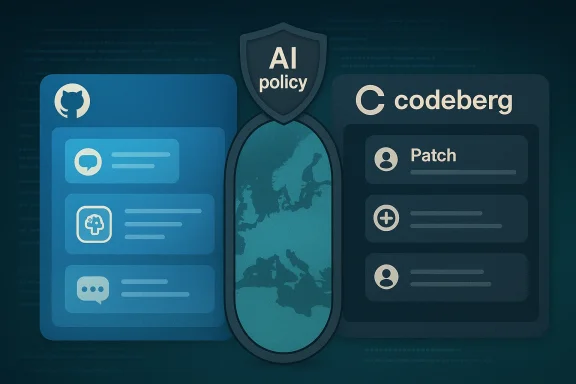
Gentoo has quietly begun the long, deliberate task of pulling its contributor-facing mirrors off GitHub and onto Codeberg, a move the distribution frames as a practical workaround for an ethical and operational problem: GitHub’s increasingly aggressive push of Copilot-style AI features into maintainer workflows and the wider community fallout from AI-generated contributions.
Gentoo’s action is not a wholesale flight from GitHub overnight. The project explicitly describes the Codeberg presence as a mirror and an alternative contribution channel; Gentoo will continue to host its canonical git, bug tracker, and infrastructure under project control while offering Codeberg as a place where contributors can file pull requests and submit patches without interacting with GitHub’s AI tooling. This is a staged, pragmatic migration rather than a hard cut.
Key practical points for contributors right now:
That policy matters for two reasons. First, it establishes a baseline of trust and responsibility in contributions: when maintainers review a patch, they rely on human authorship and accountability. Second, the policy runs up against corporate product features that make avoiding AI tooling on-host difficult—precisely Gentoo’s complaint about Copilot-style prompts and automated reviews appearing in or around their GitHub mirrors.
Experienced maintainers and community leaders have amplified these concerns. Jeff Geerling, who manages hundreds of projects, described AI-generated contributions as easier to produce but not getting meaningfully smarter—arguing that the human review overhead has increased while the quality improvements have stalled. His widely read blog post catalogues real examples and frames the problem as both operational and cultural for open source.
GitHub has also discussed other, less extreme options: improved triage tools, bot‑assisted filtering that flags likely AI‑generated contributions, and enhanced transparency mechanisms to surface when a PR or review used an AI tool. The debate on GitHub and in the wider community is whether disclosure or tooling will be enough to preserve the open‑source social compact that depends on accountability, reputation, and meaningful human interaction.
Whether this approach scales—either technically across many projects or culturally within the wider open source community—remains uncertain. The path ahead will test small forges’ capacity, GitHub’s responsiveness to maintainers’ needs, and the community’s appetite for rebalancing convenience against sovereignty. For now, Gentoo’s migration is a clear, deliberate statement: maintainers value provenance and trust over platform convenience, and they are willing to bear the migration costs to defend it.
Source: theregister.com Gentoo dumps GitHub over Copilot nagware
 Background
What changed—and why it matters
For decades, GitHub has been the default hub for open source collaboration. That centrality makes any decision to abandon it a big deal; projects that move away do so not for light reasons. Gentoo’s decision is rooted in two linked developments: first, the project’s formal 2024 policy forbidding contributions created with Natural Language Processing (NLP) AI tools; and second, a rising tide of low‑quality, often AI-produced pull requests and automated reviews that are increasing the maintenance burden on volunteer maintainers.Gentoo’s action is not a wholesale flight from GitHub overnight. The project explicitly describes the Codeberg presence as a mirror and an alternative contribution channel; Gentoo will continue to host its canonical git, bug tracker, and infrastructure under project control while offering Codeberg as a place where contributors can file pull requests and submit patches without interacting with GitHub’s AI tooling. This is a staged, pragmatic migration rather than a hard cut.
The Codeberg/Forgejo alternative
Codeberg is a European, non‑profit hosting service built on Forgejo (a fork of Gitea). It emphasizes community governance, privacy, and modest resource policies compared with large corporate platforms; projects such as Zig have already moved their canonical workflows there in recent months. For projects wary of corporate-driven feature pushes—particularly where those pushes have side effects such as training models on public repo data—Codeberg presents a philosophically aligned home.The announcement, and the immediate facts
What Gentoo has done so far
On February 16 Gentoo posted that it now has a presence on Codeberg and that contributions could be submitted to a Codeberg mirror of the gentoo repository; the team said additional repositories would become available in time. Community threads and the gentoo-dev mailing list show contributors and council members discussing the migration logistics and clarifying that the move is currently mirror‑centric—the official canonical infrastructure remains under Gentoo control.Key practical points for contributors right now:
- Codeberg hostings are mirrors intended for convenience when submitting changes.
- Gentoo’s primary git and curated infrastructure remain the authoritative source.
- For now, Portage sync (the daily emerge --sync flow used by Gentoo users) remains unchanged; the Codeberg mirrors are not yet being treated as sync sources for end users.
How this fits into a broader trend
Gentoo is not unique in exploring alternatives to GitHub. Other notable projects have tested or completed migrations to Codeberg or Forgejo instances in the last 12–18 months, frequently citing concerns about platform governance and the direction of product features tied to corporate priorities. The Gentoo move adds weight to a growing chorus of maintainers and projects reevaluating where their work should live.The rationale: Copilot, data use, and the maintainers’ burden
Gentoo’s explicit policy
Gentoo’s 2024 AI policy is unusually blunt for an open source project: the Gentoo Council unanimously approved a motion stating “It is expressly forbidden to contribute to Gentoo any content that has been created with the assistance of Natural Language Processing artificial intelligence tools.” The council cited three categories of concern: copyright exposure from model training, the quality risk of plausibly‑wrong content generated by LLMs, and broader ethical issues around ecosystem impacts. Gentoo’s ban covers both code and documentation submitted to project repositories and the wiki.That policy matters for two reasons. First, it establishes a baseline of trust and responsibility in contributions: when maintainers review a patch, they rely on human authorship and accountability. Second, the policy runs up against corporate product features that make avoiding AI tooling on-host difficult—precisely Gentoo’s complaint about Copilot-style prompts and automated reviews appearing in or around their GitHub mirrors.
The “AI slop” phenomenon
The phrase “AI slop” has become shorthand in many reports: it refers to a rising volume of pull requests, issue reports, bug triage entries, and automated review comments that were generated by AI agents or mass-produced with LLM prompts. These contributions frequently fail to follow project conventions, repeat existing issues, or present superficially plausible but incorrect code—requiring maintainers to invest time reviewing, rebutting, or rejecting them. GitHub product teams have publicly acknowledged the problem and opened a maintainer community discussion about possible mitigations, including restricting or disabling pull requests for repositories.Experienced maintainers and community leaders have amplified these concerns. Jeff Geerling, who manages hundreds of projects, described AI-generated contributions as easier to produce but not getting meaningfully smarter—arguing that the human review overhead has increased while the quality improvements have stalled. His widely read blog post catalogues real examples and frames the problem as both operational and cultural for open source.
The platform angle: GitHub’s response and product changes
GitHub’s short-term toolbox
GitHub has been actively engaging maintainers to identify both immediate and long‑term responses. Tactical product features—such as the ability to disable Pull Requests entirely for a repository or to restrict PR creation to collaborators—are now documented and available as blunt instruments that maintainers can wield to stem the tide. Those options are intended as emergency brakes, not long‑term solutions, because turning off PRs fundamentally alters how public collaboration works.GitHub has also discussed other, less extreme options: improved triage tools, bot‑assisted filtering that flags likely AI‑generated contributions, and enhanced transparency mechanisms to surface when a PR or review used an AI tool. The debate on GitHub and in the wider community is whether disclosure or tooling will be enough to preserve the open‑source social compact that depends on accountability, reputation, and meaningful human interaction.
The product paradox
There’s an uncomfortable paradox here: GitHub long ago helped popularize AI coding via Copilot, which lowered barriers and increased productivity for many developers. Now, GitHub is grappling with the downstream effects of that same technology flooding the network with low‑value noise. For maintainers of projects with strict quality and licensing requirements—such as Gentoo—the net effect is a platform mismatch: the default experience increasingly includes AI artifacts that Gentoo’s policy explicitly forbids. That tension is the proximate cause for Gentoo’s Codeberg migration.What Codeberg brings to the table (and its limits)
Strengths: governance, privacy, and alignment
Codeberg’s pitch is simplicity: a non‑profit governance model, European data protection norms, and an infrastructure run more like a community service than a profit-driven platform. For projects that prioritize control over contribution channels and want to avoid platform‑level imposition of AI features, that model is attractive. It also has practical benefits: account flows, PR mechanisms, and issue tracking are familiar enough that many contributors can adapt quickly.- Community governance reduces the chance of unilateral feature pushes that alter contributor experience.
- European hosting and non‑profit status provide stronger privacy assurances and different incentives than a large, ad‑or revenue‑driven company.
- Forgejo/Gitea roots mean developers can expect light, Git‑native workflows without heavyweight vendor lock‑in.
Limits and operational tradeoffs
Codeberg is not a drop‑in replacement for GitHub at scale. The platform relies on community funding and volunteer effort; large, bandwidth‑heavy mirrors (like Gentoo’s full sync mirror) are specifically noted by Gentoo maintainers as something they will not offload to Codeberg so as not to abuse community resources. That means Codeberg is treated as a contribution surface rather than the location of canonical archives or user sync backends. Contributors and tooling integrations will need adjustments: CI, release automation, and third‑party integrations will require engineering work to port or rewire.Practical implications for contributors, downstream users, and maintainers
For contributors
If you plan to submit patches to Gentoo:- Understand that Codeberg is now an alternative place to file PRs; GitHub mirrors may still exist but are not the only path.
- Preserve Gentoo’s contribution rules—especially the ban on AI‑assisted content—because Gentoo will hold contributors accountable regardless of platform.
- Expect to update local git remotes if you prefer to submit via Codeberg and to create a Codeberg account for PRs.
For maintainers
Maintain the same verification and trust practices Gentoo has always favoured: cryptographic signing, careful review, and a preference for human‑authored changes. Consider the following mitigations:- Use repository settings to restrict PR creation to trusted contributors for maintenance‑critical repos.
- Adopt clear contribution templates that set expectations (including AI disclosure and provenance requirements).
- Leverage automated checks that validate style, security, and basic functionality before human reviewers spend time.
For the wider open source ecosystem
Gentoo’s move is a signal: when platform features materially interfere with a project’s values or workflow, projects will either accept the change or find alternatives. A wider migration wave would accelerate development of Forgejo/Codeberg‑compatible tooling, but it would also fragment where issues, PRs, and community history are hosted—raising discovery, onboarding, and archival questions. The debate now is not only technical but cultural: how does open source sustain the norms of authorship and accountability in an age of generative tooling?Risks and secondary effects
Fragmentation and discoverability
A move away from a single dominant hosting site fragments contributor pathways. Newcomers—especially those who learned to file issues and PRs on GitHub—may be slowed by new account creation steps or differing interfaces. Fork/patch workflows will remain possible, but the social momentum of a single hub is difficult to replicate quickly. This is a short‑to‑medium term cost of principled migration.Resource pressure on smaller forges
If many major projects begin using Codeberg or other small forges as canonical hosts, those services could face capacity and funding pressure. Gentoo’s maintainers have already signalled they will avoid overburdening the Codeberg instance with the full sync mirror; other projects will need similar discipline to prevent platform strain.Potential for arms‑race responses
GitHub’s engineering teams are already exploring product responses—triage automation, AI‑disclosure tooling, and access controls. Those product changes could either reconcile maintainer concerns (if implemented with meaningful control and transparency) or deepen platform tension (if the features remain coercive or poorly opt‑outable). The next several months will show whether GitHub and large project communities find workable compromises.Critical analysis: is Gentoo’s choice defensible—and replicable?
Strengths of the decision
Gentoo’s move is defensible on principle and practice. The project’s AI policy is clear and intentionally strict; GitHub’s new defaults and Copilot tie‑ins have encroached on Gentoo’s ability to enforce that policy operationally on a corporate platform. By offering Codeberg as a contributor‑facing alternative, Gentoo reduces exposure to automated reviews and AI prompts while retaining their canonical infrastructure and cryptographic verification model. That hybrid approach minimizes risk while signaling a firm position.Points of caution
- The migration is not cost‑free: tooling, CI, contributor onboarding, and external integrations will need work.
- Fragmentation could make the project harder to navigate for new contributors.
- This strategy depends on Codeberg and Forgejo’s continued stability, funding, and willingness to scale responsibly.
Will others follow?
Some projects have already moved or mirrored to Codeberg; others will watch closely. Projects with strict legal, ethical, or quality constraints (embedded systems, safety‑critical code, or projects with strong licensing constraints) will be particularly attentive. But for many repositories—especially those that benefit from GitHub’s ecosystem of CI, package registries, and discoverability—the calculus will weigh more heavily toward remaining on GitHub unless and until GitHub offers stronger, non‑coercive opt‑out and transparent model‑use guarantees.Practical checklist for projects considering migration
- Inventory: catalog which repos are canonical, which are mirrors, and which are contributor-facing.
- Policy alignment: ensure contribution policies (including AI usage rules) are documented and enforceable.
- Infrastructure mapping: list CI, release pipelines, package registries, badges, and integrations that must be migrated or rewired.
- Community communication: publish clear migration timelines and contributor how‑tos to avoid confusion.
- Funding and capacity: verify the alternative host can handle expected load or agree on resource limits to avoid overuse.
Conclusion
Gentoo’s move to open Codeberg mirrors is a pragmatic, principle‑driven reaction to a specific and growing friction: the collision of a strict anti‑AI contribution policy with a dominant hosting platform that is increasingly oriented around AI features. The migration is a symptom of a larger architectural and cultural crossroads in open source: do communities accept feature sets imposed by centralized platforms, or do they rebuild a federated, community‑governed ecosystem that preserves maintainer authority and contributor accountability? Gentoo’s answer is to experiment with the latter while keeping its core infra under its direct control.Whether this approach scales—either technically across many projects or culturally within the wider open source community—remains uncertain. The path ahead will test small forges’ capacity, GitHub’s responsiveness to maintainers’ needs, and the community’s appetite for rebalancing convenience against sovereignty. For now, Gentoo’s migration is a clear, deliberate statement: maintainers value provenance and trust over platform convenience, and they are willing to bear the migration costs to defend it.
Source: theregister.com Gentoo dumps GitHub over Copilot nagware
