

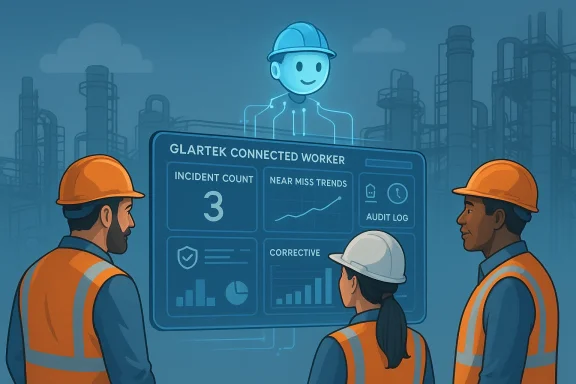
Glartek’s new AI agent, Gil, arrives as a tightly packaged promise: bring frontline safety intelligence out of siloed EHS systems and into the same Copilot-driven workflow where managers, engineers, and contractors already work. Announced on January 31, 2026, Gil is presented as an “AI EHS agent” embedded in Glartek’s Connected Worker platform and integrated into the Microsoft Copilot ecosystem — a two-way interface that both feeds real‑time safety data into Copilot and accepts commands from Copilot to create actions, report incidents, set alerts, and automate workflows. For EHS leaders and IT teams wrestling with operational risk, workforce adoption, and the promise of agentic automation, Gil crystallizes an important question: can an agentic Copilot experience materially improve workplace safety without creating new governance and security exposures?
Glartek has positioned itself as a VC‑backed EHS Connected Worker vendor founded in 2017, with a product portfolio focused on frontline safety, quality and learning workflows for asset‑intensive industries. The company’s message around Gil is straightforward: give frontline workers and managers a natural language, voice or chat interface to ask safety questions, create or close corrective actions, and generate reports — all without leaving Copilot or switching apps.
Potential benefits:
Cautions: default severity assignments must be conservative and human-approved for regulatory reporting.
Cautions: avoid gamification that encourages underreporting; maintain transparent metrics and integrity checks.
Cautions: ensure contractors cannot modify authoritative documents and track access provenance for compliance.
For IT and EHS leaders, the right approach is pragmatic and staged: validate platform controls, pilot with conservative permissions, require human‑in‑the‑loop for safety‑critical actions, and measure outcomes against clear safety and compliance KPIs. If those conditions are met, agents like Gil can be a powerful instrument in the toolbox — enabling faster decisions, higher reporting fidelity, and a safer work environment where frontline workers and managers use natural language to make safety visible and actionable.
Source: lelezard.com Glartek Unveils the World's First AI EHS Agent, Gil, Integrated in the Microsoft Copilot Ecosystem
 Background
Why this matters now
The last two years have seen enterprise software shift from standalone analytics and mobile checklists toward agentic, conversational assistants that can act on behalf of workers and orchestrate multi-step processes. Microsoft has explicitly built Copilot to host and manage agents, with governance features and production readiness tooling aimed at making third‑party agents first‑class citizens inside the Copilot ecosystem. That platform-level trend makes it practical for domain specialists — in this case, Environment, Health & Safety (EHS) software vendors — to publish domain-specific agents that surface grounded, tenant-scoped operational data inside everyday productivity flows.Glartek has positioned itself as a VC‑backed EHS Connected Worker vendor founded in 2017, with a product portfolio focused on frontline safety, quality and learning workflows for asset‑intensive industries. The company’s message around Gil is straightforward: give frontline workers and managers a natural language, voice or chat interface to ask safety questions, create or close corrective actions, and generate reports — all without leaving Copilot or switching apps.
What Glartek says Gil does (summary)
- Extracts real‑time safety and operational data from Glartek’s EHS Connected Worker platform and surfaces it inside the Microsoft Copilot experience.
- Converts that data into structured artifacts — charts, trend reports, metrics — and allows other Copilot agents to act on it.
- Provides a two‑way interface: users can ask Gil for information or instruct Gil (via chat or voice) to create actions, report incidents, set alerts, or trigger automation.
- Delegates routine notifications and semi‑autonomous tasks (for example, sending congratulatory messages to teams when KPIs improve).
- Is available to subcontractors and frontline personnel, aiming to speed response times and reduce friction in reporting safety issues.
Overview of the integration: how Gil fits into the Copilot ecosystem
The platform context: Copilot, agents and governance
Microsoft’s Copilot ecosystem has evolved into an agent platform that supports:- Tenant‑grounded agents and a control plane for agent lifecycle management.
- Copilot Studio and runtime tooling for authoring, publishing and managing agents.
- Governance primitives — identity, policy and observability — intended to make agents auditable and controllable at enterprise scale.
- Authenticate as a tenant‑scoped principal (so actions are attributable).
- Respect role‑based access and data sensitivity labels.
- Provide traceable logs and audit trails for regulatory and compliance reviews.
Technical mechanics (high level)
- Data grounding: Gil surfaces Glartek platform data in Copilot so retrieval‑augmented answers and structured artifacts are anchored in current, tenant‑owned records (incidents, corrective actions, metrics).
- Two‑way commands: Using Copilot’s agent invocation model, Gil can accept natural language or voice commands to create records in the Glartek backend.
- Automation & delegation: Gil can be delegated automation tasks — e.g., notification sequences, escalations or KPI announcements — although the vendor emphasizes configurable automation rather than uncontrolled autonomy.
- Interoperability: Because Copilot supports multiple agents and connectors, Gil’s outputs can be handed off to other agents (for example, reporting into a corporate analytics agent or running follow-up scheduling flows).
What Gil promises for EHS operations
Real-time visibility and faster analysis
One of Gil’s core promises is to collapse the latency between frontline events and organizational insight. Instead of pulling reports from an EHS dashboard, managers can ask Copilot for up-to-the-minute incident frequency, overdue corrective actions, near‑miss trends, or site‑specific safety KPIs — and immediately get charts or documents created inside Copilot.Potential benefits:
- Shorter analysis loops: rapid triage of incidents and near misses.
- Democratized access: managers and contractors get answers without training on a separate EHS UI.
- Cross‑agent workflows: Gil’s structured outputs can feed analytics agents or compliance reporting agents inside Copilot.
Frontline usability: chat and voice
Glartek emphasizes chat and voice for frontline accessibility. That matters in noisy industrial settings and for subcontractors who may not have desktop access. The ability to report incidents or request procedures using voice or chat from a mobile device reduces friction and can improve reporting completeness.Automation and routine actions
Gil supports delegated automation (for example, auto‑notifying teams when KPIs improve). When configured carefully, these automations can reduce manual messaging and accelerate recognition loops in safety programs.Extending to subcontractors
The vendor points out that Gil is available to subcontractors, enabling them to request procedural guidance or report incidents without separate logins into EHS portals. This could increase compliance and capture of critical safety events across complex supply chains — if access and governance are properly implemented.Strengths and opportunities
- Bold move to meet users where they work: embedding EHS workflows into Copilot reduces app switching and aligns safety with daily productivity flows, increasing the chance that workers and managers will use the system when it matters.
- Real‑time grounding mitigates “stale data” problems common in EHS programs. If Gil truly pulls live records and metrics, organizations can move from lagging indicators to near-real‑time operational insight.
- Voice and chat accessibility are genuinely useful for frontline workers and contractors who lack PC access but need to record events or retrieve procedures on the go.
- Platform interoperability: by integrating into the Copilot ecosystem, Gil can feed and be fed by other tenant agents, fostering composite workflows (for example, connecting safety incidents to maintenance scheduling agents).
- Enterprise controls are in place at the platform level (agent identities, admin controls) to support compliance and auditability — provided tenants adopt those controls.
Risks, caveats, and what to watch for
No new capability arrives without tradeoffs. Below are the principal risks and practical mitigations EHS, IT, and compliance teams should consider.1) Marketing claims vs. verifiable facts
Glartek describes Gil as the “world’s first AI EHS agent fully integrated in the Microsoft Copilot ecosystem.” That formulation is a vendor positioning statement and should be treated as such. Independent validation of “world’s first” claims is inherently difficult because definitions vary (what counts as “fully integrated,” which Copilot surfaces are included, whether other EHS vendors have published agents privately, etc.). Treat the claim as marketing unless you can verify comparative launches from competitors or Microsoft records.2) Data governance and exposure risks
Giving an agent both read and write access to EHS systems increases the attack surface and the potential for accidental or malicious exposure.- Mitigations: use tenant-level governance features; assign least-privilege permissions via tenant identity (agent IDs), apply sensitivity labels and Purview-style controls to EHS records, and enforce admin approval workflows for agent actions that create or change high-impact records.
3) Auditability and non-repudiation
When Gil creates or modifies records from a conversational command, it must be crystal‑clear who initiated the action (user vs. agent), what the agent did, and why. This matters for incident investigations and regulatory reporting.- Mitigations: require Entra-based agent identities tied to tenant principals, preserve full audit logs, and ensure that human approvals are required for actions with regulatory implications.
4) Hallucination and grounding failure
Conversational agents can hallucinate or produce plausible‑sounding but incorrect outputs. In an EHS context, an incorrect safety procedure or missing critical control could have safety consequences.- Mitigations: require the agent to cite source records or present the original document when recommending procedures; restrict the agent’s knowledge sources to curated, validated repositories for safety-critical content; implement human-in-the-loop gates for high-risk recommendations.
5) Contractual and subcontractor access
Allowing subcontractors to access Gil simplifies cooperation but raises identity, credentialing and liability questions. Who is responsible for an incorrectly filed incident by a subcontractor? How is data residency handled for third parties?- Mitigations: set granular tenant policies for contractor roles, time‑bound access tokens, and explicit audit trails that include subcontractor identity and authorization context.
6) Operationalizing automation
Automations — especially those that trigger notifications or corrective actions — must be treated as production services. Poorly scoped automations can trigger alert fatigue or unwanted escalations.- Mitigations: pilot automations in controlled scopes, maintain easy manual override capabilities, and instrument metrics to measure false positives, response times, and behavioral impact.
7) Change management and frontline adoption
Even with a smooth UX, successful adoption depends on training, cultural integration, and the perceived reliability of the agent.- Mitigations: complement agent rollout with targeted training, on-shift champions, and short feedback cycles to fix UX or fidelity problems rapidly.
Governance checklist for IT and EHS leaders (practical steps)
- Inventory data flows and determine what records Gil will read and write.
- Map access controls to Entra user roles and agent identities; apply least privilege.
- Create a policy for human review thresholds — require human approval for any action that impacts incident classification, regulatory reporting, or permit-to-work status.
- Configure audit logging and retention for agent‑initiated actions; ensure logs are tamper‑evident and accessible for internal audits.
- Define onboarding and offboarding procedures for subcontractor access with short‑lived credentials and mandatory training.
- Implement a phased pilot (site → region → enterprise) that measures adoption, incident reporting completeness, and any unintended side effects.
- Maintain a runbook for incident response to erroneous agent actions, including rollback procedures and communication templates.
- Test the agent’s grounding rigor by running knowledge‑consistency exercises: ask Gil identical safety questions across roles and compare answers to authoritative procedures.
Deployment patterns and real-world workflows
Example 1 — Rapid incident triage
- A frontline technician reports a near miss via voice to Gil at a job site.
- Gil captures the incident details, assigns a preliminary severity tag, and creates an incident record in the Glartek backend.
- Copilot generates a summary report (with charts and immediate corrective action items) and notifies the site manager.
- The manager reviews, approves any immediate corrective actions, and delegates follow-up tasks — all from Copilot.
Cautions: default severity assignments must be conservative and human-approved for regulatory reporting.
Example 2 — KPI-driven recognition and learning
- Gil monitors safety KPIs (e.g., reduced incident frequency) and, upon threshold achievement, triggers congratulatory messages and pushes micro‑learning assignments to teams.
- Automated rewards or recognition flows can be used to reinforce safe behaviors.
Cautions: avoid gamification that encourages underreporting; maintain transparent metrics and integrity checks.
Example 3 — Contractor enablement
- A subcontractor working on a turnaround asks Gil for the approved confined space procedure via Teams/Copilot.
- Gil returns the current, labeled procedure and logs the access request.
- The subcontractor confirms steps and records a safety check, which creates a timestamped entry in the EHS system.
Cautions: ensure contractors cannot modify authoritative documents and track access provenance for compliance.
Questions IT and EHS teams should ask vendors and partners
- Does the agent authenticate with tenant-scoped identities and can those identities be controlled by our IT team?
- How are data sources selected and restricted? Can the agent be restricted to a set of validated procedures and records?
- What audit and logging capabilities exist for agent-initiated actions, and how long are logs retained?
- How is subcontractor access provisioned, and can we enforce short-lived credentials and conditional access policies?
- What safeguards prevent the agent from proposing or creating safety-critical actions without human review?
- How are model updates and prompt changes governed? Can we lock agent behavior for regulatory stability?
- What are the compliance and data residency considerations for our industry and operating geographies?
The vendor claim: “world’s first” — a pragmatic note
Glartek’s positioning of Gil as the “world’s first AI EHS agent fully integrated with the Microsoft Copilot ecosystem” is a clear marketing claim that signals ambition and timing. Practically, buyers should treat “world’s first” as a marketing differentiator rather than an objective metric. For procurement and risk assessment, the more important questions are about integration fidelity, governance controls, auditability, and real-world reliability — not absolute chronological primacy.Strategic takeaways for WindowsForum readers and enterprise buyers
- Embedding EHS workflows into Copilot represents a logical evolution — aligning safety intelligence with the daily productivity context reduces friction and can materially speed responses to frontline incidents.
- The operational value depends less on whether Gil is the “first” and more on whether the vendor’s implementation enforces rigorous grounding, retains robust audit trails, and integrates with tenant governance controls (identity, data labeling, admin approvals).
- Security and compliance are not optional. Agents that can both read and write EHS data must be governed like production services: identity‑bound, least‑privilege, auditable, and human‑supervised for high‑impact operations.
- Pilots are essential. Roll out Gil in narrow, measurable pilots — e.g., a single site or contractor cohort — and instrument both user behavior and safety metrics to confirm the agent drives measurable improvement (or identify where training or rules must be adjusted).
Conclusion
Glartek’s Gil crystallizes a clear industry trend: domain specialists are embedding agentic AI into productivity ecosystems to deliver operational capabilities directly into the flow of work. For EHS functions — where timeliness, accuracy, and traceable actions are essential — that shift promises material gains in responsiveness and frontline engagement. But the promise comes with responsibility: without tenant-level governance, explicit identity mapping, conservative automation design, and rigorous grounding to validated procedures, agentic EHS tools risk creating new failure modes rather than eliminating old ones.For IT and EHS leaders, the right approach is pragmatic and staged: validate platform controls, pilot with conservative permissions, require human‑in‑the‑loop for safety‑critical actions, and measure outcomes against clear safety and compliance KPIs. If those conditions are met, agents like Gil can be a powerful instrument in the toolbox — enabling faster decisions, higher reporting fidelity, and a safer work environment where frontline workers and managers use natural language to make safety visible and actionable.
Source: lelezard.com Glartek Unveils the World's First AI EHS Agent, Gil, Integrated in the Microsoft Copilot Ecosystem
