

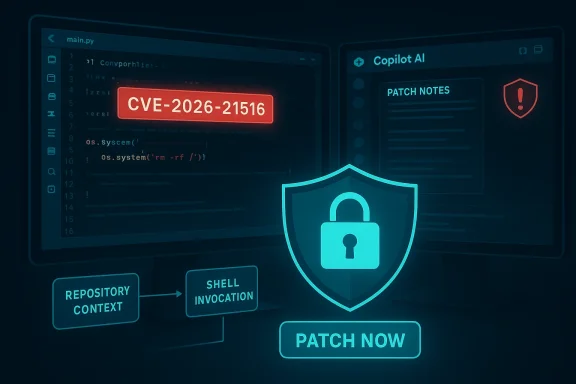
GitHub’s Copilot integration for JetBrains IDEs has been linked to a high‑severity command‑injection / remote code‑execution class flaw that can allow attacker‑controlled content to become executable on a developer’s workstation, and vendor tracking entries (including Microsoft’s Update Guide) list the issue under the advisory identifier provided by the vendor — but public tracking shows ambiguity in CVE mappings and limited technical disclosure, so defenders must treat the risk as confirmed, urgent, and environment‑specific until they validate and apply vendor patches. ([msrc.microsoft.csoft.com/update-guide/vulnerability/CVE-2026-21516/))
The rapid adoption of AI coding assistants — GitHub Copilot chief among them — has moved these tools from passive suggestion engines to active parts of developer workflows. They read repository context, synthesize edits, and in some configurations apply changes or construct tool invocations on behalf of the user. That functional power creates a new trust boundary inside IDEs: model output that is treated as executable or concatenated into shell/tool commands must be validated and neutralized. When that validation fails, command injection and related integrity failures become practical exploitation paths. Multiple vendor advisories and independent aggregators have described this class of weakness in late‑2025 and early‑2026, and the Copilot/JetBrains integration has been specificry vendors.
Why this matters now: developer workstations are not ordinary endpoints. They often hold private keys, long‑lived tokens, CI credentials, and access to build pipelines. A single local code‑execution event on a developer machine can cascade into supply‑chain compromise, artifact tampering, or credential theft — making IDE‑level vulnerabilities disproportionately valuable to attackers.
Independent technical trackers and commercial vulnerability databases converge on the same high‑level characterization: improper neutralization of special elements used in command construction (CWE‑77), a high base CVSS score in several feeds (commonly cited around 8.4), and the practical attack vector being local user interaction typically triggered by opening or interacting with attacker‑controlled repository artifacts. See coverage and advisories from Tenable, Positive Technologies/DBUGS, and industry watchers for corroboration.
Important caveat on identifiers and public details: public writeups during the disclosure period show inconsistent CVE mappings (multiple CVE identifiers and vendor‑provided IDs appear in different feeds) and a reluctance by vendors to publish low‑level exploit artifacts until patches were widely deployed. That means the CVE number you see in one tracker may differ from another, and technical PoCs are scarce or non‑canonical in authoritative soueat any single CVE claim carefully and confirm the mapping in your patch console or MSRC lookup before actioning.
Key technical mechanics to keep in mind:
Because JetBrains IDEs cover many platform variants and the plugin interacts differently per IDE and OS, the exact scope is environment dependent: validate your installed combinations (IDE version + Copilot plugin version + OS) against the vendor KB referenced by the MSRC advisory before assuming complete coverage.
Be clear about what remains uncertain: exact low‑level exploit code, definitive evidence of widespread active exploitation, and uniform CVE mappings across feeds — these items may remain ambiguous in the public record for a time. Do not let ambiguity delay remediation: fix, harden, and monitor. If you must prioritize, start with the hosts and accounts that hold signing keys, persistent tokens, or CI privileges — a single compromised developer machine can escalate rapidly into a supply‑chain incident.
The era of AI‑assisted coding has brought productivity gains and a new class of integrity risks. Addressing CVe Copilot/JetBrains command‑injection issue requires more than a single patch: it needs a combination of timely vendor updates, operational discipline in development teams, improved IDE security primitives, and an industry‑wide shift toward designing tools with untrusted model output in mind. Apply the patches, harden the developer surface, and treat AI assistants as a first‑class element in your attack‑surface inventory — because attackers already see them that way.
Source: MSRC Security Update Guide - Microsoft Security Response Center
 Background / Overview
The rapid adoption of AI coding assistants — GitHub Copilot chief among them — has moved these tools from passive suggestion engines to active parts of developer workflows. They read repository context, synthesize edits, and in some configurations apply changes or construct tool invocations on behalf of the user. That functional power creates a new trust boundary inside IDEs: model output that is treated as executable or concatenated into shell/tool commands must be validated and neutralized. When that validation fails, command injection and related integrity failures become practical exploitation paths. Multiple vendor advisories and independent aggregators have described this class of weakness in late‑2025 and early‑2026, and the Copilot/JetBrains integration has been specificry vendors.Why this matters now: developer workstations are not ordinary endpoints. They often hold private keys, long‑lived tokens, CI credentials, and access to build pipelines. A single local code‑execution event on a developer machine can cascade into supply‑chain compromise, artifact tampering, or credential theft — making IDE‑level vulnerabilities disproportionately valuable to attackers.
What the advisory(s) say — clarity and ambiguity
Vendor listings in the Microsoft Security Update Guide and related advisories record the Copilot/JetBrains issue and map it to a local command‑injection / RCE classification. The vendor acknowledgement is the strongest indicator that a real, actionable flaw exists in the product’s command‑construction and output‑validation logic. (msrc.microsoft.com)Independent technical trackers and commercial vulnerability databases converge on the same high‑level characterization: improper neutralization of special elements used in command construction (CWE‑77), a high base CVSS score in several feeds (commonly cited around 8.4), and the practical attack vector being local user interaction typically triggered by opening or interacting with attacker‑controlled repository artifacts. See coverage and advisories from Tenable, Positive Technologies/DBUGS, and industry watchers for corroboration.
Important caveat on identifiers and public details: public writeups during the disclosure period show inconsistent CVE mappings (multiple CVE identifiers and vendor‑provided IDs appear in different feeds) and a reluctance by vendors to publish low‑level exploit artifacts until patches were widely deployed. That means the CVE number you see in one tracker may differ from another, and technical PoCs are scarce or non‑canonical in authoritative soueat any single CVE claim carefully and confirm the mapping in your patch console or MSRC lookup before actioning.
The technical root cause (high level)
At its core the flaw arises when an assistant or plugin:- ingests untrusted workspace or repo content as model context,
- produces suggestions or command fragments that include special characters, delimiters or path constructs, and
- hands that model output to command‑construction or tool‑invocation logic without sufficient escaping, validation, or user confirmation.
Key technical mechanics to keep in mind:
- Command construction without escaping: building CLI invocations via string templating that include model output is high risk.
- Path canonicalization failures: relative paths and escape sequences generated by a model can climb outside intended directories if APIs resolve paths insecurely.
- Auto‑apply and automation bypass: editor behaviors that permit suggestions to be saved or applied without explicit final validation convert a suggestion into code or config immediately.
- Model context poisoning: attackers can hide instructions in comment blocks, README text, or PR metadata that the model ingests as authoritative context.
Practical exploitation scenarios
- Supply‑chain trojan
- Attacker plants a crafted repo or example dependency with hidden instructions.
- Developer opens the repo in a JetBrains IDE with Copilot enabled.
- Copilot suggests changes or constructs a tool invocation that includes injected delimiters.
- The plugin executes the constructed command (or writes a config executed later), running attacker code under the developer’s user account.
- Malicious pull request prompt injection
- An external PR contains an innocuous file with embedded instructions in comments or markdown.
- When the developer asks Copilot to summarize or refactor the PR, the assistant ingests the malicious content and generates a suggestion that triggers local execution when applied.
- Compromised MCP/remote context
- If the integration fetches context from an untrusted Model Context Protocol (MCP) endpoint or a remote snippet service and that endpoint is controlled or poisoned by the attacker, model suggestions can carry executable payloads back into the IDE.
Affected products and versions
Multiple advisories and scanner plugins (for example, Tenable’s Nessus plugin) identify the affected product as the GitHub Copilot integration/plugin for JetBrains IDEs (IntelliJ IDEA, PyCharm, GoLand, Rider, etc.) and point to plugin versions prior to a patched release (commonly cited as versions earlier than 1.5.60). Organizations must verify installed plugin versions and the IDE release train against the vendor’s update mapping.Because JetBrains IDEs cover many platform variants and the plugin interacts differently per IDE and OS, the exact scope is environment dependent: validate your installed combinations (IDE version + Copilot plugin version + OS) against the vendor KB referenced by the MSRC advisory before assuming complete coverage.
Exploitability, PoC status, and confidence
- Existence confidence: High. Vendor listing in MSRC and multiple independent trackers confirm the vulnerability’s existence and general technical class. (msrc.microsoft.com)
- Technical detail confidence: Moderate. Public descriptions reliably indicate a command injection / improper neutralization weakness, but vendors have withheld low‑level exploit artifact out. That is a standard responsible disclosure posture but leaves some exploitation permutations unverified in the open.
- Proof‑of‑concept: As of vendor disclosure, authoritative PoCs were not widely published in mainstream trackers. Community writeups describe plausible chains and demonstrations of the underlying attack primitives, but few (if any) provide a canonical, vendor‑verified exploit script. Absence of a PoC reduces immrgency but does not diminish the practical risk to supply chains and high‑value developer endpoints.
Detection and hunting guidance
Prioritize telemetry and EDR signals that can surface the specific failure modes attackers would exploit:- File integrity alerts on:
- .idea/ and .vscode/ settings files
- CI pipeline manifests (YAML, .github/workflows, .gitlab-ci.yml)
- Build scripts and hooks (Makefiles, Gradle/Maven configs)
- Process telemetry:
- IDE processes (JetBrains IDE executables) spawning shells, PowerShell, or unexpected toolchain binaries directly after opening untrusted repositories.
- Network telemetry:
- Sudden outbound requests initiated by IDE extensions to unknown domains, or fetch activity from assistant features just prior to suspicious file writes.
- Version control indicators:
- Unexpected commits that modify sensitive build or deploy manifests originating from developer accounts immediately after editor sessions.
Immediate mitigation and remediation checklist
- Patch now (0–24 hours)
- Apply vendor updates for the GitHub Copilot plugin for JetBrains and the JetBrains IDEs as mapped in your patch console and the MSRC advisory. Confirm exact plugin build numbers in your environment. (msrc.microsoft.com)
- Short‑term hardening (0–48 hours)
- Disable GitHub Copilot on high‑risk hosts (shared developer VMs, CI runners, build agents) until the plugin is patched and validated.
- Enforce workspace and extension trust features so that any extension writes or auto‑applies require explicit user confirmation.
- Enforce an extension allowlist through endpoint or image build pipelines.
- Secrets and token hygiene (24–72 hours)
- Rotate any secrets or long‑lived tokens that were present on machines identified as at‑risk prior to patching.
- Move to short‑lived credential patterns and vaults where possible.
- Operational detection (ongoing)
- Increase logging and retention for developer endpoints.
- Add rules to EDR and SIEM to watch for IDE processes writing to CI manifests or invoking shells.
- Dev process controls (1–2 weeks)
- Treat AI‑generated changes like external contributions: require peer review, CI validation, and blocking changes to sensitive files without human review.
- Add pre‑commit and CI gates that reject changes to critical configuration files unless they pass explicit checks.
Enterprise risk model — who should prioritize this
- Highest priority: developer machines and shared developer VMs that have access to signing keys, CI write privileges, or long‑lived deployment tokens. A compromise here can directly affect build integrity and releases.
- Elevated priority: remote development containers and cloud dev environments used by multiple principals, where a single compromised container could taint downstream builds.
- Moderate priority: individual home developer machines with limited access; risk exists but is lower unless those machines hold tokens or credentials used in production pipelines.
- Lower priority: servers that do not run interactive IDEs or Copilot itions with large Copilot deployments should treat this as a strategic issue: the attack surface grows with the number of developer endpoints that have auto‑apply or high‑privilege extension privileges enabled.
Strengths of the vendor and community response — and remaining risks
Notable strengths- Vendor acknowledgement via MSRC and coordinated advisories shows responsible disclosure and gives administrators the canonical mapping to patches and KBs. That vendor confirmation elevates confidence in the advisory’s legitimacy. ([msrc.microsoftrosoft.com/update-guide/vulnerability/CVE-2026-21516/))
- Rapid issuance of patches and guidance — including disabling auto‑apply behaviors and hardening fetch/remote‑fetch semantics in chat flows — reduces the attack window for many common exploitation patterns.
- Multiple independent trackers and commercial scanners (Tenable, PTSecurity, ZDI commentary) converged on the technical class and recommended mitigations, providing cross‑validation for defenders. ([tenable.com] risks
- Identifier and detail fragmentation: inconsistent CVE mappings across trackers (different CVE IDs used in various feeds) complicate automated patching and reporting. Administrators must verify CVE→KB mappings explicitly in MSRC/official patch portals before patching at scale.
- Information gap on PoC and exploitation in the wild: vendors withheld low‑level exploit artifacts while patches were distributed — a prudent choice, but it leaves defenders with modeling rather than replication evidence. Absence of public PoCs reduces panic but not necessity to patch.
- Architectural mismatch: existing IDE designs were not built with autonomous agents in mind. Until IDE and plugin architectures adopt "Secure for AI" principles (principle of least authority for assistants, rigorous output neutralization, and explicit action confirmation), this class of vulnerability will recur across multiple assistants and editors. Industry research labeled this a widespread problem in late‑2025 (the so‑called "IDEsaster" analysis), highlighting the long‑term need for re‑engineering.
Concrete recommendations for security teams and dev leads
- Inventory and prioritize
- Enumerate all JetBrains IDE instances and installed Copilot plugin versions. Use management tools to scan endpoints and flag pre‑patch versions for immediate remediation.
- Patch and validate
- Deploy vendor patches to a pilot group (canary) and validate critical workflows before broad rollout. Confirm plugin+IDE compatibility and monitor for regressions.
- Minimize blast radius
- Remove persistent local admin privileges where unnecessary.
- Move critical keys and credentials into vaults and short‑lived tokens.
- Lock down CI/build images
- Do not run interactive Copilot features or unvetted extensions in CI or build runner images.
- Use hardened, minimal images for build agents without extension support.
- Developer policy and training
- Train teams to review AI‑generated code, avoid “accept‑all” habits, and treat AI edits like external contributions subject to the same reviews.
- Long‑term: architect for Secure for AI
- Advocate for and adopt tools and IDE configurations that:
- Impose strict isolation for assistant actions
- Require explicit, auditable confirmation steps for any operation that writes to sensitive files or executes commands
- Provide transparent logs of assistant‑initiated actions
Final assessment: what defenders must assume
Treat vendor advisories and independent trackers as confirming a real, high‑impact vulnerability class in Copilot’s JetBrains integration. Although mass remote exploitation is constrained by the need for user interaction or a social‑engineering vector, the real risk profile is targeted supply‑chain and developer‑focused attacks that can have outsized downstream effects. Immediate patching of Copilot plugins and JetBrains IDEs, combined with operational hardening (disable on high‑risk hosts, enforce extension allowlists, enforce workspace trust), is the appropriate defensive posture today. (msrc.microsoft.com)Be clear about what remains uncertain: exact low‑level exploit code, definitive evidence of widespread active exploitation, and uniform CVE mappings across feeds — these items may remain ambiguous in the public record for a time. Do not let ambiguity delay remediation: fix, harden, and monitor. If you must prioritize, start with the hosts and accounts that hold signing keys, persistent tokens, or CI privileges — a single compromised developer machine can escalate rapidly into a supply‑chain incident.
The era of AI‑assisted coding has brought productivity gains and a new class of integrity risks. Addressing CVe Copilot/JetBrains command‑injection issue requires more than a single patch: it needs a combination of timely vendor updates, operational discipline in development teams, improved IDE security primitives, and an industry‑wide shift toward designing tools with untrusted model output in mind. Apply the patches, harden the developer surface, and treat AI assistants as a first‑class element in your attack‑surface inventory — because attackers already see them that way.
Source: MSRC Security Update Guide - Microsoft Security Response Center
