

The center of gravity at GitHub Universe 2025 was unmistakable: developers, not just models, are driving the next wave of AI-powered software by designing, orchestrating, and governing fleets of autonomous agents — and GitHub, together with Microsoft’s Azure stack, is positioning itself as the mission control for that movement.
GitHub Universe 2025 framed a simple but profound thesis: the capability to see, steer, and build across agents will determine which teams and platforms succeed in turning AI into reliable, repeatable business outcomes. That framing is more than marketing rhetoric — it reflects a multi-product strategy linking Copilot, GitHub Models, Visual Studio Code extensions, the Microsoft Agent Framework, Azure runtime services, and protocol work such as the Model Context Protocol (MCP) to create an end-to-end developer path from prototype to production.
In practical terms, GitHub and Microsoft are pushing developers away from writing isolated scripts and toward building agentic applications — systems made of models, tool connectors, long-running state, and human-in-the-loop governance. The goal is to let agents take on repetitive, tactical work (dependency updates, triage, documentation, runbook actions) while humans focus on architectural intent, security, and creative problem solving.
Startups gain an advantage when small teams can build more features faster, but they must also adopt discipline around observability and cost control to avoid runaway spend or surprising failures when agents scale.
Source: Microsoft Azure Developer innovation at the center at GitHub Universe 2025
 Background
GitHub Universe 2025 framed a simple but profound thesis: the capability to see, steer, and build across agents will determine which teams and platforms succeed in turning AI into reliable, repeatable business outcomes. That framing is more than marketing rhetoric — it reflects a multi-product strategy linking Copilot, GitHub Models, Visual Studio Code extensions, the Microsoft Agent Framework, Azure runtime services, and protocol work such as the Model Context Protocol (MCP) to create an end-to-end developer path from prototype to production.In practical terms, GitHub and Microsoft are pushing developers away from writing isolated scripts and toward building agentic applications — systems made of models, tool connectors, long-running state, and human-in-the-loop governance. The goal is to let agents take on repetitive, tactical work (dependency updates, triage, documentation, runbook actions) while humans focus on architectural intent, security, and creative problem solving.
What changed at GitHub Universe 2025
Agents as first-class engineering artifacts
The announcements at Universe were explicit: agents are no longer experimental helpers in a lab — they are new types of software artifacts that must be versioned, tested, observed, and governed like code. Microsoft and GitHub showcased tooling that treats agent manifests, prompt templates, evaluation suites, and traces as first-class repo assets, enabling developers to iterate locally and push agents into production with CI/CD-driven guardrails. This local-first, traceable workflow is central to the vendor pitch for scaling agent-based systems.Agent HQ — unified lifecycle and governance
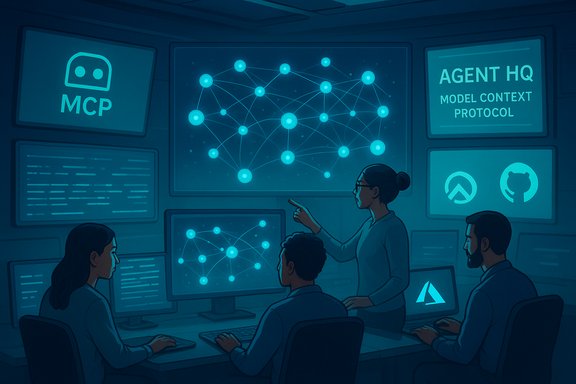
A headline innovation is Agent HQ, described as an open ecosystem and a single control plane to assign, govern, and track multiple agents. Agent HQ aims to make agents discoverable, auditable, and manageable at scale — providing identity, budgets, lifecycle states, and observability across agent fleets. This is the operational layer enterprises need if autonomous actors are going to run inside regulated, mission-critical environments.Azure MCP Server and the Model Context Protocol (MCP)
Microsoft positioned Azure MCP Server as the bridge between Azure services and agent runtimes. Built on the Model Context Protocol (MCP), MCP‑compatible hosts can call tools, describe capabilities, and exchange structured context so agents can safely invoke databases, APIs, and cloud services. Azure MCP Server promises to reduce bespoke adapter work and to enable consistent governance (authentication, network controls, and auditing) when agents act inside corporate systems.IDE-first agent development and evaluation
A notable shift is the emphasis on building agents directly where developers work. GitHub and Microsoft demonstrated:- AI Toolkit for Visual Studio Code, which lets developers explore models, assemble prompt-first agents, and run evaluation and tracing inside the editor.
- Prompt-first agent creation powered by GitHub Copilot and the Microsoft Agent Framework, enabling teams to design agent behavior in natural language, iterate with unit-like evaluations, and trace decision paths during test runs.
The data: record-breaking momentum and what it means
GitHub’s 2025 snapshot points to continued developer growth and rapid adoption of AI-first workflows. The Octoverse highlights and related metrics announced this season underscore several trends:- Massive platform scale and growth in projects and contributions.
- Explosive growth in AI-related repositories and in the number of developers adopting Copilot early in their GitHub lifecycle.
- Language popularity shifts (with TypeScript and Python prominent), reflecting the tooling and library ecosystems that power AI and agent frameworks.
How Microsoft and GitHub fit together: the end-to-end stack
Developer experience: local-first, reproducible, and traceable
Microsoft’s thesis is that developer velocity is now the key scaling lever for agentic systems. The practical implications are:- Local-first prototyping that mirrors production runtimes, so "it works on my machine" becomes "it works in production."
- Versioned prompts, model configs, and evaluation artifacts stored in the same repo as code.
- Tracing and continuous evaluation to expose agent call graphs, tool calls, and decision points.
Runtime and orchestration: Azure AI Foundry and the Agent Framework
At the runtime layer, Azure AI Foundry (and related Foundry services) play the role of production inference API, agent lifecycle management, observability, and integration with identity and networking guardrails. The Microsoft Agent Framework and Copilot Studio provide developer-facing flows for agent composition and low-code creation, while Foundry handles scale, state, and deployment. This separation aligns with how teams are used to thinking about dev/test/prod while keeping model and tool calls predictable under load.Protocols, connectors, and identity
Two protocol initiatives are central to the platform vision:- Model Context Protocol (MCP) — standardizes how tools describe inputs/outputs and how hosts expose capabilities to models and agents, reducing adapter complexity.
- Agent-to-Agent (A2A) — proposes structured messaging so agents can discover, delegate, and coordinate tasks with one another.
What this means for developers, startups, and enterprises
Developer benefits: speed, focus, and new craft
Agents are being sold as a productivity multiplier: routine tasks like dependency upgrades, triage, documentation, and automated PR scaffolding can be delegated to agents. That lets human engineers concentrate on high‑value areas — architecture, security design, and edge cases that require human judgment. For startups, the combination of Copilot, AI Toolkit for VS Code, and cloud runtimes promises faster time-to-market with smaller teams.Enterprise value: scale with governance
Enterprises gain the potential for automation at scale, but only if operational guardrails are in place. The stack’s built-in observability, identity controls, and MCP-based connectors are explicitly designed to help enterprises migrate legacy processes into agentic flows while maintaining compliance and auditability. Microsoft frames this as a migration play: reduce friction for enterprises to adopt agent-driven automation by offering first‑party solutions across IDEs, cloud, and identity.Startup and partner opportunity
The open‑ecosystem posture around MCP and A2A creates opportunities for third-party tool builders, connector authors, and specialized agent marketplaces. If the protocols gain traction, there will be demand for agent templates, horizontal tool connectors, and vertical agents tuned to industry-specific workflows. This is fertile ground for startups that can deliver secure, production-ready connectors and evaluation tooling.Strengths of the combined GitHub + Azure approach
- End-to-end continuity: GitHub and Azure span IDEs, source control, runtime, identity, and observability, reducing integration friction for teams already embedded in the Microsoft ecosystem.
- Developer-first tooling: Local-first flows, VS Code integrations, and repository‑centric evaluation make agent development faster and more reproducible.
- Protocol-first interoperability: Emphasizing MCP and A2A reduces bespoke integrations and supports cross-vendor collaboration when the specs mature.
- Operational primitives: Built-in tracing, CI-driven evaluation, and identity-backed agent objects give enterprises tools to measure and govern agent behavior.
Risks, gaps, and things to watch
The announcements are promising, but important caveats remain. Responsible adoption requires acknowledging the following:1) Preview maturity and API churn
Several components are still in preview. APIs and behaviors can—and often do—change during preview phases, which creates migration costs for production systems. Treat preview features as experimental until they reach general availability.2) Operational complexity and new attack surfaces
Orchestrating agent fleets introduces operational domains that many teams aren’t familiar with: tool discovery registries, cross‑agent tracing, long-running state management, and ephemeral credential management. Without disciplined identity and secrets controls, agents can expand attack surfaces and amplify misconfigurations.3) Safety, trust, and the limits of automation
Agentic systems can reduce human oversight, which raises the likelihood of high-impact errors if safeguards are inadequate. Features like prompt shields, PII detectors, and human‑approval gates mitigate risk but don’t eliminate it. High‑impact actions should retain human‑in‑the‑loop approval and adversarial testing.4) Cost and model economics
Multi-agent workflows can be model-call intensive. Uncontrolled orchestration across multiple models and multimodal endpoints can produce unexpected cloud costs. Cost-control patterns (hybrid routing, caching, token budgeting) are essential.5) Ecosystem fragmentation risk
Standards like MCP and A2A are nascent. If multiple competing specs emerge, the interoperability promise could fragment, reducing the value of the open-agent web. Adoption by a broad set of vendors and cloud providers is a prerequisite for the “single control plane” vision to deliver on its promise.Practical recommendations — a phased playbook for teams
- Prototype locally
- Scaffold an agent manifest in VS Code, run it against a local mock of Foundry’s inference API, and trace its tool calls. This validates the execution model without production risk.
- Harden identity and secret management
- Integrate agents with enterprise identity (Entra), require ephemeral credentials for tool calls, and enforce least privilege for MCP endpoints.
- Bake in observability and evaluation early
- Store prompt templates, evaluation artifacts, and metrics in repos; run CI-driven evaluations on PRs to detect regressions in agent behavior.
- Add safety gates for high-risk actions
- Use human‑in‑the‑loop approval flows for irreversible actions (production DB writes, user notification systems), and run red‑team style tests for prompt injection and adversarial inputs.
- Optimize cost and model routing
- Use a single inference API abstraction to experiment with model swapping, and implement hybrid routing to keep expensive model calls limited to where they add measurable value.
- Iterate with operations
- Add agent traces to runbooks, and rehearse failure scenarios (timeouts, bad tool outputs, credential expiry) to ensure graceful degradation and rollback.
The developer viewpoint: craft and culture changes
Developers will need new skills and practices to succeed in an agentic world. The craft shifts from hand-writing every routine operation to designing intent, specifying safe tool schemas, and composing multi-agent workflows. Versioning prompts, authoring robust evaluation suites, and interpreting trace outputs will become part of daily engineering practice. Teams that adopt those disciplines early will convert the rapid productivity benefits into long-term, low-friction automation.Startups gain an advantage when small teams can build more features faster, but they must also adopt discipline around observability and cost control to avoid runaway spend or surprising failures when agents scale.
Where this could go next
The short-to-medium term is likely to bring:- Broader adoption of MCP and A2A if vendors align; that would unlock third-party agent marketplaces and tool registries.
- More prebuilt agent templates (domain verticals, business processes) that reduce time-to-first-value for enterprises.
- Continued convergence on local-first developer workflows and stronger CI/CD guardrails so agents can be treated like any other production artifact.
Conclusion
GitHub Universe 2025 didn’t just showcase new features; it mapped a clear path for how software will be built in the agent era. The combined GitHub + Microsoft strategy — agent manifests and tracing in the dev workflow, protocol-first interoperability (MCP/A2A), and cloud runtime services for scale and governance — reframes developers as designers of autonomous systems rather than mere coders of isolated modules. That shift promises huge productivity gains, new product categories, and startup opportunity — but it also demands operational rigor, security discipline, and a careful, staged approach to adoption. The teams that marry developer velocity with enterprise-grade governance will be the ones that turn agentic experimentation into sustained business advantage.Source: Microsoft Azure Developer innovation at the center at GitHub Universe 2025
