
GMKtec will open early access registration for the AMD-powered EVO-X3 mini PC on June 22, 2026, ahead of a global launch on June 29, with a Ryzen AI Max+ 395 configuration, up to 128GB of memory, OCuLink expansion, Wi-Fi 7, and high-end PCIe 4.0 storage support. The headline spec is not merely that a tiny desktop can carry workstation-class memory; it is that compact PCs are now being marketed as local AI boxes first and Windows desktops second. The EVO-X3 looks like a modest refresh of the earlier EVO-X2 on paper, but the small changes reveal where this category is going. In 2026, the mini PC arms race is less about shrinking the tower and more about deciding how much GPU-adjacent memory, I/O, and thermals can fit on a desk before the machine stops being “mini” in any meaningful sense.
The EVO-X3 arrives at a moment when the mini PC market has split in two. At one end are the familiar palm-sized office machines built for web apps, light creative work, and a tidy monitor stand. At the other end are dense little compute bricks aimed at developers, creators, homelab owners, and local AI experimenters who increasingly want workstation behavior without workstation volume.
GMKtec is clearly chasing the second group. The company’s stated configuration pairs AMD’s Ryzen AI Max+ 395 with 128GB of memory, a figure that matters less for traditional Windows productivity than it does for workloads that treat memory as the limiting resource. Large language models, local inference experiments, video workflows, 3D assets, virtual machines, and GPU-heavy development environments all benefit from a pool of memory that dwarfs what most compact desktops have historically offered.
That is why the EVO-X3’s launch timing matters. GMKtec is not introducing a new category from scratch; it is trying to stay visible in a category that is suddenly crowded with AI-labeled desktops, compact workstations, and developer boxes. The company’s June 22 early access registration and June 29 global launch give it a neat marketing runway, even if the unknown retail price remains the most important missing fact.
The $20 coupon is mostly symbolic at this tier. Nobody cross-shopping a Ryzen AI Max+ machine with 128GB of RAM is making the decision on a lunch-money discount. The coupon’s real function is to build a list of interested buyers and turn a product reveal into a launch funnel.
That distinction matters for buyers. If someone already owns an EVO-X2, the EVO-X3 is unlikely to feel like a transformative performance upgrade in the conventional CPU-and-GPU sense. If someone skipped the EVO-X2 because of expansion limits, cooling concerns, or the desire for a more polished chassis, the X3 may be the version that makes the proposition easier to defend.
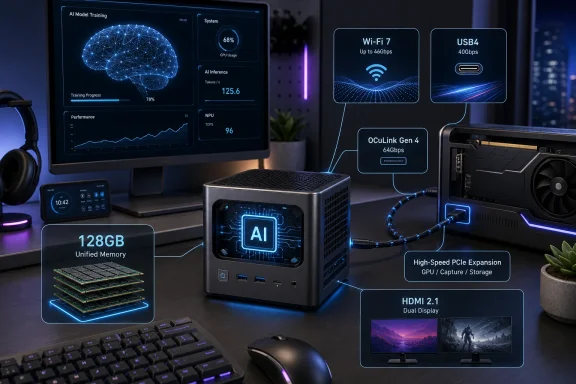
The most visible addition is OCuLink Gen 4, an interface that gives the system a more direct path to external PCIe expansion than ordinary USB-based external GPU setups. The machine also includes USB4 at 40Gbps, HDMI 2.1, Wi-Fi 7, dual-display support, and the promise of a triple-fan cooling system designed to let the APU reach up to 140W of peak performance. Those are not cosmetic changes; they are the difference between a sealed curiosity and a small workstation that can participate in a larger desktop ecosystem.
Still, there is a ceiling to how excited anyone should get before pricing lands. The EVO-X3 could be a compelling compact AI and creator machine if priced aggressively. It could also become a niche luxury box if it lands too close to larger desktops with discrete GPUs, upgradeable memory, and standard parts.
The Radeon 8060S is the part that changes the conversation. Reports comparing it to RTX 4070 Laptop-class performance should be read carefully, because performance varies by workload, power limit, memory bandwidth, cooling, drivers, and whether an app is optimized for AMD’s stack. But the broader point is sound: this is an integrated GPU that can credibly handle demanding graphics and compute work without requiring a discrete graphics card on day one.
That changes the role of OCuLink. In many older mini PCs, external GPU support felt like a workaround for weak integrated graphics. In the EVO-X3, OCuLink is more like an escape hatch. Buyers may not need it for most daily tasks, but its presence gives the system a longer shelf life and makes the machine more attractive to hobbyists who already own external GPU docks or want direct PCIe expansion for specialized hardware.
For Windows users, the trade-off is familiar. AMD’s hardware story is strong, but software maturity and driver behavior often determine whether that hardware feels elegant or fiddly. A compact AI workstation is only as useful as the frameworks, acceleration paths, BIOS updates, fan curves, and display stability that ship with it.
Unified memory gives these systems a particular appeal. Instead of splitting system RAM from discrete VRAM, machines built around Ryzen AI Max can allocate a large shared pool to graphics and compute tasks. That is a clean story for local model users who keep running into the wall of 8GB, 12GB, or 16GB graphics cards.
It is also why GMKtec’s future Ryzen AI Max+ 495 configuration is worth watching. The company has indicated that a later EVO-X3 variant will move beyond the launch model, with reports pointing to a 192GB memory configuration. If that arrives as described, GMKtec will be leaning even harder into the market for people who want local AI capacity in a box small enough to sit beside a monitor.
The catch is that memory capacity alone does not guarantee a satisfying AI workstation. Local inference depends on memory bandwidth, GPU acceleration, framework support, quantization choices, thermals, and drivers. A 128GB compact system may load models that smaller machines cannot, but whether it runs them quickly, reliably, and with minimal tinkering is a more complicated question.
OCuLink has become a favorite among mini PC enthusiasts because it avoids some of the overhead and awkwardness associated with older external GPU paths. It is not as seamless as a full desktop PCIe slot, and the experience depends heavily on docks, cables, firmware, and operating system behavior. But for a compact workstation, it offers a more serious expansion story than a spec sheet filled only with USB ports.
That matters for the EVO-X3’s target audience. Developers and homelab users are often less interested in a perfectly sealed appliance than in a machine that can be bent into new roles. One month the box may run Windows 11, Visual Studio, Docker, and a local coding model; the next it may sit under a desk attached to an external GPU or storage expansion.
GMKtec also includes USB4, but the absence of USB4 v2 will disappoint anyone hoping for the newest external bandwidth story. That is not fatal, because 40Gbps USB4 remains useful for docks, fast storage, and display connectivity. But in a machine marketed around peak compact performance, every missing forward-looking interface stands out.
The question is not simply whether the EVO-X3 can hit 140W. The real question is how long it can sustain high power, how loud it gets, how hot the chassis becomes, and whether performance remains stable after an hour of rendering, compiling, gaming, or model inference. Burst numbers make for great launch material; sustained behavior determines whether sysadmins and creators trust the box.
Triple-fan cooling can be a strength if engineered well. More fans can move air at lower individual speeds, spreading thermal load across the chassis. But small fans also tend to produce sharper acoustics than larger desktop coolers, and compact enclosures can turn airflow into a negotiation between temperature, noise, dust, and component density.
This is where independent testing will matter. GMKtec can publish peak performance claims, but the buyers most likely to care about the EVO-X3 will wait for sustained benchmarks, noise measurements, power draw figures, and teardown photos. The difference between a powerful mini workstation and a hot little novelty is usually found after the marketing slides end.
A Ryzen AI Max+ 395 mini PC with 128GB of memory gives Windows users room to experiment without building a full tower. It can be a developer workstation, a compact gaming box, a media machine, a virtualization host, or a local model playground. That versatility is exactly why these systems are more compelling than many first-generation “AI PC” laptops, which often shipped with NPUs that were impressive on paper but underused in everyday software.
The NPU still has a role, especially as Windows and application developers continue shifting more workloads toward dedicated AI acceleration. But in the current enthusiast market, GPU compute and memory capacity remain the more immediately persuasive parts of the story. Buyers want to know which models fit, which frameworks accelerate, and whether the system can run their workload today rather than after a future software update.
This creates a strange gap between vendor messaging and user motivation. Vendors sell AI PCs with TOPS figures and polished demos. Enthusiasts buy them to run messy local workloads, open-source tools, and experimental stacks that may care more about ROCm, Vulkan, DirectML, or driver quirks than about the official AI badge on the box.
A larger desktop can offer more flexibility. Standard DIMMs, full-size GPUs, better cooling, easier repair, more storage bays, and cheaper upgrades remain powerful arguments. A compact system like the EVO-X3 has to justify its premium through density, elegance, power efficiency, and the convenience of having a large unified memory pool in a small footprint.
That pitch will work for some buyers. A developer who wants a quiet local AI workstation near a monitor may value compactness more than maximum upgradeability. A creator with limited desk space may prefer one dense box to a tower. A homelab user may see the EVO-X3 as a powerful node that can be moved, stacked, or repurposed.
But the market is unforgiving. If the EVO-X3 approaches the cost of a much faster discrete-GPU desktop, buyers will start doing uncomfortable math. If the later Ryzen AI Max+ 495 version is priced dramatically higher, it may become an object of fascination rather than a practical Windows workstation.
A machine like the EVO-X3 is not designed for the average office deployment. It is overbuilt for spreadsheets and under-expandable compared with a traditional workstation. Its real value sits in the middle: enough CPU, GPU, memory, storage, and I/O to satisfy users who want serious local compute without committing to a full tower.
That middle is expanding because workloads are changing. Developers run containers, local services, and model-assisted coding tools. Creators juggle higher-resolution media and AI-enhanced workflows. Enthusiasts want machines that can game, stream, render, transcode, and experiment. The old line between “desktop PC” and “workstation” is blurring at the exact moment that the physical PC is shrinking.
The result is a market full of machines that are harder to categorize but easier to desire. The EVO-X3 may not be the fastest PC a buyer can assemble for the money. It may not be the smallest mini PC on the market. Its appeal is that it tries to concentrate a modern workstation’s most fashionable attributes — unified memory, AI acceleration, strong integrated graphics, fast storage, and expansion — into a box that feels more like consumer electronics than office furniture.
 GMKtec Turns the Mini PC Into an AI Appliance
The EVO-X3 arrives at a moment when the mini PC market has split in two. At one end are the familiar palm-sized office machines built for web apps, light creative work, and a tidy monitor stand. At the other end are dense little compute bricks aimed at developers, creators, homelab owners, and local AI experimenters who increasingly want workstation behavior without workstation volume.GMKtec is clearly chasing the second group. The company’s stated configuration pairs AMD’s Ryzen AI Max+ 395 with 128GB of memory, a figure that matters less for traditional Windows productivity than it does for workloads that treat memory as the limiting resource. Large language models, local inference experiments, video workflows, 3D assets, virtual machines, and GPU-heavy development environments all benefit from a pool of memory that dwarfs what most compact desktops have historically offered.
That is why the EVO-X3’s launch timing matters. GMKtec is not introducing a new category from scratch; it is trying to stay visible in a category that is suddenly crowded with AI-labeled desktops, compact workstations, and developer boxes. The company’s June 22 early access registration and June 29 global launch give it a neat marketing runway, even if the unknown retail price remains the most important missing fact.
The $20 coupon is mostly symbolic at this tier. Nobody cross-shopping a Ryzen AI Max+ machine with 128GB of RAM is making the decision on a lunch-money discount. The coupon’s real function is to build a list of interested buyers and turn a product reveal into a launch funnel.
The EVO-X3 Is a Refresh, but the Refresh Tells the Story
The most awkward fact about the EVO-X3 is that its launch configuration uses the same Ryzen AI Max+ 395 that powered the EVO-X2. That does not make the new system uninteresting, but it does mean GMKtec’s story has to come from the platform around the chip rather than the chip itself. The EVO-X3 is not a clean generational leap at launch; it is a packaging and I/O revision with a future upgrade path teased for later in the year.That distinction matters for buyers. If someone already owns an EVO-X2, the EVO-X3 is unlikely to feel like a transformative performance upgrade in the conventional CPU-and-GPU sense. If someone skipped the EVO-X2 because of expansion limits, cooling concerns, or the desire for a more polished chassis, the X3 may be the version that makes the proposition easier to defend.
The most visible addition is OCuLink Gen 4, an interface that gives the system a more direct path to external PCIe expansion than ordinary USB-based external GPU setups. The machine also includes USB4 at 40Gbps, HDMI 2.1, Wi-Fi 7, dual-display support, and the promise of a triple-fan cooling system designed to let the APU reach up to 140W of peak performance. Those are not cosmetic changes; they are the difference between a sealed curiosity and a small workstation that can participate in a larger desktop ecosystem.
Still, there is a ceiling to how excited anyone should get before pricing lands. The EVO-X3 could be a compelling compact AI and creator machine if priced aggressively. It could also become a niche luxury box if it lands too close to larger desktops with discrete GPUs, upgradeable memory, and standard parts.
AMD’s Strix Halo Moment Reaches the Desk
The Ryzen AI Max+ 395 is the reason any of this is plausible. AMD’s high-end mobile-derived platform combines Zen 5 CPU cores, Radeon 8060S integrated graphics, an NPU, and a large unified memory configuration into a package that behaves very differently from the integrated graphics PCs of old. The result is not a gaming desktop replacement in every scenario, but it is far beyond the “good enough for display output” iGPU reputation that has followed compact PCs for years.The Radeon 8060S is the part that changes the conversation. Reports comparing it to RTX 4070 Laptop-class performance should be read carefully, because performance varies by workload, power limit, memory bandwidth, cooling, drivers, and whether an app is optimized for AMD’s stack. But the broader point is sound: this is an integrated GPU that can credibly handle demanding graphics and compute work without requiring a discrete graphics card on day one.
That changes the role of OCuLink. In many older mini PCs, external GPU support felt like a workaround for weak integrated graphics. In the EVO-X3, OCuLink is more like an escape hatch. Buyers may not need it for most daily tasks, but its presence gives the system a longer shelf life and makes the machine more attractive to hobbyists who already own external GPU docks or want direct PCIe expansion for specialized hardware.
For Windows users, the trade-off is familiar. AMD’s hardware story is strong, but software maturity and driver behavior often determine whether that hardware feels elegant or fiddly. A compact AI workstation is only as useful as the frameworks, acceleration paths, BIOS updates, fan curves, and display stability that ship with it.
The 128GB Number Is About Models, Not Multitasking
In a normal consumer PC review, 128GB of RAM would be overkill for nearly everyone. In this class, it is the point. The memory is not there so Microsoft Edge can open more tabs; it is there because local AI workloads and heavy creative tasks increasingly behave like memory capacity tests.Unified memory gives these systems a particular appeal. Instead of splitting system RAM from discrete VRAM, machines built around Ryzen AI Max can allocate a large shared pool to graphics and compute tasks. That is a clean story for local model users who keep running into the wall of 8GB, 12GB, or 16GB graphics cards.
It is also why GMKtec’s future Ryzen AI Max+ 495 configuration is worth watching. The company has indicated that a later EVO-X3 variant will move beyond the launch model, with reports pointing to a 192GB memory configuration. If that arrives as described, GMKtec will be leaning even harder into the market for people who want local AI capacity in a box small enough to sit beside a monitor.
The catch is that memory capacity alone does not guarantee a satisfying AI workstation. Local inference depends on memory bandwidth, GPU acceleration, framework support, quantization choices, thermals, and drivers. A 128GB compact system may load models that smaller machines cannot, but whether it runs them quickly, reliably, and with minimal tinkering is a more complicated question.
OCuLink Is the Port That Admits the Machine Has Limits
The most interesting thing about OCuLink on the EVO-X3 is the honesty of it. GMKtec is effectively saying that the integrated GPU is good enough for many buyers, but not sacred. If the workload grows, the machine needs a way out.OCuLink has become a favorite among mini PC enthusiasts because it avoids some of the overhead and awkwardness associated with older external GPU paths. It is not as seamless as a full desktop PCIe slot, and the experience depends heavily on docks, cables, firmware, and operating system behavior. But for a compact workstation, it offers a more serious expansion story than a spec sheet filled only with USB ports.
That matters for the EVO-X3’s target audience. Developers and homelab users are often less interested in a perfectly sealed appliance than in a machine that can be bent into new roles. One month the box may run Windows 11, Visual Studio, Docker, and a local coding model; the next it may sit under a desk attached to an external GPU or storage expansion.
GMKtec also includes USB4, but the absence of USB4 v2 will disappoint anyone hoping for the newest external bandwidth story. That is not fatal, because 40Gbps USB4 remains useful for docks, fast storage, and display connectivity. But in a machine marketed around peak compact performance, every missing forward-looking interface stands out.
Cooling Is the Spec Sheet’s Quiet Liability
GMKtec says the EVO-X3’s triple-fan setup will allow up to 140W of peak performance from the AMD APU. That is an ambitious figure for a compact desktop, and it points to the oldest problem in small-form-factor computing: heat is easy to generate and hard to remove quietly. A mini PC can have workstation-class silicon, but it cannot repeal physics.The question is not simply whether the EVO-X3 can hit 140W. The real question is how long it can sustain high power, how loud it gets, how hot the chassis becomes, and whether performance remains stable after an hour of rendering, compiling, gaming, or model inference. Burst numbers make for great launch material; sustained behavior determines whether sysadmins and creators trust the box.
Triple-fan cooling can be a strength if engineered well. More fans can move air at lower individual speeds, spreading thermal load across the chassis. But small fans also tend to produce sharper acoustics than larger desktop coolers, and compact enclosures can turn airflow into a negotiation between temperature, noise, dust, and component density.
This is where independent testing will matter. GMKtec can publish peak performance claims, but the buyers most likely to care about the EVO-X3 will wait for sustained benchmarks, noise measurements, power draw figures, and teardown photos. The difference between a powerful mini workstation and a hot little novelty is usually found after the marketing slides end.
Windows Gets a New Class of Local AI Box
For WindowsForum readers, the EVO-X3 is interesting because it sits at the intersection of Windows enthusiasm and local AI pragmatism. Microsoft has spent the last several years trying to make AI feel native to Windows through Copilot branding, NPUs, and developer frameworks. But the most demanding local AI users often care less about branded AI experiences than about raw memory, GPU acceleration, and whether their preferred tools actually run.A Ryzen AI Max+ 395 mini PC with 128GB of memory gives Windows users room to experiment without building a full tower. It can be a developer workstation, a compact gaming box, a media machine, a virtualization host, or a local model playground. That versatility is exactly why these systems are more compelling than many first-generation “AI PC” laptops, which often shipped with NPUs that were impressive on paper but underused in everyday software.
The NPU still has a role, especially as Windows and application developers continue shifting more workloads toward dedicated AI acceleration. But in the current enthusiast market, GPU compute and memory capacity remain the more immediately persuasive parts of the story. Buyers want to know which models fit, which frameworks accelerate, and whether the system can run their workload today rather than after a future software update.
This creates a strange gap between vendor messaging and user motivation. Vendors sell AI PCs with TOPS figures and polished demos. Enthusiasts buy them to run messy local workloads, open-source tools, and experimental stacks that may care more about ROCm, Vulkan, DirectML, or driver quirks than about the official AI badge on the box.
Price Will Decide Whether This Is a Workstation or a Curiosity
The missing price is not a detail; it is the hinge of the entire story. High-end mini PCs built around AMD’s Ryzen AI Max platform are not cheap, and 128GB memory configurations push them further away from impulse-buy territory. GMKtec can win attention with specs, but it will win buyers only if the EVO-X3 lands at a price that makes sense against both compact competitors and conventional desktops.A larger desktop can offer more flexibility. Standard DIMMs, full-size GPUs, better cooling, easier repair, more storage bays, and cheaper upgrades remain powerful arguments. A compact system like the EVO-X3 has to justify its premium through density, elegance, power efficiency, and the convenience of having a large unified memory pool in a small footprint.
That pitch will work for some buyers. A developer who wants a quiet local AI workstation near a monitor may value compactness more than maximum upgradeability. A creator with limited desk space may prefer one dense box to a tower. A homelab user may see the EVO-X3 as a powerful node that can be moved, stacked, or repurposed.
But the market is unforgiving. If the EVO-X3 approaches the cost of a much faster discrete-GPU desktop, buyers will start doing uncomfortable math. If the later Ryzen AI Max+ 495 version is priced dramatically higher, it may become an object of fascination rather than a practical Windows workstation.
The Mini PC Market Is Growing Up and Getting Weirder
The EVO-X3 is part of a broader transformation in compact desktops. Mini PCs used to compete on convenience: small, quiet, cheap enough, and good for everyday computing. Now the most interesting models compete on specialization, and specialization always makes the buying decision more complicated.A machine like the EVO-X3 is not designed for the average office deployment. It is overbuilt for spreadsheets and under-expandable compared with a traditional workstation. Its real value sits in the middle: enough CPU, GPU, memory, storage, and I/O to satisfy users who want serious local compute without committing to a full tower.
That middle is expanding because workloads are changing. Developers run containers, local services, and model-assisted coding tools. Creators juggle higher-resolution media and AI-enhanced workflows. Enthusiasts want machines that can game, stream, render, transcode, and experiment. The old line between “desktop PC” and “workstation” is blurring at the exact moment that the physical PC is shrinking.
The result is a market full of machines that are harder to categorize but easier to desire. The EVO-X3 may not be the fastest PC a buyer can assemble for the money. It may not be the smallest mini PC on the market. Its appeal is that it tries to concentrate a modern workstation’s most fashionable attributes — unified memory, AI acceleration, strong integrated graphics, fast storage, and expansion — into a box that feels more like consumer electronics than office furniture.
The Launch Window Leaves Buyers With a Short but Important Checklist
GMKtec has now given potential buyers enough detail to be interested, but not enough to buy blindly. The launch date, early registration window, processor, memory ceiling, expansion story, and storage claims sketch a serious compact workstation. The unknowns are the ones that determine whether it will be a recommendation or a warning.- The EVO-X3 launches globally on June 29, 2026, with early access registration opening on June 22 for a $20 discount coupon.
- The first configuration uses AMD’s Ryzen AI Max+ 395, making it closer to an EVO-X2 platform refresh than a full generational replacement.
- The addition of OCuLink Gen 4 is the most important practical upgrade because it gives the mini PC a more credible external expansion path.
- The 128GB memory configuration is aimed less at ordinary multitasking and more at local AI, creator, developer, and virtualization workloads.
- The promised 140W peak performance will need independent testing before buyers can know whether the cooling system sustains heavy work without excessive noise.
- The later Ryzen AI Max+ 495 model could make the EVO-X3 more distinctive, but pricing and availability will decide whether it matters beyond the enthusiast niche.
References
- Primary source: Notebookcheck
Published: 2026-06-18T12:30:21.672026
GMK details new AMD-powered mini PC with 128GB RAM ahead of global launch - Notebookcheck News
The GMKtec EVO-X3 is now set to launch globally on June 29, 2026. GMK will open "early access registration" on June 22, which will offer a $20 discount coupon. The company has also confirmed all the core specs of this high-end AMD mini PC. www.notebookcheck.net
- Related coverage: tweaktown.com
GMKtec EVO-X3 mini PC is coming with OCuLink support and a Ryzen AI MAX+ PRO 495 variant packing 192GB of memory
The EVO-X3 adds native OCuLink over the EVO-X2, with a Ryzen AI MAX+ PRO 495 variant offering 192GB of memory and 160GB of configurable VRAM coming later. www.tweaktown.com
- Related coverage: 4pda.to
GMKtec анонсировала мини-ПК EVO-X3 со 192 ГБ ОЗУ и OCuLink - 4PDA
GMKtec анонсировала мини-ПК EVO-X3 со 192 ГБ ОЗУ и OCuLink4pda.to - Related coverage: techradar.com
GMKtec's new EVO-T2 mini PC has an Intel Core Ultra X9 388H processor and up to 128GB of LPDDR5x memory | TechRadar
The new product was launched at CES 2026 and signed by Intel CEO Lip-Bu Tanwww.techradar.com - Related coverage: digitalcitizen.life
GMKtec EVO-X3 Mini PC Adds OCuLink, WiFi 7, and a Future 192GB Ryzen AI MAX+ 495 Model
GMKtec is preparing the EVO-X3, a new mini PC that builds on last year’s EVO-X2 with upgraded connectivity, stronger expansion options, and a future configuration that will push unified memory capacity much higher. The system was shown at Computex 2026 as a follow up to the EVO-X2, which used...www.digitalcitizen.life
- Related coverage: lunar.computer
GMK EVO-X3 Mini PC Adds OCuLink and 192GB Memory Option for Linux AI Workloads
GMK's EVO-X3 mini PC adds an OCuLink port, a second M.2 slot, and an upcoming 192GB Ryzen AI Max+ PRO 495 configuration aimed at local AI workloads.lunar.computer
- Related coverage: correiodiario.com.br
GMKtec lança Mini PC EVO-X3 com processador AMD Ryzen AI MAX+
A GMKtec lançou o Mini PC EVO-X3 com processador AMD Ryzen AI MAX+ 395, 128 GB de memória, 2 TB de armazenamento e porta OCuLink. O modelo possui novo design para otimizar a refrigeração e suporte ao Wi-Fi 7. Uma versão com chip Ryzen AI MAX+ 495 e 192 GB de memória será disponibilizada no fim...correiodiario.com.br
