

GMKtec has announced the EVO-X3, a $3,600-and-up vertical AI mini PC workstation built around AMD’s Ryzen AI Max+ 395 processor, with early access beginning June 22, 2026 and global launch and shipping scheduled for July 6, according to TechRadar and GMKtec’s own launch materials. The surprise is not that GMKtec is chasing the local-AI workstation market; it is that the company is doing so with familiar silicon, a much more expensive chassis, and a pitch that sounds less like “mini PC” than “developer appliance.” This is a machine built for the moment when small desktops stop competing on desk space and start competing on how many tokens they can generate without phoning home.
TechRadar framed the EVO-X3 as GMKtec’s priciest mini PC yet, and that is the right starting point. The product is not merely an iterative replacement for the EVO-X2. It is a bet that enthusiasts, developers, and small-office AI users will pay workstation money for a compact box that looks and behaves less like a NUC and more like a self-contained inference tower.
The EVO-X3 is still being sold as a mini PC, but the term is doing less work than it used to. The old mental image of a mini PC is a flat square puck hiding behind a monitor, quietly handling office work, media playback, or light development. GMKtec’s new machine is taller, louder in intent, and explicitly built around sustained compute.
The shift to a vertical tower-style chassis matters because it acknowledges a truth the mini PC market has spent years trying to dodge: compact performance is mostly a thermal problem. The EVO-X2 already showed that AMD’s Ryzen AI Max+ 395 could deliver serious CPU, GPU, and NPU capability in a small footprint. But reviewers also criticized the previous machine for its plasticky build, awkward internal access, and fan noise under load, problems that become harder to ignore when the price climbs into workstation territory.
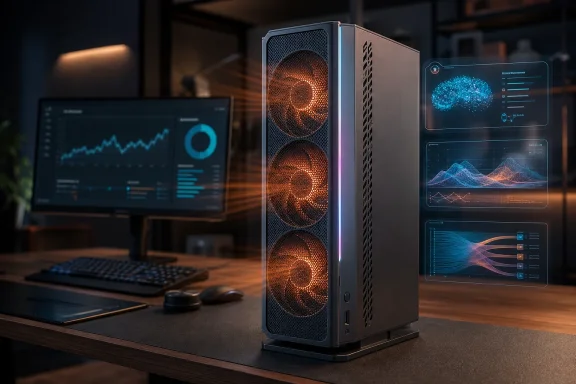
GMKtec’s answer is a triple-fan tower that TechRadar described as closer to a steel-wrapped graphics card than a conventional mini PC. That description is telling. Graphics cards are not designed to disappear into the background; they are designed around heat, airflow, and sustained load. The EVO-X3 appears to adopt that same philosophy, giving up some of the old mini PC discretion in exchange for a more credible claim to professional durability.
The company says the redesign is meant to balance performance, efficiency, and thermal stability during continuous workloads. That is exactly the promise buyers in this category will want to hear, but it remains a promise until independent testing arrives. A better-looking airflow path is not the same thing as quiet, stable, all-day operation under real local-inference, compilation, rendering, or virtualization workloads.
But the decision is less absurd than it first appears. The Ryzen AI Max+ 395, known under AMD’s Strix Halo umbrella, remains a serious piece of silicon. It combines 16 Zen 5 CPU cores, Radeon integrated graphics, and an XDNA 2 neural processing unit rated at 50 TOPS, which clears Microsoft’s 40 TOPS floor for Copilot+ PC branding.
For the Windows enthusiast crowd, that 50 TOPS figure has become both useful and misleading. It matters because Microsoft has made the NPU a gatekeeper for certain AI-era Windows experiences. But for local large-language-model work, the more interesting story is unified memory, GPU capability, software support, and sustained thermals. A machine can be Copilot+ capable and still not be the right box for the workloads its marketing implies.
That is why the EVO-X3’s use of 128GB of LPDDR5X-8000 memory is arguably more important than the specific model number on the APU. Local AI workloads are often constrained less by raw compute than by whether the model fits in memory at all. GMKtec is pitching the EVO-X3 as a machine that can run very large models locally, and that pitch depends on memory capacity as much as peak AI TOPS.
The comparison with GMKtec’s own history is brutal. TechRadar noted that the EVO-X2 launched at $1,999 with 64GB of memory and a 1TB drive, while the earlier EVO-X1 sat closer to $900 with a Ryzen AI 9 HX 370. In roughly two product generations, GMKtec’s flagship mini PC story has moved from high-end hobbyist hardware to premium workstation pricing.
Some of that increase is explainable. The EVO-X3 doubles the memory floor compared with the cited EVO-X2 launch configuration, ships with more storage, uses a more ambitious chassis, and targets a different buyer. But the emotional response from the market will not be governed only by bill-of-materials arithmetic. At $3,600, a customer is no longer forgiving the rough edges of a clever little box.
That price also puts GMKtec in a complicated neighborhood. It is not simply competing against other mini PCs. It is competing against small-form-factor desktops with discrete GPUs, Apple’s higher-end Mac Studio configurations, boutique workstation builds, and emerging AI appliances from larger vendors. The EVO-X3 has to justify not just its performance, but its form factor and ecosystem.
That pitch lands directly in the current anxiety around cloud AI. Developers and small businesses increasingly want local systems because cloud inference can introduce recurring token costs, data-governance issues, latency, and vendor dependence. A box that runs capable models locally offers a different bargain: pay a lot up front, then keep your data and workloads under your own roof.
For WindowsForum readers, this is where the EVO-X3 becomes interesting even if nobody should impulse-buy it. The Windows PC is trying to become an AI workstation again, not by bolting a chatbot onto the Start menu, but by absorbing workloads that recently belonged to rented GPUs and remote APIs. AMD’s Strix Halo platform is one of the clearest attempts to make that happen in a compact desktop.
The danger is that local-AI marketing often compresses too much into one number. Parameter counts do not tell the whole story. Quantization, context length, model architecture, software backend, driver maturity, and thermals can separate a useful workstation from an expensive demo machine. A claim that a system can load a model is not the same as proving it can run that model at speeds and quality levels professionals will tolerate.
But the EVO-X3 is not really being sold as a Copilot+ showcase. It is being sold as a local AI workstation. The difference is important because Microsoft’s consumer AI features and the needs of local-model operators are not the same thing. Recall, live captions, image features, and assistant integrations are different workloads from running a large model locally for code assistance, document analysis, or agentic automation.
This is where the NPU conversation becomes slippery. NPUs are efficient and increasingly important, but today’s local LLM community often leans heavily on GPU acceleration and memory bandwidth. AMD’s integrated graphics and unified memory architecture may be the bigger practical attraction than the NPU alone. GMKtec’s marketing blends all of these elements into a single AI story, but buyers should separate them before opening their wallets.
The Windows ecosystem also has a software maturity problem. Local AI on Windows is improving quickly, but Linux tooling, ROCm support, Vulkan paths, DirectML, vendor utilities, and application-specific backends still create a patchwork experience. GMKtec’s bundled software may reduce friction, but it cannot repeal the broader reality that local AI remains a fast-moving, sometimes fragile stack.
That does not mean the EVO-X3 is automatically better. Triple fans can move heat more effectively, but they can also create a new acoustic profile. A tower can improve airflow, but it may complicate placement on crowded desks or in racks. A more ambitious enclosure can feel premium, but it can also make servicing more awkward if the internal layout is not thoughtful.
Still, the direction is sensible. The mini PC market has spent years chasing thinner, smaller, and more invisible machines. AI workstations invert that priority. Users running local models, indexing large datasets, compiling code, or doing GPU-heavy creative work want sustained performance more than they want a computer that hides behind a monitor arm.
The comparison to a PlayStation 4 standing upright, as TechRadar relayed, is helpful because it puts the machine in a familiar physical category. This is not a shoebox workstation, but it is also not a pocketable NUC. It is the kind of device that asks for visible desk space and then has to earn it.
Models, quantized variants, embeddings, datasets, checkpoints, containers, virtual machines, and project files accumulate quickly. A workstation pitched at local inference cannot treat storage as an afterthought. Two standard M.2 slots are a practical advantage, especially for users who want to separate system storage from model and project storage.
There is a catch. High-capacity NVMe drives add heat, and heat in compact systems is always a shared budget. A chassis designed for better airflow should help, but the real question is whether GMKtec has accounted for fully populated storage under sustained load. Mini PC makers often quote expansion ceilings that look better on a spec sheet than they behave in a cramped thermal environment.
For sysadmins and lab builders, storage accessibility also matters. TechRadar noted that the EVO-X2 drew criticism for difficult internal access. If the EVO-X3 improves that, it becomes a more credible workstation. If it merely adds capacity on paper while keeping upgrades fiddly, GMKtec will have solved the wrong problem.
That is a difficult lane to occupy. Nvidia’s advantage is not only hardware; it is CUDA, developer familiarity, documentation, and years of ecosystem gravity. AMD has been improving its AI software story, but buyers who need predictable deployment often care as much about the software path as the silicon. A cheaper box can become expensive if it costs days of debugging.
GMKtec’s answer appears to be appliance-like software bundling. Claw+Wrangler is meant to make local AI setup easier, with one-click deployment and agent workflows. If that software is genuinely good, it could be the thing that makes the EVO-X3 more than a parts list. If it is thin wrapperware around a brittle stack, it becomes another bundled utility that power users uninstall or ignore.
The broader trend is still significant. The AI PC market is no longer just about laptops getting NPUs so Windows can run new features. It is also about compact workstations promising local control over models and data. That is a more serious and more expensive market, and GMKtec wants in before the category settles.
If a 192GB version is really coming later, the current EVO-X3 becomes harder to assess. For some local AI users, 128GB is already the reason to buy. For others, the jump to 192GB would be transformative because memory headroom directly affects which models and context sizes are practical. A buyer spending nearly $4,000 today does not want to feel like the true flagship is just around the corner.
GMKtec may be segmenting the market deliberately. The Ryzen AI Max+ 395 version can serve early buyers who need a system now, while a later 495 model can chase the top end. That is a familiar PC-industry pattern. But it is riskier in a niche market where the customer base is technically literate and acutely aware of silicon roadmaps.
The company’s problem is not that the 395 is weak. It is that the EVO-X3’s price makes timing part of the value proposition. At $900, buyers forgive being one generation off. At $3,600, they ask what the machine will look like six months from now.
That has consequences for Windows users. The machines that once looked like enthusiast toys are being reframed as private compute nodes. A developer might use one for local code models. A small business might use one for document processing without sending sensitive material to a cloud service. A homelab user might use one as a quiet-ish inference server sitting near a router and NAS.
The word “quiet-ish” is doing real work there. The EVO-X3 has to prove that it can be both powerful and livable. A local AI box that sounds like a hair dryer under load is not a great office machine. A compact workstation that throttles to preserve acoustics is not a great workstation. The new chassis is GMKtec’s attempt to square that circle.
This is also where Windows itself remains both strength and liability. Windows 11 gives GMKtec access to the biggest desktop software ecosystem and Microsoft’s AI PC branding. But many local AI workflows still assume Linux-first tooling or at least Linux-friendly documentation. The EVO-X3’s success will depend partly on how well GMKtec’s software bridges that gap for users who want the convenience of Windows without giving up serious local inference.
That does not mean smaller vendors cannot compete. In fact, they often move faster than the giants. GMKtec got attention with the EVO-X2 in part because it brought Ryzen AI Max+ 395 hardware to market aggressively. AMD CEO Lisa Su’s signed EVO-X2 moment gave the company a useful legitimacy boost, at least symbolically.
But symbolism is not support. When a machine becomes the centerpiece of a developer workflow or a business process, the buyer is not just purchasing a processor and memory. They are buying confidence that BIOS updates will arrive, drivers will work, fans will remain replaceable, and the bundled AI stack will not become abandonware.
This is where reviews will matter more than spec sheets. Independent testing needs to answer mundane questions that marketing avoids: how loud is it, how hot does it get, how easy is it to service, how stable is it under overnight inference, how mature is the software, and how painful is recovery when something breaks?
That is a compelling idea, especially for users who care about privacy and recurring costs. But the higher the price climbs, the less persuasive raw novelty becomes. Buyers need proof, not just promise.
TechRadar framed the EVO-X3 as GMKtec’s priciest mini PC yet, and that is the right starting point. The product is not merely an iterative replacement for the EVO-X2. It is a bet that enthusiasts, developers, and small-office AI users will pay workstation money for a compact box that looks and behaves less like a NUC and more like a self-contained inference tower.
 GMKtec’s Mini PC Has Outgrown the Mini PC Category
The EVO-X3 is still being sold as a mini PC, but the term is doing less work than it used to. The old mental image of a mini PC is a flat square puck hiding behind a monitor, quietly handling office work, media playback, or light development. GMKtec’s new machine is taller, louder in intent, and explicitly built around sustained compute.The shift to a vertical tower-style chassis matters because it acknowledges a truth the mini PC market has spent years trying to dodge: compact performance is mostly a thermal problem. The EVO-X2 already showed that AMD’s Ryzen AI Max+ 395 could deliver serious CPU, GPU, and NPU capability in a small footprint. But reviewers also criticized the previous machine for its plasticky build, awkward internal access, and fan noise under load, problems that become harder to ignore when the price climbs into workstation territory.
GMKtec’s answer is a triple-fan tower that TechRadar described as closer to a steel-wrapped graphics card than a conventional mini PC. That description is telling. Graphics cards are not designed to disappear into the background; they are designed around heat, airflow, and sustained load. The EVO-X3 appears to adopt that same philosophy, giving up some of the old mini PC discretion in exchange for a more credible claim to professional durability.
The company says the redesign is meant to balance performance, efficiency, and thermal stability during continuous workloads. That is exactly the promise buyers in this category will want to hear, but it remains a promise until independent testing arrives. A better-looking airflow path is not the same thing as quiet, stable, all-day operation under real local-inference, compilation, rendering, or virtualization workloads.
The Chip Choice Is Conservative, but Not Irrational
The headline complaint is easy to understand: GMKtec ignored AMD’s newer Ryzen AI Max+ 495 and stuck with the Ryzen AI Max+ 395. In a market trained to treat every refresh as a moral obligation, that looks like a strange move for the company’s most expensive desktop. If you are asking at least $3,600, buyers expect the newest badge.But the decision is less absurd than it first appears. The Ryzen AI Max+ 395, known under AMD’s Strix Halo umbrella, remains a serious piece of silicon. It combines 16 Zen 5 CPU cores, Radeon integrated graphics, and an XDNA 2 neural processing unit rated at 50 TOPS, which clears Microsoft’s 40 TOPS floor for Copilot+ PC branding.
For the Windows enthusiast crowd, that 50 TOPS figure has become both useful and misleading. It matters because Microsoft has made the NPU a gatekeeper for certain AI-era Windows experiences. But for local large-language-model work, the more interesting story is unified memory, GPU capability, software support, and sustained thermals. A machine can be Copilot+ capable and still not be the right box for the workloads its marketing implies.
That is why the EVO-X3’s use of 128GB of LPDDR5X-8000 memory is arguably more important than the specific model number on the APU. Local AI workloads are often constrained less by raw compute than by whether the model fits in memory at all. GMKtec is pitching the EVO-X3 as a machine that can run very large models locally, and that pitch depends on memory capacity as much as peak AI TOPS.
The Price Is the Real Product Story
The EVO-X3 starts at $3,600 for the 128GB memory and 2TB storage configuration, rising to $3,849 for the 4TB model, according to TechRadar and other launch coverage. Those are described as pre-launch discounted prices, with early access registration offering a further small discount. This is no longer the world of bargain mini PCs.The comparison with GMKtec’s own history is brutal. TechRadar noted that the EVO-X2 launched at $1,999 with 64GB of memory and a 1TB drive, while the earlier EVO-X1 sat closer to $900 with a Ryzen AI 9 HX 370. In roughly two product generations, GMKtec’s flagship mini PC story has moved from high-end hobbyist hardware to premium workstation pricing.
Some of that increase is explainable. The EVO-X3 doubles the memory floor compared with the cited EVO-X2 launch configuration, ships with more storage, uses a more ambitious chassis, and targets a different buyer. But the emotional response from the market will not be governed only by bill-of-materials arithmetic. At $3,600, a customer is no longer forgiving the rough edges of a clever little box.
That price also puts GMKtec in a complicated neighborhood. It is not simply competing against other mini PCs. It is competing against small-form-factor desktops with discrete GPUs, Apple’s higher-end Mac Studio configurations, boutique workstation builds, and emerging AI appliances from larger vendors. The EVO-X3 has to justify not just its performance, but its form factor and ecosystem.
Local AI Is the New Workstation Religion
GMKtec’s most aggressive claim is not about Windows productivity or compact gaming. It is about local inference. The company says the EVO-X3 can run models as large as 235 billion parameters entirely on-device in its 128GB configuration, using its bundled Claw+Wrangler software suite for one-click setup and round-the-clock AI agents.That pitch lands directly in the current anxiety around cloud AI. Developers and small businesses increasingly want local systems because cloud inference can introduce recurring token costs, data-governance issues, latency, and vendor dependence. A box that runs capable models locally offers a different bargain: pay a lot up front, then keep your data and workloads under your own roof.
For WindowsForum readers, this is where the EVO-X3 becomes interesting even if nobody should impulse-buy it. The Windows PC is trying to become an AI workstation again, not by bolting a chatbot onto the Start menu, but by absorbing workloads that recently belonged to rented GPUs and remote APIs. AMD’s Strix Halo platform is one of the clearest attempts to make that happen in a compact desktop.
The danger is that local-AI marketing often compresses too much into one number. Parameter counts do not tell the whole story. Quantization, context length, model architecture, software backend, driver maturity, and thermals can separate a useful workstation from an expensive demo machine. A claim that a system can load a model is not the same as proving it can run that model at speeds and quality levels professionals will tolerate.
Microsoft’s Copilot+ Threshold Is Only the Beginning
The Ryzen AI Max+ 395’s 50 TOPS NPU gives GMKtec a clean way to position the EVO-X3 inside Microsoft’s AI PC narrative. Microsoft’s Copilot+ PC requirement set made 40 TOPS a shorthand for “future-facing Windows machine,” and AMD’s chip clears that line comfortably. That matters for branding and for compatibility with Windows features that assume modern neural hardware.But the EVO-X3 is not really being sold as a Copilot+ showcase. It is being sold as a local AI workstation. The difference is important because Microsoft’s consumer AI features and the needs of local-model operators are not the same thing. Recall, live captions, image features, and assistant integrations are different workloads from running a large model locally for code assistance, document analysis, or agentic automation.
This is where the NPU conversation becomes slippery. NPUs are efficient and increasingly important, but today’s local LLM community often leans heavily on GPU acceleration and memory bandwidth. AMD’s integrated graphics and unified memory architecture may be the bigger practical attraction than the NPU alone. GMKtec’s marketing blends all of these elements into a single AI story, but buyers should separate them before opening their wallets.
The Windows ecosystem also has a software maturity problem. Local AI on Windows is improving quickly, but Linux tooling, ROCm support, Vulkan paths, DirectML, vendor utilities, and application-specific backends still create a patchwork experience. GMKtec’s bundled software may reduce friction, but it cannot repeal the broader reality that local AI remains a fast-moving, sometimes fragile stack.
A Vertical Chassis Is a Confession
The EVO-X3’s tower redesign is easy to treat as cosmetic, but it is really a confession. GMKtec appears to be admitting that its earlier flat mini PC approach was not the ideal shape for the machine it now wants to sell. If you are building for sustained professional workloads, airflow beats cuteness.That does not mean the EVO-X3 is automatically better. Triple fans can move heat more effectively, but they can also create a new acoustic profile. A tower can improve airflow, but it may complicate placement on crowded desks or in racks. A more ambitious enclosure can feel premium, but it can also make servicing more awkward if the internal layout is not thoughtful.
Still, the direction is sensible. The mini PC market has spent years chasing thinner, smaller, and more invisible machines. AI workstations invert that priority. Users running local models, indexing large datasets, compiling code, or doing GPU-heavy creative work want sustained performance more than they want a computer that hides behind a monitor arm.
The comparison to a PlayStation 4 standing upright, as TechRadar relayed, is helpful because it puts the machine in a familiar physical category. This is not a shoebox workstation, but it is also not a pocketable NUC. It is the kind of device that asks for visible desk space and then has to earn it.
The Storage Story Is Practical, Not Glamorous
The EVO-X3 ships in 2TB and 4TB configurations, with two M.2 2280 PCIe Gen4x4 slots allowing total storage expansion up to 8TB, according to TechRadar’s report. That is not the flashiest part of the announcement, but it may be one of the most important for real users. Local AI work eats storage.Models, quantized variants, embeddings, datasets, checkpoints, containers, virtual machines, and project files accumulate quickly. A workstation pitched at local inference cannot treat storage as an afterthought. Two standard M.2 slots are a practical advantage, especially for users who want to separate system storage from model and project storage.
There is a catch. High-capacity NVMe drives add heat, and heat in compact systems is always a shared budget. A chassis designed for better airflow should help, but the real question is whether GMKtec has accounted for fully populated storage under sustained load. Mini PC makers often quote expansion ceilings that look better on a spec sheet than they behave in a cramped thermal environment.
For sysadmins and lab builders, storage accessibility also matters. TechRadar noted that the EVO-X2 drew criticism for difficult internal access. If the EVO-X3 improves that, it becomes a more credible workstation. If it merely adds capacity on paper while keeping upgrades fiddly, GMKtec will have solved the wrong problem.
GMKtec Is Selling Against Nvidia Without Saying So
The EVO-X3’s price and positioning inevitably invite comparison with dedicated AI boxes and GPU workstations. TechTimes compared its starting price with Nvidia’s DGX Spark pricing and AMD’s own Ryzen AI Halo desktop positioning, and that comparison captures the strategic tension. GMKtec is trying to make a compact AMD-based local AI workstation feel like the pragmatic alternative to more expensive or more specialized AI appliances.That is a difficult lane to occupy. Nvidia’s advantage is not only hardware; it is CUDA, developer familiarity, documentation, and years of ecosystem gravity. AMD has been improving its AI software story, but buyers who need predictable deployment often care as much about the software path as the silicon. A cheaper box can become expensive if it costs days of debugging.
GMKtec’s answer appears to be appliance-like software bundling. Claw+Wrangler is meant to make local AI setup easier, with one-click deployment and agent workflows. If that software is genuinely good, it could be the thing that makes the EVO-X3 more than a parts list. If it is thin wrapperware around a brittle stack, it becomes another bundled utility that power users uninstall or ignore.
The broader trend is still significant. The AI PC market is no longer just about laptops getting NPUs so Windows can run new features. It is also about compact workstations promising local control over models and data. That is a more serious and more expensive market, and GMKtec wants in before the category settles.
Enthusiasts Will Notice the Missing 495
The Ryzen AI Max+ 495 shadow hangs over this launch. Notebookcheck reported earlier Computex-era indications that an EVO-X3 variant with Ryzen AI Max+ PRO 495 and higher memory capacity could arrive later, and community discussion has already focused on whether buyers should wait. That is exactly the kind of uncertainty that can freeze a premium launch.If a 192GB version is really coming later, the current EVO-X3 becomes harder to assess. For some local AI users, 128GB is already the reason to buy. For others, the jump to 192GB would be transformative because memory headroom directly affects which models and context sizes are practical. A buyer spending nearly $4,000 today does not want to feel like the true flagship is just around the corner.
GMKtec may be segmenting the market deliberately. The Ryzen AI Max+ 395 version can serve early buyers who need a system now, while a later 495 model can chase the top end. That is a familiar PC-industry pattern. But it is riskier in a niche market where the customer base is technically literate and acutely aware of silicon roadmaps.
The company’s problem is not that the 395 is weak. It is that the EVO-X3’s price makes timing part of the value proposition. At $900, buyers forgive being one generation off. At $3,600, they ask what the machine will look like six months from now.
Windows Users Get a Preview of the Post-Gaming Performance PC
For years, the performance desktop market revolved around gaming, content creation, and developer work. AI has added a fourth pillar, and it is changing what “high end” means. The EVO-X3 is not optimized around a discrete GPU upgrade path or RGB-laden gaming identity. It is optimized around compact local compute, unified memory, and an AI-first sales pitch.That has consequences for Windows users. The machines that once looked like enthusiast toys are being reframed as private compute nodes. A developer might use one for local code models. A small business might use one for document processing without sending sensitive material to a cloud service. A homelab user might use one as a quiet-ish inference server sitting near a router and NAS.
The word “quiet-ish” is doing real work there. The EVO-X3 has to prove that it can be both powerful and livable. A local AI box that sounds like a hair dryer under load is not a great office machine. A compact workstation that throttles to preserve acoustics is not a great workstation. The new chassis is GMKtec’s attempt to square that circle.
This is also where Windows itself remains both strength and liability. Windows 11 gives GMKtec access to the biggest desktop software ecosystem and Microsoft’s AI PC branding. But many local AI workflows still assume Linux-first tooling or at least Linux-friendly documentation. The EVO-X3’s success will depend partly on how well GMKtec’s software bridges that gap for users who want the convenience of Windows without giving up serious local inference.
The Value Equation Depends on Trust
A $3,600 mini workstation from an established enterprise vendor would face tough questions. From GMKtec, it faces tougher ones. The company has built a visible presence in the mini PC market, but premium workstation buyers expect support, firmware updates, warranty clarity, parts availability, and consistent documentation.That does not mean smaller vendors cannot compete. In fact, they often move faster than the giants. GMKtec got attention with the EVO-X2 in part because it brought Ryzen AI Max+ 395 hardware to market aggressively. AMD CEO Lisa Su’s signed EVO-X2 moment gave the company a useful legitimacy boost, at least symbolically.
But symbolism is not support. When a machine becomes the centerpiece of a developer workflow or a business process, the buyer is not just purchasing a processor and memory. They are buying confidence that BIOS updates will arrive, drivers will work, fans will remain replaceable, and the bundled AI stack will not become abandonware.
This is where reviews will matter more than spec sheets. Independent testing needs to answer mundane questions that marketing avoids: how loud is it, how hot does it get, how easy is it to service, how stable is it under overnight inference, how mature is the software, and how painful is recovery when something breaks?
The Small Tower Carries a Big Ask
The EVO-X3’s most concrete lesson is that the AI PC boom is pushing mini PCs into a new price and expectation class. GMKtec is not merely asking whether buyers want a faster small desktop. It is asking whether they believe a compact Windows machine can replace some of what they currently rent from the cloud or build with a discrete GPU tower.That is a compelling idea, especially for users who care about privacy and recurring costs. But the higher the price climbs, the less persuasive raw novelty becomes. Buyers need proof, not just promise.
- The EVO-X3 launches globally on July 6, 2026, after early access opened on June 22.
- The first configurations use AMD’s Ryzen AI Max+ 395 rather than the newer Ryzen AI Max+ 495.
- The system includes 128GB of LPDDR5X-8000 memory and either 2TB or 4TB of storage.
- GMKtec’s new vertical triple-fan chassis appears designed to address build, access, and noise complaints aimed at the EVO-X2.
- The $3,600 starting price moves GMKtec from enthusiast mini PC territory into compact workstation territory.
- The machine’s real test will be sustained local AI performance, software maturity, acoustics, and support rather than peak TOPS figures.
References
- Primary source: TechRadar
Published: Fri, 03 Jul 2026 00:20:00 GMT
GMKtec turned its AI mini PC into a tower and nearly quadrupled the price along the way | TechRadar
From $900 in 2024 to $3,600 in 2026 — GMKtec mini PCs are getting pricierwww.techradar.com - Related coverage: gizmochina.com
Gmktec launches Evo-X3 Mini PC with Ryzen AI Max+ 395, 128GB LPDDR5X RAM & OCuLink - Gizmochina
Gmktec launches the Evo-X3 mini PC with Ryzen AI Max+ 395, 128GB LPDDR5X RAM, OCuLink, Wi-Fi 7, and up to 16TB storage. www.gizmochina.com
- Related coverage: gmktec.com
EVO-X3 Is Coming: A New Compact AI Workstation Built for Local AI – GMKtec
The next generation of AI computing is moving closer to users—and it's happening locally. GMKtec is preparing to introduce EVO-X3, our most advanced - GMKtec www.gmktec.com
- Related coverage: techtimes.com
GMKtec EVO-X3 Launches at $3,600: Chinese Manufacturer Laws Apply Before Buying
GMKtec EVO-X3 early access is open now at $3,600, undercutting the Nvidia DGX Spark by $1,099. The redesigned mini PC workstation adds native OCuLink PCIe Gen4 eGPU support over the EVO-X2, shipswww.techtimes.com - Related coverage: wccftech.com
GMKtec Launches EVO-X3, Powered By AMD Ryzen AI Max+ 395 With Up To 126 TOPS Of AI Power, Starting At $3600
GMKtec's EVO-X3 mini PC features a 16-core Ryzen AI Max+ 395, 128 GB RAM, options up to 4 TB, starting at $3600 launching July 6, 2026.wccftech.com
- Related coverage: notebookcheck.net
GMK announces new mini PC with OCuLink and top-end AMD APU - Notebookcheck News
The GMKtec EVO-X3 has now been formally announced in China, and it's essentially a reshaped EVO-X2 with some notable upgrades. It's powered by the same AMD Ryzen AI Max+ 395, and has an OCuLink port. www.notebookcheck.net
- Related coverage: pcnews.ru
Ryzen AI Max+ 395, 126 TOPS, 128 ГБ унифицированной памяти и до 16 ТБ.SSD. На мировой рынок выходит мини-ПК GMKtec Evo-X3 - PCNEWS.RU
Все компьютерные новости на PCNews.ru. Вся новая информация, о компьютерах и информационных технологиях. Синдикация новостей, статей, пресс-релизов со всех сайтов компьютерной (ИТ или IT) тематики.pcnews.ru
- Related coverage: technetbooks.com
GMKtec EVO X3 Mini PC Launches Globally with AMD Ryzen AI Max plus 395 | Technetbook
GMKtec announces the EVO X3 mini PC featuring the Ryzen AI Max plus 395 APU, OCuLink connectivity, and support for up to 128GB of RAM.www.technetbooks.com
- Related coverage: 24wireless.info
Ryzen AI Max+ 395搭載ミニPC「EVO-X3」の価格が判明、128GB+2TBモデルで50万円台から | 24Wireless
2026年6月22日現在、GMKtekの公式サイトでミニPC「EVO-X3」の予約注文受付が開始されています。同日時点の価格は128GB RAM + 2TB SSDモデルが576,576円、128GB RAM + 4TB SSDモデルが61...24wireless.info - Related coverage: pcgpu.com
GMKtec EVO X3 Launched with Ryzen AI Max+ 395
GMKtec EVO X3 AI workstation powered by Ryzen AI Max+ 395 with 128GB unified memory, a Radeon 8060S GPU, Wi-Fi 7, and OCuLink interfacepcgpu.com - Related coverage: manuals.plus
