

A parser bug in the Go standard library — tracked as CVE‑2024‑34158 — lets a specially crafted build-tag line trigger stack exhaustion inside go/build/constraint’s Parse routine and crash processes that parse untrusted source files; the bug was fixed in the emergency releases that shipped in September 2024, and operators must treat this as an availability-oriented supply‑chain risk for any system that consumes or builds Go code.
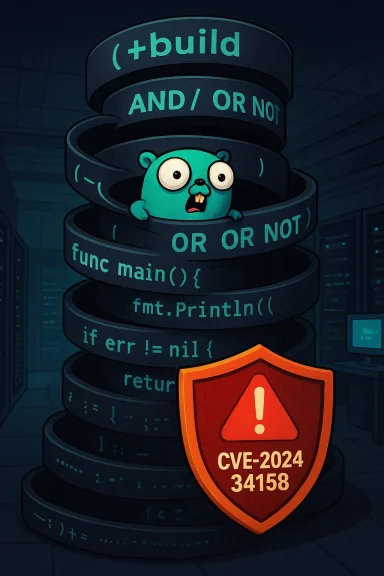
The Go toolchain supports legacy and modern build constraints via special source-file comments such as the traditional "// +build" tags. Those build tags are parsed by the package go/build/constraint, which exposes a Parse function used by tooling and by parts of the standard toolchain. In CVE‑2024‑34158 the Parse implementation did not sufficiently limit recursion when presented with deeply nested boolean expressions inside a single "// +build" line; an attacker who can supply a Go source file with a carefully constructed build-tag expression can force the parser into uncontrolled recursion and exhaust the process stack, causing a panic (process crash) and a denial-of-service condition. (go.dev)
This is not an information disclosure or code‑execution vulnerability: its severity comes from its availability impact. In environments where user‑supplied or third‑party Go files are parsed — continuous integration (CI) systems, build servers, code indexing services, linters, package registries, container build tools that inspect source trees, or any service that programmatically reads and evaluates Go source — the vulnerability can be weaponized to crash a process or pipeline. Multiple Linux distributors and cloud image maintainers tracked and pushed fixes in their downstream Go packages in September–October 2024.
WindowsForum will continue to track downstream vendor advisories and community discussions as distributors and cloud providers finish their packaging cycles; keep an eye on your vendor security feeds and prioritize the remediation steps above to remove the immediate availability risk.
Conclusion: patch now, rebuild what you ship, and harden build pipelines — CVE‑2024‑34158 is not a theoretical parser oddity, it’s an operational DoS vector with a straightforward but imperative remediation path.
Source: MSRC Security Update Guide - Microsoft Security Response Center
 Background
The Go toolchain supports legacy and modern build constraints via special source-file comments such as the traditional "// +build" tags. Those build tags are parsed by the package go/build/constraint, which exposes a Parse function used by tooling and by parts of the standard toolchain. In CVE‑2024‑34158 the Parse implementation did not sufficiently limit recursion when presented with deeply nested boolean expressions inside a single "// +build" line; an attacker who can supply a Go source file with a carefully constructed build-tag expression can force the parser into uncontrolled recursion and exhaust the process stack, causing a panic (process crash) and a denial-of-service condition. (go.dev)This is not an information disclosure or code‑execution vulnerability: its severity comes from its availability impact. In environments where user‑supplied or third‑party Go files are parsed — continuous integration (CI) systems, build servers, code indexing services, linters, package registries, container build tools that inspect source trees, or any service that programmatically reads and evaluates Go source — the vulnerability can be weaponized to crash a process or pipeline. Multiple Linux distributors and cloud image maintainers tracked and pushed fixes in their downstream Go packages in September–October 2024.
What the fix and advisories say
- The Go project assigned GO‑2024‑3107 as the internal vulnerability identifier and linked it to CVE‑2024‑34158; the advisory entries and the Go issue thread describe the root cause and track the fix. (go.dev)
- The Go team and downstream vendors released patched builds: the fix was applied in Go 1.22.7 for the 1.22 branch and in 1.23.1 for the 1.23 branch; distributors packaged these updates and published security announcements. Operators should treat those versions as the minimum safe releases.
- National vulnerability repositories (NVD) and multiple vendor advisories catalog the issue and classify it as a stack‑exhaustion/uncontrolled‑recursion problem (CWE‑674 / CWE‑400). The commonly used CVSS v3.1 rating assigned by several aggregators places the impact mainly in the availability dimension.
Technical analysis: how the crash happens
What goes wrong inside Parse
The Parse function in go/build/constraint reads a text expression built from logical operators (AND, OR, NOT) composed in parenthesized expressions typical of build-tag syntax. The parsing logic used a recursive descent approach that, when faced with artificially deep nesting, recursed without adequate bounds checks or tail‑recursion avoidance. That recursion consumes stack frames linearly with the depth of nesting and eventually overflows the available stack capacity, producing a runtime panic. The failure mode is deterministic: a sufficiently nested expression will trigger a crash whenever Parse is invoked on that line. (go.dev)Why this matters for tooling and supply chains
Many tools treat Go source as data. CI runners, static analyzers, language servers, and source‑control bots frequently open and parse Go files to generate diagnostics or to build artifacts. If any of those components call Parse on attacker-controlled files — for example in a pull request or untrusted package — an attacker can weaponize the build tag to crash the tool and halt pipelines. Because the vulnerability manifests as a local panic, it’s not limited by network access or privileges beyond the ability to supply files the process will parse. This makes it a practical Denial‑of‑Service vector in multi‑tenant services and automated build systems.Is code execution possible?
Available public analyses and the Go issue thread indicate the bug is a resource‑exhaustion (stack) panic, not a memory‑corruption or arbitrary‑code execution primitive. The risk therefore is operational disruption rather than code compromise. Still, operational disruption in cloud or CI systems can cascade into higher‑severity impacts (failed deployments, missed security scans, or recovery steps that expose other weaknesses). Cross‑checking multiple advisories and the official issue confirms the crash‑only behavior.Who and what is affected
Affected Go versions
- Vulnerable: all Go versions before 1.22.7, and versions in the interim 1.23.0-0 before 1.23.1.
Affected consumers and downstream packages
Because this bug lives in the Go standard library, anything that bundles or uses the affected Go runtime or libraries in a manner that invokes Parse on build tags is potentially impacted. Vendor advisories and distribution trackers list common places where the patched Go packages were backported:- Distribution packages for Go across Debian, Ubuntu, Red Hat, SUSE and Amazon Linux were updated.
- Container and build tooling that embed Go (buildah, podman, runc toolchains, and similar) were pointed out for updates by multiple vendors because those tools ship Go packages or link to Go‑built binaries. Vendor package lists and security trackers record those as targets for updates.
- Developer tools — language servers, linters, scanners — are only affected if they call Parse on untrusted build‑tag content; many common tools donts to compute package sets, so they should be updated or rebuilt against fixed Go releases.
Real‑world exposure patterns
Two classes of real‑world exposure are particularly concerning:- CI/CD and automated build services that accept untrusted pull requests or run builds on contributed code (public package hosting, forks, etc.). A malicious PR containing a single crafted Go file could crash the build worker.
- Source‑analysis services and code intelligence platforms that index third‑party repositories at scale. An attacker can submit a repository or file that causes the indexer to panic, potentially requiring operator intervention.
Exploitability and public proof‑of‑concepts
Several vulnerability aggregators and trackers list PoC artifacts or note public exploits; operator guidance is to treat those as potentially available and urgent impetus to patch. Aggregators often point to GitHub PoCs where researchers have submitted minimal inputs demonstrating process crashes; when PoCs exist they significantly raise exploitation likelihood in opportunistic contexts (e.g., public CI runners). As always, exercise caution when searching or handling public PoC code — executing unknown code or feeding crafted files into production systems is dangerous. Cross‑checks of mainstream vulnerability databases confirm the availability and classification of the issue.Mitigation and remediation: practical steps
Immediate remediation requires a short, disciplined program: inventory, patch, rebuild, and harden pipelines.- Inventory: determine where vulnerable Go runtimes or binaries are present.
- Search build hosts, CI runners, and developer machines for go tool versions. Prioritize machines that accept external code (build agents, public CI runners, code scanning endpoints).
- Scan container images, buildpacks, and toolchain packages for included Go versions. Vendor advisories list specific packages to upgrade.
- Patch: upgrade to fixed Go releases (minimum safe versions).
- Upstream fixes were issued in Go 1.22.7 and Go 1.23.1; update to those or later releases. For distro packages, apply vendor security updates that backport the Go fixes.
- Rebuild: rebuild tooling and containers that statically include Go binaries.
- Rebuilding ensures the updated standard library is linked into tools and images. Anything compiled with an affected Go release should be rebuilt with the patched release. Vendor advisories for container tooling enumerate the affected package sets that should be rebuilt or replaced.
- Apply operational controls:
- If you cannot patch immediately, block untrusted inputs from being parsed by vulnerable tools. For example, require contributor approval or use isolated, disposable build agents for untrusted pull requests.
- Add input sanitation rules in linters or pre‑processing steps: reject "// +build" lines whose nesting depth exceeds a safe threshold. This is a pragmatic temporary control where complete patching is infeasible. Note that such a workaround is brittle -- updating the runtime is the proper fix.
- Monitor and validate:
- After patching and rebuilding, monitor CI runners and indexing services for unexpected panics or restarts.
- Use runtime monitoring to detect repeated parser panics or abnormal process restarts, and correlate those with recent untrusted inputs.
Example scanning and detection hints
- Search your source repositories for " +build" lines with long sequences of parentheses or operators. A simple code‑search that looks for long lines or many opening parentheses in build tags is a good start.
- Instrument language servers and indexers with conservative timeouts or worker isolation so that a hung or crashing parse does not take down the master process.
How to prioritize remediation in a large environment
- Critical rating: treat build servers and externally facing CI runners as highest priority. These systems are likely to be reachable by adversarial inputs (public PRs, external repos).
- Medium rating: developer machines and internal build systems where only trusted code runs — still important but lower immediate risk.
- Low priority: air‑gapped devices or long‑lived artifacts built before the vulnerability window where no parsing of new code occurs.
- Patch and rebuild CI runners and any image/tooling used to process external code.
- Patch developer build toolchains used to produce production artifacts.
- Patch offline or isolated hosts as time allows.
Broader implications: supply‑chain and tooling hygiene
CVE‑2024‑34158 is a reminder that small parser logic mistakes in language runtimes propagate into operational risks when toolchains are widely embedded. The vulnerability class — parser recursion leading to stack exhaustion — has now appeared several times across language ecosystems; defenders need a multi‑layered approach:- Keep toolchain versions pinned and patch windows short. Language runtime vulnerabilities require rebuilding downstream artifacts, so short patch‑latency and automated rebuilds reduce exposure.
- Treat code‑parsing services as potentially exposed to adversarial inputs: use worker isolation, minimal privileges, and ephemeral runners for untrusted content.
- Add input‑validation layers where feasible: reject or sandbox suspiciously complex source constructs before invoking heavy parsers.
- Track vendor attestations and distribution advisories closely. Multiple Linux distributors and cloud vendors issued updates in September–October 2024; mapping those to your own inventory is essential. WindowsForum’s ongoing vulnerability tracking shows community discussions and distributor rollouts that can help map exposure in complex environments.
Responsible disclosure and timeline (short)
The Go project tracked CVE‑2024‑34158 internally and coordinated fixes and release updates. A dedicated issue and code change were used to address the parser recursion. Downstream distributors backported the fix into package updates in the immediate weeks that followed, with SUSE, Debian, Amazon Linux and other vendors publishing advisories and package updates. The coordinated response is typical for language runtime security fixes — a central patch, followed by distributor packaging and rebuilds. (go.dev)Practical checklist for administrators and developers
- Inventory: list hosts running Go toolchains and identify versions.
- Patch: apply official Go releases 1.22.7 or 1.23.1 (or later), or install vendor packages that include the fix.
- Rebuild: recompile static tools and container images with patched Go.
- Isolate: run untrusted code in ephemeral, restricted build agents.
- Scan: search repositories for suspiciously complex build‑tag lines and sanitize or reject them.
- Monitor: add detection for parser panics and rapid restarts in build runners and language servers.
- Vendor mapping: ensure vendor-supplied images, cloud VM images, and managed build services applied fixes; reach out to vendors if undisclosed or unclear.
Final assessment: strengths and risks
- Strengths: The Go project responded in an orderly fashion — an upstream fix plus rapid packaging by major distributors — so the window of vulnerability became manageable for organizations that maintain a healthy patch cadence. The issue is also narrow in scope (Parse on "// +build" lines), which makes scanning and targeted remediation feasible. ([openwall.coml.com/lists/oss-security/2024/09/05/1)
- Risks: The vulnerability is operationally dangerous in high‑automation and multi‑tenant contexts. Even though it is not an arbitrary code execution flaw, its ease of exploitation where untrusted files are parsed makes it an effective Denial‑of‑Service tool in CI/CD and automated indexing workflows. The need to rebuild downstream binaries makes full remediation potentially time‑consuming in large fleets, increasing the near‑term risk window for organizations slow to patch. Aggregated vulnerability trackers and some vendor pages also indicate public PoCs surfaced after disclosure, increasing opportunistic exploitation risk.
Closing recommendations
CVE‑2024‑34158 is a concrete example of how a focused parser bug can create outsized operational risk. The technical fix is available and distributed; the critical work is operational: inventory your Go toolchains, patch quickly, rebuild affected binaries and images, and adopt runtime and pipeline hardening that treats parsers as exposed services. Until you can apply updates, isolate and harden build agents that accept untrusted inputs and scan repositories for suspicious build‑tag constructs.WindowsForum will continue to track downstream vendor advisories and community discussions as distributors and cloud providers finish their packaging cycles; keep an eye on your vendor security feeds and prioritize the remediation steps above to remove the immediate availability risk.
Conclusion: patch now, rebuild what you ship, and harden build pipelines — CVE‑2024‑34158 is not a theoretical parser oddity, it’s an operational DoS vector with a straightforward but imperative remediation path.
Source: MSRC Security Update Guide - Microsoft Security Response Center
