

A subtle bug in a widely used Go PostgreSQL driver has opened the door to SQL injection under a narrow—but realistic—set of conditions, and the fix requires immediate attention from any team that embeds the pgx library. The vulnerability, tracked as CVE-2024-27289, allows user-controlled input to be interpreted as SQL when the library is operating in simple protocol mode and a very specific placeholder pattern appears on a single SQL line. The issue was fixed in pgx v4.18.2; until you upgrade, the two practical mitigations are to stop using the simple protocol or to avoid placing a minus sign immediately before numeric placeholders.
pgx is a popular PostgreSQL driver and toolkit for Go that provides both low-level protocol handling and higher-level conveniences for database access. For performance and compatibility reasons pgx supports two protocol modes when communicating with PostgreSQL: the extended (default) protocol and the simple protocol. The simple protocol is sometimes chosen explicitly via configuration (for example, by setting PreferSimpleProtocol to true or via connection-string flags) or implicitly by certain client patterns.
CVE-2024-27289 was disclosed in early March 2024. The vulnerability is a classic SQL injection (CWE-89) but with a twist: it only manifests when the driver’s simple protocol is active and when a pair of parameter placeholders follow a precise arrangement on a single line of the SQL text. The bug was patched in pgx v4.18.2; maintainers and downstream vendors began taking action rapidly because, while the conditions are constrained, the consequences are high if an attacker can control both parameters involved.
Note: I am intentionally keeping this section conceptual to avoid publishing a ready‑to‑run exploit. The public advisories contain sanitized examples and the library’s patch is available for inspection; developers should treat those examples as a diagnostic aid only and perform tests in isolated environments.
The real-world risk model depends on two axes:
Cross‑verification: the vulnerability description, affected versions, and the v4.18.2 fix are consistently recorded in at least two independent trackers (GitLab Advisory and cvedetails/NVD summaries), and have been acknowledged by vendor bulletins such as IBM’s advisory. This cross‑checks the fix and the remediation path.
From a governance perspective, add this class of driver-level CVEs to your SBOM and third‑party risk checks so you can quickly identify which applications inherit the risk and prioritize remediation by exposure and data sensitivity.
Above all, treat driver-level CVEs with urgency — they are an attractive target for attackers and can quietly undermine higher-layer protections if left unpatched. The fix is available now; prioritize it in your next maintenance window and add the detection and testing guidance outlined here to your remediation playbook.
Source: MSRC Security Update Guide - Microsoft Security Response Center
 Background / Overview
pgx is a popular PostgreSQL driver and toolkit for Go that provides both low-level protocol handling and higher-level conveniences for database access. For performance and compatibility reasons pgx supports two protocol modes when communicating with PostgreSQL: the extended (default) protocol and the simple protocol. The simple protocol is sometimes chosen explicitly via configuration (for example, by setting PreferSimpleProtocol to true or via connection-string flags) or implicitly by certain client patterns.CVE-2024-27289 was disclosed in early March 2024. The vulnerability is a classic SQL injection (CWE-89) but with a twist: it only manifests when the driver’s simple protocol is active and when a pair of parameter placeholders follow a precise arrangement on a single line of the SQL text. The bug was patched in pgx v4.18.2; maintainers and downstream vendors began taking action rapidly because, while the conditions are constrained, the consequences are high if an attacker can control both parameters involved.
What exactly is the bug?
The narrow conditions that enable exploitation
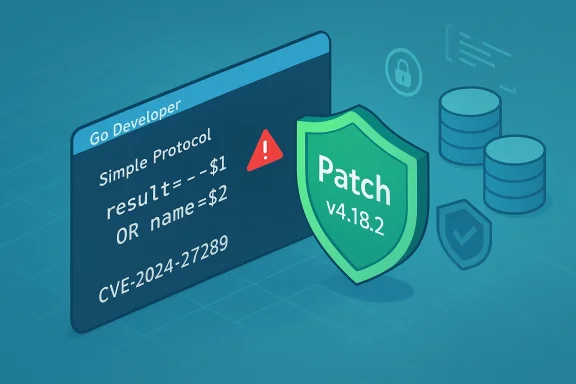
The advisory and multiple vulnerability databases agree on the prerequisite conditions for exploitation:- The pgx connection is using the non-default simple protocol rather than the extended/prepared protocol.
- There is a numeric parameter placeholder immediately preceded by a minus sign on the SQL text line (for example,
result=-$1). - On the same line there is a second placeholder for a string parameter following the numeric placeholder (for example,
OR name=$2). - Both parameter values are fully under attacker control (the attacker can supply the numeric and string inputs).
How the bug leads to injection (high‑level)
When pgx operates in simple protocol mode it assembles a single query string by substituting parameter values into placeholders rather than executing the query as a parameterized, typed message (the extended protocol keeps data separate from the query syntax and is therefore not vulnerable in the same way). Under the simple protocol path, a specific interaction of a minus sign with a numeric placeholder and a multi-line string parameter can cause the produced SQL to contain a line-comment marker or otherwise alter the intended statement structure — effectively allowing an attacker-controlled string to extend the SQL, inject boolean logic or UNIONs, or terminate clauses. Several vulnerability trackers and advisories document that the resulting query can be malformed in a way that enables SQL injection.Note: I am intentionally keeping this section conceptual to avoid publishing a ready‑to‑run exploit. The public advisories contain sanitized examples and the library’s patch is available for inspection; developers should treat those examples as a diagnostic aid only and perform tests in isolated environments.
Severity and real-world impact
Multiple vulnerability intelligence sources classify CVE-2024-27289 as High severity with CVSS v3.1 base scores reported in the 8.x range (commonly 8.1), reflecting network attack vector, high confidentiality/integrity/availability impact, and the absence of needed privileges in some scenarios. Red Hat / Rapid7 and other trackers list the vulnerability with severe impact because a successful injection can disclose or modify data and, in some applications, allow an attacker to execute arbitrary SQL commands.The real-world risk model depends on two axes:
- Probability: How likely is the application to be using simple protocol and to present the specific placeholder pattern? For many modern Go applications the answer is “moderate” — simple protocol is not the default but is intentionally enabled in a non-trivial set of codebases (for deterministic behavior, to avoid server-side prepared statement state, or via connection-string flags).
- Impact: If an attacker controls both parameters, they can read sensitive rows, alter data, or escalate follow-on attacks (for example, by writing back credentials or planting logic that leads to further compromise). That makes the impact high for confidentiality and integrity when the conditions are met.
What the patch changes (and where it landed)
The maintainers released pgx v4.18.2 to resolve this issue. The fix corrects how parameter substitution and simple-protocol assembly handle adjacent placeholders and leading minus signs, ensuring that untrusted input cannot be interpreted as part of the SQL syntax. Multiple vulnerability databases list v4.18.2 as the fixed release and the project’s advisory entry documents the resolution and recommended mitigations.Cross‑verification: the vulnerability description, affected versions, and the v4.18.2 fix are consistently recorded in at least two independent trackers (GitLab Advisory and cvedetails/NVD summaries), and have been acknowledged by vendor bulletins such as IBM’s advisory. This cross‑checks the fix and the remediation path.
Immediate actions for developers and operators
If your environment uses pgx (directly or indirectly), treat this as high priority. The following steps are the recommended immediate response checklist:- Inventory: Locate all projects, modules, and third‑party products that import pgx (or embed it via another dependency). Search your codebase for both direct imports of the pgx module and for usages of PreferSimpleProtocol or connection strings that include prefer_simple_protocol.
- Patch: Upgrade pgx to v4.18.2 or later at the earliest opportunity. For Go modules, update your dependency lines (for example, update go.mod and run your module tooling to vendor or tidy). The fix is available in the project’s v4.18.2 release.
- Short-term workaround: If you cannot immediately upgrade, change your configuration to disable simple protocol (prefer the extended/prepared protocol) or modify SQL so that a minus sign never appears directly before a numeric placeholder. Both are documented workarounds in the advisory. # Important — these are mitigations, not substitutes for patching.
- Test: Run unit and integration tests that exercise any query-building codepaths that might create arithmetic expressions or unary minus syntax adjacent to placeholders. Execute tests in an isolated environment and verify queries behave as parameterized statements in extended protocol. (Do not test with live sensitive production data.)
- CI/CD policy: Enforce dependency pruning and automated alerts (dependabot, Renovate, or your SCM’s alerts) so that future pgx updates land promptly. Add a code search in CI that flags the use of "PreferSimpleProtocol" or "prefer_simple_protocol=true" so teams can review intent.
- Vendor follow‑up: If you rely on third‑party products (for example, managed services, observability agents, or enterprise consoles) that may embed pgx, check vendor advisories and request timelines for their fixes. IBM’s bulletin specifically called out products embedding pgx.
Detection and hunting guidance
Detection for this class of vulnerability has two parts: runtime detection of suspicious queries and static detection of susceptible patterns in code.- Static search (fast, immediate):
- Scan code repositories and infrastructure-as-code for:
- Import statements referencing pgx (e.g., packages importing github.com/jackc/pgx or github.com/jackc/pgx/v4).
- Configuration flags or connection strings containing prefer_simple_protocol or similar toggles.
- SQL fragments that include
-$or constructs likeresult=-$1where a minus is adjacent to a parameter placeholder on the same line. - Add these searches to your developer prerequisites and pre-merge checks.
- Runtime/logging (where possible):
- Review database query logs (carefully — only when logging is enabled and you comply with privacy policies) for occurrences of unexpected syntax or queries containing comment markers inserted in places they shouldn’t be.
- Instrument DB access layers to log when the simple protocol is used; if feasible, temporarily disable simple-protocol usage unless explicitly required.
- Application security scanning:
- Use dependency scanners (SCA) that track CVE-2024-27289 and ensure they generate tickets for all affected services. Many commercial scanners and the public vulnerability databases have mappings for this CVE.
Developer guidance: how to code defensively around query-building
Even with the fix applied, this CVE is a reminder of defensive coding best practices:- Prefer the extended protocol / prepared statements for parameter passing; they keep SQL syntax and parameter values strictly separate.
- Avoid constructing SQL by concatenating user input. Always use parameterization and typed binding.
- Do not rely on library internals; follow public API contracts and update third‑party libs promptly.
- When an edge-case protocol option (like simple protocol) is used for a reason, document the reason in code and security reviews, and add focused tests to exercise those codepaths under adversarial inputs.
- Add unit tests that simulate untrusted inputs, including multi-line strings, control characters, and long payloads, to ensure the query builder and driver handle them safely. Use fuzzing where possible to detect protocol edge cases before production.
Why this matters for supply‑chain security
pgx is a dependency found in many Go projects. A flaw in a database driver is a high‑leverage place for attackers — an exploited injection can compromise upstream databases, pivot to application logic, or break audit trails. The disclosure triggered multiple vendor advisories and remediation workflows; enterprise teams must be able to demonstrate that they have inventoried and updated the affected dependency across products, including embedded or vendor-provided components. IBM’s advisory and Red Hat’s tracking exemplify how the issue ripples into enterprise stacks.From a governance perspective, add this class of driver-level CVEs to your SBOM and third‑party risk checks so you can quickly identify which applications inherit the risk and prioritize remediation by exposure and data sensitivity.
Testing strategy (safe, responsible)
- Create an isolated test environment (local VM or container) with a disposable PostgreSQL instance and instrumentation to capture executed SQL.
- Upgrade a test application to pgx v4.18.2 to verify normal behavior and compare it to the pre-patch behavior.
- For pre-patch verification only in controlled conditions, attempt to reproduce the problematic placeholder arrangement using mocked inputs and capture the assembled SQL. Do not run these tests on production systems or with real data.
- Validate that toggling simple protocol off prevents the risky substitution behavior.
- Add unit tests and CI checks to prevent future regressions.
Long‑term lessons and mitigations beyond the immediate fix
CVE-2024-27289 highlights a recurring theme: subtle protocol or formatting differences at the driver layer can nullify higher-level application safeguards. To reduce long-term risk:- Harden your dependency management process: require timely upstream updates, and use automated tooling to flag security releases for immediate triage.
- Enforce a default “safe configuration” posture: disable non-default protocols unless there is an explicit, documented justification.
- Increase test coverage of driver codepaths that handle protocol-level message assembly. Consider integrating fuzzing on DB clients where untrusted input meets query construction.
- Maintain an SBOM and a searchable inventory of third‑party binaries and libraries so you can rapidly map CVE exposures to impacted services.
What to tell leadership and stakeholders
- Impact summary for execs: This is a high‑severity SQL injection in a widely used Go DB driver that can lead to data disclosure or modification when a specific protocol mode and query pattern are present. The fix is available; remediation is primarily an upgrade and configuration change.
- Business risk: If your systems use pgx and allow untrusted inputs into queries that may follow the vulnerable pattern, treat remediation as high priority. For customer‑facing and sensitive data systems, apply the patch and perform validation within the next patch cycle.
- Compliance/regulatory note: If your environment is subject to data-protection or audit controls, include this remediation in your compliance reporting and update your risk register accordingly.
Final assessment and verdict
CVE-2024-27289 is a textbook example of a high-leverage vulnerability: the underlying bug is localized to a driver and only exploitable under a constrained set of conditions, but the potential impact to confidentiality, integrity, and availability is significant in those cases. Multiple independent vulnerability trackers and vendor advisories corroborate the issue, its root causes, and the remediation in pgx v4.18.2. The defensible path is straightforward: inventory, patch, and (if necessary) apply short-term mitigations such as disabling simple protocol. Teams should also use this incident to strengthen dependency governance and testing around protocol-level behavior.Above all, treat driver-level CVEs with urgency — they are an attractive target for attackers and can quietly undermine higher-layer protections if left unpatched. The fix is available now; prioritize it in your next maintenance window and add the detection and testing guidance outlined here to your remediation playbook.
Source: MSRC Security Update Guide - Microsoft Security Response Center
