

GOG’s new leadership has delivered one of the bluntest assessments of Windows in years — calling it “poor‑quality software” — and announced a clear pivot toward Linux that could reshape how the DRM‑free storefront serves retro gamers, handheld users, and preservationists going forward.
GOG.com was founded in 2008 on a promise to sell games without digital rights management (DRM) and to preserve classics for future players. That mission has become the company’s identity and the central selling point distinguishing GOG from larger, more proprietary storefronts. In late December 2025, co‑founder Michał Kiciński completed a purchase that made him the sole owner of GOG, buying 100% of the shares for PLN 90,695,440 (roughly $25 million). The acquisition was formalized in a share purchase agreement executed in December and recognized in CD PROJEKT’s regulatory filings. Kiciński’s return to full control arrives against a turbulent backdrop for desktop Windows. Microsoft ended mainstream updates and security support for Windows 10 on October 14, 2025, a watershed moment that has accelerated conversations about alternative operating systems for gaming and everyday use.
If executed well, GOG’s Linux focus could make preserved classics easier to play on devices like the Steam Deck and other handhelds, strengthen GOG’s brand among enthusiasts, and nudge the wider industry toward better multi‑platform compatibility. If mishandled, it could be an expensive experiment with limited commercial payoff. The difference will come down to disciplined prioritization, honest communication with users, and targeted engineering investments that turn rhetorical support for Linux into tangible, playable outcomes.
Source: TheGamer GOG Owner Says Windows Is "Poor-Quality Software," Plans To Focus More On Linux
 Background
GOG.com was founded in 2008 on a promise to sell games without digital rights management (DRM) and to preserve classics for future players. That mission has become the company’s identity and the central selling point distinguishing GOG from larger, more proprietary storefronts. In late December 2025, co‑founder Michał Kiciński completed a purchase that made him the sole owner of GOG, buying 100% of the shares for PLN 90,695,440 (roughly $25 million). The acquisition was formalized in a share purchase agreement executed in December and recognized in CD PROJEKT’s regulatory filings. Kiciński’s return to full control arrives against a turbulent backdrop for desktop Windows. Microsoft ended mainstream updates and security support for Windows 10 on October 14, 2025, a watershed moment that has accelerated conversations about alternative operating systems for gaming and everyday use. What GOG’s new ownership and public comments mean
A candid critique that signals strategy, not just rhetoric
Kiciński’s public comments — calling Windows “such poor‑quality software” — were delivered in the context of a wide‑ranging interview about GOG’s independence and future direction. That frankness is notable because it comes from an industry founder who also has deep ties to mainstream PC gaming. His managing director, Maciej Gołębiewski, immediately followed by saying GOG will look closer at Linux as a strategic area this year. Those statements together read as both a cultural stance and an operational pivot: GOG intends to invest more attention and resources toward non‑Windows platforms.A concrete change in corporate structure
The purchase isn’t symbolic. CD PROJEKT’s regulatory disclosures make clear this was a conventional sale: a share purchase agreement executed as part of a competitive process, with payment and distribution provisions spelled out in the filing. The deal also included a distribution agreement ensuring CD PROJEKT games will still be available through GOG for the foreseeable future, indicating both parties want continuity for users and developers. That continuity reduces one obvious risk of the change: sudden catalog fragmentation or the removal of key titles from GOG’s library.Why Linux matters for GOG — and why the timing is right
Steam Deck and the rise of Linux handhelds
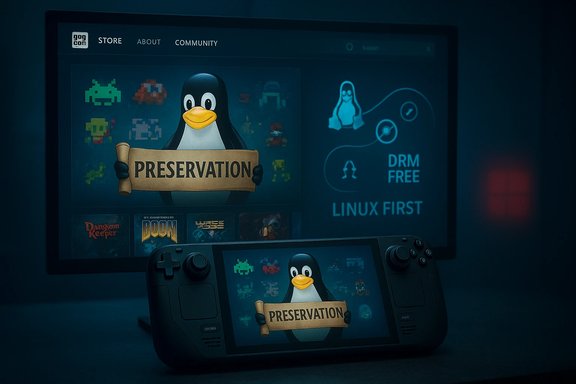
Valve’s Steam Deck showed that a polished, Linux‑based handheld can succeed at scale. SteamOS 3 on the Deck — an Arch Linux‑based distribution paired with Valve’s Proton compatibility layer — has made large swathes of a traditionally Windows‑centric game library playable on Linux hardware. The Deck’s success sparked increased interest in other SteamOS‑compatible handhelds and drove upticks in Linux usage among gamers. For GOG, this changing device landscape represents a practical opportunity: better Linux support simplifies running GOG’s DRM‑free installers and preservation builds on handhelds, and it improves discoverability among a growing Linux‑native audience.Game preservation meets platform diversification
GOG’s Game Preservation program — the team’s effort to restore, test, and maintain classic titles for modern systems — is a core asset. That program explicitly promises DRM‑free distribution, offline installers, and long‑term support for preserved builds. By leaning into Linux support, GOG can make those preserved packages easier to run on Steam Deck, other handhelds, and a rising group of desktop Linux users. The technical work involved — containerized DOSBox builds, modern wrappers, Proton‑friendly packaging, and portable installers — plays to GOG’s strengths and its historical brand promise.Market signals: Windows fatigue + institutional nudges
Windows 11’s rollout, aggressive integration of AI features, and Microsoft’s insistence that users migrate from Windows 10 (which reached end of support in October 2025) have all created friction. For many gamers, that friction is practical (compatibility, driver regressions, anti‑cheat issues) and cultural (upsells, telemetry, UI changes). Those dynamics make Linux an appealing option for a subset of the audience that values ownership, control, and fewer platform intrusions. GOG is positioning itself to capture that sentiment: preserve classic games, keep them DRM‑free, and make them easy to run on platforms where users feel more autonomy.Technical realities: what “more Linux support” can — and can’t — achieve
Where GOG can make immediate gains
- Improved installers packaged for Proton and Wine compatibility, reducing the need for manual tweaks.
- Official packaging and testing for SteamOS 3 and Steam Deck profiles, simplifying one‑click installs on handhelds.
- Bundled, verified compatibility layers for preserved titles (DOSBox Pure, ScummVM, etc. to reduce fragmentation.
- Native Linux clients or Flatpak/Steam packaging for titles where native ports are feasible.
Hard limits and persistent obstacles
- Anti‑cheat: Many modern multiplayer titles rely on anti‑cheat systems with Windows‑only drivers or client‑side components. Those systems remain the single largest technical barrier to making every game fully functional on Linux. Proton and the anti‑cheat vendors have made progress, but gaps remain for a meaningful chunk of the catalog.
- Developer support and testing: Native Linux ports or high‑quality compatibility builds require cooperation from publishers and developers. For third‑party titles where GOG acts as a distributor rather than an owner, porting depends on rights, budgets, and developer priorities.
- Fragmentation: Different Linux distributions, driver stacks, and runtime libraries create testing overhead. Ensuring a game works across Arch‑based SteamOS, Ubuntu variants, and other distros requires either exhaustive testing or a more opinionated platform approach (e.g., recommending specific distros or providing containerized runtimes).
- Revenue model: Historically, Linux gamers have been a small slice of overall market share. Investing significant engineering resources without clear revenue or retention returns is a business risk.
Strategic strengths: why GOG is well‑positioned to push Linux support
Brand and trust in DRM‑free distribution
GOG’s unwavering commitment to DRM‑free sales and offline installers is not just a marketing line — it’s an operational differentiator. For users who value ownership, GOG’s model reduces the dependency on platform clients and centralized online services. That trust makes GOG a natural partner for anyone trying to run classics on a device that doesn’t use Windows. Investment in Linux compatibility directly leverages the company’s strongest asset.Preservation expertise as a competitive moat
GOG’s preservation team already performs binaries‑level fixes, provides community‑facing technical support for old builds, and ships installers that work with legacy content. This know‑how lowers the incremental cost of targeting other OSes — the same methods used to make a DOS‑era title behave on modern Windows often translate into making it behave under Linux with the right wrapper or runtime configuration. That expertise is rare and defensible.Independence and product focus
The acquisition by Kiciński restores an ownership model that emphasizes product mission over corporate synergy. That can enable bolder, longer‑term investments that might not have fit inside a larger publisher’s priorities. If the owners commit to a sustained engineering push for Linux compatibility, GOG’s catalog and preservation program could become a leading destination for non‑Windows gaming.Risks and downside scenarios
Financial sustainability: investing in a minority platform
Linux still represents a single‑digit share of desktop gaming. Shipping high‑quality Linux builds for large numbers of titles requires testing, infrastructure, and ongoing maintenance. If the user uptake doesn’t match the investment, GOG could find itself squeezed financially, especially given the generally thin margins in digital storefronts that position around DRM‑free sales. The company will need to balance passion with pragmatism: prioritize titles where Linux support yields the best return on engineering effort.Developer relationships and anti‑cheat politics
High‑profile publishers and multiplayer titles often dictate anti‑cheat policies that limit Linux access. If GOG pushes strongly for Linux support, it may need to negotiate with third parties, fund compatibility work, or accept that some titles will remain Windows‑exclusive. Aggressive public criticism of Windows risks souring relations where cooperation is required, even if a distribution agreement with CD PROJEKT reduces friction for that publisher’s own releases.User expectations and delivery risk
Public statements create expectations. If GOG signals a “Linux first” posture but delivers incremental or low‑impact changes, community disappointment could erode trust. Clear timelines, prioritized roadmaps, and transparent updates on what’s achievable (and what isn’t) will be crucial to avoid perception of overpromising. Ambition without execution is a reputational risk.Practical scenarios: what users should expect in the next 12–24 months
- Improved documentation and official guidance for running GOG purchases under Proton and SteamOS, including curated compatibility notes and Deck profiles for preserved titles.
- Updated installers and packaged runtimes for a subset of preservation program titles — those with the highest user interest and the fewest technical blockers.
- Closer collaboration with the Steam Deck/SteamOS community and possibly official testing pipelines for Deck compatibility. This could include “verified” or “deck‑friendly” labels for GOG titles.
The wider industry impact: preservation, competition, and platform power
Preservation as public good and competitive differentiator
GOG’s preservation program acts as both a public service and a competitive moat. If GOG can make preserved titles frictionless on Linux handhelds, it could capture a dedicated niche of enthusiasts who prioritize ownership and retro play. That audience is vocal and influential; success there could shape how other stores approach legacy titles.Pressure on other stores to improve platform options
A visible, working example of a DRM‑free catalog that runs well on Linux handhelds would pressure larger retailers to improve their own Linux and handheld support. Valve’s Proton has already forced some progress; a credible GOG Linux push could accelerate industry attention on compatibility, anti‑cheat solutions, and user experience across OSes.Windows ecosystem: competence or complacency?
Kiciński’s harsh critique of Windows will reverberate because it’s a founder‑level indictment — blunt but not unique. Developers and publishers are sensitive to platform quality when it affects user experience and support costs. If a sustained exodus (or even partial defection) from Windows gaming accelerates, platform owners — including Microsoft — may face increased pressure to prioritize stability and developer tooling. Whether that pressure yields substantive change remains to be seen. Microsoft’s official EoS for Windows 10 and ongoing push to migrate users to Windows 11 suggest platform shifts will continue to be strategic levers, not quick fixes.Recommendations for stakeholders
For GOG leadership
- Publish a clear, prioritized Linux roadmap with measurable milestones and a candid statement on anti‑cheat limitations.
- Start with high‑impact preservation titles and handheld‑friendly UX changes that demonstrate early wins.
- Maintain the DRM‑free promise while communicating expectations to users and developers.
For developers and publishers
- Treat Proton and SteamOS as viable target environments for patching and QA, at least for single‑player and older titles.
- Engage with GOG and community testers for low‑cost compatibility validation on common SteamOS configurations.
For Linux handheld users and preservation advocates
- Support early GOG initiatives through feedback, test reports, and patronage programs that fund preservation work. That kind of community investment directly offsets the engineering cost of multi‑platform testing.
Conclusion
GOG’s new ownership and the blunt critique of Windows represent more than media theater: they point to a deliberate, mission‑driven pivot that leverages GOG’s unique strengths — DRM‑free distribution and deep preservation expertise — to capitalize on a growing Linux and handheld gaming market. The path ahead is technically feasible and strategically sound for certain categories of games, but it’s not without risks: anti‑cheat constraints, distribution economics, and cross‑distro fragmentation will limit what’s possible in the short term.If executed well, GOG’s Linux focus could make preserved classics easier to play on devices like the Steam Deck and other handhelds, strengthen GOG’s brand among enthusiasts, and nudge the wider industry toward better multi‑platform compatibility. If mishandled, it could be an expensive experiment with limited commercial payoff. The difference will come down to disciplined prioritization, honest communication with users, and targeted engineering investments that turn rhetorical support for Linux into tangible, playable outcomes.
Source: TheGamer GOG Owner Says Windows Is "Poor-Quality Software," Plans To Focus More On Linux
