

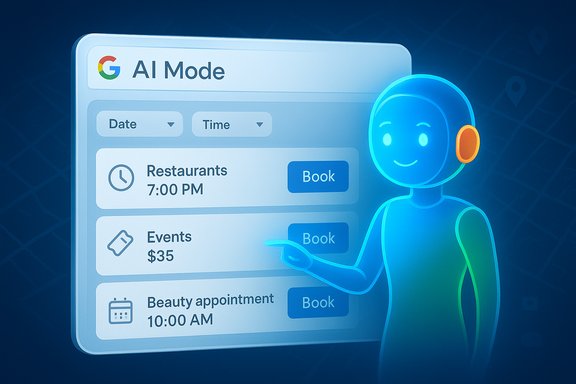
Google’s experimental AI Mode in Search has taken a decisive step from “find-it-for-me” to do-it-for-me: Search Labs users in the U.S. can now ask Google’s AI to hunt real‑time availability and surface direct booking links for restaurant reservations, event tickets, and beauty & wellness appointments — effectively turning Search into an agentic, digital concierge that does the legwork across third‑party booking sites.
AI Mode launched earlier in 2025 as Google’s conversational layer inside Search, designed to handle follow‑up questions, synthesize results, and surface deeper, multimodal answers. Over the past months Google has iteratively expanded the feature set — adding “agentic” capabilities that allow the system to perform multi‑site queries and present summarized, actionable options rather than only links and snippets. This experiment is surfaced through Search Labs and is explicitly labeled as early and experimental. The agentic booking rollout marks a strategic pivot for Google Search: moving beyond indexing and ranking toward short‑path transaction discovery and task automation. For users this promises fewer app‑switches and faster outcomes; for Google it opens new product hooks for subscriptions and deeper involvement in commerce flows. Multiple industry outlets tested and reported the behavior — showing that AI Mode will scan booking sites, collate available time slots or ticket prices, and deep‑link users to provider pages to finalize the booking.
However, three business risks are notable:
Pragmatically, users who value convenience and already trust Google’s ecosystem will find the feature valuable for planning and last‑minute organization. Businesses should prepare for increased AI‑driven referral traffic while watching conversion metrics and ensuring robustness of booking endpoints. Regulators and consumer advocates will rightly demand clarity on partner economics, remedial channels for errors, and data‑use transparency as agentic capabilities scale.
The experiment is live in Search Labs and explicitly described as early and imperfect; that combination — ambitious capability plus explicit limitations — is precisely what makes this a watershed moment in how search can behave. Expect aggressive iteration from Google and competitors alike, and plan for both immediate utility and longer‑term structural changes to how consumers discover and book services online.
Source: TechJuice Google Rolls Out Agentic Booking Capabilities in AI Mode As A Shift in How We Search
 Background / Overview
AI Mode launched earlier in 2025 as Google’s conversational layer inside Search, designed to handle follow‑up questions, synthesize results, and surface deeper, multimodal answers. Over the past months Google has iteratively expanded the feature set — adding “agentic” capabilities that allow the system to perform multi‑site queries and present summarized, actionable options rather than only links and snippets. This experiment is surfaced through Search Labs and is explicitly labeled as early and experimental. The agentic booking rollout marks a strategic pivot for Google Search: moving beyond indexing and ranking toward short‑path transaction discovery and task automation. For users this promises fewer app‑switches and faster outcomes; for Google it opens new product hooks for subscriptions and deeper involvement in commerce flows. Multiple industry outlets tested and reported the behavior — showing that AI Mode will scan booking sites, collate available time slots or ticket prices, and deep‑link users to provider pages to finalize the booking. What’s actually new: the agentic booking experience
From query to curated booking options
The new agentic flow lets users write natural, multi‑constraint prompts such as:- “Find me a dinner reservation for 3 people this Friday after 6pm around Logan Square, craving ramen or bibimbap.”
- “Find me 2 cheap tickets for the Shaboozey concert coming up; prefer standing floor tickets.”
What “agentic” means in practice
Agentic capabilities are not full autonomous purchasing agents that complete transactions for you (at least not yet). Instead, the system:- Performs automated discovery across multiple platforms and sites.
- Filters and ranks options based on user constraints.
- Presents straightforward, actionable choices and deep links.
- Leaves final checkout, payment, and confirmation to the merchant’s site.
Who gets access and the subscription angle
Eligibility and rollout
The experiment is available to U.S. users who opt into Search Labs, are 18 or older, and use English as their Search language. Restaurant reservations are available broadly to enrolled Labs users; event tickets and local service (beauty & wellness) bookings are being piloted with Google AI Pro and Google AI Ultra subscribers receiving higher usage quotas and priority access. Google underscores that this is an early test and that outcomes can be imperfect.Google AI Pro and AI Ultra — the premium tiers
Google’s AI subscription tiers were introduced earlier in 2025. Google AI Pro is positioned as the mid tier (around $19.99/month), while Google AI Ultra is the top tier (advertised at $249.99/month) that bundles higher usage limits, access to more advanced models and early experimental features such as agentic tools. The experiment’s tiered access demonstrates how Google is using subscriptions to gate higher‑limit or higher‑priority agentic capabilities.How it works under the hood (what Google has disclosed)
Multi‑site fan‑out + Project Mariner
Public descriptions indicate AI Mode breaks a user’s request into numerous sub‑queries and runs them across a variety of booking sites and aggregators in real time, then aggregates results back into a compact set of options. This is consistent with Google’s prior descriptions of Project Mariner or similar agentic prototypes that can “read” and act across web pages and forms, filling and comparing information to surface a handful of usable choices. The experience is focused on discovery and selection; the final transaction remains on the merchant site.Data & account requirements to get the “full” experience
To use the agentic booking features you must be signed into a personal Google Account you manage, and some functionality requires Web & App Activity to be enabled so AI Mode can use contextual signals (like saved preferences). Google has also indicated that personalization and past interactions can inform recommendations in AI Mode, though agentic booking initially operates within the constraints of the explicit prompt.Partners, integrations and what’s confirmed versus reported
Industry reporting and Google’s Search Labs descriptions agree that AI Mode queries multiple third‑party booking sources to return real‑time results. Various outlets have listed plausible partners for different booking categories — including OpenTable, Resy, Tock for restaurants and Ticketmaster, StubHub, SeatGeek for event tickets. Some reports have also cited provider platforms for local services and wellness bookings (examples include Booksy and other appointment systems). That said, Google’s public Search Labs page does not provide a definitive, exhaustive partner list in the experiment’s landing copy. A few media outlets repeated a specific claim — present in some local reporting — that Google integrated APIs from OpenTable, Ticketmaster, and Mindbody. Mindbody does have a documented history of working with Google in prior “Reserve with Google” programs, but a current, explicit Mindbody API integration into AI Mode (as of the present experiment launch) is not confirmed on Google’s landing page or in Google’s primary announcements; that particular vendor attribution should be treated as reported but not independently verified at this time. Historical Mindbody–Google work (Reserve with Google) did occur in prior years, however.- Confirmed: Google is scanning multiple booking sites and surfacing deep links.
- Reported, not fully verified: exact third‑party API roster (Mindbody attribution is plausible given past integrations but not explicitly listed by Google in the experiment page).
Privacy, safety and data handling — what to watch
Google positions this feature within Search’s existing quality, safety, and privacy frameworks, but agentic bookings raise new questions that users and regulators will examine closely.- Data minimization & Web & App Activity: Some features require Web & App Activity to be enabled for personalization. That setting collects search and app usage signals that may be used to tailor suggestions. Users should explicitly review this setting before opting in.
- Action vs. transaction: AI Mode currently performs discovery and redirects users to merchant sites for transactions. That separation reduces Google’s direct exposure to payment data in the short term, but it still allows Google to capture intent, selection and referral signals — data that is commercially valuable.
- Accuracy and hallucination risk: Google warns the experiment may make mistakes: misread times, miss recent availability changes, or misapply preferences. Users should always verify booking details on the provider page before confirming.
- Shared results & link‑sharing: In related AI Mode updates, Google added link‑sharing for AI conversations. Sharing AI Mode results extends the reach of recommendation data and raises questions about control over shared content and the persistence of that data. Users should use the built‑in controls to view or delete shared links.
Business and partner impact
Merchants and booking platforms
Integrations that route discovery directly to booking pages can be a boon for booking platforms and local merchants: increased visibility, reduced friction and potentially higher conversion. Aggregators and platforms that provide stable, machine‑readable APIs will have an operational advantage in AI‑led discovery flows.However, three business risks are notable:
- Referral terms & economics: if Google steers demand to particular booking partners, the economics of referral fees, commissions and prominence will be renegotiated.
- Control over user flow: merchants will need to ensure their booking pages are robust to automated agents and are clear about cancellation/refund policies when presented via third‑party AI discovery.
- Visibility vs. dependency: local businesses may gain incremental bookings but could become dependent on Google’s discovery pipeline, which shifts bargaining power to the aggregator.
Ticketing and secondary markets
Event ticketing is sensitive: prices fluctuate and seat availability can be ephemeral. By surfacing price‑sensitive options across ticketing partners, AI Mode could reduce buyer search time — but it could also accelerate price discovery that benefits arbitrageurs and secondary sellers, complicating fairness debates and regulatory attention. Ticketing platforms must ensure seat maps and hold statuses are reliably surfaced to avoid sell‑through confusion.Risks, regulatory and antitrust considerations
This shift from referral to agentic facilitation compresses the consumer path and makes Search more central to commerce execution. That increases scrutiny from several angles:- Competition & gatekeeper power: regulators will look at whether Google’s privileged positioning of agentic features disadvantages competing discovery or booking businesses and whether search ranking or default behaviors unfairly favor Google’s partners.
- Consumer protection and error remediation: when AI directs a user toward an available slot that turns out to be unavailable, responsibility lines blur. Who is accountable for incorrect availability surfaced by the agent? Clear disclaimers and remediation channels are required.
- Transparency & explainability: users will want to know how options were ranked and which platforms were queried; regulators increasingly expect explainability when services make choices on behalf of users.
Competitor landscape: where this fits in the agent era
Google is not alone. OpenAI introduced agentic workflows via ChatGPT Agents, and Microsoft has been building agent integrations across Copilot and its Bing ecosystem. What differentiates Google’s approach is the immediate tie to Search and Maps contextual data, plus direct connections to the web of booking experiences. That gives Google unique reach for local, time‑sensitive tasks like reservations and appointments. The competition will push all players to refine accuracy, speed, and safety in agentic interactions.Practical guidance for users (how to try it safely)
- Join Search Labs and enable AI Mode (if you’re in the U.S. and meet the eligibility criteria).
- Make sure you’re signed into a personal Google Account and review your Web & App Activity settings.
- Start with discovery (no payments) prompts such as “Find dinner reservations…” to understand how results are presented.
- Always verify the provider page before confirming a booking — double‑check time, location, cancellation policy, and the merchant’s own confirmation.
- Use share and privacy controls to manage persisted links and any shared AI Mode outputs.
Practical guidance for businesses and platforms
- Ensure booking pages and seat maps are machine‑readable and perform reliably under automated queries.
- Expose clean APIs or structured data (schema.org markup, OpenTable/Resy/Tock connectors) so agentic discovery returns accurate availability.
- Prepare customer support pathways for customers arriving via AI Mode (e.g., clear confirmation emails, quick contact channels).
- Monitor referral traffic to understand conversion lifts and renegotiate partner economics if Google‑driven volume becomes material.
- Audit your cancellation/refund policies for clarity; AI‑led discovery increases the need for frictionless, customer‑friendly remediation.
Strengths and strategic upsides
- Friction reduction: AI Mode’s agentic booking materially shortens the path from intent to action, improving user experience for time‑sensitive needs.
- Aggregation power: surface‑level knowledge gaps are reduced because the AI can compare availability and pricing across multiple suppliers in seconds.
- Competitive moat: Google leverages Search and Maps context to offer richer, localized recommendations that are hard for standalone agents to match.
- Subscription revenue: gating higher‑usage agentic tasks behind Pro/Ultra tiers creates a monetization path for Google’s advanced AI tooling.
Weaknesses and risks (what could go wrong)
- Accuracy & stale inventory: if provider pages change rapidly, the agent can return stale availability — producing broken expectations and support friction.
- Opaque partner roster: lack of a transparent, definitive partner list complicates merchant onboarding and can lead to inconsistent coverage across regions.
- Privacy tradeoffs: requiring Web & App Activity for the “full” experience may deter privacy‑minded users.
- Regulatory exposure: given the gatekeeper role of Search, agentic commerce features will draw regulatory attention on competition and consumer protection grounds.
Where this goes next — plausible trajectories
- Short term: Google will iterate to improve accuracy, widen partner coverage, and scale the experiment beyond the U.S. while collecting feedback and repair flows.
- Medium term: merchant dashboards and partnerships will surface (merchant analytics, referral reporting, potential ad/productized placements inside AI Mode).
- Long term: the line between discovery, booking, and payment may blur as Google experiments with completing transactions on users’ behalf — which will escalate regulatory and privacy stakes.
Final assessment
Google’s agentic booking experiment is a substantive evolution of Search: it shortens the path from intent to booking, leverages Google’s unique contextual signals, and positions AI Mode as a practical assistant rather than a mere conversational interface. The technology delivers clear consumer convenience and commercial upside, but it also raises immediate operational questions for merchants, and material privacy, accuracy, and competition concerns that Google must address transparently.Pragmatically, users who value convenience and already trust Google’s ecosystem will find the feature valuable for planning and last‑minute organization. Businesses should prepare for increased AI‑driven referral traffic while watching conversion metrics and ensuring robustness of booking endpoints. Regulators and consumer advocates will rightly demand clarity on partner economics, remedial channels for errors, and data‑use transparency as agentic capabilities scale.
The experiment is live in Search Labs and explicitly described as early and imperfect; that combination — ambitious capability plus explicit limitations — is precisely what makes this a watershed moment in how search can behave. Expect aggressive iteration from Google and competitors alike, and plan for both immediate utility and longer‑term structural changes to how consumers discover and book services online.
Source: TechJuice Google Rolls Out Agentic Booking Capabilities in AI Mode As A Shift in How We Search
