

Google’s Ironwood TPU has arrived as a bold, unequivocal statement: the company intends to own more of the AI hardware stack and to shape the economics of large‑scale inference the same way it once reshaped search. The new seventh‑generation accelerator is shipping with headline specs—192 GB of high‑bandwidth memory per chip, support for FP8 numeric formats, and the ability to aggregate up to 9,216 chips into single pods—while Google and its early partners position the chip as a direct counterweight to GPU‑centric datacenter designs.
Yet the competitive battlefield remains nuanced: Nvidia retains a commanding software and hardware lead for many training and mixed workloads, Microsoft and Amazon press their own silicon plays, and geography and policy (export controls, regional procurement preferences) will shape how these ecosystems fragment. The realistic near‑term market is heterogeneous, but the stakes—and the scale—are higher than ever.
At the same time, the transition will be pragmatic and incremental. The software and ecosystem inertia around GPUs is real; so are the engineering costs of migrating tuned stacks. Adoption will therefore be workload‑driven: where price‑performance and latency tradeoffs clearly favor TPU pods, migration will accelerate; elsewhere, a hybrid, multi‑backed strategy will prevail.
Actionable priorities are straightforward: validate claims with representative benchmarks, demand contractual clarity before committing large spend, preserve portability in model packaging, and design for hybrid deployments that can route workloads dynamically to the most cost‑effective accelerator. Treat Ironwood as a strategic expansion of choice in the AI compute market—powerful, cleverly engineered, and potentially disruptive—but not a single‑event replacement for the existing GPU ecosystem. In short: Ironwood raises the stakes in the AI hardware race. The next 12–24 months will reveal how much of that promise translates into day‑to‑day cost savings, real‑world latency improvements, and ecosystem shifts—and whether Ironwood becomes the blueprint for vertical integration across hyperscalers or an important but specialized piece of a multi‑vendor future.
Source: AzerNews Google unveils its most powerful AI chip
 Background
Where Ironwood fits in the TPU lineage
Google’s TPU program began as a research project and evolved into a family of purpose‑built accelerators tuned for the tensor‑multiply heavy workloads that underpin modern transformer models. Ironwood (TPU v7) is framed publicly as the first TPU generation designed primarily for inference at hyperscale while retaining training capability where it makes sense. That shift reflects a broader market turn: as models move from experimental to production, steady‑state inference cost, latency, and context window size increasingly determine platform economics.The commercial drumbeat: Anthropic and capacity commitments
The commercial context for Ironwood matters as much as the silicon. Anthropic announced a multi‑year expansion to access up to one million Google TPUs—described in public filings and press statements as worth tens of billions of dollars and delivering well over a gigawatt of capacity beginning in 2026. That deal is both a demand signal and a distribution vector: large, marquee customers reserving capacity make new architectures viable at hyperscale and give Google Cloud a high‑margin consumption anchor.What Ironwood actually is: the technical snapshot
Core silicon and memory
- Each Ironwood chip ships with 192 GB of HBM (likely HBM3E in vendor materials), a dramatic increase in local model memory that reduces off‑chip transfers for large transformer layers. This is repeatedly cited in Google’s materials and independent reporting.
- Reported HBM bandwidth is in the ~7.3–7.4 TB/s range per chip—again, a step‑change over previous TPU generations and designed to feed wider matrix units efficiently for memory‑bound transformer workloads.
Peak compute and numeric formats
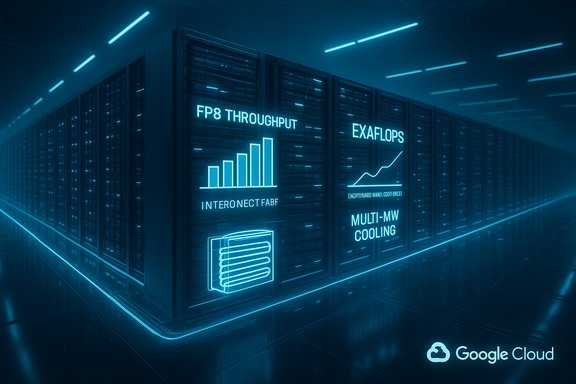
- The chip’s vendor‑presented peak throughput uses FP8 numeric formats and is reported in the multi‑petaFLOP range per chip—independent analyses and press reporting place per‑chip FP8 peaks around ~4.6 petaFLOPS (4,614 TFLOPS). These peak numbers are useful for throughput comparisons but must be normalized when compared to GPU claims that typically use BF16/FP16 or FP32/FP64 metrics.
- Ironwood’s native FP8 support is significant: lower‑precision formats enable substantially higher arithmetic throughput and smaller memory footprints for many LLM inference workloads, but they trade numerical range and dynamic behavior—making software and quantization tooling critical.
Interconnect and the pod model
- The defining systems claim is pods up to 9,216 chips connected via an enhanced Inter‑Chip Interconnect (ICI), with Google advertising exaFLOPS‑class aggregated performance for inference workloads. The company’s pod topology and the ICI fabric are intended to simplify very large single‑request inference (extremely large context windows) without brittle multi‑host sharding.
Cooling, packaging, and power
- Pod‑scale deployments are not low‑power in absolute terms: vendor materials and independent reporting note multi‑megawatt provisioning for full pod allocations and widespread use of liquid cooling at rack/pod scale. Google claims improved TFLOPS‑per‑watt compared with prior TPUs, but absolute power draw and datacenter engineering remain significant operational commitments.
Why the numbers matter — and why they require careful reading
Performance claims are precision‑dependent
Vendor headlines such as “4× faster than the previous TPU generation” or “24× El Capitan” are marketing shorthand. They are true under specific measurement choices—precision format (FP8 vs FP64), which predecessor SKU is used as baselining (v5p, v6/Trillium, etc., and whether peak theoretical throughput or sustained real‑world performance is referenced. Independent commentary urges treating headline multipliers as illustrative, not universal.Peak FLOPS versus real‑world throughput
Peak petaFLOPS figures tell part of the story. Real token latency, tail latency percentiles, on‑chip memory utilization, and end‑to‑end I/O throughput determine per‑token cost and feasibility for production agents. Until third‑party benchmarks appear, translation of peak numbers into per‑token cost metrics requires conservative skepticism.Benchmarking caveats
FP8‑focused peak figures are not directly comparable to FP64 HPC numbers or to GPU peak figures quoted under different numeric conventions. Any meaningful cross‑vendor comparison must:- Match numeric formats (or normalize across them).
- Use representative model workloads (your model, not synthetic kernels).
- Measure tail latency (p99/p999), throughput at target concurrency, and energy draw under sustained loads.
The competitive and commercial implications
Google Cloud’s positioning
Google is packaging Ironwood alongside platform updates that emphasize lower latency, better price‑performance, and flexibility in cloud instance offerings. The objective: make Google Cloud the “AI ecosystem of the future” where customers can scale models without infrastructure constraints—and lock in long‑term capacity buys with model vendors. Public earnings data show meaningful cloud momentum: Google Cloud revenue grew 34% year‑over‑year in Q3, a number Google uses to justify heavy infrastructure investment.Anthropic’s reservation changes the market calculus
Anthropic’s commitment to up to one million TPUs is a landmark commercial validation. At these numbers—multiple hundreds of thousands to a million chips—economies of scale matter: Anthropic will be able to pursue larger context windows, faster iteration cycles, and cheaper steady‑state inference if the price‑performance case holds in practice. But the public “one million” figure is a contractual cap and should be interpreted as a phased commitment rather than an instantaneous handover of hardware.What this means for Nvidia and the GPU market
The near‑term reality remains multi‑modal: NVIDIA’s software ecosystem (CUDA, cuDNN, TensorRT), extensive optimizations, and absolute throughput for many training workloads still make GPUs the default for frontier training. Hyperscalers’ move to proprietary silicon is a strategic hedge: reclaiming even a portion of GPU spend at hyperscaler scale yields multi‑billion‑dollar leverage. The likely medium‑term outcome is not a sudden GPU collapse but a nuanced mix—GPUs for certain workloads, TPUs or Trainium for others—where portability tooling and runtime maturity become decisive.Strengths: what Ironwood brings to the table
- Large local memory (192 GB HBM) reduces off‑chip shuffling and simplifies sharded inference for massive models and long context windows.
- High HBM bandwidth (~7.3–7.4 TB/s) and wide matrix units (FP8 acceleration) help memory‑bound transformer workloads.
- Pod fabric scale (9,216 chips) enables very large single‑request inference without complex host‑level sharding, which is valuable for retrieval‑augmented generation and agent systems that must reason over long documents.
- Price‑performance & energy narrative—if the vendor claims are realized, running inference fleets on Ironwood pods could materially reduce steady‑state per‑token costs versus a purely GPU approach for certain classes of workloads. Early customers say price‑performance and efficiency were key decision drivers.
Risks, unknowns, and practical caveats
1) Software and ecosystem friction
The software story is as important as the hardware. Porting tuned CUDA‑centric workloads, kernel stacks and model pipelines to a TPU‑centric runtime takes engineering effort. This migration cost slows wholesale shifts away from GPUs; until portability tooling matures, many organizations will favor a hybrid approach.2) Benchmarks and real‑world verification
The Ironwood announcement is high‑level. Independent benchmarks that measure per‑token latency, tail latency, energy per token, and sustained throughput are necessary before wide production commitments. Vendor peak numbers are directional but not a substitute for third‑party, workload‑specific testing.3) Vendor lock‑in and contractual clarity
Large, long‑term capacity deals (like Anthropic’s) are strategic but create vendor dependency risks. Organizations negotiating multi‑year commitments should require:- Regional availability and phased delivery windows.
- Measurable SLAs for throughput and tail latency.
- Proof‑of‑value on representative workloads before capacity is committed at scale.
4) Energy and facilities constraints
Scaling to megawatt+ pods requires substantial datacenter upgrades: liquid cooling, power provisioning, and local utility arrangements. Public descriptions of “well over a gigawatt” are useful signals of scale but are not precise energy accounting; they refer to peak capacity provisioning rather than sustained draw. Customers must model facility impact carefully.5) Precision and numeric tradeoffs
FP8 yields throughput gains but exposes models to quantization sensitivity. Achieving identical model quality at FP8 may require quantization‑aware training, calibration, or mixed‑precision strategies—factors that complicate migration. Independent studies and production pilots are necessary to validate model fidelity at FP8 in the wild.What Windows developers, IT teams, and enterprises should do now
Quick checklist for cautious adoption
- Map dependency on CUDA and optimized GPU kernels. Inventory which workloads are GPU‑bound for technical reasons (e.g., custom kernels) versus those that are migration candidates.
- Run production‑profile benchmarks across backends (Ironwood TPU, NVIDIA H100/Blackwell class, Trainium) using representative models and datasets. Measure per‑token cost, p99/p999 latency, and energy draw.
- Negotiate contractual transparency: ask providers for phased delivery schedules, proof‑of‑value commitments, and observability telemetry that maps requests to physical hosts/regions.
- Preserve portability: prefer model formats and runtimes that ease cross‑backend movement (ONNX, Triton, or multi‑backend tooling). Maintain a multi‑cloud fall‑back plan.
- Design for hybrid operation: route workloads by cost‑performance profile—keep latency‑sensitive workloads on the best numeric platform for the job while using TPUs for economical steady‑state inference where validated.
For Windows app developers and ISVs
- Plan model packaging to be agnostic of accelerator types when possible. Use containerized runtime environments and clear instrumentation to map latency issues to compute backends.
- For desktop or local inference use cases, remain focused on on‑device acceleration options (APUs/NPUs) rather than large TPU fleets; Ironwood primarily affects cloud economics and server‑side services.
Bigger picture: is this the start of a “chip race for intelligence”?
Ironwood is the clearest signal yet that hyperscalers intend to treat custom silicon as a long‑term lever in the AI wars. By vertically integrating chips, runtimes, and cloud services and then anchoring demand with multibillion‑dollar customer commitments, firms like Google reshape who captures margin in the AI stack.Yet the competitive battlefield remains nuanced: Nvidia retains a commanding software and hardware lead for many training and mixed workloads, Microsoft and Amazon press their own silicon plays, and geography and policy (export controls, regional procurement preferences) will shape how these ecosystems fragment. The realistic near‑term market is heterogeneous, but the stakes—and the scale—are higher than ever.
Independent verification and flagged claims
- Verified by multiple independent outlets: the core Ironwood hardware numbers—192 GB HBM per chip, ~7.3–7.4 TB/s HBM bandwidth, ~4.6 petaFLOPS FP8 per chip, and pod aggregation up to 9,216 chips—are reported consistently across vendor materials, Tom’s Hardware, The Register, InfoQ, and other reputable trade press. These claims align across multiple independent write‑ups.
- Commercial commitments such as Anthropic’s “up to one million TPUs” and the tens of billions valuation of the arrangement are confirmed by Anthropic’s own announcement and corroborated by multiple press outlets reporting on the same public declaration. Treat the “up to” phrasing and the headline monetary figure as directional—accurate at a summary level but subject to contract phasing and region‑by‑region rollouts.
- Cautionary flags: vendor‑presented multipliers (4×, 10× vs older TPUs, or exaFLOPS comparisons to supercomputers) should be interpreted with precision‑format and baseline awareness. Direct apples‑to‑apples comparisons with GPU performance require normalized numeric formats and workload parity; absent that, treat claims as illustrative. Independent tests remain necessary to convert vendor peak numbers to production‑grade per‑token costs.
Final analysis — practical verdict for IT leaders and Windows developers
Ironwood is both engineering and market theater: it delivers meaningful hardware advancements that matter for large‑context inference and hyperscaler economics, and it arrives backed by commercial commitments that will help Google Cloud scale supply and secure demand. For many enterprise inference workloads—especially those that prioritize long context windows, deterministic tail latency, and cost‑per‑token efficiency—Ironwood‑style TPUs could become the most economical option within a few quarters.At the same time, the transition will be pragmatic and incremental. The software and ecosystem inertia around GPUs is real; so are the engineering costs of migrating tuned stacks. Adoption will therefore be workload‑driven: where price‑performance and latency tradeoffs clearly favor TPU pods, migration will accelerate; elsewhere, a hybrid, multi‑backed strategy will prevail.
Actionable priorities are straightforward: validate claims with representative benchmarks, demand contractual clarity before committing large spend, preserve portability in model packaging, and design for hybrid deployments that can route workloads dynamically to the most cost‑effective accelerator. Treat Ironwood as a strategic expansion of choice in the AI compute market—powerful, cleverly engineered, and potentially disruptive—but not a single‑event replacement for the existing GPU ecosystem. In short: Ironwood raises the stakes in the AI hardware race. The next 12–24 months will reveal how much of that promise translates into day‑to‑day cost savings, real‑world latency improvements, and ecosystem shifts—and whether Ironwood becomes the blueprint for vertical integration across hyperscalers or an important but specialized piece of a multi‑vendor future.
Source: AzerNews Google unveils its most powerful AI chip
