
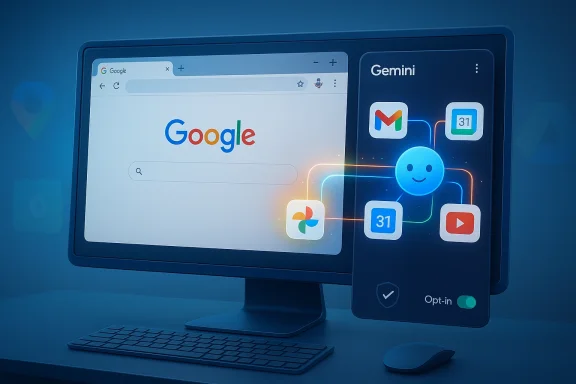
Google’s move to roll Personal Intelligence into three flagship entry points — the Gemini app, AI Mode in Search, and the Gemini integration inside Chrome — marks a deliberate shift from AI novelty toward everyday utility. The company has begun enabling an opt‑in experience that lets Gemini draw from your connected Google apps (Gmail, Google Photos, Search and, in places, YouTube and other Google services) to answer questions and take actions with personal context. The initial launches target eligible U.S. users on Google’s paid AI tiers, and Google says broader availability — including a wider free‑tier rollout and deeper Chrome integration — will follow in phases.
Google first announced Personal Intelligence for the standalone Gemini app in mid‑January 2026, positioning it as a beta connection that lets Gemini reason across a person’s Google apps to deliver personalized answers. A week later Google expanded the capability to AI Mode in Search, letting opt‑in users ask the search experience to use Gmail and Google Photos context for responses. Chrome has also received a more persistent Gemini side panel and agentic features such as Auto Browse, and Google has signaled that Personal Intelligence support will arrive inside Chrome in the months after the initial app and Search rollouts.
The incremental launch pattern — Gemini app first, Search next, Chrome thereafter — is deliberate. It lets Google gather feedback and tune privacy guardrails before embedding the same cross‑app intelligence deeper into services people use most often. The resulting product is less a single feature than a layer of “ambient” personalization that can be turned on or off, and configured for specific kinds of data.
But the risks are equally tangible. Privacy promises are necessary but not sufficient — they must be accompanied by transparent provenance, simple data hygiene tools, and strong defaults for any agentic behavior. The early product design shows an awareness of these concerns: opt‑in defaults, temporary chats, and explicit disconnect controls. The next six months will tell whether those safeguards are operationally effective and whether Google’s assurances about training, retention and provenance survive real‑world use and scrutiny.
For people who value convenience and are comfortable with Google’s ecosystem, Personal Intelligence will likely become an indispensable tool. For privacy‑sensitive users, or organizations with compliance constraints, caution and gradual adoption — combined with careful configuration — remain the prudent path.
Conclusion
Google’s push to weave Personal Intelligence across Gemini, AI Mode in Search, and eventually Chrome is a decisive move to make AI assistants a routine part of daily computing. It amplifies what these assistants can do by turning personal data into usable context — and in doing so, creates both powerful convenience and fresh responsibilities. The coming months of rollout, feedback and regulatory observation will determine whether Personal Intelligence becomes a trusted layer of everyday productivity or a cautionary example of personalization pushed too quickly. Users should approach opt‑in thoughtfully, demand clear provenance and editing controls, and watch how the company translates privacy promises into dependable practice.
Source: The Tech Buzz https://www.techbuzz.ai/articles/google-expands-personal-intelligence-ai-across-search-and-gemini/
Background / Overview
Google first announced Personal Intelligence for the standalone Gemini app in mid‑January 2026, positioning it as a beta connection that lets Gemini reason across a person’s Google apps to deliver personalized answers. A week later Google expanded the capability to AI Mode in Search, letting opt‑in users ask the search experience to use Gmail and Google Photos context for responses. Chrome has also received a more persistent Gemini side panel and agentic features such as Auto Browse, and Google has signaled that Personal Intelligence support will arrive inside Chrome in the months after the initial app and Search rollouts.The incremental launch pattern — Gemini app first, Search next, Chrome thereafter — is deliberate. It lets Google gather feedback and tune privacy guardrails before embedding the same cross‑app intelligence deeper into services people use most often. The resulting product is less a single feature than a layer of “ambient” personalization that can be turned on or off, and configured for specific kinds of data.
What is Personal Intelligence?
Core idea
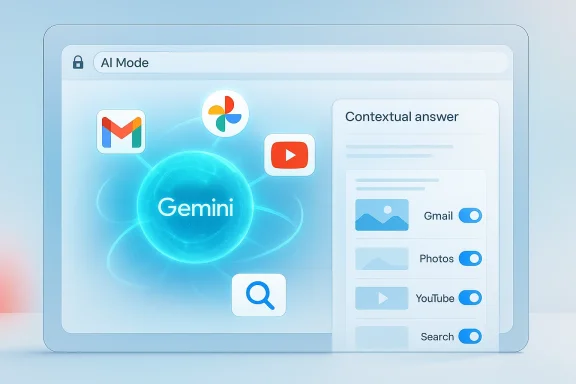
At its heart, Personal Intelligence is about contextualizing generative AI responses with a user’s own data so answers become personally relevant rather than merely generic. Instead of answering only from public web content, Gemini can consult a user’s connected Gmail, Google Photos, Search history, and other linked content to:- Retrieve specific details (flight reservations, receipts, photos).
- Reason across data sources (combine calendar events with travel confirmations to suggest an itinerary).
- Make proactive, personalized suggestions (shopping recommendations tuned to previously purchased brands or sizes).
How it’s exposed to users
Personal Intelligence is delivered as an opt‑in feature. Google’s announced behavior:- In the Gemini app, users can enable Personal Intelligence in settings and select which Google apps to connect.
- In AI Mode in Search, eligible users can choose to connect Gmail and Google Photos to allow AI Mode to use personal context for Search answers.
- In Chrome, Gemini runs as a side‑panel assistant and the company has said Personal Intelligence will be added to that experience in subsequent stages.
Eligibility and limits
At launch Google limited the feature to eligible personal Google accounts in the United States, with early access given to Google AI Pro and AI Ultra subscribers. Google has repeatedly emphasized that the feature is currently not intended for Workspace business, education, or enterprise accounts and that rollout will expand over time.Rollout timeline — factual snapshot
- Jan 14, 2026 — Google announced Personal Intelligence for the Gemini app as a U.S. beta; users could opt in and connect Gmail, Google Photos, YouTube and Search. This announcement included explicit privacy and control messaging from Google.
- Jan 22, 2026 — Google expanded Personal Intelligence into AI Mode in Search, enabling eligible U.S. AI Pro/Ultra users to opt in and let Search reference Gmail and Google Photos for personalized answers.
- Late January 2026 — Google rolled a persistent Gemini side panel and other AI features into Chrome (Auto Browse, Nano Banana image tools). Google stated Personal Intelligence would arrive in Chrome “in the coming months,” with Chrome receiving staged updates to add deeper connected‑apps functionality.
- March 2026 — Google continued to refine the availability and control surface, announcing broader Search tweaks and reminding users of opt‑in controls and feedback mechanisms.
Why this matters: the product case
1) Utility at scale
Integrating personal data with a large language model fundamentally changes the kinds of tasks the assistant can help with. Instead of only producing general advice, Gemini can:- Summarize your week of meetings by scanning Calendar invites and Gmail threads.
- Locate a boarding pass or booking confirmation from Gmail and summarize travel logistics.
- Pull a specific photo (or details from it) to answer immediate questions, such as vehicle identifiers or receipts.
2) Competitive differentiation
Google is leveraging an advantage few rivals can match: the breadth of apps that many people already use and store data in (Search history, Gmail, Photos, YouTube, Maps, Calendar, Drive). Where Apple emphasizes on‑device processing and Microsoft embeds Copilot across Office and Windows, Google’s strategy is to make the assistant aware of the entire Google app ecosystem. For many users this could feel more seamless than juggling several separate AI tools.3) New workflow surfaces
The combination of a persistent browser sidebar (Gemini in Chrome), a proactive auto‑browsing agent, and cross‑app context creates new workflow primitives:- Auto Browse can perform multi‑step web tasks (research, form filling, price comparison) and then surface candidate results for confirmation.
- The side panel decouples the assistant from the active tab, letting it keep long‑running tasks visible while you do other work.
- Personal Intelligence supplies the context that makes agent actions more accurate and personally useful.
The privacy and safety argument (Google’s claim)
Google’s public framing emphasizes several controls and safeguards:- Personal Intelligence is opt‑in and user‑configurable — you pick which apps to connect and can disconnect at any time.
- Google states that Gemini does not directly train models on your raw Gmail or Photos; training uses limited feedback artifacts and obfuscated prompts rather than direct ingestion of personal content.
- The system will attempt to attribute when it uses personal content and let users ask for more explanation or correct mistakes.
- Google offers temporary chats or the option to regenerate responses without personalization for privacy-sensitive interactions.
Critical analysis — strengths and limits
Strengths (what feels genuinely new)
- Contextual accuracy: For personal tasks, an assistant that “remembers” bookings, prior purchases, or family preferences is immediately more useful than the stateless chatbots many people have used to date.
- Friction reduction: Tasks that previously required manually copying emails or opening multiple apps can now be handled in one place with a natural‑language prompt.
- Rapid iteration: Staged rollouts let Google iterate on privacy and correctness before broad exposure; early access to paid subscribers provides higher‑quality feedback loops.
Practical limits and current weaknesses
- Rollout scope is narrow at first: U.S. personal accounts on paid AI tiers get first access. Many users will not see the feature for months.
- Accuracy and nuance: Google itself warns about over‑personalization — the assistant can make wrong inferences (for example, mistaking frequent photos at a golf course as a love of golf when photos reflect family attendance).
- Opaque decisioning: While Google promises explanations, current systems often struggle to produce clear provenance about exactly which piece of personal data produced a claim. That creates risk for useful but unverifiable assertions.
The privacy tradeoffs — what to watch for
Google’s opt‑in approach is critical, but opt‑in does not eliminate risk. Key privacy considerations:- Scope creep: A feature that begins with Gmail and Photos might later expand to Drive, Contacts, Maps, your Shopping history, and more. Each expansion multiplies potential exposure.
- Data lifecycle and deletion: Users need simple, reliable ways to see what was used, edit or delete the assistant’s derived summaries, and know whether those derived artifacts influence future responses.
- Training vs. inference: Google asserts that raw personal content isn’t used to train models directly. But “training on limited info” is vague. Independent auditing and transparency about what minimal signals are retained are necessary to build trust.
- Agentic actions: Auto Browse and agentic tools that log into websites or fill forms introduce new attack surfaces. Any agent that stores credentials or automates web interactions requires hardened security and explicit confirmation flows for sensitive transactions.
- Regulatory and compliance concerns: For users in regulated industries, or where data residency matters, personal assistants that cross apps may create compliance exposures. Google has already restricted the initial beta to personal accounts rather than Workspace, which reflects some of these concerns.
Enterprise and policy implications
- Not for Workspace by default: Google’s public notes say the beta is not for Workspace business, enterprise or education users. That reduces immediate enterprise risk but doesn’t eliminate the potential for similar features to appear inside Workspace later.
- Governance: Organizations will need policy controls — for example, can employees link their personal Gmail/Photos to a corporate browser used for work? Admin controls and endpoint policies will be required.
- Auditability: Enterprises will demand logs and governance tools showing what the assistant read and when. Without this, adoption in regulated workplaces will be slow.
Security and abuse scenarios
- Phishing or social engineering amplification: A personal assistant that can summarize your recent emails might be a target for phishing lure sequences tailored to your schedule or recent purchases.
- Automatic actions gone wrong: Auto Browse that signs into accounts or posts on behalf of users must require strong, explicit confirmation and robust rollback paths.
- Cross‑account leakage: Shared devices, multiple signed‑in accounts, or ephemeral logins risk accidental cross‑account context mixing if safeguards are imperfect.
How users should approach Personal Intelligence today
If you are considering enabling Personal Intelligence, here is a practical checklist:- Review eligibility: ensure you’re aware whether your account is on a qualifying Google AI Pro/Ultra tier and whether the feature is available in your region.
- Start with limited connections: enable only the apps you absolutely need (for trip planning, enable Gmail and Calendar; for photo lookups, enable Photos). Don’t connect everything at once.
- Use temporary chats for sensitive topics: opt for a temporary chat when discussing financial, legal or medical details.
- Learn where settings live: Google’s setup paths are surfaced in the Gemini app and Search personalization settings. Familiarize yourself with how to disconnect apps and delete Gemini history.
- Monitor provenance: when Gemini cites personal content, ask it to show the source and confirm before acting on it.
- If you use Chrome, treat Auto Browse cautiously: require manual confirmations for purchase flows and credential submissions.
What Google should do next (recommended product and policy changes)
- Granular provenance UI: Don’t just say “I used your Gmail.” Show which message or photo and surface a secure link back to the source with a timestamp.
- Editable user summaries: If the assistant builds a “user summary” or memory, let users edit or delete individual items without clearing all history.
- Transparent telemetry: Publish a clear, machine‑readable description of what minimal signals are used for model improvement and how long they are retained.
- Stronger default safeguards for agentic tasks: Auto Browse should have strict default limits (no purchases, no posting) until the user explicitly raises the permission level.
- Independent audits: Invite third‑party privacy and security auditors to validate claims about training and data handling and publish summaries of findings.
Competitive context — Apple, Microsoft, and others
- Apple emphasizes on‑device processing and private cloud compute; the company pitches privacy and local computation as a differentiator. That model reduces central server risk but limits the scale of cross‑app integration that cloud‑native services can provide.
- Microsoft has pushed Copilot across Windows and Microsoft 365 with memory and actions tied into Office apps and Windows itself. Microsoft’s approach prioritizes enterprise governance and integration with business workflows.
- Google is aiming for the opposite tradeoff: broader, ecosystem‑level synergies across consumer apps in the cloud. The result is richer cross‑app assistance — at the cost of raising more complex privacy and governance questions.
The immediate industry implications
- Expect rapid iteration. Personal assistants move quickly from “experimental” to feature expectations for users who try them. Google’s staged rollout means competing platforms will accelerate their own integration stories.
- Regulators and privacy watchdogs will watch agentic abilities (Auto Browse, cross‑app access) carefully, especially where those agents can access financial data, identity artifacts, or post on behalf of users.
- Developers and third‑party services will need guidance and controls if the assistant begins to act as a bridge between users and external commerce platforms (the Universal Commerce Protocol experiments point to that future).
Final assessment — utility vs. risk
Personal Intelligence represents a meaningful step toward assistants that are actually useful for day‑to‑day life: contextually accurate travel help, shopping made personal, and a browser assistant that can compare and act across tabs without continuous manual coordination. For many users, the convenience payoff will be real and immediate.But the risks are equally tangible. Privacy promises are necessary but not sufficient — they must be accompanied by transparent provenance, simple data hygiene tools, and strong defaults for any agentic behavior. The early product design shows an awareness of these concerns: opt‑in defaults, temporary chats, and explicit disconnect controls. The next six months will tell whether those safeguards are operationally effective and whether Google’s assurances about training, retention and provenance survive real‑world use and scrutiny.
For people who value convenience and are comfortable with Google’s ecosystem, Personal Intelligence will likely become an indispensable tool. For privacy‑sensitive users, or organizations with compliance constraints, caution and gradual adoption — combined with careful configuration — remain the prudent path.
Conclusion
Google’s push to weave Personal Intelligence across Gemini, AI Mode in Search, and eventually Chrome is a decisive move to make AI assistants a routine part of daily computing. It amplifies what these assistants can do by turning personal data into usable context — and in doing so, creates both powerful convenience and fresh responsibilities. The coming months of rollout, feedback and regulatory observation will determine whether Personal Intelligence becomes a trusted layer of everyday productivity or a cautionary example of personalization pushed too quickly. Users should approach opt‑in thoughtfully, demand clear provenance and editing controls, and watch how the company translates privacy promises into dependable practice.
Source: The Tech Buzz https://www.techbuzz.ai/articles/google-expands-personal-intelligence-ai-across-search-and-gemini/
- Joined
- Mar 14, 2023
- Messages
- 99,164
- Thread Author
-
- #2
Google’s push to make Gemini feel less like a standalone chatbot and more like a continually mindful assistant took a major step forward this year with the rollout of Personal Intelligence across the Gemini app, AI Mode in Google Search, and deeper integration inside Chrome — a coordinated expansion that turns private Gmail, Photos, YouTube and Search history into usable context for on‑demand answers while keeping the experience opt‑in and, Google says, privacy‑first. ://blog.google/innovation-and-ai/products/gemini-app/personal-intelligence))
Google’s Gemini program has evolved rapidly from research prototype to a broad product strategy that layers multimodal models and agentic tooling over core consumer and enterprise products. The company formally announced the Personal Intelligence beta for U.S. users on January 14, 2026, explaining that the feature will allow Gemini to access selected Google apps — Gmail, Google Photos, YouTube history and Search — to produce responses that are tailored to users’ lives and past activity. The announcement came as part of a wider January sweep of AI updates that also reinforced Gemini’s presence in Search (AI Mode), Gmail, and Chrome. (blog.google) (blog.google)
The expansion is not just cosmetic. Over the past 12 months Google has systematically embedded Gemini across product entry points: a dedicated Gemini app, an AI Mode in Search that surfaces generative overviews and interactive tools, and a native Gemini assistant inside Chrome that can act across tabs and, in time, execute multi‑step agentic tasks. Those platform moves mean the “personalization” layer now has multiple surfaces through which it can assist users — from ad‑hoc, conversational queries in Gemini to contextual suggestions and actions while you search or browse.
As the tech press and labs coverage has documented, Google’s commercial model continues to combine free, broadly available features with premium tiers (Google AI Pro and Google AI Ultra) that get earlier access to the most advanced models and extended context windows. Personal Intelligence launched first to subscribers and trusted testers before moving to a wider U.S. audience, with Google explicitly promising to expand to more countries and tiers over time. (blog.google)
That framing addresses obvious concerns, but several important caveats remain:
Publishers and web professionals should prepare for a world where:
For everyday users, the sensible approach is cautious curiosity: try the feature where it clearly helps, but lock down accounts and review connected apps. For enterprises and regulators, rigorous testing, auditability, and explicit contractual guarantees should be the minimum preconditions for broad adoption. Google’s roadmap promises substantial productivity gains, but the company must earn trust through transparency and hard engineering guarantees if Personal Intelligence is to be both widely useful and responsibly deployed. (blog.google)
Source: The Tech Buzz https://www.techbuzz.ai/articles/google-expands-personal-intelligence-across-search-and-gemini/
Source: The Tech Buzz https://www.techbuzz.ai/articles/google-s-personal-intelligence-rolls-out-to-all-us-users/
Background / Overview
Google’s Gemini program has evolved rapidly from research prototype to a broad product strategy that layers multimodal models and agentic tooling over core consumer and enterprise products. The company formally announced the Personal Intelligence beta for U.S. users on January 14, 2026, explaining that the feature will allow Gemini to access selected Google apps — Gmail, Google Photos, YouTube history and Search — to produce responses that are tailored to users’ lives and past activity. The announcement came as part of a wider January sweep of AI updates that also reinforced Gemini’s presence in Search (AI Mode), Gmail, and Chrome. (blog.google) (blog.google)The expansion is not just cosmetic. Over the past 12 months Google has systematically embedded Gemini across product entry points: a dedicated Gemini app, an AI Mode in Search that surfaces generative overviews and interactive tools, and a native Gemini assistant inside Chrome that can act across tabs and, in time, execute multi‑step agentic tasks. Those platform moves mean the “personalization” layer now has multiple surfaces through which it can assist users — from ad‑hoc, conversational queries in Gemini to contextual suggestions and actions while you search or browse.
As the tech press and labs coverage has documented, Google’s commercial model continues to combine free, broadly available features with premium tiers (Google AI Pro and Google AI Ultra) that get earlier access to the most advanced models and extended context windows. Personal Intelligence launched first to subscribers and trusted testers before moving to a wider U.S. audience, with Google explicitly promising to expand to more countries and tiers over time. (blog.google)
What exactly is Personal Intelligence?
How it works, in practical terms
At its core Personal Intelligence is an access layer that lets Gemini read and reason across user‑selected Google data sources when responding to requests. Instead of providing generic answers pulled only from the public web, Gemini can pull specifics from your inbox, your photo library, and your search activity to:- Retrieve factual details from your own messages (flights, receipts, appointments).
- Summarize or surface photos and videos that corroborate a claim or answer.
- Combine personal signals with public knowledge to make tailored recommendations (e.g., restaurant choices aligned to past trips).
- Provide proactive, context‑aware assistance in search and browsing scenarios where the system can infer intent from past behavior.
Two technical strengths Google highlights
- Cross‑source reasoning — Gemini’s models are used to synthesize evidence across text, images and video to answer complex questions that combine formats (for example, verifying travel dates from an itinerary and photos).
- Retrieval of specific details — the system can pull particular facts (a booking number, a photo timestamp) and use them in a response, reducing friction for the user. (blog.google)
Where users will see Personal Intelligence
Gemini app (the primary testbed)
The Gemini app is the canonical place to opt in and configure Personal Intelligence. The Google blog shows a guided setup flow that lists the connected apps and explains how Personal Intelligence will use them; the interface also includes options to turn the feature off. For many users, the Gemini app will remain the most polished environment for experimenting with personalized prompts and follow‑ups. (blog.google)AI Mode in Google Search
Google is integrating Personal Intelligence into AI Mode in Search, which already supplies AI Overviews and interactive Canvas workspaces for deeper tasks. In AI Mode, Personal Intelligence allows Search to answer queries with your context — for example, factoring a recent gift card email into a recommendation or surfacing your flight confirmation when you ask about upcoming travel. Google has said that AI Mode’s integrated use of Gemini models is now part of the company’s core search experience in English for U.S. users. (blog.google)Gemini in Chrome and agentic browsing
Chrome’s native Gemini integration — formerly tested with subscription gating — has been expanded in desktop builds to allow a toolbar assistant, an AI Mode accessible from the omnibox, and the groundwork for “agentic” features that can perform multi‑step chores across tabs and Google services. That means in the future, at least for certain users or tiers, Personal Intelligence could power Chrome actions such as auto‑filling details from your Gmail or scheduling events using contextual information found in your inbox. Google’s Chrome announcements and media reporting show the company positioning the browser as the next major surface for AI assistance.Verified timeline and availability
- Jan 14, 2026 — Google announced Personal Intelligence in the Gemini app as a U.S. beta. The company described the feature, the apps it connects to, and the opt‑in controls. (blog.google)
- Prior to that, throughout 2025 Google progressively embedded Gemini models into Search (AI Mode) and Chrome, with notable Chrome integrations and agentic feature previews reported during fall 2025. Chrome’s Gemini assistant began appearing for U.S. desktop users in staged rollouts in late 2025.
- January–March 2026 — Google publicly signaled and executed expansions that put AI Mode and Canvas features into a broader U.S. pool of users; different features (Canvas in AI Mode, Gemini in Chrome) have followed their own incremental rollouts to both subscribers and general U.S. users. Some Canvas and AI Mode features were confirmed in March 2026 as being available to all U.S. Search users in English.
Privacy, data use and user controls — what Google says, and what to watch
Google’s messaging centers on three core privacy claims: the feature is opt‑in, users choose precisely which apps they connect, and personal data used by Personal Intelligence is not used to train Google’s base models. Those points appear repeatedly in the company’s blog post and in collateral accompanying the launch. The setup flow explicitly lists Gmail, Photos, YouTube and Search as connection candidates and allows users to toggle them. (blog.google)That framing addresses obvious concerns, but several important caveats remain:
- Data residency and corporate governance. Google’s argument that data “already lives at Google securely” is true for consumer accounts but complicates enterprise deployments where Workspace administrators control data policies. Organizations will need explicit governance for agents that can read user mail or Drive files; otherwise the same convenience that helps an individual can create leakage risks in shared or regulated environments. (blog.google)
- No‑training claim vs. downstream model updates. Google’s stated policy that Personal Intelligence data will not be used to train models is important but operationally complex: systems must isolate retrieval‑only stores from training pipelines and publish audit evidence. Independent verification will be required for trust to be meaningful. Google says Personal Intelligence is built with privacy in mind, but third‑party audits or machine‑readable guarantees would materially improve credibility. (blog.google)
- Scope creep and feature expansion. The current opt‑in model limits immediate exposure, but product teams often expand convenience features over time. Users should treat an opt‑in as a consent for a defined set of features at a point in time; product change logs and clear in‑app notices are essential if the scope of data use grows. (blog.google)
Security, abuse and agentic risk
Embedding personal app data into a live assistant and enabling browser‑level automation increases both usefulness and attack surface.- Account compromise risks. If an account is compromised, an attacker might use agentic features to triangulate financial information, automatically submit forms, or extract contact lists. Security hygiene — strong passwords, multi‑factor authentication, and session management — becomes more critical when agents can act on your behalf. Google has signaled investments in AI‑driven scam detection and automated password resets as part of the broader Chrome/Gemini rollout, but the defensive story must keep pace with the new capabilities.
- Agentic automation hazards. The vision of an assistant that books travel, schedules appointments, or purchases on your behalf is compelling, but it opens a class of actionable errors — if the assistant misreads a preference or acts on stale information the consequences can be real (double bookings, unwanted purchases). Risk mitigation requires explicit confirmation flows, bounded permissions, and human‑in‑the‑loop safeguards. Several outlets flagged this class of risk when Chrome’s agentic features were previewed.
- Malicious uses and prompt abuse. Personalization can amplify social engineering: attackers who already have limited access to a user’s digital footprint could craft highly convincing scams that exploit the assistant’s tendency to rely on familiar context. Google’s claims of anti‑abuse tooling must be accompanied by threat models and red‑team results to be persuasive.
Implications for publishers, SEO and the web ecosystem
Google’s broader AI strategy — pushing Gemini into Search and delivering richer AI Overviews — has already changed how users interact with the web. Independent reporting and search industry analysis signaled that AI Overviews have reduced clickthrough rates to websites; that effect is central to publisher concerns and antitrust scrutiny. The Personal Intelligence layer adds a personal dimension: answers that reference your own data reduce the need to follow links for personalization‑specific tasks (e.g., “What’s in my upcoming travel itinerary?”).Publishers and web professionals should prepare for a world where:
- Surface answers are often delivered directly in search results without a click.
- Users increasingly interact with generated summaries that blend public and private information.
- New signals (structured data, explicit API feeds, and high‑quality canonical answers) could be necessary to retain visibility when Search answers queries directly.
Enterprise angle: governance, Gemini Enterprise and policy
Google’s enterprise strategy — embodied in Gemini Enterprise and Workspace integrations — runs parallel to the consumer Personal Intelligence push. For organizations, the difference between employee convenience and corporate risk is pronounced. Gemini Enterprise promises centralized governance, connectors and agent tooling geared for workplace control; Google has positioned that product as a direct competitor to Microsoft Copilot and other enterprise assistants. Enterprises evaluating Personal Intelligence‑style features should demand:- Clear data flow diagrams showing where data is accessed, cached, and stored.
- Admin controls that prevent cross‑tenant leakage and permit per‑user opt‑out.
- Audit logs for agentic actions and retrievals.
- Contractual guarantees on how personal/enterprise data is used or retained.
Practical guidance: how to evaluate and manage Personal Intelligence right now
If you’re a consumer or an IT admin wondering what to do next, here are concrete, actionable steps.- Review the opt‑in flow inside the Gemini app or Search AI Mode and confirm which apps are requested. Google’s step sequence to enable Personal Intelligence is intentionally explicit: open Gemini → Settings → Personal Intelligence → select Connected Apps. (blog.google)
- Start small. For consumers, try connecting a single, low‑sensitivity source (e.g., Search history) before allowing access to Gmail. Assess benefit vs. perceived exposure. (blog.google)
- For Workspace admins: pilot with a controlled group, document agent actions and audit logs, and define a policy for what classes of data may be surfaced to an agent (customer PII, HR records, and finance data may need stricter rules).
- Harden accounts: enforce multi‑factor authentication, monitor sign‑ins, and apply session timeout policies for accounts with agent access.
- Stay current with Google’s public notices. Because Google is rolling features in phases, change logs and blog posts are the first place to spot scope expansions or new surfaces (Chrome, Search, Gmail). (blog.google)
Strengths: why this matters
- Productivity uplift. Personal Intelligence can remove friction for routine tasks, saving time by surfacing precise personal facts without manual searching.
- Integration leverage. Google’s control of core consumer surfaces (Search, Gmail, Photos, Chrome) gives it a unique advantage: it can combine signals from multiple, high‑value data sources in ways few competitors can match.
- User control model. The opt‑in design and per‑app toggles are positive design choices that put control in user hands, at least initially. Google’s early messaging emphasizes privacy and control, which is a better starting point than opaque defaults. (blog.google)
Risks and open questions
- Auditability and verification. Google’s non‑training promises require independent verification. Without transparent audits or machine‑readable guarantees, users and enterprises may be justified in cautious skepticism. (blog.google)
- Attack surface expansion. Agentic browsing, while powerful, raises the stakes for account compromises and social engineering. The security stack must evolve in step.
- Regulatory scrutiny. As Google moves personalized AI deeper into core services, regulators may question how personalized answers affect competition, privacy rights, and fair access to information. Policymakers already watch search and browser market power closely; adding personalized AI increases the significance of those debates.
- Economic impacts on publishers. Continued decline in referral traffic could pressure the economics of many independent publishers, accelerating calls for compensation, attribution standards, or search result reforms.
What Google should do next (recommendations)
- Publish a clear, machine‑readable privacy policy specific to Personal Intelligence that details retention, training exclusions, and access logs.
- Provide downloadable audit reports for enterprise customers showing retrievals and agent actions tied to user requests.
- Introduce granular connection controls (date range, labels/folders, file type exclusions) so users and admins can tailor exposure.
- Implement conservative defaults for agentic actions: explicit user confirmation for financial transactions or contact‑list alterations.
- Fund or welcome independent audits (third‑party, community‑driven audits) to validate “not used to train” claims and other privacy assurances.
The strategic angle: why Google is moving now
Embedding Personal Intelligence across Search, Chrome and Gemini turns Google’s scale into a behavioral moat. The company is betting that once personalized assistants become useful in everyday moments (booking, organizing, retrieving personal facts), users will favor an integrated stack. This strategy plays to Google’s strengths — ubiquitous storage of personal data and dominant search/browsing surfaces — but it also magnifies scrutiny from regulators, enterprises and the media. The next 12 months will be decisive: product maturity and governance will determine whether the feature is embraced or becomes a reputational liability. (blog.google)Conclusion
Personal Intelligence is a meaningful evolution in conversational AI: it shifts generative assistants from generic helpers to context‑rich, personally useful companions across the Gemini app, AI Mode in Search, and Chrome. That convenience is real and compelling, but it carries a matching set of responsibilities — robust security, verifiable privacy guarantees, and clear governance for both consumers and enterprises.For everyday users, the sensible approach is cautious curiosity: try the feature where it clearly helps, but lock down accounts and review connected apps. For enterprises and regulators, rigorous testing, auditability, and explicit contractual guarantees should be the minimum preconditions for broad adoption. Google’s roadmap promises substantial productivity gains, but the company must earn trust through transparency and hard engineering guarantees if Personal Intelligence is to be both widely useful and responsibly deployed. (blog.google)
Source: The Tech Buzz https://www.techbuzz.ai/articles/google-expands-personal-intelligence-across-search-and-gemini/
Source: The Tech Buzz https://www.techbuzz.ai/articles/google-s-personal-intelligence-rolls-out-to-all-us-users/
Similar threads
- Article
- Replies
- 0
- Views
- 2
- Replies
- 0
- Views
- 10
- Article
- Replies
- 0
- Views
- 35
- Article
- Replies
- 1
- Views
- 352
- Article
- Replies
- 0
- Views
- 25