

Google reportedly limited Meta’s access to Gemini AI models in March 2026 after Meta tried to buy more AI computing capacity than Alphabet could supply, disrupting some internal Meta AI projects and exposing a hard infrastructure ceiling inside the generative-AI boom. The detail that matters is not simply that two rivals had a commercial disagreement. It is that one of the world’s largest AI builders was leaning on another hyperscaler’s models, and even that hyperscaler could not say yes. The AI race is increasingly being decided not by demos, slogans, or keynote bravado, but by who can get enough accelerators, power, networking, data-center space, and scheduling priority when everyone wants the same scarce machines at once.
For the past two years, the industry has sold artificial intelligence as software: a subscription, an assistant, a pane in the browser, a chatbot in the enterprise suite, a button in the operating system. That framing was convenient because software scales almost mythically in the public imagination. Write the code once, push it to the cloud, and the world can use it.
Generative AI does not scale like that. Every prompt burns inference capacity. Every internal benchmark, model comparison, coding assistant session, synthetic-data run, and agentic workflow consumes tokens that must be processed somewhere, on hardware that is expensive, power-hungry, and not instantly replaceable.
That is why the reported Google-Meta squeeze is more than another episode in the Silicon Valley rivalry machine. It is a glimpse of the economic substrate beneath the AI layer. The companies telling enterprises that AI is ready to become a default input into every workflow are still discovering how hard it is to provide that default at industrial scale.
Meta is not a small customer who underestimated its monthly API bill. It is one of the richest and most infrastructure-savvy technology companies on the planet, a company that has poured billions into its own AI chips, data centers, research labs, and open-weight model strategy. If Meta can run into a supply wall while trying to buy Gemini capacity from Google, then the wall is real.
Meta has spent years presenting itself as a full-stack AI contender. It has promoted Llama as a strategic counterweight to closed models, pushed Meta AI across Facebook, Instagram, WhatsApp, and Ray-Ban smart glasses, and tried to turn distribution into a moat. Its pitch is that it can place AI in front of billions of people without asking permission from Microsoft, OpenAI, Google, or Anthropic.
Yet the reported disruption suggests Meta’s internal AI work still depended, at least in part, on access to Google’s frontier or near-frontier models. That does not mean Meta has failed. Large AI labs routinely compare models, use external systems for evaluation, augmentation, coding support, distillation experiments, data generation, and internal tooling. In 2026, model pluralism is not a weakness; it is how serious teams work.
But dependence becomes strategically awkward when a rival controls the throttle. If Gemini capacity is part of an internal development pipeline, Google does not need to cut Meta off to create pressure. It only needs to say: not as much as you wanted, not as fast as you planned, not at the priority level you assumed.
That turns “AI access” from a procurement line item into a strategic vulnerability. Enterprises already know this problem in cloud computing. The difference is that classic cloud capacity shortages were usually regional, temporary, or tied to particular VM families. AI capacity is more exotic. The hottest GPUs and TPUs are not interchangeable with ordinary compute, and the software stack around them is not a commodity utility.
On one level, this is the dream scenario. Customers are not being dragged reluctantly into AI pilots. They are queuing up for expensive capacity, signing large commitments, and asking for more than the provider can immediately deliver. The market signal is clear: if Google had more AI compute available, it could sell more of it.
But a sold-out cloud is not the same as a healthy cloud. Capacity constraints can flatter demand while quietly damaging trust. If a customer builds a workflow around Gemini and then receives usage limits, the customer learns a lesson that no sales deck can undo: AI capacity is not yet as elastic as cloud marketing implies.
That matters especially for CIOs and platform teams. The whole premise of cloud migration was that enterprises could stop planning hardware years in advance and buy what they needed when they needed it. AI is dragging the market back toward reservation, scarcity, and long-horizon infrastructure planning. The cloud is beginning to look less like an infinite pool and more like a priority queue.
Google is hardly alone here. Microsoft has repeatedly had to balance Azure AI demand, OpenAI workloads, Copilot expansion, and enterprise commitments. Amazon is racing to position AWS as the default neutral infrastructure layer for AI builders. Oracle, CoreWeave, and newer GPU-cloud providers have built entire narratives around capacity availability. The difference in the Google-Meta case is the optics: one AI giant reportedly telling another AI giant that the cupboard is not full enough.
For years, employee technology usage was measured in devices, licenses, storage, bandwidth, and compute instances. AI adds a new metered resource to the enterprise stack: tokens. Tokens are not just a billing abstraction. They are the unit by which language-model work is priced, throttled, optimized, and rationed.
That changes internal behavior. Engineers who once treated model calls as an abundant convenience now have to think about prompt length, retry loops, batch processing, caching, model selection, and whether a frontier model is necessary for a given task. Product managers who imagined AI features as a UX layer must confront the fact that every enthusiastic user interaction can become a marginal infrastructure cost.
The Windows analogy is not perfect, but it is useful. In the PC era, sloppy software could assume faster CPUs, more RAM, and bigger disks would arrive soon enough. In the cloud era, sloppy architecture produced ugly bills but usually kept running. In the AI era, sloppy token use can hit both the budget and the quota ceiling.
This is where IT pros should pay attention. Token efficiency is becoming the new performance engineering. The next generation of enterprise AI governance will not be limited to privacy rules and approved model lists. It will include internal budgets, routing policies, prompt standards, observability, and escalation paths for scarce model capacity.
Google has incentives to serve large paying customers, even competitors. Cloud providers have long sold infrastructure to companies they also compete with. Microsoft hosts workloads for firms that use competing productivity suites. Amazon runs AWS for retailers that compete with Amazon’s commerce business. Google Cloud wants enterprise credibility, and telling the market that it cannot satisfy a huge AI customer is not a risk-free boast.
The more plausible reading is less theatrical and more structural. Google is triaging demand. Meta wanted more capacity than Google could provide. Other clients were reportedly affected too, though less severely. Meta’s demand was unusually large, so Meta felt the squeeze more visibly.
That distinction matters because it tells us this is not merely a dispute between rivals. It is a market-wide capacity crunch surfacing in one especially conspicuous relationship. The AI industry has spent the last year talking about model quality as if the next leaderboard would decide everything. But model quality only matters if users can access the model at acceptable latency, reliability, and cost.
For enterprise buyers, the uncomfortable conclusion is that a model’s benchmark score is only half the procurement question. The other half is capacity assurance. Can the vendor support your expected usage during peak periods? Can it isolate your workloads from consumer demand spikes? Can it commit to throughput rather than vague availability? Can it explain what happens when its own first-party products need the same accelerators you are renting?
Microsoft has an advantage Google does not fully share: it owns the dominant enterprise productivity estate. If Copilot can be embedded into Outlook, Teams, Excel, Word, Visual Studio Code, GitHub, and Windows management workflows, Microsoft does not need users to go shopping for AI. The AI shows up where work already happens.
But that advantage cuts both ways. Ubiquity multiplies demand. A successful Copilot rollout is not a few power users chatting with a model; it is millions of employees asking systems to summarize meetings, draft documents, query internal data, write code, analyze spreadsheets, triage alerts, and automate repetitive tasks. Every “make AI ambient” strategy is also a “make compute demand unpredictable” strategy.
Microsoft’s Azure customers have already seen capacity as a practical issue in the AI buildout. GPU availability, regional constraints, quota approvals, and reserved capacity have become ordinary parts of enterprise planning. The Google-Meta report reinforces the lesson: even the biggest clouds cannot magically turn capital expenditure into live AI capacity overnight.
That creates an opening for Microsoft if it can make reliability part of the Copilot sales pitch. Enterprises do not merely want the cleverest assistant. They want the assistant that shows up every workday, respects governance boundaries, performs predictably, and does not force the help desk to explain why the AI button is temporarily less capable because the provider’s accelerators are oversubscribed.
If every useful AI interaction has to round-trip to a hyperscale model, the economics get ugly fast. Latency rises, privacy questions multiply, and cloud capacity becomes a gating factor. Local AI will not replace frontier models, but it can absorb routine tasks that do not require the most capable system in the fleet.
That is where Windows could become strategically important again. A billion-client ecosystem with NPUs, local models, enterprise policy controls, and hybrid routing could reduce pressure on cloud inference while making AI feel more continuous to users. The trick is not to pretend a laptop NPU can do what a data center full of accelerators can do. The trick is to route the right task to the right tier.
For admins, that future is both promising and messy. Local models introduce patching, policy, audit, and data-boundary questions. Cloud models introduce cost, capacity, compliance, and vendor-lock-in questions. Hybrid AI introduces all of them at once.
Still, the direction is hard to miss. If Google can struggle to supply enough Gemini capacity to Meta, then the industry has a strong incentive to push smaller, cheaper, and more specialized models wherever they can run effectively. The AI PC is not just a consumer gimmick in that context. It is part of a broader attempt to stop every mundane task from becoming a premium cloud inference event.
Those questions still matter, but they are no longer enough. The Google-Meta report suggests enterprises should treat AI capacity the way they treat disaster recovery, identity, and network architecture: as a first-class operational risk.
The uncomfortable truth is that many AI pilots have been too small to reveal the real problem. A department-level proof of concept can look impressive while barely touching the vendor’s infrastructure. A global rollout is different. So is an internal developer platform that thousands of engineers begin using all day. So is an agent system that calls models repeatedly in the background, converting one human request into dozens of inference steps.
That is why procurement needs to evolve. Enterprises should ask vendors for capacity commitments, throttling rules, peak-use assumptions, regional availability, model fallback policies, and cost behavior under heavy usage. If a vendor cannot answer those questions clearly, the customer is not buying a platform. It is buying a best-effort service wrapped in enterprise language.
There is also a governance issue hiding here. When token budgets become constrained, organizations will need policies for who gets priority. Does security operations get premium model access before marketing? Do developers get more generous coding-agent quotas than general office users? Do executives get unrestricted access while frontline workers are routed to cheaper models? These are not technical details. They are organizational choices expressed through infrastructure.
But open weights do not conjure compute out of the air. Running a large model at scale still requires accelerators, memory bandwidth, networking, storage, power, cooling, and operations expertise. Fine-tuning, serving, monitoring, and securing open models can shift dependence away from a model vendor, but not away from infrastructure.
That is the paradox for Meta. Its open-model approach weakens the moat of closed model providers, but its own internal demand may still lead it to use those providers when they offer capabilities or convenience it wants. Openness changes the bargaining position. It does not erase the need for capacity.
For enterprises, open models remain a powerful hedge. They can reduce lock-in, support private deployments, allow customization, and enable fallback strategies when a hosted model becomes too expensive or constrained. But they are not a magic exit from the AI supply chain. Someone still has to pay for the machines.
This is where smaller models may matter more than ideological debates about open versus closed AI. A smaller model that performs well enough, runs cheaply, and can be deployed reliably may beat a larger model that wins benchmarks but cannot be guaranteed at scale. In production IT, available and adequate often beats brilliant and scarce.
The time horizon is brutal. A product team can invent an AI feature in a quarter. A data center campus can take years. Power infrastructure can take longer. The mismatch between software ambition and physical buildout is now shaping the competitive landscape.
That is why cloud backlogs and capex forecasts have become central AI indicators. Investors watch them as proof that demand is real. Customers should watch them as proof that supply is contested. A giant backlog means the vendor has customers lined up. It can also mean the vendor has promised more future capacity than it can instantly deliver.
There is also a prioritization problem. Hyperscalers are not neutral utilities when it comes to AI. They have first-party products, strategic partners, sovereign customers, enterprise commitments, and internal research teams competing for the same infrastructure. When capacity tightens, allocation becomes strategy.
Google must decide how much compute goes to Search, Gemini consumer products, Google Workspace, Cloud customers, DeepMind research, YouTube features, Android integrations, and external clients like Meta. Microsoft must balance OpenAI, Copilot, Azure customers, GitHub, security products, and Windows experiences. Amazon must serve AWS customers while developing its own AI stack. The scarce resource is no longer just chips; it is executive attention over who gets them first.
One new feature can multiply usage. One viral consumer workflow can spike inference. One internal mandate to use coding agents can change developer behavior across a company in weeks. One agentic architecture can turn a single business process into a cascade of model calls. A new model release can pull customers from older systems overnight, or create a rush of benchmarking and migration activity.
That lumpiness makes capacity planning harder. Providers must build ahead of demand without overbuilding into a depreciation cliff. Customers must commit enough to secure access without locking themselves into a vendor or model family that may look second-rate six months later.
The Google-Meta story sits exactly at that tension point. Meta reportedly wanted more capacity. Google reportedly could not supply all of it. Both sides may be acting rationally, and the result is still friction.
For the broader market, this is a sign that AI is leaving the toy phase. Scarcity becomes visible when usage becomes real. The industry is no longer arguing only about whether people will use AI. It is now discovering what happens when they do.
For IT leaders, the vendor conversation needs to become more concrete. The right questions are increasingly about throughput, fallback, cost ceilings, data residency, observability, and contractual remedies. AI strategy cannot be delegated entirely to innovation teams if the result is a production dependency on scarce external capacity.
The same applies to developers. Prompt engineering was the first folk discipline of the generative-AI era. The next discipline is inference engineering: choosing models, minimizing token waste, caching outputs, evaluating smaller systems, batching workloads, and designing agents that do not spend compute like a drunken sailor.
Security teams should also pay attention. When organizations face AI scarcity, employees may route work through unofficial tools that appear faster, cheaper, or less restricted. Shadow AI is not only a data-loss problem. It is a capacity and convenience problem. If the sanctioned tool is throttled and the unsanctioned tool is not, policy will be tested.
The winning enterprises will not be the ones that ban everything until the market settles. They will be the ones that build a layered AI architecture early: approved cloud models for high-value tasks, local or private models for sensitive and routine work, clear governance, and enough telemetry to know where the tokens are going.
The next phase of AI competition will not be won only by the lab with the cleverest model or the company with the loudest keynote. It will be won by the firms that can turn intelligence into dependable infrastructure: enough capacity, in the right places, at tolerable cost, with governance that enterprises can trust. The reported Gemini limit on Meta is a warning flare from that future, and the industry should treat it less like gossip between rivals and more like an early capacity incident in the operating system of the AI economy.
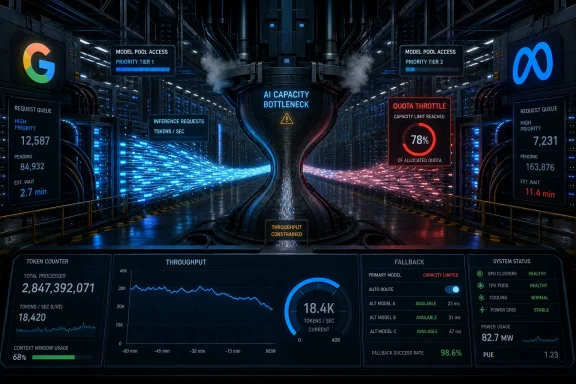 The AI Boom Has Found Its Bottleneck, and It Is Not Imagination
For the past two years, the industry has sold artificial intelligence as software: a subscription, an assistant, a pane in the browser, a chatbot in the enterprise suite, a button in the operating system. That framing was convenient because software scales almost mythically in the public imagination. Write the code once, push it to the cloud, and the world can use it.Generative AI does not scale like that. Every prompt burns inference capacity. Every internal benchmark, model comparison, coding assistant session, synthetic-data run, and agentic workflow consumes tokens that must be processed somewhere, on hardware that is expensive, power-hungry, and not instantly replaceable.
That is why the reported Google-Meta squeeze is more than another episode in the Silicon Valley rivalry machine. It is a glimpse of the economic substrate beneath the AI layer. The companies telling enterprises that AI is ready to become a default input into every workflow are still discovering how hard it is to provide that default at industrial scale.
Meta is not a small customer who underestimated its monthly API bill. It is one of the richest and most infrastructure-savvy technology companies on the planet, a company that has poured billions into its own AI chips, data centers, research labs, and open-weight model strategy. If Meta can run into a supply wall while trying to buy Gemini capacity from Google, then the wall is real.
Meta’s Gemini Dependency Is the Quietly Embarrassing Part
The obvious headline is that Google put limits on Meta’s Gemini use. The more interesting fact is that Meta was using enough Gemini capacity for the restriction to matter.Meta has spent years presenting itself as a full-stack AI contender. It has promoted Llama as a strategic counterweight to closed models, pushed Meta AI across Facebook, Instagram, WhatsApp, and Ray-Ban smart glasses, and tried to turn distribution into a moat. Its pitch is that it can place AI in front of billions of people without asking permission from Microsoft, OpenAI, Google, or Anthropic.
Yet the reported disruption suggests Meta’s internal AI work still depended, at least in part, on access to Google’s frontier or near-frontier models. That does not mean Meta has failed. Large AI labs routinely compare models, use external systems for evaluation, augmentation, coding support, distillation experiments, data generation, and internal tooling. In 2026, model pluralism is not a weakness; it is how serious teams work.
But dependence becomes strategically awkward when a rival controls the throttle. If Gemini capacity is part of an internal development pipeline, Google does not need to cut Meta off to create pressure. It only needs to say: not as much as you wanted, not as fast as you planned, not at the priority level you assumed.
That turns “AI access” from a procurement line item into a strategic vulnerability. Enterprises already know this problem in cloud computing. The difference is that classic cloud capacity shortages were usually regional, temporary, or tied to particular VM families. AI capacity is more exotic. The hottest GPUs and TPUs are not interchangeable with ordinary compute, and the software stack around them is not a commodity utility.
Google’s Problem Is the Kind Every Cloud Vendor Wants — Until It Isn’t
Alphabet’s recent cloud numbers make the reported shortage easier to understand. Google Cloud has been growing rapidly, with AI infrastructure and enterprise AI services becoming central to its momentum. Alphabet has also acknowledged that demand for compute has been strong enough to constrain growth, while its cloud backlog has ballooned.On one level, this is the dream scenario. Customers are not being dragged reluctantly into AI pilots. They are queuing up for expensive capacity, signing large commitments, and asking for more than the provider can immediately deliver. The market signal is clear: if Google had more AI compute available, it could sell more of it.
But a sold-out cloud is not the same as a healthy cloud. Capacity constraints can flatter demand while quietly damaging trust. If a customer builds a workflow around Gemini and then receives usage limits, the customer learns a lesson that no sales deck can undo: AI capacity is not yet as elastic as cloud marketing implies.
That matters especially for CIOs and platform teams. The whole premise of cloud migration was that enterprises could stop planning hardware years in advance and buy what they needed when they needed it. AI is dragging the market back toward reservation, scarcity, and long-horizon infrastructure planning. The cloud is beginning to look less like an infinite pool and more like a priority queue.
Google is hardly alone here. Microsoft has repeatedly had to balance Azure AI demand, OpenAI workloads, Copilot expansion, and enterprise commitments. Amazon is racing to position AWS as the default neutral infrastructure layer for AI builders. Oracle, CoreWeave, and newer GPU-cloud providers have built entire narratives around capacity availability. The difference in the Google-Meta case is the optics: one AI giant reportedly telling another AI giant that the cupboard is not full enough.
Tokens Have Become the New Office Electricity
The report that Meta encouraged staff to use AI tokens more efficiently is easy to dismiss as corporate housekeeping. It is actually one of the most revealing details in the story.For years, employee technology usage was measured in devices, licenses, storage, bandwidth, and compute instances. AI adds a new metered resource to the enterprise stack: tokens. Tokens are not just a billing abstraction. They are the unit by which language-model work is priced, throttled, optimized, and rationed.
That changes internal behavior. Engineers who once treated model calls as an abundant convenience now have to think about prompt length, retry loops, batch processing, caching, model selection, and whether a frontier model is necessary for a given task. Product managers who imagined AI features as a UX layer must confront the fact that every enthusiastic user interaction can become a marginal infrastructure cost.
The Windows analogy is not perfect, but it is useful. In the PC era, sloppy software could assume faster CPUs, more RAM, and bigger disks would arrive soon enough. In the cloud era, sloppy architecture produced ugly bills but usually kept running. In the AI era, sloppy token use can hit both the budget and the quota ceiling.
This is where IT pros should pay attention. Token efficiency is becoming the new performance engineering. The next generation of enterprise AI governance will not be limited to privacy rules and approved model lists. It will include internal budgets, routing policies, prompt standards, observability, and escalation paths for scarce model capacity.
The Rivalry Story Is Smaller Than the Infrastructure Story
It is tempting to frame this as Google taking a subtle shot at Meta. That version is satisfying, but probably too neat.Google has incentives to serve large paying customers, even competitors. Cloud providers have long sold infrastructure to companies they also compete with. Microsoft hosts workloads for firms that use competing productivity suites. Amazon runs AWS for retailers that compete with Amazon’s commerce business. Google Cloud wants enterprise credibility, and telling the market that it cannot satisfy a huge AI customer is not a risk-free boast.
The more plausible reading is less theatrical and more structural. Google is triaging demand. Meta wanted more capacity than Google could provide. Other clients were reportedly affected too, though less severely. Meta’s demand was unusually large, so Meta felt the squeeze more visibly.
That distinction matters because it tells us this is not merely a dispute between rivals. It is a market-wide capacity crunch surfacing in one especially conspicuous relationship. The AI industry has spent the last year talking about model quality as if the next leaderboard would decide everything. But model quality only matters if users can access the model at acceptable latency, reliability, and cost.
For enterprise buyers, the uncomfortable conclusion is that a model’s benchmark score is only half the procurement question. The other half is capacity assurance. Can the vendor support your expected usage during peak periods? Can it isolate your workloads from consumer demand spikes? Can it commit to throughput rather than vague availability? Can it explain what happens when its own first-party products need the same accelerators you are renting?
Microsoft Should Read This as Both Warning and Opportunity
For WindowsForum readers, the most relevant comparison is Microsoft. Redmond has tied its AI strategy to Copilot across Windows, Microsoft 365, GitHub, Security, Dynamics, Azure, and developer tools. That strategy only works if AI becomes a dependable layer, not a feature that appears abundant in demos and scarce in production.Microsoft has an advantage Google does not fully share: it owns the dominant enterprise productivity estate. If Copilot can be embedded into Outlook, Teams, Excel, Word, Visual Studio Code, GitHub, and Windows management workflows, Microsoft does not need users to go shopping for AI. The AI shows up where work already happens.
But that advantage cuts both ways. Ubiquity multiplies demand. A successful Copilot rollout is not a few power users chatting with a model; it is millions of employees asking systems to summarize meetings, draft documents, query internal data, write code, analyze spreadsheets, triage alerts, and automate repetitive tasks. Every “make AI ambient” strategy is also a “make compute demand unpredictable” strategy.
Microsoft’s Azure customers have already seen capacity as a practical issue in the AI buildout. GPU availability, regional constraints, quota approvals, and reserved capacity have become ordinary parts of enterprise planning. The Google-Meta report reinforces the lesson: even the biggest clouds cannot magically turn capital expenditure into live AI capacity overnight.
That creates an opening for Microsoft if it can make reliability part of the Copilot sales pitch. Enterprises do not merely want the cleverest assistant. They want the assistant that shows up every workday, respects governance boundaries, performs predictably, and does not force the help desk to explain why the AI button is temporarily less capable because the provider’s accelerators are oversubscribed.
Windows AI Features Will Live or Die on Capacity Discipline
The AI PC narrative has often been presented as a way to move inference closer to the user. Neural processing units in Windows laptops promise local transcription, image processing, recall-style indexing, background effects, and eventually more sophisticated on-device agents. That story sometimes gets wrapped in marketing fog, but the capacity crunch gives it a harder business rationale.If every useful AI interaction has to round-trip to a hyperscale model, the economics get ugly fast. Latency rises, privacy questions multiply, and cloud capacity becomes a gating factor. Local AI will not replace frontier models, but it can absorb routine tasks that do not require the most capable system in the fleet.
That is where Windows could become strategically important again. A billion-client ecosystem with NPUs, local models, enterprise policy controls, and hybrid routing could reduce pressure on cloud inference while making AI feel more continuous to users. The trick is not to pretend a laptop NPU can do what a data center full of accelerators can do. The trick is to route the right task to the right tier.
For admins, that future is both promising and messy. Local models introduce patching, policy, audit, and data-boundary questions. Cloud models introduce cost, capacity, compliance, and vendor-lock-in questions. Hybrid AI introduces all of them at once.
Still, the direction is hard to miss. If Google can struggle to supply enough Gemini capacity to Meta, then the industry has a strong incentive to push smaller, cheaper, and more specialized models wherever they can run effectively. The AI PC is not just a consumer gimmick in that context. It is part of a broader attempt to stop every mundane task from becoming a premium cloud inference event.
Enterprise AI Buyers Need to Start Asking Less Glamorous Questions
The first wave of enterprise AI evaluation was obsessed with capability. Could the model summarize accurately? Could it reason over documents? Could it write acceptable code? Could it pass internal tests without hallucinating something legally or operationally dangerous?Those questions still matter, but they are no longer enough. The Google-Meta report suggests enterprises should treat AI capacity the way they treat disaster recovery, identity, and network architecture: as a first-class operational risk.
The uncomfortable truth is that many AI pilots have been too small to reveal the real problem. A department-level proof of concept can look impressive while barely touching the vendor’s infrastructure. A global rollout is different. So is an internal developer platform that thousands of engineers begin using all day. So is an agent system that calls models repeatedly in the background, converting one human request into dozens of inference steps.
That is why procurement needs to evolve. Enterprises should ask vendors for capacity commitments, throttling rules, peak-use assumptions, regional availability, model fallback policies, and cost behavior under heavy usage. If a vendor cannot answer those questions clearly, the customer is not buying a platform. It is buying a best-effort service wrapped in enterprise language.
There is also a governance issue hiding here. When token budgets become constrained, organizations will need policies for who gets priority. Does security operations get premium model access before marketing? Do developers get more generous coding-agent quotas than general office users? Do executives get unrestricted access while frontline workers are routed to cheaper models? These are not technical details. They are organizational choices expressed through infrastructure.
Open Models Do Not Eliminate Scarcity
Meta’s open-weight strategy has often been described as a way to commoditize the model layer. If powerful models are widely available, the argument goes, developers and enterprises are less dependent on closed providers. Llama and its descendants have helped make that argument credible.But open weights do not conjure compute out of the air. Running a large model at scale still requires accelerators, memory bandwidth, networking, storage, power, cooling, and operations expertise. Fine-tuning, serving, monitoring, and securing open models can shift dependence away from a model vendor, but not away from infrastructure.
That is the paradox for Meta. Its open-model approach weakens the moat of closed model providers, but its own internal demand may still lead it to use those providers when they offer capabilities or convenience it wants. Openness changes the bargaining position. It does not erase the need for capacity.
For enterprises, open models remain a powerful hedge. They can reduce lock-in, support private deployments, allow customization, and enable fallback strategies when a hosted model becomes too expensive or constrained. But they are not a magic exit from the AI supply chain. Someone still has to pay for the machines.
This is where smaller models may matter more than ideological debates about open versus closed AI. A smaller model that performs well enough, runs cheaply, and can be deployed reliably may beat a larger model that wins benchmarks but cannot be guaranteed at scale. In production IT, available and adequate often beats brilliant and scarce.
The Cloud Has Become a Geopolitical and Electrical Problem
Behind every AI capacity story sits a less glamorous physical stack. Chips must be manufactured, packaged, shipped, installed, powered, cooled, and connected. Data centers need land, grid connections, permits, water strategies, substations, fiber, and enough skilled labor to build and operate them.The time horizon is brutal. A product team can invent an AI feature in a quarter. A data center campus can take years. Power infrastructure can take longer. The mismatch between software ambition and physical buildout is now shaping the competitive landscape.
That is why cloud backlogs and capex forecasts have become central AI indicators. Investors watch them as proof that demand is real. Customers should watch them as proof that supply is contested. A giant backlog means the vendor has customers lined up. It can also mean the vendor has promised more future capacity than it can instantly deliver.
There is also a prioritization problem. Hyperscalers are not neutral utilities when it comes to AI. They have first-party products, strategic partners, sovereign customers, enterprise commitments, and internal research teams competing for the same infrastructure. When capacity tightens, allocation becomes strategy.
Google must decide how much compute goes to Search, Gemini consumer products, Google Workspace, Cloud customers, DeepMind research, YouTube features, Android integrations, and external clients like Meta. Microsoft must balance OpenAI, Copilot, Azure customers, GitHub, security products, and Windows experiences. Amazon must serve AWS customers while developing its own AI stack. The scarce resource is no longer just chips; it is executive attention over who gets them first.
The Market Is Learning That AI Demand Is Lumpy
Traditional enterprise software demand is relatively smooth. Seat counts rise or fall. Storage grows. Compute expands with applications. AI demand is stranger.One new feature can multiply usage. One viral consumer workflow can spike inference. One internal mandate to use coding agents can change developer behavior across a company in weeks. One agentic architecture can turn a single business process into a cascade of model calls. A new model release can pull customers from older systems overnight, or create a rush of benchmarking and migration activity.
That lumpiness makes capacity planning harder. Providers must build ahead of demand without overbuilding into a depreciation cliff. Customers must commit enough to secure access without locking themselves into a vendor or model family that may look second-rate six months later.
The Google-Meta story sits exactly at that tension point. Meta reportedly wanted more capacity. Google reportedly could not supply all of it. Both sides may be acting rationally, and the result is still friction.
For the broader market, this is a sign that AI is leaving the toy phase. Scarcity becomes visible when usage becomes real. The industry is no longer arguing only about whether people will use AI. It is now discovering what happens when they do.
The Gemini Squeeze Leaves IT With Fewer Illusions
The practical lesson from the Google-Meta report is not that enterprises should avoid Gemini, distrust Google, or assume Meta is behind. It is that AI capacity has become a board-level dependency disguised as an API.For IT leaders, the vendor conversation needs to become more concrete. The right questions are increasingly about throughput, fallback, cost ceilings, data residency, observability, and contractual remedies. AI strategy cannot be delegated entirely to innovation teams if the result is a production dependency on scarce external capacity.
The same applies to developers. Prompt engineering was the first folk discipline of the generative-AI era. The next discipline is inference engineering: choosing models, minimizing token waste, caching outputs, evaluating smaller systems, batching workloads, and designing agents that do not spend compute like a drunken sailor.
Security teams should also pay attention. When organizations face AI scarcity, employees may route work through unofficial tools that appear faster, cheaper, or less restricted. Shadow AI is not only a data-loss problem. It is a capacity and convenience problem. If the sanctioned tool is throttled and the unsanctioned tool is not, policy will be tested.
The winning enterprises will not be the ones that ban everything until the market settles. They will be the ones that build a layered AI architecture early: approved cloud models for high-value tasks, local or private models for sensitive and routine work, clear governance, and enough telemetry to know where the tokens are going.
The March Throttle Was a Preview, Not an Exception
The concrete points are now hard to avoid, and they cut through much of the AI hype cycle’s theatrical fog.- Google reportedly told Meta around March 2026 that it could not provide all the Gemini capacity Meta wanted to purchase.
- The reported shortfall disrupted or delayed some internal Meta AI projects, which suggests external frontier-model access can matter even inside companies building their own models.
- Other Google customers were reportedly affected to a lesser extent, making the issue look more like broad capacity pressure than a one-off rivalry maneuver.
- Token efficiency is becoming an operational concern, not merely a billing optimization.
- Enterprise buyers should treat AI capacity commitments as seriously as uptime, security, compliance, and disaster recovery.
- Windows and endpoint AI strategies become more credible when cloud inference is visibly scarce, because local and hybrid models can absorb work that should not require premium data-center capacity.
The next phase of AI competition will not be won only by the lab with the cleverest model or the company with the loudest keynote. It will be won by the firms that can turn intelligence into dependable infrastructure: enough capacity, in the right places, at tolerable cost, with governance that enterprises can trust. The reported Gemini limit on Meta is a warning flare from that future, and the industry should treat it less like gossip between rivals and more like an early capacity incident in the operating system of the AI economy.
References
- Primary source: Firstpost
Published: Sun, 28 Jun 2026 11:12:37 GMT
Loading…
www.firstpost.com - Independent coverage: NDTV Profit
Published: Sun, 28 Jun 2026 10:45:55 GMT
Loading…
www.ndtvprofit.com - Independent coverage: The Business Standard
Published: Sun, 28 Jun 2026 07:35:00 GMT
Loading…
www.tbsnews.net - Related coverage: business-standard.com
Loading…
www.business-standard.com - Related coverage: investing.com
Google limits Meta’s use of its Gemini AI models, FT reports By Reuters
Google limits Meta’s use of its Gemini AI models, FT reportswww.investing.com - Related coverage: cybernews.com
Loading…
cybernews.com
- Related coverage: thestar.com.my
Loading…
www.thestar.com.my - Related coverage: livemint.com
Loading…
www.livemint.com - Related coverage: marketscreener.com
Loading…
www.marketscreener.com - Related coverage: whbl.com
Loading…
whbl.com - Related coverage: brecorder.com
Loading…
www.brecorder.com - Related coverage: anews.com.tr
Loading…
www.anews.com.tr - Related coverage: dawn.com
Loading…
www.dawn.com - Related coverage: chronicleclub.in
Loading…
chronicleclub.in - Related coverage: techcrunch.com
Google Cloud surpasses $20B, but says growth was capacity-constrained | TechCrunch
Google Cloud topped $20B in quarterly revenue for the first time, fueled by surging demand for AI. But capacity constraints mean it could have grown even faster.techcrunch.com - Related coverage: techfastforward.com
Google Cloud Q1 2026: $20B Revenue, 63% Growth, But Not... | TechFastForward
Google Cloud hits $20B revenue with 63% YoY growth in Q1 2026, but Sundar Pichai warns demand exceeds available compute supplytechfastforward.com - Related coverage: neura.market
Google Cloud Q1 Revenue Exceeds $20B on AI Demand | Neura Market
Google Cloud reported over $20B in Q1 2026 revenue, up 63% YoY, driven by AI like Gemini Enterprise. Capacity limits doubled backlog to $462B, with CEO Pichai notingwww.neura.market - Related coverage: crn.com
Google Cloud’s $80B Run Rate, 800 Percent AI Growth And $460B Backlog: Google’s Q1 Earnings Key Results
Google Cloud’s $20 billion in Q1 2026 sales, enterprise AI customer increase, 800 percent AI revenue growth and $460 billion backlog highlight by Google during its first quarter earnings report.www.crn.com - Related coverage: futurumgroup.com
Loading…
futurumgroup.com - Related coverage: tomshardware.com
Google, Microsoft, Meta, and Amazon capex spending to hit $725 billion in 2026, up 77% from last year — analyst says bear thesis is 'garbage' | Tom's Hardware
Microsoft's CFO attributed $25 billion of its record capex budget to rising memory chip prices.www.tomshardware.com - Related coverage: androidcentral.com
AI in Google Search is paying off: Alphabet posts strong Q1 2026 growth | Android Central
Alphabet posted $109.9B revenue with continued double-digit growth.www.androidcentral.com - Related coverage: techradar.com
Alphabet sees results soar, boosted once again by soaring AI and cloud demand | TechRadar
Latest results show Alphabet revenue up 14%, cloud revenue climbs 32%www.techradar.com - Related coverage: itpro.com
Big tech earnings: Hyperscaler growth rates impress, but concerns remain over surging infrastructure capex | IT Pro
Concerns remain over big tech infrastructure spending despite positive earnings reportswww.itpro.com