

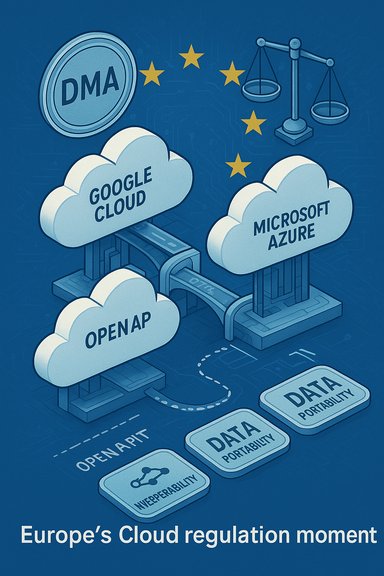
Google’s quiet decision to withdraw its formal antitrust complaint against Microsoft has converted a high‑profile bilateral regulatory fight into a broader institutional test of how Europe will police the cloud era — and it shifts the most consequential questions about vendor lock‑in, cloud portability, and gatekeeper regulation from private litigation to the European Commission’s Digital Markets Act (DMA) machinery.
Background and immediate facts
Google Cloud originally filed a formal competition complaint with the European Commission on September 25, 2024, alleging that Microsoft’s licensing and commercial practices — notably for Windows Server and SQL Server — made it materially harder and more expensive for customers to run Microsoft workloads on rival clouds. The complaint highlighted alleged differential licensing, migration friction, and technical integrations that disadvantaged non‑Azure infrastructure. On November 18, 2025, the European Commission announced a trio of market investigations under the Digital Markets Act: company‑level probes into Microsoft Azure and Amazon Web Services (AWS), plus a horizontal study to decide how the DMA’s toolbox should be applied to cloud infrastructure. The Commission framed the move as an assessment of whether AWS and Azure act as “important gateways” and whether the DMA’s obligations are fit for cloud markets. Ten days later Google updated its original blog post with an editorial note formally withdrawing the complaint, explicitly citing the Commission’s new DMA‑based investigations as the more appropriate vehicle to address the structural issues it raised. Google said it “stands behind” the substance of its earlier arguments while redirecting enforcement energy into the Commission’s process.Why the withdrawal matters: forum, leverage, and remedies
This procedural move is not merely bureaucratic housekeeping. It alters the institutional leverage and the potential remedies available.- A standalone antitrust complaint typically follows the Article 102 enforcement route: ex‑post, case‑specific remedies that require difficult legal showings about abuse of dominance and causal harm.
- The DMA, by contrast, is an ex‑ante regulatory regime that can impose prescriptive obligations on designated gatekeepers — obligations covering interoperability, non‑discrimination, data portability, and limits on tying/self‑preferencing — and it includes clear enforcement levers and fines. If the Commission designates a cloud operator as a gatekeeper for specific cloud services, Brussels can order systemic rules rather than bespoke remedies limited to a single complainant.
Core allegations: what Google and allies said (and what’s verifiable)
Google’s original complaint and later public materials focused on several repeatable claims:- Differential licensing and surcharges. Google and industry groups argue that Microsoft’s commercial terms can make running the same Microsoft software on non‑Azure infrastructure substantially more expensive — a difference Microsoft itself has highlighted in marketing materials that assert other clouds may be “up to five times more expensive” for certain Windows Server and SQL Server workloads. That “up to five times” formulation appears on Microsoft’s own public pages and is central to the pricing inequality allegation.
- Practical migration friction. Complainants cite contractual clauses, repurchase requirements, and limited BYOL (Bring‑Your‑Own‑License) options that increase the time and cost of moving production workloads off Azure. Independent trade‑group analyses have attempted to quantify aggregate impacts for European customers; some extrapolations have suggested figures in the hundreds of millions to billions of euros, but those numbers derive from selective scenarios and remain contested. Regulators will need direct documentary evidence to verify aggregate cost claims. Treat headline aggregate figures with caution.
- Technical lock‑in through control‑plane and managed services. The complaint emphasised that managed services, proprietary control‑plane APIs, and deep integration between Microsoft’s platform services could increase the engineering cost and risk of porting applications, producing technical—not just contractual—switching costs. These are inherently technical arguments that require detailed engineering evidence to validate.
Cross‑checking the record: what independent sources say
Multiple independent outlets and official documents corroborate the chronology and substance of the pivot:- The European Commission’s press release dated November 18, 2025, confirms the launch of three market investigations under the DMA and explicitly names AWS and Microsoft Azure as company‑level targets of review. That release sets out the Commission’s ambition to test whether cloud providers may be treated as DMA gatekeepers.
- Reuters reported Google’s withdrawal and highlighted Google’s statement that the move was made “in light of the recent announcement that the EC will assess problematic practices affecting the cloud sector under a separate process.” Reuters also reiterated market share figures commonly used in industry reporting (AWS ~30%, Microsoft ~20%, Google ~13%), underlining the market structure at stake.
- Google’s own Cloud blog preserves the original complaint post and the editorial withdrawal note added on November 28, 2025, making Google’s position and timeline fully traceable.
What the DMA probes can (and cannot) fix
The Digital Markets Act gives Brussels tools that can address several systemic problems, but translating high‑level obligations into robust, technically precise remedies will be challenging.What the DMA can deliver:
- Mandated non‑discrimination: rules requiring parity of treatment between the operator’s own services and third‑party offerings.
- Interoperability orders: requirements to document and open certain APIs or interfaces to facilitate third‑party alternatives.
- Data and portability rights: clearer obligations for business users to access data generated through their activity and to move workloads with technical safeguards.
- Pre‑emptive behavioural proscriptions: bans on tying, bundling, or marketplace self‑preferencing in clearly defined contexts.
- Fine‑grained technical interoperability. Forcing an operator to open a control plane or replicate complex managed services across providers raises substantial engineering and security questions. Poorly specified obligations can create fragmentation or instability.
- Price equalisation. The DMA can restrict discriminatory contractual terms but redesigning pricing schemes across nested product families (licenses, support, extended security updates) is complex and may be litigated as a separate commercial issue.
- Global coherence. Cloud providers operate globally; DMA obligations in the EU may produce tensions with US, UK, or other non‑EU legal regimes.
Strategic implications for the major players
- Google. By withdrawing the private complaint, Google declaws the optics of a head‑to‑head litigation posture and positions itself as a policy participant within a public rule‑making process. The company retains the ability to submit evidence and shape remedies while avoiding the squeeze of a single adversarial case. This is a pragmatic redistribution of enforcement resources.
- Microsoft. The DMA probe raises the prospect of prescriptive restraints on business practices that have been commercially effective for Microsoft. If the Commission designates Azure as a gatekeeper for cloud services, Microsoft could face obligations that demand product and commercial model changes — potentially affecting Azure’s architecture, licensing, and go‑to‑market strategies. Microsoft has historically argued that comparable settlements with trade groups had already addressed many concerns, and it will likely contest any over‑broad remedial design.
- AWS. The parallel investigation into AWS signals that the Commission is examining the competitive dynamics across multiple hyperscalers, not singling out Microsoft. AWS will need to defend its practices and demonstrate why DMA obligations calibrated for consumer platforms should not be forced into complex enterprise contract markets.
- European cloud providers and trade bodies. Groups such as CISPE have previously alleged concrete harms and attempted to negotiate settlements; the DMA probes give them a higher‑profile channel to push for systemic protections. But smaller providers face a dual risk: regulatory remedies could lower entry barriers or, conversely, produce compliance costs that benefit larger players with legal and engineering resources.
Risks, trade‑offs, and unintended consequences
Regulatory interventions at the infrastructure layer carry both promise and peril.- Engineering risk. Forcing interoperability without clear technical standards risks brittle integrations or security regressions. Cloud control planes coordinate complex identity, networking, and telemetry systems; mandating API access without careful specification could create attack surfaces or performance regressions.
- Regulatory overreach and market distortion. Broad, poorly targeted remedies could penalise legitimate product differentiation, removing incentives for innovation in managed services that customers value.
- Legal and commercial fragmentation. Divergent obligations across jurisdictions may complicate global product roadmaps. Firms could respond by offering EU‑specific product variants or contractual carve‑outs, which creates operational complexity for customers.
- Concentration of compliance costs. Smaller cloud providers may struggle with compliance costs if the remedies require elaborate audit trails or technical re‑engineering, inadvertently entrenching leaders who can shoulder the investment. Conversely, carefully calibrated remedies could empower smaller competitors by reducing artificial pricing premiums or contractual barriers.
Practical advice for enterprise IT and procurement teams
The regulatory environment is likely to be dynamic over the next 12–18 months. Organizations should prepare pragmatically:- Inventory exposure. Map where Windows Server, SQL Server, and other Microsoft‑licensed workloads run and quantify licensing dependencies and potential repurchase or support penalties.
- Negotiate portability clauses. Require contractual commitments about data export formats, patch parity, and BYOL portability in new cloud agreements.
- Plan for hybrid and multi‑cloud architectures. Design workloads with abstraction layers and containerisation where feasible to reduce technical coupling to provider‑specific managed services.
- Engage procurement for liability and exit terms. Seek defined egress SLAs, transitional support, and explicit pricing for license portability in RFPs and renewals.
- Track regulatory process. Monitor Commission evidence requests and consult with industry bodies; regulators’ technical questions will shape likely remedies and timelines.
What to watch next: timeline and decision points
- The Commission indicated an approximate 12‑month horizon for the company‑level market investigations, meaning preliminary findings or interim measures could appear within a year. The horizontal study will likely take longer and will influence any legislative follow‑up or delegated DMA acts specific to cloud markets.
- Expect rounds of written information requests, technical workshops, and confidential document exchanges with market players. Regulators will want to see contract examples, pricing spreadsheets, and engineering evidence about interoperability and patching regimes.
- Watch for third‑party submissions from industry groups and cloud consumers; these will shape evidentiary records and could signal the Commission’s likely remedial preferences.
- Be alert to parallel actions in the UK and individual member states: national authorities or the UK Competition and Markets Authority (CMA) may pursue complementary inquiries, increasing the global enforcement footprint. Recent national probes have already shaped the public debate on cloud competition.
Strengths of the regulatory shift — and lingering uncertainties
The pivot from a private complaint to a DMA‑centred process has clear benefits: it moves the debate into a forum with powers to design systemic remedies; it aligns an array of stakeholders under a single evidentiary process; and it reduces the binary optics of one vendor suing another. For regulators and enterprises seeking structural change, the DMA investigations provide a realistic route to enforceable obligations.But major uncertainties remain. Translating high‑level objectives like “interoperability” into precise, enforceable engineering requirements is difficult. Aggregate damage claims and headline price multipliers are based on contested contract scenarios and require rigorous documentary verification. And any remedies that alter pricing or product packaging could ripple across global cloud markets in unpredictable ways.
Regulatory ambition must therefore be paired with technical competence and iterative rule‑making that respects operational realities.
Conclusion
Google’s withdrawal of its EU antitrust complaint against Microsoft does not close the matter — it reframes it. The core dispute over cloud portability, licensing asymmetries, and the architecture of competitive advantage has moved from a bilateral complaint into the European Commission’s broader DMA scrutiny. That shift elevates the potential for systemic, industry‑wide remedies while forcing the technical and policy questions into a public, institutional process with global implications. Enterprises, cloud providers, and policy makers will now confront the hard work of converting high‑level competition goals into precise, technically feasible rules that protect choice without stifling innovation. The next 12–18 months will be decisive for how Europe — and by extension the global cloud market — defines the balance between platform power and open competition.Source: SDxCentral Google withdraws antitrust complaint against Microsoft after new EU probe
