

Microsoft Teams is already the place where government work happens — meetings, messages, and decisions — but turning it into a safe, auditable coordination layer for inter‑agency services requires more than rolling out seats; it demands sovereignty, governance, and measurable value across the lifecycle.
Across Europe and beyond, public-sector IT leaders face a paradox: they want the speed and convenience of modern collaboration platforms, yet they must satisfy hard constraints around data sovereignty, procurement, auditability, and cost. The recent industry conversation — captured in an extended feature on Microsoft Teams for public sector collaboration — shows why treating Teams as a mere meeting app wastes its potential and why careful governance turns it into a force multiplier for service delivery.
At its best, a governed Teams deployment becomes the single auditable place where citizen cases, inter‑agency handoffs, and operational dashboards converge. At its worst, unmanaged sprawl, unclear ownership, and ambiguous cross‑border data flows create headlines and regulatory headaches. The question for public CIOs is not whether Teams can help, but how to make it help without trading away control.
A few practical realities drive urgency:
Public sector IT leaders that succeed will be those who:
Source: UC Today Microsoft Teams Public Sector: Breaking Silos with Safe Inter-Agency Collaboration
 Background / Overview
Across Europe and beyond, public-sector IT leaders face a paradox: they want the speed and convenience of modern collaboration platforms, yet they must satisfy hard constraints around data sovereignty, procurement, auditability, and cost. The recent industry conversation — captured in an extended feature on Microsoft Teams for public sector collaboration — shows why treating Teams as a mere meeting app wastes its potential and why careful governance turns it into a force multiplier for service delivery.At its best, a governed Teams deployment becomes the single auditable place where citizen cases, inter‑agency handoffs, and operational dashboards converge. At its worst, unmanaged sprawl, unclear ownership, and ambiguous cross‑border data flows create headlines and regulatory headaches. The question for public CIOs is not whether Teams can help, but how to make it help without trading away control.
Why Now: the urgency of connected government
Public services are experiencing intense pressure to reduce latency in decision making, eliminate “who owns this?” handoffs, and present coherent end‑to‑end experiences to citizens. Hybrid and distributed workflows — the norm after pandemic-era change — made the cost of disconnected systems painfully obvious: lost documents, duplicated effort, missed deadlines, and fractured audit trails.A few practical realities drive urgency:
- Citizens notice delays and inconsistent outcomes; that erodes trust faster than any internal KPI can measure.
- Agencies increasingly rely on cloud and AI tooling that amplify both productivity and governance risk.
- Geopolitical shifts and court decisions in Europe are elevating sovereignty and data residency from niche compliance items to core policy drivers.
The strategic value of Microsoft Teams in the public sector
Microsoft Teams is not just a chat client; when built into the workflow it can host casework, telephony, RPA, low‑code apps, analytics, and AI agents. The strategic value is visible in four practical dimensions.Unified collaboration and operational efficiency
When Teams becomes the central workspace for projects and communities of practice, agencies reduce app switching, collapse meeting noise into actionable artifacts, and preserve context across handoffs. Australia’s GovTEAMS is a concrete example: it combines Teams and Microsoft 365 to host tens of thousands of communities and thousands of active guest users — a living demonstration of what a governed public collaboration platform can look like. The official GovTEAMS portal reports roughly 36,000 active APS members monthly, some 11,000 active guest users, and more than 20,000 communities. Those figures underscore how scale and trust follow governance and tiered access models.Case resolution and service acceleration (real outcomes)
The biggest productivity gains appear when Teams hosts embedded operational apps, not just meetings. Microsoft customer stories verify multiple public‑sector examples:- Oklahoma City Fire Department digitized workflows with 15 Power Apps embedded in Teams and reported a 40% reduction in manual tasks while providing live dashboards across 43 locations. That transformation was delivered using Power Apps, Power Automate, Power BI and SharePoint integrated into Teams.
- The San Francisco Police Department built RESTVOS with Power Apps to reduce time-per‑record for recovered vehicles from hours to minutes, saving roughly 500 officer hours per month. The Power Platform blog documents this improvement and the associated officer time savings.
Citizen experience and contact centers
When telephony, routing, and CRM are embedded in Teams, the citizen front door can stop being a black hole and start being an outcome engine. The UK Home Office migrated 63,000 users to Teams Phone in eight working days — a fast, automated telephony consolidation that Microsoft and partners documented as delivering a 97% satisfaction rating and an NPS of 9.8 in early reporting. The rollout is an example of rapid consolidation that prioritized automation and user communication scripts to avoid traditional cutover challenges. Banks and other citizen‑facing institutions have followed similar playbooks: Banco de la Ciudad de Buenos Aires used Microsoft 365 Copilot and Copilot Studio to build AI agents and automation, freeing thousands of hours annually and reducing call center cost metrics. These cases show how Teams plus Copilot can lighten routine workloads when governance and data flows are properly managed.Security, compliance and auditability
Public‑sector adoption will stall without verifiable audit trails and strong access controls. Modern Teams deployments now expose fine‑grained audit events, advanced DLP, sensitivity labels, and tenant‑level controls that provide traceability of who did what and when. Alameda County’s migration of 62 TB to Azure VMware Solution shows how moving to the cloud can cut patching effort and produce measurable cost and time savings (the county reports 100 hours saved per patching cycle and roughly $50,000 per year). But the savings come alongside a governance commitment: encrypt data, define ownership, and instrument auditing so compliance teams can reconstruct events.The Teams Public Sector playbook: what works
Turning Teams from “chat and meetings” into a trusted coordination layer is a program of policy, procurement, operations, and culture.1) Build trust and governance foundations
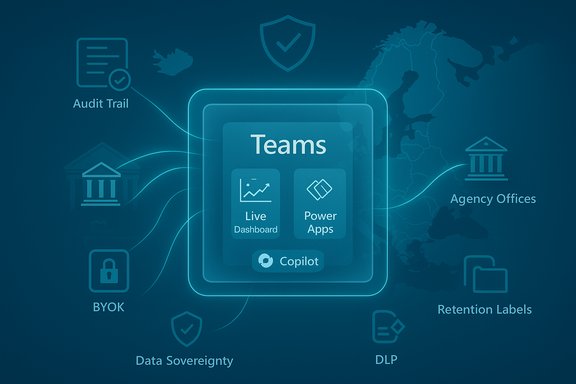
Start with a governance minimum viable product that makes the secure path the easy path. Practical controls that deliver disproportionate returns:- Lifecycle policies for Teams groups and default naming templates to prevent sprawl.
- Sensitivity labels and retention policies applied at provisioning time.
- Guest access reviews and role‑based owner policies.
- Automated archiving, two‑owner rules for team deletion, and provisioning blueprints that attach compliance settings at creation.
2) Address sovereignty and compliance head‑on
European debates over sovereignty are political as much as technical. Several regions — Schleswig‑Holstein in Germany and national ministries in Denmark, among others — have publicly signalled moves away from parts of the Microsoft stack in favor of open‑source or European solutions, citing digital sovereignty and procurement cost concerns. Multiple news outlets and government statements confirm these shifts; they illustrate that national policy can compel technical change even when platforms offer regional protections. Practical tenant‑level mitigations that agencies use today include:- Customer‑managed keys and bring‑your‑own‑key (BYOK) approaches.
- Federated architectures with clear boundary controls that limit cross‑border metadata flow.
- Contractual and procurement clauses to preserve data portability and audit rights.
3) Align procurement and policy to avoid hidden risks
Procurement is where many risks enter: license terms, data processing agreements, and third‑party integrations can introduce exposure. Forward‑thinking public teams are baking compliance clauses into RFPs (data portability, encryption, operator roles, interoperability) and specifying technical acceptance criteria such as Operator Connect for Teams or documented data flow diagrams for any telephony integration.4) Secure the collaboration layer operationally
Operational security remains classic: enforce multifactor authentication, device compliance, approved‑app lists, and tenant‑wide posture checks. But collaboration platforms also require dataset‑aware DLP (covering transcripts, recordings, and prompt inputs to Copilot), SIEM integration for audit streams, and regular guest access reviews. Microsoft’s Purview, Defender telemetry and Advanced Audit are commonly used pieces of this puzzle; agencies should map these into incident playbooks and legal hold processes.5) Pilot, measure and scale with FinOps discipline
Start with high‑value micro‑use cases and instrument everything. Typical pilots:- A casework workspace that embeds a simple Power App for intake and measures mean time to resolution.
- A contact center pilot consolidating PSTN routing into Teams Phone and tracking average handle time and transfer rate.
- A Copilot pilot limited to non‑sensitive administrative tasks with prompt logging and human review thresholds.
Realities, tradeoffs and risks
No platform is risk‑free. Several hard truths deserve explicit attention.- Sovereignty is policy as much as tech. Moving workloads out of U.S.-based hyperscalers can be politically driven and technically expensive. News coverage from Denmark and Schleswig‑Holstein shows how national policy choices can drive migrations that require years of engineering and retraining. Agencies must model the migration cost and service‑continuity risk before political deadlines push them into expensive cutovers.
- Vendor case studies show outcomes but carry scope caveats. Customer stories from Microsoft verify concrete numbers — Oklahoma City’s 40% drop in manual tasks and Alameda County’s 62 TB migration with patching time reductions are documented in Microsoft’s case studies — but those numbers were achieved with partners, specific architectures and governance commitments. Treat them as validated examples, not guaranteed outcomes for every tenant.
- AI integration brings productivity and audit risk. Copilot and Copilot Studio can accelerate drafting, extraction and citizen triage — Breda’s pilot reports up to 28 hours saved per person per month for some workers — but generative AI also introduces the need to protect prompt inputs and outputs and to keep humans in the loop for all high‑risk decisions. The right pattern is to pilot in suggestion mode, log prompts and responses, and expand only when auditability and accuracy meet the standard required by the service.
- Procurement lock‑in remains the unseen cost. Consolidating identity, telephony, CRM and AI with a single vendor reduces integration effort but raises migration costs and regulatory scrutiny. Build exportable APIs, require documented data formats in procurement language and plan for vendor‑agnostic evacuation paths.
Practical checklist: turning Teams into the coordination layer
- Define 2–3 measurable micro‑use cases that will move the needle (case intake, recovered asset tracking, contact‑center routing).
- Run 8–12 week pilots instrumented with telemetry and manager‑verified samples.
- Build workspace templates with embedded labels, guest policies and automated life‑cycle rules.
- Enforce Zero Trust: MFA, conditional access, device compliance and least privilege.
- Gate Copilot and connectors behind sensitivity labels and Commercial Data Protection where applicable.
- Map procurement clauses to technical acceptance (data portability, key management, encryption at rest and in transit).
- Create a CoE for Teams, Power Platform and Copilot with clear owner responsibilities and escalation paths.
Verification of key claims (explicit)
To preserve journalistic rigor, the most important factual claims in the playbook were cross‑checked against public documentation and vendor case studies:- GovTEAMS usage numbers (36,000 active APS members per month; 11,000 active guest users; 20,000+ communities) are published on the GovTEAMS portal, confirming the scale of the Australian model.
- The Oklahoma City Fire Department’s 40% reduction in manual tasks and deployment of 15 Power Apps are described in Microsoft’s customer story for OKCFD dated June 19, 2025. That story documents the partner, the tools used, and the claimed outcomes.
- San Francisco Police Department’s RESTVOS case and the estimated 500 officer hours saved per month are detailed in Microsoft’s Power Platform customer stories and blog posts.
- Alameda County’s migration of approximately 62 TB to Azure VMware Solution and cited savings including 100 hours per patching cycle and roughly $50,000 per year are documented in Microsoft’s Alameda County customer story.
- Breda’s Microsoft Copilot pilot (150 participants, up to 28 hours saved per month for certain tasks) is described in Microsoft’s customer story for the Municipality of Breda.
- The UK Home Office migration to Teams Phone (63,000 users in eight days) is documented in both Microsoft customer materials and independent UC Today reporting on the migration timeline and satisfaction metrics. Organizations planning similar moves should validate telco, operator and user training readiness before adopting an 8‑day cadence.
Conclusion: collaboration with accountability
The challenge for governments is not to avoid modern collaboration platforms — it is to manage them deliberately. Microsoft Teams, when treated as a coordination layer rather than a meeting app, can collapse silos, speed case resolution, and improve citizen outcomes. But the benefits are conditional: they depend on visible governance, procurement discipline, tenant‑level sovereignty checks, and a measured approach to AI.Public sector IT leaders that succeed will be those who:
- Make “the secure way” the default way through templates and automation;
- Insist on verifiable data residency and contractual clarity where sovereignty concerns are political priorities;
- Pilot Copilot and Power Platform in controlled, auditable settings before wider release; and
- Measure outcomes in CFO‑grade terms (hours reclaimed, case resolution latency, citizen satisfaction), not raw adoption counts.
Source: UC Today Microsoft Teams Public Sector: Breaking Silos with Safe Inter-Agency Collaboration
