

Microsoft has begun embedding OpenAI’s GPT‑5.2 into its Copilot family, putting a multi‑variant, enterprise‑tuned model directly inside Microsoft 365 Copilot, Copilot Studio, and the Foundry model router to deliver faster everyday writing and deeper reasoning for complex business workflows.
OpenAI released the GPT‑5.2 family in December 2025 as a three‑tiered product: GPT‑5.2 Instant for low‑latency tasks, GPT‑5.2 Thinking for deeper, multi‑step reasoning, and GPT‑5.2 Pro for the highest‑fidelity professional work. The company’s published system notes highlight substantial benchmark gains in long‑context comprehension, coding, reasoning, and vision—claims that OpenAI frames around productivity and “knowledge work” improvements. Microsoft confirmed same‑day integration of GPT‑5.2 into Microsoft 365 Copilot and Copilot Studio, exposing the new variants in Copilot’s model selector and tying model routing to its internal Work IQ signals so responses can use tenant context (meetings, mail, documents, calendars) rather than generic web knowledge. Microsoft positions this as a practical upgrade for daily productivity and agent orchestration across enterprise workflows. The editorial coverage that first circulated the Copilot integration framed the change as both a product upgrade and a platform strategy: staged rollouts, model choice for different job types, and additional operational responsibilities for IT and governance teams.
Source: Editorialge https://editorialge.com/microsoft-brings-gpt-5-2-to-copilot/
 Background / Overview
OpenAI released the GPT‑5.2 family in December 2025 as a three‑tiered product: GPT‑5.2 Instant for low‑latency tasks, GPT‑5.2 Thinking for deeper, multi‑step reasoning, and GPT‑5.2 Pro for the highest‑fidelity professional work. The company’s published system notes highlight substantial benchmark gains in long‑context comprehension, coding, reasoning, and vision—claims that OpenAI frames around productivity and “knowledge work” improvements. Microsoft confirmed same‑day integration of GPT‑5.2 into Microsoft 365 Copilot and Copilot Studio, exposing the new variants in Copilot’s model selector and tying model routing to its internal Work IQ signals so responses can use tenant context (meetings, mail, documents, calendars) rather than generic web knowledge. Microsoft positions this as a practical upgrade for daily productivity and agent orchestration across enterprise workflows. The editorial coverage that first circulated the Copilot integration framed the change as both a product upgrade and a platform strategy: staged rollouts, model choice for different job types, and additional operational responsibilities for IT and governance teams.The Announcement and Rollout Timeline
What Microsoft announced, in plain terms
- GPT‑5.2 is now selectable inside Microsoft 365 Copilot and Copilot Studio.
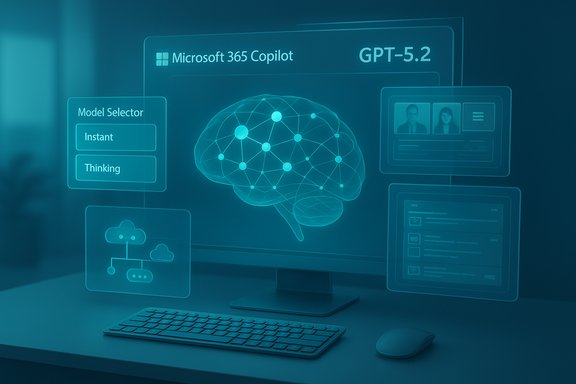
- Microsoft surfaces two practical modes for customers in the Copilot UI—Instant (fast, lower cost) and Thinking (deeper reasoning)—while the Pro tier is available primarily through OpenAI’s API for the heaviest quality needs.
- Rollout is staged: Microsoft begins with Copilot license holders and early‑release Copilot Studio tenants, with a broader tenant rollout and Premium plan expansions following in waves.
Why Microsoft uses a staged rollout
A staged rollout reduces systemic risk and gives Microsoft time to monitor latency, accuracy, and reliability at scale. For enterprises, staged deployment also enables internal testing, governance alignment, and training before broad enablement—important because GPT‑5.2’s Thinking mode changes response behavior, latency, and compute cost in meaningful ways.What GPT‑5.2 Adds: Model Options, Performance, and Daily Impact
A family, not a single engine
The commercial packaging of GPT‑5.2 as a family (Instant, Thinking, Pro) is a pragmatic move: it lets platform integrators route routine prompts to a faster, cheaper variant while reserving more compute‑intensive reasoning to a variant designed for long, structured tasks. That tradeoff—speed versus depth versus cost—is central to how Microsoft intends to operate Copilot at scale.Key technical claims (vendor reporting)
OpenAI’s published metrics position GPT‑5.2 Thinking as a step change on benchmarks that matter for professional work: GDPval (knowledge‑work tasks), SWE‑Bench Pro (software engineering), and long‑context evaluations (MRCRv2). OpenAI reports GDPval wins or ties in ~70.9% of knowledge tasks for GPT‑5.2 Thinking versus 38.8% for earlier GPT‑5. Caveat: these are vendor‑reported metrics and are directional rather than guaranteed real‑world performance. Organizations should validate results on representative tenant data before assuming parity with published numbers.Practical differences users will feel
The most tangible improvements for Copilot users commonly appear across five domains:- Long‑document handling: less “drift” across long threads, meeting transcripts, and multi‑page files. GPT‑5.2 Thinking has expanded long‑context capability, useful for summarizing legal documents, long reports, and cross‑file analysis.
- Structured outputs: better at preserving tables, checklists, decision frameworks, and constrained formats when instructed to do so.
- Business tone and fidelity: improved reliability in neutral, executive wording—helpful for email drafts, briefings, and slide summaries.
- Cross‑input synthesis: improved ability to merge notes, emails, and meeting transcripts into coherent action lists or briefings.
- Reduced hallucination in common scenarios: stronger internal reasoning and tool‑calling behavior reduce the frequency of confident but incorrect assertions in many business‑oriented prompts—though no model is hallucination‑free.
How GPT‑5.2 Works Inside Microsoft 365 Copilot and Copilot Studio
The Copilot ecosystem: model + platform
Copilot is more than a chat interface: it’s an orchestration layer that connects a user’s request to context (Work IQ), selects a model (the model selector or the Foundry router), and enforces tenant permissions and policies before producing an output. GPT‑5.2 supplies the language and reasoning capability; Microsoft’s platform controls what context the model can access and how outputs are audited and routed.Work IQ: context that matters
Work IQ aggregates signals from a user’s meetings, emails, documents, and activity. When Copilot answers a business query—“Summarize the latest plan and identify open risks”—the ideal flow is to ground its synthesis in permitted internal sources rather than public web knowledge. Microsoft says Copilot’s Work IQ integration helps make these outputs more relevant and safer for enterprise use.Copilot Studio and agent building
Copilot Studio is Microsoft’s authoring surface for custom copilots and agents. GPT‑5.2’s inclusion into Copilot Studio improves:- Intent recognition and routing — better natural‑language interpretation to route workflows to the right bots or templates.
- Multi‑step agent orchestration — more reliable clarifying question sequences, input gathering, and final output assembly.
- Consistent formatted outputs — templates, structured fields, and compliance‑friendly documents are easier to produce when the underlying model reliably follows constraints.
Security, Compliance, and Data Boundaries
The top enterprise questions
IT and security teams will want answers to four core questions:- Does Copilot respect identity and access boundaries? Microsoft claims Copilot inherits tenant permissions so the assistant only accesses files a user is authorized to read. That behavior is central to preserving confidentiality.
- Where does the data go? Enterprises must verify tenant settings and contractual terms to confirm whether content used in Copilot is processed or logged in ways that affect regulatory compliance.
- Is data used to train external models? Vendors publish their policies, but organizations should confirm data‑use protections in contractual terms and admin settings. Treat any vendor statement as a starting point for legal review.
- What audit and admin controls exist? Microsoft points to admin configuration, logging, and model‑routing controls in Foundry and Copilot Studio, but the depth of auditing required will depend on industry regulation and internal policy.
Practical guardrails and operational controls
- Enforce tenant policy to limit which apps Copilot can query.
- Require human review for external‑facing or legally sensitive outputs.
- Instrument telemetry and logging to measure both accuracy and potential data leaks.
- Use sandbox tenants for agent migrations and behavior testing before full rollout.
Verifying Claims: What the Benchmarks Actually Say (and What They Don’t)
OpenAI’s public materials list several headline numbers: GDPval wins/ties at ~70.9% for GPT‑5.2 Thinking, SWE‑Bench Pro scores, MRCRv2 long‑context metrics, and very high tool‑calling accuracy in domain benchmarks. These are meaningful indicators of progress, but they are vendor‑provided and should be validated internally. Real‑world performance depends on prompt quality, grounding data, token limits, and the exact distribution of tasks in your environment. Independent press coverage corroborates launch timing and availability claims, and coverage highlights the competitive dynamics that likely accelerated development cycles—important context for procurement and risk analysis. Treat vendor benchmark claims as directional; run representative tests on your actual workflows before relaxing governance.Risks, Limitations, and Reasonable Skepticism
Notable risks
- Overconfidence and hallucination: GPT‑5.2 reduces but does not eliminate hallucination. In high‑stakes outputs, confident but incorrect content can have meaningful business consequences. Human review and guardrails remain essential.
- Cost and token economics: Higher‑quality reasoning implies higher compute per request. At scale, unfiltered use of Thinking or Pro will materially increase cloud costs. Implement routing policies to control spend.
- Migration surprises: Agents auto‑migrated from GPT‑5.1 to GPT‑5.2 may produce subtle behavior changes that break downstream workflows or formatting expectations. Test migrations in sandbox tenants.
- Regulatory and contractual exposure: Organizations in regulated industries must verify where data is processed and how vendor terms map to compliance obligations. Audit trails must be sufficient for investigations.
Mitigations and best practices
- Start with a small, controlled pilot on low‑risk workflows.
- Define prompt templates and response expectations for typical outputs.
- Configure model routing policies so high‑risk workflows default to Thinking or Pro, while routine tasks use Instant.
- Maintain human‑in‑the‑loop checks for legal, financial, or externally distributed content.
- Instrument KPI telemetry to measure time saved versus error rates and to identify when models drift or regress.
Market Context, Competition, and Strategic Implications
OpenAI’s GPT‑5.2 launch and Microsoft’s immediate integration reflect an industry pivot toward heterogenous model stacks and platform orchestration. Competitors such as Google (Gemini family), Anthropic, and others are pushing similar multi‑variant and agentic capabilities, which in turn compresses vendor timelines for new releases and increases the importance of enterprise orchestration and governance. For Microsoft, the strategic win is distribution: Copilot is embedded in the productivity surface used by millions, so even small improvements in drafting, summarization, and planning scale into large productivity gains. For OpenAI, enterprise deployments through Microsoft demonstrate model utility in business contexts beyond standalone chat. Both companies will measure success in real productivity KPIs—not just benchmark wins. Three near‑term platform trends to watch:- Agentic workflows: Assistants that execute multi‑step tasks end‑to‑end (gather inputs, run checks, produce deliverables) will be the next battleground—Copilot Studio will be a key testbed.
- Automatic model routing: Smart defaults will increasingly auto‑select between Instant and Thinking based on task complexity and tenant policies; administrators will need transparent routing rules.
- Enterprise reliability & guardrails: As adoption widens, demand for granular audit logs, strict attribution to internal documents, and formatting guarantees will grow. Platform controls—not just model improvements—will determine enterprise uptake.
Practical “Next Steps” (Who Should Do What)
Individual employees
- Try GPT‑5.2 for one recurring, low‑risk task (meeting summaries, email drafts) to build trust and discover differences between Instant and Thinking.
Team leads
- Create and distribute approved prompt templates for common outputs (status updates, vendor comparisons, meeting summaries) to increase consistency and reduce rework.
IT administrators
- Pilot GPT‑5.2 in a controlled group and validate tenant‑level settings: permission boundaries, logging, and model routing. Use sandbox tenants for agent migrations.
Agent builders (Copilot Studio)
- Upgrade one non‑critical agent to GPT‑5.2 and measure differences in resolution time and accuracy. Pay attention to tool‑calling behavior and template conformance.
Conclusion
GPT‑5.2’s arrival inside Copilot is not mere marketing fluff: it is a pragmatic pairing of a higher‑capability model family with a large, governed productivity platform. For organizations that treat the change as an operational upgrade—running pilots, tightening governance, instrumenting performance, and routing tasks to the right variant—GPT‑5.2 can deliver measurable productivity gains in meetings, documents, inbox workflows, and agent automation. That upside is real, but so are the operational responsibilities it imposes. Human review, explicit permission checks, staged enablement, telemetry, and cost controls are not optional; they are the difference between a productivity win and a compliance headache. The model upgrade raises the ceiling for what Copilot can do—Microsoft’s platform and governance layers will determine whether that ceiling becomes routine, reliable performance for your organization.Source: Editorialge https://editorialge.com/microsoft-brings-gpt-5-2-to-copilot/
