

OpenAI and Anthropic launched dueling model updates on the same day, and the result is a sharpened frontline in the AI wars — one where Microsoft, long enmeshed with OpenAI, now finds itself awkwardly wedged between rival architectures, competing commercial strategies, and a rapidly changing enterprise market.
The AI landscape has moved from single-model dominance to an open competition of specialized models and multi-model products. Over the last two years, startups and hyperscalers alike have shifted from one-size-fits-all foundation models to targeted releases optimized for particular workflows: coding, long-form knowledge work, agentic orchestration, and enterprise integrations. The lines between “assistant,” “agent,” and “platform” are blurring, and February’s simultaneous model releases underline how quickly capability, integration, and go-to-market strategy can change the calculus for developers, IT teams, and cloud providers.
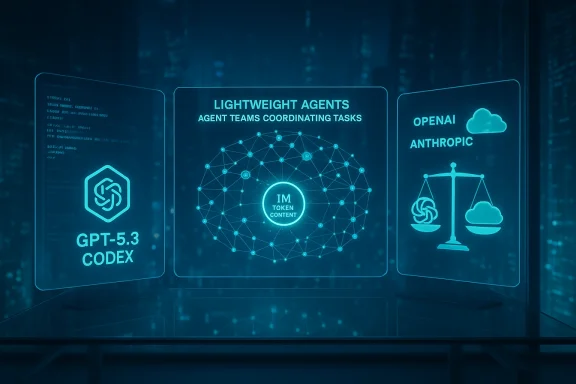
Two announcements matter right now. OpenAI introduced GPT‑5.3‑Codex, a Codex-branded variant that pushes agentic coding and long-running workflows, touts faster throughput and deeper integration into developer tooling. Anthropic released Claude Opus 4.6, an iteration focused on multi-agent coordination, large-context workflows, and tighter productivity integrations for knowledge workers. Both moves are designed to capture more of the enterprise workflow stack — but they do it with different tradeoffs. Understanding those tradeoffs is essential for IT planners and CTOs deciding how to deploy AI in production.
At the same time, competition between model vendors fosters rapid innovation. OpenAI’s engineering-led speed improvements and Anthropic’s safety-and-productivity emphasis show two plausible paths to enterprise adoption: maximal raw capability vs. measured, workflow-friendly capability. Enterprises and cloud providers will be forced to pick approaches or stitch them together.
Microsoft’s role is the story to watch. It can either be torn between competing vendor alliances, or it can convert that tension into an advantage by making Azure the neutral, policy-driven ground where enterprises pick the right tool for each job. Doing so will require investments in orchestration, observability, and clear governance — plus honest messaging about where each model fits best.
For IT leaders, the practical takeaway is straightforward: treat vendor announcements as the start of a rigorous evaluation cycle, not the end. Run pilots with real workloads, demand reproducible benchmarks, harden pipelines for model-generated code, and build the organizational controls necessary to deploy powerful AI models safely and sustainably. In an era when models can write, test, and iterate like colleagues, the difference between success and failure will be how well organizations integrate those colleagues into disciplined, monitored, and auditable workflows.
Source: Petri IT Knowledgebase First Ring Daily: New AI Models - Petri IT Knowledgebase
 Background
The AI landscape has moved from single-model dominance to an open competition of specialized models and multi-model products. Over the last two years, startups and hyperscalers alike have shifted from one-size-fits-all foundation models to targeted releases optimized for particular workflows: coding, long-form knowledge work, agentic orchestration, and enterprise integrations. The lines between “assistant,” “agent,” and “platform” are blurring, and February’s simultaneous model releases underline how quickly capability, integration, and go-to-market strategy can change the calculus for developers, IT teams, and cloud providers.Two announcements matter right now. OpenAI introduced GPT‑5.3‑Codex, a Codex-branded variant that pushes agentic coding and long-running workflows, touts faster throughput and deeper integration into developer tooling. Anthropic released Claude Opus 4.6, an iteration focused on multi-agent coordination, large-context workflows, and tighter productivity integrations for knowledge workers. Both moves are designed to capture more of the enterprise workflow stack — but they do it with different tradeoffs. Understanding those tradeoffs is essential for IT planners and CTOs deciding how to deploy AI in production.
What OpenAI’s GPT‑5.3‑Codex brings to the table
A model optimized for sustained, agentic coding
OpenAI’s GPT‑5.3‑Codex is explicitly framed as an agentic, coding-first model. The announcement emphasizes improvements in core developer tasks: multi-language engineering, terminal-level automation, test generation, bug hunting, and long-duration project management. Unlike earlier Codex variants that focused primarily on immediate code completion, GPT‑5.3‑Codex is designed to start, iterate, and complete end-to-end projects while maintaining context across many interactions.- Performance claims: OpenAI highlights state‑of‑the‑art scores on specialized benchmarks (SWE‑Bench Pro, Terminal‑Bench 2.0) and reports a 25% speed improvement in Codex environments compared with GPT‑5.2‑Codex.
- Agentic experience: The model is integrated into the Codex app and related IDE and CLI tooling, where it provides continuous updates and interacts with users while tasks are in-progress — effectively functioning like a collaborative teammate that can be steered in-flight.
- Beyond code: OpenAI positions GPT‑5.3‑Codex as useful for non-coding knowledge work typical of software lifecycles: PRDs, documentation, tests, data analysis, deployment scripts, and monitoring tasks.
Infrastructure and engineering notes
GPT‑5.3‑Codex is stated to be co-designed and deployed on NVIDIA GB200 NVL72 hardware. OpenAI also emphasizes a development loop where Codex variants helped debug and accelerate their own training and deployment — a notable claim because it suggests internal tooling and model-in-the-loop workflows are enhancing engineering velocity.Security posture and dual‑use mitigation
OpenAI highlights a more explicit cybersecurity posture for GPT‑5.3‑Codex: classification as a “High capability” model for cybersecurity tasks under its internal preparedness framework, offers for trusted-access pilots for defensive research, codebase scanning grants, and a commitment of API credits for defenders. These steps acknowledge the dual‑use risk: models that can write production-grade code are powerful for defenders and attackers alike.Availability and commercial surfaces
GPT‑5.3‑Codex is rolled out across Codex surfaces — the Codex app, IDE extensions, CLI, and paid ChatGPT/Codex plans — with API access promised soon. The positioning is clear: OpenAI wants Codex to be the default agent inside developer workflows while keeping options to monetize through productized surfaces.What Anthropic’s Claude Opus 4.6 delivers
Agent teams and long-context productivity
Anthropic’s Opus 4.6 introduces a concept Anthropic calls agent teams — the ability to spin up collections of lightweight agents, each responsible for a distinct subtask, which coordinate in parallel to complete complex workflows. This model-level feature is an architectural shift toward distributed agentic work and mirrors how engineering teams actually collaborate.- One‑million‑token context window (beta): Opus 4.6 extends context capability toward a one‑million‑token range in preview scenarios, enabling far richer multi-document projects, large codebases, and complex spreadsheet/presentation workflows without losing thread.
- Productivity integrations: Anthropic has doubled down on enterprise productivity by embedding Claude directly into productivity apps (notably as an integrated panel inside presentation software), reducing friction between generation and editing.
- Agent orchestration tools: The agent teams capability allows work to be sharded across agents — one writes tests, another reviews API usage, another prepares a slide deck — and then merges results, a useful pattern for cross-functional knowledge work.
Safety and measured rollouts
Anthropic continues to emphasize safety testing and conservative rollouts. Opus 4.6 is presented as rigorously tested against harmful behavior, cybersecurity vulnerabilities, and user well‑being metrics. Anthropic’s playbook remains focused on aligning model release velocity with safety signals, even as it offers powerful productivity features.Pricing and accessibility
Anthropic has kept pricing at parity with prior Opus releases while expanding capabilities, signaling a bet on adoption and volume rather than short-term price hikes. For enterprises, this makes the proposition attractive: more capability for the same price point and a clear path to enterprise-grade integrations.Microsoft: stuck in the middle or strategically diversified?
A long, evolving relationship with OpenAI
Microsoft’s investment and partnership with OpenAI have been foundational to many enterprise AI plays: Azure for infrastructure, Copilot for productivity, and large-scale resells into enterprise customers. That partnership, however, now sits alongside Microsoft’s pragmatic business aim to offer customers the best tool for each job — sometimes that means integrating rival models.Why “stuck in the middle” is a tempting narrative
There are three dynamics that create the impression Microsoft is trapped:- Vendor balancing act: Microsoft has deep ties to OpenAI but is also integrating Anthropic models into Azure and Microsoft 365 Copilot. That creates political and engineering complexity when the models diverge in capability and pricing.
- Performance and product gaps: Internal commentary from Microsoft leaders and analysts suggests aspects of Copilot and certain integrations have not met internal expectations relative to competing offerings like Google’s or Anthropic’s adjacent features.
- Market and earnings pressure: Analysts and investors expect AI to be a growth engine for Microsoft. As competitors push differentiated models and integrations, those market pressures intensify and reveal tradeoffs in exclusivity versus openness.
Strategic options Microsoft can pursue
Microsoft’s current posture — to be both cloud provider and product integrator of multiple models — is defensible and potentially advantageous. It allows Azure to act as a neutral ground where enterprises can choose models by policy, cost, and performance. But this is not without friction:- Integration complexity: Supporting multiple models means more surface area for testing, compliance and billing. It complicates Copilot’s “single experience” promise.
- Partner tension: Deep investments in one partner (OpenAI) while commercializing another partner’s models (Anthropic) are delicate to manage at the executive level.
- Differentiation risk: If customers perceive Copilot as a wrapper that can pivot between vendors, Microsoft’s ability to capture long-term value through proprietary integrations weakens.
Technical comparison: capabilities, context, and agentic nuance
Context window and long-form work
Context length is now a primary differentiator for practical knowledge work. Anthropic’s push toward one‑million‑token contexts is a direct answer to the real‑world need to work across large documents, codebases, and multi-file projects. OpenAI’s Codex variants have historically focused on performant token usage and efficient incremental context, while trading off absolute ultra-long windows in favor of speed and compactness.- For enterprise teams dealing with long litigation documents, engineering monoliths, or multi-week agent workflows, larger context windows reduce the engineering overhead of chunking and stitching.
- For developer-centric tasks where latency and iteration speed matter more than pure context mass, Codex’s speed gains and terminal abilities may be preferable.
Agent teams vs single-agent orchestration
Opus 4.6’s agent teams provide a built-in concurrency model. In contrast, OpenAI’s Codex improvements emphasize a highly steerable single agent with better proactivity and in‑workflow interactivity. Both solve similar problems differently:- Agent teams: better for naturally divisible tasks and parallelism; easier mapping to organizational roles.
- Single steerable agent: better for continuous, diffused tasks where context consolidation and central decision-making are needed.
Benchmarks and real‑world performance
Benchmarks named in announcements — SWE‑Bench Pro, Terminal‑Bench 2.0, GDPval — matter, but they are proxies. Benchmarks demonstrate technical progress and allow apples-to-apples comparisons, yet they rarely capture integration costs, latency under load, prompt engineering overhead, or the cost-performance tradeoff in production. IT teams should treat benchmarks as indicators, not absolutes.Enterprise impact and procurement implications
Vendor selection and multi‑model strategies
IT organizations must reconcile three forces when selecting models:- Capabilities: Which model actually performs the tasks you need reliably?
- Compliance and control: How will data residency, auditing, and access controls be enforced?
- Total cost of ownership: What are inference costs, support SLAs, and integration expenses?
- Identify primary models for specific classes of workloads (e.g., Codex variants for sustained engineering pipelines; Opus variants for research-and-analysis).
- Set up policy-based routing in the cloud layer to select models by workload, cost, or compliance requirements.
- Bake observability and post‑hoc evaluation into every deployment using continuous A/B testing and automated drift detection.
Cloud and edge considerations
The cost of running high-capacity models remains non-trivial. Enterprises need to plan for infrastructure scale and consider:- Using serverless or burstable inference for sporadic workloads.
- On‑prem or private cloud options for data-sensitive workloads (if providers allow local deployments).
- Hybrid strategies that keep sensitive data processing in locked environments while leveraging cloud models for public or sanitized tasks.
Developer and platform consequences
New tooling expectations
Developers now expect more than autocomplete. They want agents that can manage multi-step processes, coordinate tests, run CI/CD steps, and produce production-grade artifacts. Codex’s emphasis on terminal-level skills and Anthropic’s agent teams push platforms to provide:- Robust state management for in-progress agent runs.
- Fine-grained permissioning to prevent runaway operations that modify infrastructure.
- Strong observability: logs, execution traces, and explainable decisions from agents.
Security and software supply chain risks
A model that can autonomously write and modify code changes the threat surface for software supply chains. Threats include:- Models generating insecure code patterns or embedding secrets.
- Models used to automate exploit generation or vulnerability discovery for malicious ends.
- Over-reliance on model outputs without rigorous code review, leading to subtle bugs in production.
Risks and unresolved questions
Dual‑use and cybersecurity
Both vendors highlight improved cybersecurity tooling and defenses, but the risk remains that more capable models will accelerate offensive capabilities alongside defensive tooling. The debate over "trusted access" vs broad availability is unresolved: restricting advanced models reduces misuse vectors but throttles legitimate research and defender innovation.Economic centralization and vendor lock‑in
As models become platformized within productivity suites and cloud providers, there is a risk of increased centralization: customers could be locked into a single cloud that offers the best integrated AI stack. This favors hyperscalers and raises long-term concerns about competition and pricing power.Model evaluation and reproducibility
Model claims and benchmark wins are useful, but reproducibility outside vendor testbeds is essential. Enterprises should require independent evaluation and trial phases before committing to mission-critical workflows. Any claimed benchmark advantage should be validated with representative production datasets.Recommendations — what enterprises and Microsoft should do next
For enterprises and CIOs
- Adopt a model-agnostic abstraction layer: route calls to models via policy rather than hard-coding vendor APIs.
- Insist on pilot testing using your real data and workflows before wider rollout; prioritize safety and auditability.
- Harden CI/CD workflows to require human approvals for any model-driven code changes. Use programmatic policy enforcement to detect model-produced anomalies.
- Consider cost modeling at the token level and evaluate long-term inference costs (not just per-call pricing).
For developers and engineering managers
- Build reproducible prompts and test suites that run automatically against model outputs.
- Treat model outputs as first drafts: require unit tests, linters, and security scans before accepting model-generated changes.
- Instrument agent runs with full telemetry: input prompts, decision checkpoints, and final code artifacts.
For Microsoft
- Clarify its hybrid partner strategy publicly: explain how OpenAI and Anthropic integrations will coexist inside Copilot and Azure, emphasizing customer choice without creating cognitive load.
- Invest in model orchestration tooling within Azure that makes model selection, billing, compliance, and observability frictionless for customers.
- Push for transparent benchmarks and third-party validation to restore confidence that enterprises can reliably compare models on their workloads.
The broader market and regulatory outlook
We’re at an inflection point where capability growth outpaces institutional readiness. Regulators are increasingly focused on AI safety, consumer harms, and the economic impacts of automation. As models are deployed into critical systems — legal reviews, health workflows, financial analysis — regulators and standards bodies will demand explainability, audit trails, and liability frameworks. Firms that invest now in governance, monitoring, and defendable deployment practices will have an operational edge.At the same time, competition between model vendors fosters rapid innovation. OpenAI’s engineering-led speed improvements and Anthropic’s safety-and-productivity emphasis show two plausible paths to enterprise adoption: maximal raw capability vs. measured, workflow-friendly capability. Enterprises and cloud providers will be forced to pick approaches or stitch them together.
Conclusion
The simultaneous release of OpenAI’s GPT‑5.3‑Codex and Anthropic’s Claude Opus 4.6 sharpened a strategic choice facing enterprises and cloud providers: favor raw, agentic coding throughput and terminal-level automation, or prioritize parallelized agent teams, massive contexts, and deep productivity integrations. Both models are meaningful leaps forward, but they answer different questions.Microsoft’s role is the story to watch. It can either be torn between competing vendor alliances, or it can convert that tension into an advantage by making Azure the neutral, policy-driven ground where enterprises pick the right tool for each job. Doing so will require investments in orchestration, observability, and clear governance — plus honest messaging about where each model fits best.
For IT leaders, the practical takeaway is straightforward: treat vendor announcements as the start of a rigorous evaluation cycle, not the end. Run pilots with real workloads, demand reproducible benchmarks, harden pipelines for model-generated code, and build the organizational controls necessary to deploy powerful AI models safely and sustainably. In an era when models can write, test, and iterate like colleagues, the difference between success and failure will be how well organizations integrate those colleagues into disciplined, monitored, and auditable workflows.
Source: Petri IT Knowledgebase First Ring Daily: New AI Models - Petri IT Knowledgebase
