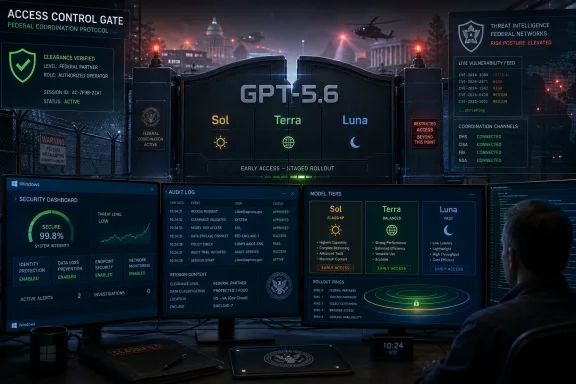
The New Model Arrived With a Handbrake Attached
OpenAI’s GPT-5.6 release has all the ingredients of a classic frontier-model launch: a flagship system, a cheaper everyday tier, a fast low-cost option, new reasoning modes, and benchmark claims aimed squarely at developers and enterprise buyers. Under ordinary circumstances, the story would be about whether Sol beats Anthropic’s latest models, whether Terra resets API economics, and whether Luna can flood high-volume workflows with cheaper intelligence.
Instead, the defining feature of GPT-5.6 is restricted access. OpenAI says the preview is limited to a small set of trusted partners whose participation has been shared with the U.S. government. Axios reported the launch group is roughly 20 companies, with broader access expected to expand in stages if testing and government coordination do not surface new concerns.
That makes GPT-5.6 a product launch with an asterisk big enough to dominate the spec sheet. The model exists. It is being used. It is not, however, available in the normal way most developers now expect from OpenAI: flip a switch in ChatGPT, call the API, update a model string, and start testing.
This matters because AI markets have been trained by speed. Developers expect immediate access, fast evaluation, and rapid integration. Enterprise buyers expect controlled rollouts, but not necessarily a federal gating process sitting between a vendor and a customer. GPT-5.6 suggests that the most capable models may be entering a new category: commercial products that can be delayed, narrowed, or staged because the government regards their capabilities as strategically sensitive.
Sol Is the Headline, but the Family Structure Is the Product Strategy
OpenAI’s naming here is not accidental. GPT-5.6 Sol is the flagship, Terra is the balanced workhorse, and Luna is the fast, cheaper option. That gives OpenAI a cleaner tiering strategy than the old patchwork of flagship, mini, turbo, preview, and dated model names that made API procurement feel like deciphering a train schedule.
Sol is the model OpenAI wants the world to notice. It is described as the strongest member of the family, with improved agentic capabilities in coding, biology, and cybersecurity. It also introduces a new max reasoning effort and an ultra mode that can use coordinated subagents to break complex work into pieces.
That last part should make every developer both interested and cautious. Subagent-style execution is exactly the kind of capability that can turn an AI model from a clever assistant into something closer to an automated analyst, software engineer, or security researcher. It also means token usage, tool calls, and audit requirements can become harder to predict.
Terra is arguably the more important enterprise model if OpenAI’s claims hold up. OpenAI says it delivers performance competitive with GPT-5.5 at half the cost. In practical terms, that is the model many organizations would want to test first for code review, document analysis, service desk workflows, compliance drafting, and internal knowledge systems.
Luna, meanwhile, is the volume play. It is designed for speed and affordability, the part of the lineup that could show up everywhere from customer support bots to developer autocomplete to background classification jobs. The irony is that even the lower-cost model is initially caught in the same restricted release net as Sol.
Washington Is No Longer Watching From the Sidelines
The federal role in GPT-5.6 is the real story. OpenAI says it previewed its plans and model capabilities to the U.S. government before launch, and that the limited rollout is happening at the government’s request. The company also says it does not want this kind of access process to become the long-term default.
That wording is careful, but the implication is blunt. OpenAI is cooperating, but it is not celebrating. The company is trying to preserve a path to wider release while signaling that customer-by-customer government involvement is a bad model for the industry if it becomes routine.
The administration’s concern centers on advanced cybersecurity capabilities. This is not an abstract fear. OpenAI says GPT-5.6 Sol improves the performance frontier for long-horizon security tasks including vulnerability research and exploitation. The company’s argument is that the model is better at helping defenders find and fix vulnerabilities than at reliably carrying out end-to-end attacks, and that it does not cross OpenAI’s own “Cyber Critical” threshold.
That distinction may be true and still not settle the policy argument. In security, the line between defensive capability and offensive capability has always been blurry. A tool that can reason through a vulnerability, identify exploitation primitives, and suggest remediation is valuable to defenders. The same tool, in the wrong workflow, may shorten the distance between curiosity and compromise.
The government’s intervention reflects that ambiguity. It is not simply asking whether GPT-5.6 can answer a dangerous prompt. It is asking whether a general-purpose reasoning system, combined with tools, code execution, browsing, agents, and a determined operator, changes the risk profile of cyber operations.
The Anthropic Precedent Turned a Rivalry Into a Regulatory Pattern
GPT-5.6 did not arrive in a vacuum. The rollout follows federal pressure on Anthropic’s Mythos and Fable models, which were also scrutinized over advanced cyber capabilities. That sequence is important because it turns what might have looked like a one-company dispute into an emerging government pattern.
The Anthropic episode reportedly centered on concerns that advanced models could help find software flaws in ways that might be weaponized. After that, OpenAI’s GPT-5.6 release became a test case for whether the same standard would apply to the industry’s most visible AI company. The answer appears to be yes.
That is politically significant. OpenAI has deep relationships in Washington, enormous strategic value to the U.S. AI ecosystem, and a central role in Microsoft’s AI platform ambitions. If even OpenAI’s launch can be slowed or narrowed, no frontier lab can assume that commercial momentum alone will carry its next release into the market.
It is also competitively significant. AI companies have spent the last several years racing one another in public: better coding scores, longer context windows, faster inference, cheaper tokens, better agent workflows. A government review layer changes the rhythm of that competition. A model that is technically ready may not be commercially available. A model that is safe enough under a company’s own framework may still be politically too hot for broad release.
For customers, this creates a new kind of platform risk. The best model on paper may not be the best model to build around if access can be delayed, restricted by nationality, narrowed to approved customers, or changed during a government review.
The Cybersecurity Case Is Stronger Than the Censorship Soundbite
It is tempting to frame the GPT-5.6 restriction as a simple free-market-versus-government-control story. That is too easy. The security case for caution is stronger than critics may want to admit.
Modern AI systems are no longer just chatbots that summarize text and write boilerplate code. The frontier models are increasingly good at multi-step reasoning, tool use, debugging, log analysis, command-line workflows, and interpreting unfamiliar codebases. Those are exactly the skills that matter in both defensive security operations and offensive exploitation.
For sysadmins and security teams, that creates a paradox. The people defending Windows fleets, hybrid identity environments, VPNs, Exchange servers, cloud tenants, and endpoint estates need better automation. They need help triaging alerts, understanding exploit chains, writing detection logic, testing patches, and reducing the human bottleneck in incident response.
But the same general capability can assist adversaries. A model that helps a defender understand a privilege escalation chain could also help an attacker refine one. A model that can reason across logs, code, and network traces can accelerate both investigation and intrusion.
OpenAI’s safeguards are therefore not window dressing. The company says GPT-5.6 uses protections trained into the model, real-time cyber and biology misuse classifiers, monitoring, account-level signals, differentiated access, and enforcement. It also says certain high-risk generations can be paused while a larger reasoning model reviews the conversation and context before output reaches the user.
That is a serious architecture. It is also an admission that old-style safety filters are not enough. If the model is powerful enough to operate as a cyber collaborator, then safety has to happen inside the model behavior, during generation, and at the account and access layer.
Enterprise IT Gets Power, Uncertainty, and Another Governance Problem
For WindowsForum’s core audience, GPT-5.6 is not just an AI industry drama. It is a preview of the governance problems coming to ordinary IT operations.
Enterprises want AI models for exactly the areas GPT-5.6 appears to improve: software engineering, vulnerability research, patch analysis, documentation, workflow automation, and incident response. In a Microsoft-heavy environment, those needs touch everything from PowerShell and Intune to Defender, Entra ID, Azure, Visual Studio, GitHub, and internal help desk systems.
The promise is obvious. A capable model could help a security team understand whether a new CVE affects its environment, generate detection queries, review risky scripts, analyze crash dumps, summarize event logs, and draft remediation steps. It could help developers modernize legacy .NET code or explain brittle Group Policy interactions that only one senior admin understands.
The complication is access. If frontier models are released first to approved partners, many organizations will not be able to evaluate them when the news cycle says they exist. Procurement teams will ask vendors whether GPT-5.6 is available. Security teams will ask whether data can be processed through it. Developers will ask why a competitor seems to have access while they do not.
That uncertainty will feed shadow AI. When official access is delayed, employees often look for unofficial routes: third-party wrappers, dubious “early access” services, personal accounts, or model claims that cannot be verified. Ironically, a cautious rollout intended to reduce risk can create a different risk if organizations do not communicate clearly about what is approved and what is not.
The sane enterprise response is not panic. It is policy. Organizations should treat frontier AI access like privileged infrastructure, not like another SaaS feature. That means logging, identity controls, data classification, vendor review, acceptable-use rules, and explicit restrictions on cyber testing outside approved environments.
Developers Are Being Asked to Build on Moving Ground
The developer impact is more subtle but just as important. GPT-5.6’s pricing and tiers suggest OpenAI still wants developers to optimize applications across model classes. Sol handles the hardest reasoning. Terra handles mainstream work. Luna handles cheap, fast volume.
That is a familiar cloud pattern. Use the expensive instance for the hard job, the general-purpose instance for the normal job, and the cheap instance for scale. Developers can route prompts based on complexity, latency, cost, and risk.
The problem is that model availability now has a policy dimension. A developer designing a product around GPT-5.6 Sol may not know when their company will get access, whether customers in certain regions will be eligible, or whether particular use cases will trigger additional review. That changes architecture decisions.
The safest technical strategy is abstraction. Applications should avoid hard-coding a single frontier model as an irreplaceable dependency. They should support model fallback, capability detection, logging of model decisions, and test suites that compare behavior across versions.
This is especially true for agentic workflows. If an application relies on Sol’s ultra mode or coordinated subagents, a fallback to Terra, Luna, GPT-5.5, or a competing model may not be functionally equivalent. The more powerful the model-specific feature, the more fragile the deployment becomes when access changes.
For software teams, the next phase of AI engineering will look less like prompt tinkering and more like distributed systems design. Models will have service levels, policy constraints, failure modes, latency profiles, and audit requirements. Treating them as magical text boxes is no longer a professional option.
Microsoft Is the Unspoken Stakeholder in Every OpenAI Rollout
OpenAI’s launch is also a Microsoft story, even when Microsoft is not the quoted actor. OpenAI’s models influence GitHub Copilot, Azure AI offerings, Microsoft 365 Copilot expectations, developer tooling, and the broader Windows ecosystem’s AI trajectory. When OpenAI’s frontier release is restricted, the ripple effects do not stop at OpenAI’s API page.
Microsoft has spent years positioning AI as a platform layer across productivity, security, development, and cloud operations. The most compelling version of that story assumes rapid access to the best models and steady integration into products users already run. A federal access process complicates that cadence.
This does not mean Copilot users should expect GPT-5.6 to appear or disappear overnight. Microsoft product integration is already gated by enterprise compliance, reliability testing, cost management, and regional availability. But the GPT-5.6 episode shows that model supply itself may become politically mediated.
That matters for CIOs. If AI features in Microsoft products depend on models that are subject to government review, customers will need more transparency about which models are used, where data goes, what capabilities are enabled, and whether restrictions differ by tenant, geography, sector, or security posture.
It also matters for Microsoft’s security business. Defender, Sentinel, GitHub Advanced Security, and related tools all benefit from better AI reasoning. If frontier cyber-capable models are considered sensitive, Microsoft and OpenAI will have to show that defenders can get the upside without handing attackers the same leverage at scale.
The Pricing Looks Rational, but Access Is the Real Cost
On paper, GPT-5.6 pricing is straightforward. Sol is the premium tier at $5 per million input tokens and $30 per million output tokens. Terra is half that. Luna is $1 per million input tokens and $6 per million output tokens.
Those prices are aggressive enough to keep the developer market interested, especially if Terra really does approach prior flagship performance at lower cost. They also make it clear that OpenAI expects customers to think carefully about routing. Not every task deserves Sol, and not every user interaction can justify premium output pricing.
But the more important cost may be operational uncertainty. If access is limited, staged, or policy-dependent, organizations cannot evaluate total cost of ownership simply by multiplying token rates. They must account for delayed integration, duplicate testing across fallback models, compliance review, and the possibility that some users or workflows cannot use the model at all.
There is also the cost of explainability to the business. IT leaders will have to tell executives why the model in the headlines is not necessarily available to the company, why an AI vendor’s roadmap depends partly on Washington, and why “general availability in the coming weeks” is not the same thing as a contractual commitment.
That is a difficult conversation in organizations already impatient to monetize AI. It is even harder when competitors claim early access or when vendors build marketing around models most customers cannot yet touch.
The Safety Stack Is Becoming Part of the Product
The GPT-5.6 launch makes one thing unavoidable: safety architecture is now a product feature. Not a policy page. Not a blog-post appendix. A feature.
OpenAI’s description of GPT-5.6 emphasizes layered safeguards, model-level refusal behavior, real-time misuse classifiers, generation pauses, account-level signals, monitoring, differentiated access, and continued testing. This is the language of production security systems, not public relations.
That shift is overdue. If frontier models are going to be used in security-sensitive domains, customers need to understand how misuse is detected, how false positives are handled, and what happens when a legitimate defender asks for help with a technique that resembles offensive activity. Overblocking can make a model useless. Underblocking can make it dangerous.
The Anthropic comparison is instructive here. Reports around Anthropic’s earlier rollout described user frustration with routing and restrictions when high-risk topics were detected. OpenAI appears eager to argue that GPT-5.6’s safeguards are more deeply integrated and less dependent on crude external filtering.
Whether that holds up in practice is an empirical question. Security researchers, enterprise customers, and developers will quickly find the edges once access expands. False positives will matter. So will false negatives. So will the ability to document why a model refused one request but answered another.
For regulated enterprises, this could become a buying criterion. A model’s benchmark score will matter less if its safety system is unpredictable, unauditable, or incompatible with legitimate security work.
The Government Has Created a Process Before It Has Defined the Rules
The most uncomfortable part of the GPT-5.6 rollout is procedural. The U.S. government is moving toward a framework for reviewing the most advanced AI systems, particularly those with cyber capabilities. But according to the reporting around this launch, the details are still being developed.
That creates an awkward interim regime. Companies are asked to cooperate with review. The government expresses concern. Access is restricted. But the standards for approval, the thresholds for intervention, and the route to full release are not yet fully clear.
OpenAI is trying to frame the current preview as a short-term bridge to a repeatable process. That is the right argument for the company to make. No industry can operate well if every major launch becomes an improvised negotiation among executives, agencies, and political staff.
At the same time, the government is not wrong to want a seat at the table. Frontier AI models are now economically important, strategically relevant, and potentially useful in cyber operations. Pretending they are ordinary software updates would be naïve.
The policy challenge is to avoid building a de facto licensing regime by accident. If model release approvals become opaque, slow, politicized, or selectively enforced, the United States risks harming the very AI ecosystem it says it wants to protect. If review is too weak, the government risks allowing dangerous capabilities to diffuse without adequate controls.
The middle path requires published standards where possible, classified review where necessary, predictable timelines, appeal mechanisms, and clear distinctions between model capability, deployment context, customer trust level, and use-case risk.
This Is the Enterprise AI Reality Check Arriving Early
The AI industry has spent years selling inevitability. Better models would arrive, costs would fall, developers would build, enterprises would adopt, and regulation would trail behind. GPT-5.6 shows a different future arriving ahead of schedule.
The most capable AI systems may not roll out like consumer apps. They may arrive in rings: government preview, trusted partners, approved enterprises, broader API access, consumer integration. Each ring will carry different logging, monitoring, and acceptable-use expectations.
That may frustrate developers, but it resembles how many high-risk technologies already work. Security tools, offensive research frameworks, cryptographic systems, surveillance capabilities, and dual-use scientific tools often sit inside layered access regimes. Frontier AI is drifting toward that world.
The risk is that AI loses some of the openness that made it useful. Developers outside the preferred circle may be slower to test, critique, improve, and compete. Smaller companies may be disadvantaged relative to giants with Washington relationships and compliance departments. Global partners may wonder whether U.S. AI infrastructure is becoming a permissioned export.
The counterargument is that unmanaged access could produce a backlash worse than staged release. A major AI-enabled cyber incident tied to a newly released frontier model would invite far harsher intervention than the current preview process. The industry is trying to avoid that future while still shipping.
The Sol Launch Leaves a Short Checklist for IT Leaders
The GPT-5.6 rollout is not a reason for every organization to rewrite its AI strategy this weekend. It is, however, a reason to update assumptions. Frontier model access is becoming a governance issue, and IT teams should plan accordingly.
- Organizations should assume that the most capable AI models may arrive first through restricted previews rather than ordinary public availability.
- Developers should build model abstraction, fallback behavior, and evaluation harnesses into AI applications from the start.
- Security teams should distinguish approved defensive AI use from unsanctioned experimentation with cyber prompts, third-party wrappers, or personal accounts.
- Procurement teams should ask vendors which model versions power AI features, whether access is regionally or contractually constrained, and how changes are communicated.
- Enterprise architects should treat advanced agentic AI as privileged infrastructure that requires identity controls, logging, data classification, and auditability.
The lesson is not that GPT-5.6 is too dangerous to use. The lesson is that it is powerful enough to force institutions to decide how use should be governed before everyone gets access.
OpenAI wants GPT-5.6 to become broadly available in the coming weeks, and it probably will reach many more developers and enterprise customers once the current review period settles. But the precedent will remain: the next great model may not simply launch; it may be cleared, staged, monitored, and negotiated into existence. For the Windows ecosystem, where AI is quickly becoming part of development, administration, productivity, and defense, that means the future will be shaped as much by access control and policy architecture as by benchmark charts.