
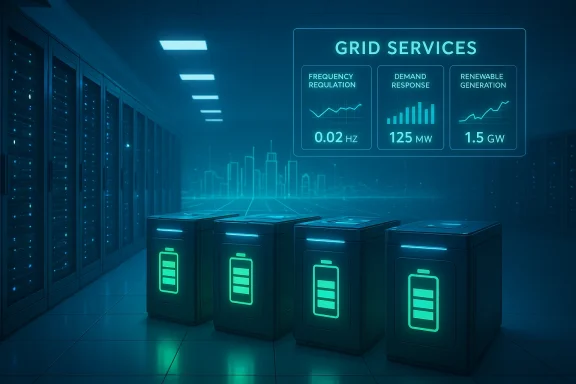
Data centers are no longer just voracious consumers of electricity; a rising number of operators are redesigning facilities, contracts and controls so those same data centers can become active partners in balancing and stabilizing power systems at scale. This shift—what the industry increasingly calls grid-friendly operations—aims to turn risk into revenue, reduce carbon intensity, and relieve pressure on stressed transmission corridors while preserving the 24/7 reliability customers demand.
The power challenge behind modern compute
Data center load growth has moved from a linear scaling problem into a grid‑level planning problem. Several independent industry analyses and reporting threads show that the clustering of hyperscale and AI‑grade facilities creates concentrated, location‑specific demand that can require multi‑hundred‑megawatt hookups and multi‑year transmission upgrades. That “time to power” mismatch—chips and racks ready before transmission and firm supply is in place—has driven operators to seek alternate solutions, from behind‑the‑meter generation to long‑term PPAs and battery deployments.
What the numbers mean (and what is uncertain)
Industry sources and utility disclosures consistently show rapid growth in electricity demand for data centers; one analysis in our files estimates data‑center power as a rising share of national load, with scenarios that materially increase grid planning needs by the late 2020s. However, some headline figures reported in broader press pieces (for example, precise terawatt‑hour totals and single‑event market impact numbers) were not verifiable in the set of documents we reviewed and should be treated with caution. Where possible below, I rely on corroborated utility and market reporting to describe trends; when a TechTarget article or other trade piece supplies a striking number that we could not independently confirm in the available documents, I flag that explicitly.
Why the sector must change
Concentrated demand creates three core problems for grids and communities:
Strengths
Some dramatic statistics—specific TWh totals attributed to a single federal report, or single‑event market impacts tied to unnamed analyses—appear in trade reporting but could not be independently verified in the file set we reviewed. Those numbers can be useful as conversation starters, but procurement teams and policymakers should demand original documentation or regulatory filings before treating headlines as fact. Where TechTarget and other outlets supply sharp figures, treat them as reporting claims to be validated against primary federal or market filings. (I could not find the original DOE/market filings for certain quoted TWh and $9.3B capacity‑market figures in the available documents; those points therefore require confirmation.)
Operators, utilities and policymakers must therefore focus on three linked priorities: rigorous contractual transparency, robust technical integration and conservative security design. Those three priorities, combined with realistic engineering—storage sized for both resilience and market participation, careful workload classification, and explicit utility coordination—are what turn today’s grid tensions into tomorrow’s flexible, lower‑carbon power systems. The promise is real; the path requires discipline, disclosure and partnership.
Source: TechTarget Smart data centers: Grid-friendly partners to power networks | TechTarget
 Background
The power challenge behind modern computeData center load growth has moved from a linear scaling problem into a grid‑level planning problem. Several independent industry analyses and reporting threads show that the clustering of hyperscale and AI‑grade facilities creates concentrated, location‑specific demand that can require multi‑hundred‑megawatt hookups and multi‑year transmission upgrades. That “time to power” mismatch—chips and racks ready before transmission and firm supply is in place—has driven operators to seek alternate solutions, from behind‑the‑meter generation to long‑term PPAs and battery deployments.
What the numbers mean (and what is uncertain)
Industry sources and utility disclosures consistently show rapid growth in electricity demand for data centers; one analysis in our files estimates data‑center power as a rising share of national load, with scenarios that materially increase grid planning needs by the late 2020s. However, some headline figures reported in broader press pieces (for example, precise terawatt‑hour totals and single‑event market impact numbers) were not verifiable in the set of documents we reviewed and should be treated with caution. Where possible below, I rely on corroborated utility and market reporting to describe trends; when a TechTarget article or other trade piece supplies a striking number that we could not independently confirm in the available documents, I flag that explicitly.
Why the sector must change
Concentrated demand creates three core problems for grids and communities:
- Local reliability risk when many large loads activate or switch modes simultaneously. Large, synchronous changes in data‑center power state can strain regional systems.
- Market and rate impacts where capacity and ancillary markets price in large, inflexible commitments from corporate customers.
- Political and permitting friction as communities weigh jobs, tax revenue and grid upgrades against environmental and land‑use concerns.
What “grid‑friendly” actually means
Grid‑friendly operations describe a spectrum of capabilities that let a data center behave as an interactive grid asset, not just as a load. In practice that includes:- Dynamic load modulation: the ability to throttle, delay or migrate non‑critical workloads in response to grid signals.
- Bidirectional energy flows: exporting or reducing draw when the grid needs capacity or absorbing surplus renewable generation.
- Fast response services: using batteries or power electronics to provide frequency regulation, synthetic inertia or ramping services.
- Market integration: participating in demand response, capacity markets, or bilateral contracts with utilities and grid operators.
Technologies that enable grid partnership
Transitioning from a passive consumer to an active grid partner requires several software and hardware components to operate in concert.Advanced energy‑management platforms
Modern energy orchestration layers combine price signals, telemetry and workload characteristics to make operational decisions automatically. These platforms can:- Predict short‑term power consumption and coordinate cooling, UPS, and battery dispatch.
- Classify workloads by delay tolerance and move flexible jobs to cheaper, lower‑carbon hours, or to other regions when appropriate.
Real‑time monitoring and predictive analytics
Operators are instrumenting power chains down to rack and PDU level, giving them sub‑second visibility that is essential for safe, reliable bidirectional operation. Predictive analytics flag equipment degradation—reducing the risk that a battery dispatch or short‑term load drop causes unplanned impact on availability. These monitoring stacks also support contractual auditing when a data center participates in grid programs.Battery energy storage systems (BESS)
Batteries are the linchpin technology for many grid services because they respond in milliseconds, can switch between backup and market operations, and are well‑suited to frequency regulation and fast ramp requirements. Multiple reports in our files document operators pairing BESS with renewables and exploring novel modes—such as replacing legacy UPS systems with distributed battery arrays that provide instantaneous backup while also participating in markets during normal operation. Batteries enable:- Frequency regulation and fast ramping
- Peak shaving and valley filling
- Arbitrage and price‑based dispatch
- Firming intermittent renewables for onsite consumption or sale
Renewable integration and hybrid assets
On‑site solar, co‑located wind, and virtual/physical PPAs remain central to decarbonization plans. But renewables alone do not guarantee hourly matching of carbon‑free electrons; operators pairing renewables with storage or firming resources (including long‑duration options) create a more credible path to 24/7 low‑carbon compute. Several recent partnership deals explicitly combine PPA offtake with storage, waste‑heat reuse pilots and cloud‑based grid optimization—signaling a shift from commodity buying to engineered energy stacks.Grid services data centers can deliver
Smart data centers can monetize flexibility while helping grids integrate more variable generation.Demand response and load shifting
By deferring, throttling or migrating non‑critical jobs, data centers can participate in demand response programs offered by utilities or system operators. These programs pay for verifiable reductions during peak stress windows. On the technical side, workload orchestration, data locality constraints and SLA discipline are the gating factors. Research and industry reporting suggest savings and revenue potential are meaningful when facilities coordinate cooling, IT load and migration strategies.Frequency regulation and fast reserves
Batteries and advanced inverter controls let data centers—or their co‑located storage assets—provide frequency regulation and fast reserves. Because batteries act immediately, they excel at short‑duration, high‑value ancillary services that were previously supplied by spinning thermal plants. Industry threads document battery usage patterns where utilities and markets price speed of response, making BESS commercially attractive in many regions.Peak shaving and valley filling
These classic strategies take on new dynamics when combined with predictive weather and price analytics. Peak shaving reduces exposure to time‑of‑use and peak capacity charges, while valley filling increases use of low‑carbon or low‑price hours. When coordinated with workload scheduling, operators realize both cost savings and grid benefits—flattening load curves that would otherwise require expensive peaking assets.Energy arbitrage and storage‑as‑a‑service
BESS allows daily arbitrage—storing cheap off‑peak energy and using or selling it during peak price events. Some operators are packaging storage capacity and selling it into capacity or ancillary markets, or offering it as a managed service to utilities. These business models turn investments in resilience into revenue-generating assets, subject to local market rules and careful contractual design.Technical implementation strategies and constraints
Turning concepts into operations requires pragmatic engineering and governance.Foundational infrastructure
Operators need flexible, bidirectional power infrastructure, adequate energy storage, and high‑density rack and cooling systems to support dynamic modes. In practice, this means:- Medium‑voltage tie‑ins and switchgear rated for bidirectional power flow
- Battery systems sized not just for blackout resilience but for market participation
- Server racks, PDUs and cooling designed for rapid load changes and dense power envelopes
Power software and controls
Sophisticated orchestration layers are required to reconcile grid dispatch signals, price forecasts, workload policies and SLA constraints. These platforms must integrate with:- Workload schedulers and container orchestrators
- Building management and cooling controls
- Battery management systems and utility telemetry
Real‑time integration with utility systems
Effective grid partnership depends on fast, reliable communications between a data center and its utility or ISO. That includes standardized dispatch signals, telemetry, and settlement mechanisms. Some utilities are developing technical specifications and programs for data centers; others require bespoke agreements. Clear technical and contractual interfaces reduce operational risk and improve the value data centers can provide to the system.Cybersecurity and resilience
Bidirectional power flows and direct integration with utility control systems expand the attack surface. Best practices include network segmentation, encrypted control channels, authenticated command and control, and OT/IT separation. Close coordination with utilities on authentication and incident response is essential to protect both the facility and the grid. Several analyst pieces in our files warn that cloud‑OT integration must be handled with conservative security design to avoid cascading failures.Market, policy and contractual context
Markets and regulations determine whether grid participation is profitable and operationally feasible.- Capacity and ancillary market design: Compensation mechanisms for fast response, frequency regulation, and capacity vary widely; where markets compensate speed and certainty, BESS and fast‑acting resources perform better financially. Several recent market outcomes and contract structures show that the structure of payments is as important as the technology itself.
- PPAs and attribute handling: Long‑term PPAs remain the primary tool for procuring renewable energy, but whether a PPA delivers real‑time hourly matching depends on contract terms, settlement design, and whether the buyer retains certificates or attributes. Recent Microsoft PPAs in Spain and the U.S. illustrate how companies combine renewables procurement with broader operational partnerships. Those deals frequently omit granular commercial terms in public statements, so the actual hourly matching will depend on underlying firming and storage arrangements.
- Regulatory incentives and programs: Incentive programs for distributed generation and storage, as well as market rules that allow storage to participate in energy and ancillary markets, materially affect business cases. Where regulators permit dual‑use of assets (i.e., backup plus market participation), operators capture more value; where they do not, economics are weaker.
Case studies and recent industry moves
These examples show both the promise and the practical limits of grid‑friendly approaches.Microsoft + Iberdrola: bundled PPA + cloud integration
Microsoft signed two PPAs in Spain totaling a headline 150 MW of contracted wind capacity while pairing that offtake with deeper Azure and Copilot integration across the Iberdrola group. The transaction is illustrative: it couples renewable procurement with digital services, and both parties emphasize exploring storage, heat reuse and hydrogen pilots to improve the effective value of those megawatts. Public reporting confirms the PPA headlines, but many commercial details—tenor, physical vs. virtual settlement, and attribute handling—remain undisclosed; those unpublished clauses will determine how useful those MWs are for hourly matching and firming.Microsoft + G42 / Khazna (UAE): large AI capacity with energy and governance overlays
Microsoft’s partnership to develop AI‑grade capacity in the UAE with G42 and Khazna shows how compute, export controls and sponsorship can be bundled. The deal includes a 200 MW commitment and regulatory approvals for certain accelerator exports—demonstrating the geopolitical and technical complexity of building AI capacity at scale, and how such projects require co‑design of energy and compute plans. Again, execution detail (timelines, energy firming) is the real test.Project Springbank and local community impacts
Large greenfield proposals such as the so‑called Project Springbank underscore the community and grid implications of massive data‑center campuses. Estimates presented in industry threads equate some campuses’ demands with the energy consumption of hundreds of thousands of homes—figures that highlight the scale but that also raise questions about how much firm, low‑carbon power is secured and how local grids will be hardened to accept the load. These projects often drive local transmission upgrades and spur debates about economic benefit versus environmental and service‑equity concerns.Strengths, risks and tradeoffs
Grid‑friendly data centers offer clear advantages but carry nontrivial risks.Strengths
- Operational flexibility unlocks new revenue streams and reduces net energy cost when markets and contracts are favorable.
- Paired with storage and renewables, data centers can materially improve the carbon profile of compute.
- Co‑designed energy + compute programs can accelerate grid modernization and create industrial partnerships that benefit both utilities and hyperscalers.
- Market and contractual opacity: public announcements often omit settlement details essential to verify hourly matching and attribute claims; such omissions can mislead stakeholders about the climate impact of a procurement headline.
- Operational complexity: integrating workload scheduling, battery dispatch and utility signals increases operational risk. A poor implementation could compromise availability or create market penalties.
- Cybersecurity: bidirectional and market‑connected assets widen the OT attack surface, demanding robust defense‑in‑depth.
- Local grid stress and political backlash: rapid build‑outs can force short‑term fossil bridging solutions (behind‑the‑meter gas, aeroderivative turbines) that contradict long‑term decarbonization goals if firm clean power is not available.
Some dramatic statistics—specific TWh totals attributed to a single federal report, or single‑event market impacts tied to unnamed analyses—appear in trade reporting but could not be independently verified in the file set we reviewed. Those numbers can be useful as conversation starters, but procurement teams and policymakers should demand original documentation or regulatory filings before treating headlines as fact. Where TechTarget and other outlets supply sharp figures, treat them as reporting claims to be validated against primary federal or market filings. (I could not find the original DOE/market filings for certain quoted TWh and $9.3B capacity‑market figures in the available documents; those points therefore require confirmation.)
Practical roadmap for data center operators
For operators and host communities seeking to pursue grid‑friendly strategies, the following pragmatic steps reduce execution risk.- Start with contract clarity: insist on transparent PPA terms that define whether energy is physically scheduled, how attributes are handled and who bears imbalance and curtailment risk.
- Build modular energy stacks: pair renewables with appropriately sized BESS and consider hybrid firming (battery + long‑duration storage or firm PPAs) for critical 24/7 loads.
- Invest in orchestration and safety: deploy an energy orchestration platform that integrates workload policy engines with BMS, cooling and grid telemetry—and put fail‑safe priority rules in place.
- Coordinate with utilities and ISOs early: secure tested technical interfaces, telemetry formats and settlement methods; join local demand response or flexibility programs where viable.
- Harden security and governance: separate OT from IT, encrypt control channels, and define joint incident response procedures with utilities.
- Pilot, measure and disclose: run pilots for demand response, frequency services and arbitrage; measure outcomes and publicly disclose verified metrics so markets and stakeholders can learn from real performance.
Conclusion
The era when data centers were passive, single‑direction power consumers is ending. A pragmatic movement toward grid‑friendly design is emerging—driven by the economics of storage and ancillary markets, regulatory changes that allow storage participation, and the operational necessity of powering rapidly growing AI workloads. When done well, grid‑friendly operations align corporate decarbonization goals, reduce overall system costs and create new revenue opportunities. When done poorly, they risk operational complexity, opaque sustainability claims and local grid stress.Operators, utilities and policymakers must therefore focus on three linked priorities: rigorous contractual transparency, robust technical integration and conservative security design. Those three priorities, combined with realistic engineering—storage sized for both resilience and market participation, careful workload classification, and explicit utility coordination—are what turn today’s grid tensions into tomorrow’s flexible, lower‑carbon power systems. The promise is real; the path requires discipline, disclosure and partnership.
Source: TechTarget Smart data centers: Grid-friendly partners to power networks | TechTarget
