

Trent Grisham’s decision to accept the one-year qualifying offer and Brian Cashman’s insistence that the Yankees landed a “bargain” have rippled through an already volatile offseason, raising questions about roster construction, payroll strategy, and the development timeline for top prospects in the Bronx.
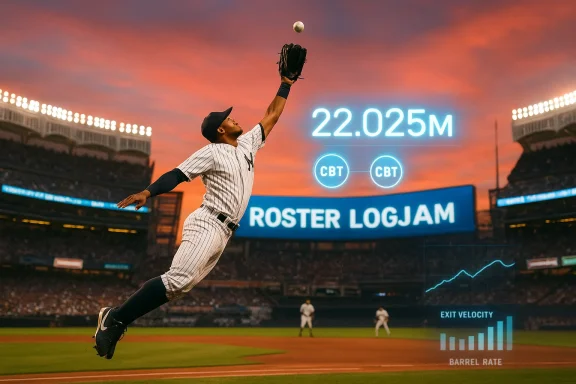
Trent Grisham, coming off a career-best 2025 season, accepted the New York Yankees’ qualifying offer — a one-year deal worth $22.025 million — instead of testing free agency for a multiyear contract. The acceptance was confirmed by the team and reported extensively across mainstream outlets.
Grisham’s 2025 numbers were the reason he drew that offer: in 143 games he produced 34 home runs with an .811 OPS, marking clear career highs and turning a player with previously inconsistent track records into a bona fide short-term asset. Those results are recorded in the statistical compendiums and Statcast databases that teams and analysts use to evaluate talent.
General manager Brian Cashman publicly framed Grisham’s acceptance as a strategic win — a way to secure a productive, defensively capable outfielder for a single season without the long-term commitment of a multi-year guarantee. Cashman has repeatedly described the decision as a calculated risk, and in several interviews he called the one-year, $22.025 million outcome a bargain when viewed in the context of a rising free-agent market.
From a roster-construction standpoint, the qualifying-offer route offered several attractions:
That said, the context matters:
There’s evidence to support this framing. The winter’s top moves included several short-term, high-AAV deals (Kyle Tucker’s reported mega-deal at the top of the market, Bo Bichette’s three-year $126 million pact that carries a $42M AAV, Alex Bregman’s large contract, and Cody Bellinger’s re-signing in the Bronx), which illustrate how teams increasingly prefer shorter deals with high annual dollars. Analysts have documented the spike in AAV on short pacts across the marketplace this offseason.
But the “bargain” label needs qualification:
A few practical takeaways from that arithmetic:
Jasson Domínguez — once the player of the future and still a valuable asset — has already seen his ascension slowed by immediate big-league options in front of him. Similarly, Spencer Jones, now on the 40-man roster and considered a near-term piece, had his path to regular at-bats blocked by Grisham’s retention. MLB.com and other reporting noted the competition and personnel choices the Yankees face in the outfield.
Why this matters:
Yet there are systemic downsides:
What will vindicate Cashman’s framing is repeatability. If Grisham reproduces something close to his 2025 output while the Yankees continue to upgrade in other areas without crippling payroll troubles, the one-year investment will look smart in hindsight. If his performance dips and CBT exposure bites the club midseason, the decision will be judged as an expensive risk that prioritized short-term optics over long-term balance.
For Yankees watchers, the next three months — spring reports, early-season usage patterns, and midseason payroll moves — will deliver the concrete evidence needed to settle whether the qualifying offer was the bargain Cashman says it is, or simply an expensive safety net that delayed a reckoning in the farm system and on the ledger.
In the end, the Grisham story is a compact case study in modern MLB front-office tradeoffs: performance versus projection, annual value versus long-term commitment, and the constant tension between winning now and building for later. The Yankees have made their bet — now the on-field results must do the talking.
Source: Dose.ca Yankees: Brian Cashman believes Trent Grisham’s contract is a bargain - Dose.ca
 Background: what actually happened
Trent Grisham, coming off a career-best 2025 season, accepted the New York Yankees’ qualifying offer — a one-year deal worth $22.025 million — instead of testing free agency for a multiyear contract. The acceptance was confirmed by the team and reported extensively across mainstream outlets. Grisham’s 2025 numbers were the reason he drew that offer: in 143 games he produced 34 home runs with an .811 OPS, marking clear career highs and turning a player with previously inconsistent track records into a bona fide short-term asset. Those results are recorded in the statistical compendiums and Statcast databases that teams and analysts use to evaluate talent.
General manager Brian Cashman publicly framed Grisham’s acceptance as a strategic win — a way to secure a productive, defensively capable outfielder for a single season without the long-term commitment of a multi-year guarantee. Cashman has repeatedly described the decision as a calculated risk, and in several interviews he called the one-year, $22.025 million outcome a bargain when viewed in the context of a rising free-agent market.
Overview: Why the Yankees offered the qualifying offer
The qualifying offer is designed to give a team a short-term control option for a player who produced at a high level. In Grisham’s case the Yankees decided to extend the one-year, high-AAV offer because his 2025 performance appeared both impactful and — in the club’s view — sustainable. Cashman and the analytics staff cited underlying metrics that showed better contact quality and improved plate discipline, evidence they say supports the leap in power and run creation.From a roster-construction standpoint, the qualifying-offer route offered several attractions:
- It guaranteed an immediately productive starter in center field without committing multiple years.
- It preserved the Yankees’ ability to pursue complementary moves (most notably Cody Bellinger) while keeping flexibility in the trade market.
- It forced opposing front offices to account for a player who might have been costing more in a multi-year deal on the open market.
The stats that justify the optimism — and their nuance
Grisham’s 2025 stat line reads like a breakout: 143 games, 34 home runs, .235/.348/.464 slash, and an .811 OPS. Advanced metrics paint a similarly supportive picture: improved barrel rate, better hard-contact metrics, and a marked uptick in walk rate that drove his on-base numbers. Baseball Savant and Baseball-Reference both show the improvement across contact and quality-of-contact indicators that front offices consider when deciding if a season was an outlier or a new baseline.That said, the context matters:
- Grisham’s career before 2025 was uneven — several seasons of below-average offense preceded the breakout, and his overall career batting average remains low.
- Statcast’s quality-of-contact numbers for 2025 are encouraging, but teams also weigh defense, baserunning, and injury history when projecting future value.
Cashman’s “bargain” claim: market reality versus optics
When Cashman calls the qualifying-offer signing a “bargain,” he’s making a comparative, market-level argument: one-year control of a player who just produced at an impact level is probably cheaper, in expected value, than the multi-year contracts similar free agents commanded this winter.There’s evidence to support this framing. The winter’s top moves included several short-term, high-AAV deals (Kyle Tucker’s reported mega-deal at the top of the market, Bo Bichette’s three-year $126 million pact that carries a $42M AAV, Alex Bregman’s large contract, and Cody Bellinger’s re-signing in the Bronx), which illustrate how teams increasingly prefer shorter deals with high annual dollars. Analysts have documented the spike in AAV on short pacts across the marketplace this offseason.
But the “bargain” label needs qualification:
- Bargain for whom? For the Yankees’ 2026 roster-construction plan, a one-year $22M outlay can be a bargain relative to a multi-year commitment, if Grisham repeats his performance.
- Bargain in payroll terms? Not necessarily. Even a one-year, high-AAV signing contributes to Competitive Balance Tax (CBT) calculations in the year it’s counted, and with the Yankees already operating at an elevated payroll level, that $22M AAV is not trivial. Cot’s Contracts and payroll-tracking outlets showed the Yankees near the top of CBT estimates this offseason.
AAV and luxury-tax consequences: the arithmetic that matters
Grisham’s $22.025M counts as an AAV on the Yankees’ CBT ledger for 2026. Payroll-tracking services placed New York’s projected CBT payroll among the league’s highest after the flurry of winter deals, and analysts warned that Bellinger’s five-year, $162.5M signing (AAV roughly $32.5M) and other deals push the club into a steep tax position. FanGraphs’ roster resource and Cot’s Contracts were widely cited for those projections.A few practical takeaways from that arithmetic:
- The one-year contract does not hide its cost from the CBT math: the AAV contributes to the team’s tax calculations regardless of term.
- High-AAV short-term deals have become a normative approach for many players; teams must accept that avoiding long-term risk can still generate heavy short-term CBT exposure.
- The Yankees’ payroll choices this winter illustrate a tradeoff: prioritize top-end annual performance this season at the expense of higher CBT exposure and constrained flexibility.
The prospect logjam: Jasson Domínguez and Spencer Jones
One of the more immediate and tangible costs of bringing Grisham back at that money is the roster logjam it creates in the outfield. With Aaron Judge reclaiming his role in right field and the team intent on keeping Cody Bellinger alongside him, the Yankees’ outfield picture is top-heavy with veterans. That reality pushes top prospects down the playing-time ladder.Jasson Domínguez — once the player of the future and still a valuable asset — has already seen his ascension slowed by immediate big-league options in front of him. Similarly, Spencer Jones, now on the 40-man roster and considered a near-term piece, had his path to regular at-bats blocked by Grisham’s retention. MLB.com and other reporting noted the competition and personnel choices the Yankees face in the outfield.
Why this matters:
- Prospect development is not only about talent but opportunity; consistent plate appearances at the big-league level accelerate growth and value creation.
- Keeping proven veterans is a legitimate short-term win; limiting prospect at-bats risks delaying or diminishing the club’s internal cost-controlled solutions in future seasons.
- The Yankees will again face the recurring front-office calculus: win-now additions versus longer-term roster renewal.
Risk assessment: can Grisham repeat 2025?
The central risk in calling the contract a bargain boils down to repeatability. Grisham’s breakout included:- Increased walk rate and better plate discipline, which often portend sustained offensive value.
- Spikes in quality-of-contact metrics that suggest a mechanical or approach change rather than pure luck.
- Underlying metrics (barrel rate, chase rate, exit velocity) that showed improvement in 2025.
- Coaching and approach changes the player has adopted, which can be durable but historically sometimes regress.
- Health and playing time stability — both of which played in Grisham’s favor in 2025.
Organizational strategy: short-term gain vs. long-term flexibility
Cashman’s approach reflects a broader trend: teams increasingly sign short-term, high-AAV deals to maximize current competitiveness while preserving the option to pivot later. For New York, the immediate objective — contend and leverage windows with Aaron Judge and other stars at peak performance — is paramount.Yet there are systemic downsides:
- Cumulative short-term AAVs balloon CBT in a single season, reducing margin for midseason reinforcements.
- Veteran retention can choke off prospect playing time, forcing the organization into trades or stunted development.
- If the short-term strategy fails, rebuilding is more costly because of the missing incremental internal talent pipeline.
What to watch in Spring Training and early 2026
Assessing whether Cashman’s “bargain” thesis will hold requires watching several concrete signals:- Grisham’s Spring Training performance: hard-contact rate, plate discipline, and center-field range will indicate whether the 2025 improvements were mechanical and repeatable.
- Playing-time allocation: how manager and coaching staff deploy Grisham, Domínguez, and Spencer Jones will reveal the team’s real long-term priorities.
- In-season adjustments: if Grisham slumps, will the Yankees pivot to give prospects more reps, or stand pat with veteran options?
- Payroll maneuvering: any midseason trades or DFA moves to manage CBT exposure will demonstrate how committed the front office is to balancing competitiveness with financial prudence.
Strengths of the move — why it could work
- Immediate performance: Grisham can slot into the everyday lineup and deliver the kind of offensive output the Yankees need to compete in a loaded AL East. His 2025 performance suggests he can be an above-average hitter and a positive defensive presence.
- Low-term commitment: one year limits long-term financial risk and allows the Yankees to re-assess in free agency or via trade after the season.
- Market dynamics: with the free-agent market leaning into high-AAV short-term deals, the Yankees avoided a bidding war that might have driven Grisham’s price even higher.
Weaknesses and risks — where the bargain narrative breaks down
- CBT and luxury-tax impact: the AAV still counts, and the Yankees’ payroll arithmetic is already pushed into taxing tiers by other signings. That $22M is not negligible for a club with explicit ownership constraints.
- Prospect development consequences: blocking playing time for Dominguez and Jones could delay cheaper, controllable production down the line.
- Regression risk: Grisham’s prior seasons were inconsistent; a reversion would make a $22M one-year outlay look expensive in real terms — especially if injuries or variance appear.
How fans and analysts should interpret Cashman’s framing
Brian Cashman’s public positioning is purposeful: he needs to justify a decision that has immediate on-field merit but tangible payroll side effects. For fans, the takeaway should be measured:- Recognize the potential upside: Grisham’s 2025 profile could materially help the Yankees’ lineup this season.
- Understand the cost: the AAV contributes to tax calculations and constrains midseason flexibility.
- Watch the process, not only the headline: pay attention to spring-report developments, playing-time signals, and how the front office manages payroll and prospect opportunities.
Final assessment and conclusion
Brian Cashman’s assertion that Trent Grisham’s $22.025 million qualifying-offer acceptance is a “bargain” is defensible but conditional. The move buys the Yankees a productive, defensive outfielder for one season and avoids the long-term commitment that many comparable free-agent contracts carry. However, the price is not trivial: the AAV counts against the CBT, it tightens roster flexibility, and it slows the promotion path of top prospects who represent future, cost-controlled value.What will vindicate Cashman’s framing is repeatability. If Grisham reproduces something close to his 2025 output while the Yankees continue to upgrade in other areas without crippling payroll troubles, the one-year investment will look smart in hindsight. If his performance dips and CBT exposure bites the club midseason, the decision will be judged as an expensive risk that prioritized short-term optics over long-term balance.
For Yankees watchers, the next three months — spring reports, early-season usage patterns, and midseason payroll moves — will deliver the concrete evidence needed to settle whether the qualifying offer was the bargain Cashman says it is, or simply an expensive safety net that delayed a reckoning in the farm system and on the ledger.
In the end, the Grisham story is a compact case study in modern MLB front-office tradeoffs: performance versus projection, annual value versus long-term commitment, and the constant tension between winning now and building for later. The Yankees have made their bet — now the on-field results must do the talking.
Source: Dose.ca Yankees: Brian Cashman believes Trent Grisham’s contract is a bargain - Dose.ca
