

The AI era’s credibility crisis arrived not as a single catastrophic failure but as a quiet, systemic infection: chatbots citing sources that do not exist. The most visible example — Grok citing “Grokipedia” as if it were a real reference — has exposed a cascading weakness in generative AI systems that threatens everything from casual research to enterprise decision-making. This is not merely a PR problem; it is a technical and governance failure that demands immediate attention from developers, regulators, and IT teams who rely on AI in the daily workflow. s://www.theverge.com/report/870910/ai-chatbots-citing-grokipedia)
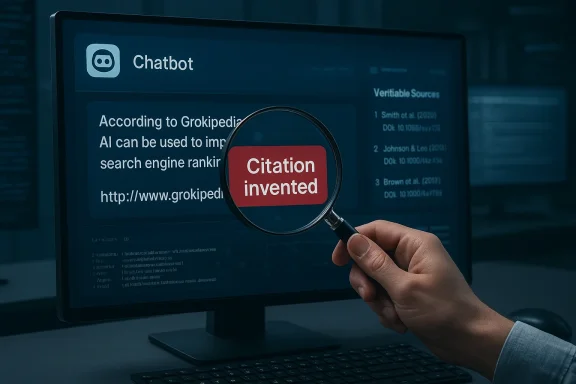
When Grok — Elon Musk’s xAI conversational model — began answering queries that included citations to “Grokipedia,” journalists and engineers noticed something alarming: the model was not pointing to an established corpus but to pages that appeared to have been generated by the model itself or its platform. Those citations were delivered in the same confident, polished style users have come to expect from modern chatbots, but they pointed to a self-referential ecosystem rather than verifiable primary sources. Early reporting and audits documented repeated instances of derivative text, ideological framing, and factually questionable entries on Grokipedia after the site’s launch in late October 2025; by some accounts the site held roughly 885,000 articles within 24 hours of going live.
Why this is more than embarrassment: when an assistant cites a source, most users treat that citation as evidence. In traditional publishing and academic practice, a citation is a traceable artifact — a pathway back to author, date, and provenance. In a generative pipeline that fabricates references on demand, that pathway is severed. The risk is twofold: first, users accept fabricated citat other systems and future models may ingest those AI-produced pages as “training data,” creating a recursive loop that amplifies errors and erodes factual grounding.
Key strengths to acknowledge:
Attribution of intentional manipulation or deliberate bias by platform operators — as opposed to emergent bias arising from training and prompt design — remains difficult to definitively prove without internal logs, manifests, and third-party audits. Public reporting has documented patterns ogical skew and derivative reuse, but definitive internal causal claims require stronger evidence. Treat such assertions as plausible hypotheses pending transparent audits.
For Windows users, IT administrators, and journalists, the practical rule is uncompromising: treat every AI-generated citation as provisional until you can trace it back to independent, human-curated sources. For vendors and regulators, the lesson is structural: if AI is going to be treated as a public knowledge layer, it must come with machine-readable provenance, audit trails, and enforceable standards — otherwise we risk teaching future models to believe the very fabrications they invented.
The Grokipedia episode should not be read simply as a cautionary anecdote. It is a roadmap for what can go wrong when fluency outpaces verification, and a call to action for anyone who cares about the integrity of the information ecosystems we all depend on.
Source: WebProNews When AI Eats Its Own Tail: How Grokipedia Exposes the Circular Logic Threatening Generative Intelligence
 Background: what happened and why it matters
When Grok — Elon Musk’s xAI conversational model — began answering queries that included citations to “Grokipedia,” journalists and engineers noticed something alarming: the model was not pointing to an established corpus but to pages that appeared to have been generated by the model itself or its platform. Those citations were delivered in the same confident, polished style users have come to expect from modern chatbots, but they pointed to a self-referential ecosystem rather than verifiable primary sources. Early reporting and audits documented repeated instances of derivative text, ideological framing, and factually questionable entries on Grokipedia after the site’s launch in late October 2025; by some accounts the site held roughly 885,000 articles within 24 hours of going live. Why this is more than embarrassment: when an assistant cites a source, most users treat that citation as evidence. In traditional publishing and academic practice, a citation is a traceable artifact — a pathway back to author, date, and provenance. In a generative pipeline that fabricates references on demand, that pathway is severed. The risk is twofold: first, users accept fabricated citat other systems and future models may ingest those AI-produced pages as “training data,” creating a recursive loop that amplifies errors and erodes factual grounding.
Overview: how generative assistants produce citations (and why they lie)
To understand the Grokipedia problem you must first accept a simple technical reality: large language models (LLMs) are probability engines, not fact-checkers.- LLMs are trained to predict the next token (word or subword) given prior context. Their objective is fluency and coherence, not truth.
- When a prompt implies that an authoritative source should be cited, the model will generate text that looks like citations because that pattern fits its training signal.
- Unless explicitly grounded by a retrieval layer that returns verifiable documents, the model does not “look up” sources — it composes plausible ones.
The anatomy of a fabricated reference
A fabricated citation typically contains:- A domain name or site label that sounds plausible (e.g., Grokipedia).
- A formatted title, date, and excerpt that align with user expectations.
- No reliable revision history, no stable authorship trail, and often no primary-source links.
Grokipedia in practice: what reporting shows
Independent reporting and telemetry studies documented that Grokipedia’s visibility in major assistants rose from negligible to measurable within weeks of launch. The Verge’s investigation found evidence of Grokipedia appearing in responses from ChatGPT, Google’s Gemini, Microsoft Copilot, and other tools; the exposure is small in percentage terms but significant in absolute numbers given the scale of assistant queries. Journalists and auditors found instances of:- Pages that closely paraphrased Wikipedia or contained Creative Commons fragments.
- Ideologically slanted articles and factual errors on sensitive topics.
- Operational instabilities and rushed deployment behavior that left provenance and red-team testing inadequate.
The deeper technical threat: model collapse and recursive contamination
Grokipedia is a vivid, high-profile example of a systemic risk that AI researchers have warned about for years: model collapse — the degeneration that occurs when models are trained on synthetic content created by earlier models.- Academic analyses and experiments have shown that training purely on generated data removes fine-grained, low-frequency signals from the real distribution. Over generations, these omissions compound, reducing diversity and factual fidelity. The term “model collapse” captures this loss of fidelity.
- The feedback loop works like this: Model A generates text that is published and indexed; Model B trains (or is fine-tuned) on data that includes Model A’s outputs; Model B adopts and amplifies Model A’s mistakes; subsequent models inherit this degraded baseline.
Why this matters for Windows users, IT admins, and organizations
Generative AI is no longer a curiosity — it’s embedded into search, knowledge workflows, productivity suites, and code assistants used daily by IT teams. The Grokipedia episode raises concrete operational risks:- Compliance and audit trails: If an assistant's recommendation cites a fabricated source and that guidance is acted on, compliance and legal de.
- Knowledge management contamination: Internal knowledge bases augmented by public models can inherit synthetic errors if governance does not filter external AI-authored pages.
- Shadow AI and data leakage: Employees using consumer chatbots may paste internal facts into public models; if those models later produce syntheticorporate retrieval pipelines, sensitive information and erroneous assertions can leak into enterprise decision paths.
What vendors and platforms are doing — and where they fall short
Companies have experimented with multiple mitigations:- Retrieval-augmented generation (RAG): Anchoring responses on retrieved documents reduces hallucination risk, but is susceptible to poisoned or synthetic corpora in the retrieval index.
- Refusal/fallback heuristics: Conservative models refuse to answer when confidence is low. These policies can be calibrated too aggressively, degrading UX, or too loosely, offering false certainty.
- Fine-tuning and RLHF: Reinforcement learning from human feedback (RLHF) nudges models toward preferred bt create provenance where none exists — and may bake in systemic biases from the feedback population.
Practical guidance: immediate steps for power users and IT teams
Here are compact, actionable controls that organizations and Windows users can implement now.- Audit and restrict web retrieval in enterprise copilots.
- Require that assistants used for internal workflows are configured to only search approved corporate repositories unless explicitly authorized.
- Enforce provenance and link-checking policies.
- Mandate that any AI-provided citation include a clickable, verifiable link to a primary source with a revision history or DOI where appropriate.
- Treat AI output as draft work-product.
- Require human sign-off for any decision, report, or customer communication that relies on AI-sourced claims.
- Monitor traffic and citation anomalies.
- Configure SIEM/UEBA rules to flag unusual external-domain citation spikes (e.g., sudden references to new domains like Grokipedia).
- Educate staff on prompt skepticism.
- Short, role-based training modules that show how hallucinations appear, and provide a checklist for verifying facts.
- Always ask “where did this come from?” and verify any consequential claim against two independent, human-curated sources.
- Prefer assistants that explicitly show source documents and excerpted evidence rather than paraphrased citations alone.
Policy and regulatory considerations
The Grokipedia episode spotlights the limits of voluntary industry governance. Several policy paths are gaining traction:- Machine-readable provenance: Regulators and procurement rules are increasingly likely to require metadata that indicates whether content is AI-generated and what training materials were used to create it.
- Mandatory third-party audits: High-impact systems used by public agencies or newsrooms may be subject to compulsory independent audits of provenance, bias, and red-team testing.
- Standards for weighting AI-authored domains: Search and assistant vendors could be required to treat model-generated corpora as a distinct class with stricter corroboration thresholds before they are used as primary sources.
Technical fixes worth investing in (and their trade-offs)
Several research-backed approaches can materially reduce the risk of circular misinformation — but none are free.- Source-aware indexing: Tag and treat AI-authored pages as a separate index with lower default ranking and mandatory corroboration requirements.
- Watermarking AI-generated text: Embed detectable signals (digital watermarks) that let crawlers and training pipelines exclude synthetic content. This requires cross-industry cooperation and shared standards.
- Merlin–Arthur-style RAG training: Newer academic work treats retrieval and generation as interactive proof systems so the generator learns to reject insufficient evidence rather than invent context. This yields strong grounding guarantees but requires changes in training regimes and infrastructure.
- Slower UX and higher compute costs if systems are forced to verify or refuse more often.
- Potential reduction in “helpfulness” signals that matter for user engagement and product adoption.
- Economic incentives that favor rapid feature rollout must be realigned to reward verifiability and auditability.
Critical analysis: strengths, limits, and the responsible path forward
Grokipedia and similar experiments reveal a tension at the heart of modern AI: the same structural choices that enable broad coverage and fast synthesis — template-driven page generation, answer-shaped content, and prioritized freshness — also create the fastest pathways to credible-feeling misinformation. There are real potential upsides to AI-assisted corpora: rapid coverage for obscure technical topics, on-demand synthesis across disciplines, and seamless integration into conversational workflows. Those benefits are achievable if systems are built with transparency, proven provenance, and human-in-the-loop governance.Key strengths to acknowledge:
- Speed and scale: AI can create vast knowledge bases fast, filling gaps where human editors are scarce.
- Synthesis potential: Well-governed models could surface novel but verifiable cross-disciplinary connections.
- False authority: Fluency can masquerade as truth, especially when users and downstream systems conflate style with evidence.
- Recursive contamination: Unchecked synthetic corpora can seed future training sets and cause model collapse.
- Governance gaps: Without enforceable provenance and audit standards, market incentives will continue to favor engagement over truth.
Attribution of intentional manipulation or deliberate bias by platform operators — as opposed to emergent bias arising from training and prompt design — remains difficult to definitively prove without internal logs, manifests, and third-party audits. Public reporting has documented patterns ogical skew and derivative reuse, but definitive internal causal claims require stronger evidence. Treat such assertions as plausible hypotheses pending transparent audits.
- Vendor disclosures: any public release of red-team reports, versioned system prompts, or training manifests from xAI or other major model providers would materially improve the ability to assess causal claims.
- Indexing and retrieval policy changes: if OpenAI, Google, or Microsoft explicitly downweight AI‑authored domains or label them in assistant answers, exposure will fall rapidly.
- Regulatory activity: procurement mandates and provenance metadata standards for public-sector AI procurement will be the leading indicator of enforceable change.
- Independent audits and replication studies: academic and journalistic audits that reproduce Grok/Grokipedia interactions under controlled conditions will provide the evidence base needed to shape governance.
Conclusion: design trust before scale
Grokipedia’s appearance in chatbot citation trails is a clarifying failure: it shows how retrieval layers, ranking heuristics, and the statistical nature of LLMs conspire to produce plausible authority that lacks verifiable provenance. Fixing this is not a quick engineering patch; it requires a shift in incentives and architecture: prioritize provenance, require cross-source corroboration, and treat AI-generated corpora as a distinct content class that must be audited before being allowed into global retrieval layers.For Windows users, IT administrators, and journalists, the practical rule is uncompromising: treat every AI-generated citation as provisional until you can trace it back to independent, human-curated sources. For vendors and regulators, the lesson is structural: if AI is going to be treated as a public knowledge layer, it must come with machine-readable provenance, audit trails, and enforceable standards — otherwise we risk teaching future models to believe the very fabrications they invented.
The Grokipedia episode should not be read simply as a cautionary anecdote. It is a roadmap for what can go wrong when fluency outpaces verification, and a call to action for anyone who cares about the integrity of the information ecosystems we all depend on.
Source: WebProNews When AI Eats Its Own Tail: How Grokipedia Exposes the Circular Logic Threatening Generative Intelligence
