

Microsoft’s push to give Copilot access to aggregated medical records and wearable data is the clearest sign yet that mainstream AI chatbots are asking for the keys to our health histories — and that users, clinicians and regulators all need to slow down and insist on stronger guardrails before handing those keys over.
Over the past year a wave of major AI companies — Microsoft, Amazon, OpenAI and Anthropic among them — announced or began trialing products that connect chatbots to personal health data. The pitch is straightforward: link disparate medical records and wearable-device streams, let the model synthesize the signals, and deliver a quick “high-level” overview or personalized guidance that helps users understand trends, prepare for doctor visits, and take cheaper, more proactive steps in managing their health. Vendors promise time savings and better context — the machine can read what would take a physician hours to manually review and can integrate continuous sensor data from smart watches and sleep trackers.
That promise contains real value. Fragmented records and opaque care pathways have left many patients bewildered and unable to leverage their own data. At the same time, these services are asking for arguably the most sensitive information anyone can have: diagnoses, medications, lab results, mental-health notes and longitudinal device streams. For regulators, privacy advocates and clinicians, the question is simple: do the benefits outweigh the risks — and can companies be trusted to behave safely when they hold such concentrated data?
This article explains how these systems work, the realistic benefits, the principal technical and legal risks, and practical steps users and clinicians should take now. It also outlines policy and product safeguards that would make a major new healthcare data stewardship model minimally acceptable.
Startups and smaller vendors may capitalize on the market by offering privacy-first or federated alternatives, but they face uphill battles in trust and reach. Insurers may be tempted to incorporate AI-derived signals into underwriting or case management — a prospect that raises deep questions about fairness and surveillance.
If these products are to be a net public good, they must be built on a foundation of verifiable technical safeguards, transparent governance, and legal protections that match the sensitivity of the data involved. Until those guardrails are in place, users should be skeptical, clinicians should be cautious, and regulators should move proactively to close the accountability gap. The future of AI-assisted health care can be bright — but only if we insist that privacy, safety and patient control are not optional features.
Source: The Star | Malaysia AI chatbots want your health records. Tread carefully.
 Background
Over the past year a wave of major AI companies — Microsoft, Amazon, OpenAI and Anthropic among them — announced or began trialing products that connect chatbots to personal health data. The pitch is straightforward: link disparate medical records and wearable-device streams, let the model synthesize the signals, and deliver a quick “high-level” overview or personalized guidance that helps users understand trends, prepare for doctor visits, and take cheaper, more proactive steps in managing their health. Vendors promise time savings and better context — the machine can read what would take a physician hours to manually review and can integrate continuous sensor data from smart watches and sleep trackers.That promise contains real value. Fragmented records and opaque care pathways have left many patients bewildered and unable to leverage their own data. At the same time, these services are asking for arguably the most sensitive information anyone can have: diagnoses, medications, lab results, mental-health notes and longitudinal device streams. For regulators, privacy advocates and clinicians, the question is simple: do the benefits outweigh the risks — and can companies be trusted to behave safely when they hold such concentrated data?
This article explains how these systems work, the realistic benefits, the principal technical and legal risks, and practical steps users and clinicians should take now. It also outlines policy and product safeguards that would make a major new healthcare data stewardship model minimally acceptable.
How these “health-enabled” chatbots work
The data plumbing: connecting records and wearables
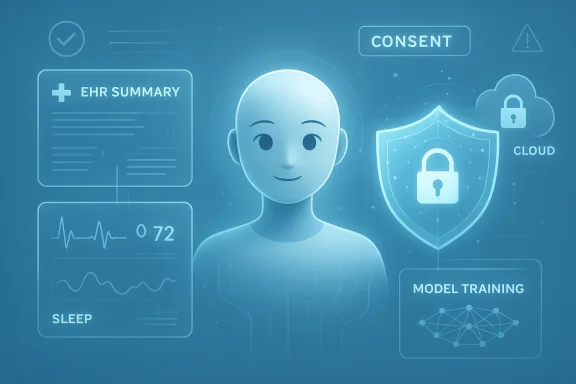
At a basic level, Copilot Health–style offerings combine three data sources:- Electronic health records (EHRs) from one or more providers (primary care, specialists, hospitals, labs).
- Consumer device telemetry from wearables (heart rate, activity, sleep stages, SpO2 proxies).
- User-provided context: symptom descriptions, demographic data and consent metadata.
What vendors say they’re doing
Vendors frame the offering as an “assistant for patients” rather than a clinical decision-maker. Typical product language emphasizes summaries, trend detection, and “guidance and support” rather than definitive diagnoses. Companies also claim to encrypt data at rest and in transit, restrict use of customer data for model training, and limit law-enforcement access to appropriate legal processes. Those are important promises — but promises are not the same as structural, verifiable protections.Potential benefits — real, but bounded
1. Practical value for patients and caregivers
AI summaries can surface patterns that are otherwise hard to see: medication interactions across multiple prescribers, a blood-pressure trend that correlates with reduced activity, or a subtle sleep decline after a certain medical event. For family caregivers managing complex elders or people with multiple chronic conditions, a single aggregated view can make care coordination easier.2. Time savings for clinicians and better visit preparation
When used as a pre-visit preparation tool, a high-quality summary can help patients and clinicians get to the critical questions faster. Rather than the clinician spending early minutes finding the relevant prior imaging or lab trends, a verified summary can turn those minutes into targeted clinical reasoning.3. Lower-cost access to health information
As healthcare costs push some patients away from routine primary care, an accessible synthesis tool can help people triage symptoms and decide when a clinical visit is essential versus when self-care or telehealth is appropriate. That could reduce some unnecessary visits and focus scarce clinical resources.4. Research and population-health upsides (conditional)
If deployed with strict de-identification, audited consent, and transparent governance, aggregated datasets could accelerate research in real-world outcomes, long-COVID, sleep disorders and other areas where longitudinal device-plus-EHR data is valuable.Principal risks — why this is not a simple “convenience” story
1. Centralization makes a lucrative target
Aggregating full medical records in a single corporate-flavored repository concentrates value for attackers. Health data is among the most sensitive and monetizable — it enables identity fraud, insurance fraud, blackmail and other harms. A central datastore maintained by a large tech vendor draws threat actors and increases systemic exposure. Even with encryption, large-scale breaches happen when ancillary systems (developer tools, admin consoles, third-party backups) are compromised.2. Regulatory asymmetry: HIPAA gaps and trust boundaries
In many jurisdictions, privacy rules that bind hospitals and insurers do not automatically apply to consumer tech platforms. Under current U.S. law, HIPAA protects covered entities and their business associates but typically does not cover consumer apps that patients voluntarily use. That means a company could claim different policies for data use, model training, or commercialization, and users may have limited legal recourse. Relying on vendor promises without structural, auditable obligations leaves patients exposed.3. Law enforcement and legal exposure
When you centralize records with a single vendor, law enforcement or government agencies can pursue data through one target rather than filing subpoenas with multiple hospital systems. In politically sensitive environments — for example where reproductive care or gender-affirming services are restricted — that centralized access becomes a real threat to vulnerable patients.4. Model limitations and clinical safety
Large language models are powerful summarizers but are not clinical experts. They hallucinate, change advice with minor prompt variations, and can miss high-risk conditions. Studies comparing chatbots to standard web searches have shown models are not yet reliably better at diagnosis or triage and sometimes fare worse. When patients treat an AI’s output as a diagnosis or as permission to delay urgent care, the consequences can be serious.5. Secondary uses and data monetization
Even with pledges, companies may evolve business models. If health data is used to improve models, it can be reidentified or indirectly influence product features in ways users never expected. Advertising, partner integrations, insurance underwriting signals or targeted offers based on health profiles are possible downstream risks.6. Psychological and behavioral harms
Health-focused AIs have already shown they can worsen anxiety, encourage unhelpful behaviors, or give dangerous recommendations when prompted. A person with access to their entire medical record plus a persuasive system that offers interpretations may experience increased health anxiety, unnecessary testing, or delayed professional care.How vendors’ technical claims should be interrogated
When a vendor says “data is encrypted” or “we don’t use your data to train models,” those are high-level assertions that require technical and organizational evidence. Responsible buyers and regulators should insist on:- Encryption specifics: Are records encrypted end-to-end under keys only the user controls, or are keys held by the vendor? True end-to-end encryption prevents the vendor from accessing plaintext; vendor-held keys do not.
- Access controls and auditability: Which internal teams can view plaintext? Are access logs immutable and independently auditable?
- Third-party risk: Which subcontractors or cloud services can access backups or metadata? Are there contractual restrictions and technical separation?
- Retention policies: How long is data retained if a user deletes their account? Is deletion implemented by cryptographic erasure or by pointer removal?
- Model training firewalls: If a company claims health data won’t train models, there must be technical isolation between the health-data pipeline and model-training pipelines, enforced and verified.
- Law-enforcement policy and transparency: Does the vendor publish transparency reports and take narrow stances on geolocation-specific legal orders?
Practical guidance for users who are considering these services
If you are thinking about letting a chatbot access your health records and wearable data, apply a risk checklist before you click “connect”:- Understand the exact permissions you are granting. Are you giving read-only access to specific records, or broad continuous access? Can you limit scope (labs only, or no mental-health notes)?
- Prefer end-to-end or client-controlled encryption where the vendor cannot decrypt data. If not available, treat claims of confidentiality cautiously.
- Audit retention and deletion: Can you delete all historical data and revoke access? How is deletion implemented and logged?
- Check the vendor’s legal status: Are they a HIPAA-covered entity or business associate? If not, what enforceable privacy law applies?
- Avoid storing particularly sensitive data in these platforms if possible — for example reproductive-health records or mental-health psychotherapy notes — until the vendor provides audited protections.
- Treat chatbot outputs as preparatory, not diagnostic. Use summaries to prepare for a clinician, not as a substitute for clinical judgment.
- Document and export your records before connecting. Keep an independent copy in your control so you can compare outputs or revoke access and still retain your data.
- Ask your clinician how they view these tools. Many clinicians are still learning where AI summaries help or harm workflow.
What clinicians and health systems should demand
- Clear liability rules: Who is responsible when an AI misses an emergency? Hospitals and clinicians should insist on contractual clarifications before integrating vendor-supplied summaries into care workflows.
- Verifiable validation studies: Independent, peer-reviewed evaluations demonstrating safety, sensitivity for emergencies and false-positive/negative profiles are essential before broad clinical use.
- Interoperability without centralization: Prefer architectures where data is federated or accessed only on-demand with patient-controlled permissions, rather than uploaded into vendor-managed silos.
- Auditability: Vendors should provide immutable logs showing who accessed what data and why, with the ability for patients and auditors to review.
- Clinical escalation pathways: Chatbots must flag potential emergency findings clearly and provide deterministic guidance to seek emergency care — not ambiguous language that can be misinterpreted.
Design patterns that reduce risk
There are concrete engineering and product patterns that materially reduce patient risk while preserving some benefits.1. On-device summaries and ephemeral views
Where possible, compute summaries on the user’s device or in a cryptographic enclave that prevents vendor access to raw records. Transmit only the final, ephemeral summary if the user chooses to share it.2. Patient-controlled keys
Adopt client-side encryption with keys the user controls. This prevents the vendor from reading health content even if the back-end is compromised.3. Model input redaction and provenance tagging
Automatically redact or flag highly sensitive fields (psychiatric notes, reproductive records) unless the user expressly authorizes their inclusion. Tag every model output with explicit provenance showing which records were used.4. Explainability and deterministic triage rules
Combine LLM-based summaries with deterministic, evidence-based triage checks for red flags (e.g., severe dyspnea, chest pain, signs of acute stroke) that always recommend immediate evaluation if triggered. Make these checks auditable and independent of the generative model.5. Separation of telemetry and identity
Architect systems so that aggregated analytics cannot be trivially linked back to personally identifying records without a separate, auditable key exchange controlled by the user.The regulatory horizon: what governments should require
To safely integrate tech platforms into the health-data ecosystem, regulators should consider:- Extending minimum privacy protections to consumer health platforms that hold or process medical records — aligning standards with HIPAA where appropriate or establishing a new consumer-health-data standard.
- Mandating technical controls like auditable access logs, data minimization, and user-controlled encryption for platforms that store PHI-level data.
- Requiring independent, pre-market clinical evaluation for consumer health AIs that provide triage or diagnostic guidance.
- Transparency obligations about secondary use and an affirmative prohibition on using health data to generate targeted advertising or discriminatory signals (e.g., for employment or insurance).
- Fast-track legal assistance and injunction pathways for individuals in jurisdictions where access to certain care is restricted, to prevent misuse of centralized health caches as enforcement vectors.
Market and industry implications
The move by major cloud and AI companies into health is not just a technical shift — it’s a reordering of market power. Big tech brings scale, UX and model capability; healthcare organizations bring legitimacy and clinical context. But the incentives don’t always align. Vendors that succeed will either demonstrate demonstrable, independent safety and privacy audits or partner closely with health systems under strict contractual governance.Startups and smaller vendors may capitalize on the market by offering privacy-first or federated alternatives, but they face uphill battles in trust and reach. Insurers may be tempted to incorporate AI-derived signals into underwriting or case management — a prospect that raises deep questions about fairness and surveillance.
Case studies and cautionary examples
Past incidents show how rapidly well-intentioned tech can produce harm when combined with opaque models and sensitive data.- Generative models have hallucinated harmful medical claims in real-world interactions, leading to misdiagnosis and dangerous behaviors.
- Centralized medical databases have been targeted in high-profile breaches that exposed entire populations’ records.
- Consumer health apps have previously sold de-identified datasets to third parties that were later re-identified, revealing the limits of de-identification at scale.
Recommendations — what vendors, regulators and users should do now
- Vendors must publish technical whitepapers describing encryption, key management and separation between health pipelines and model-training infrastructure. Independent third-party audits should be routine.
- Regulators should create a narrow, high-standard set of requirements for consumer health platforms, including audit rights, technical controls and premarket safety evaluations where clinical advice is involved.
- Health systems and clinicians should withhold deep integration until independent validation is available and require contractual protections and auditability.
- Users should default to minimal exposure: export and keep your baseline records outside of third-party platforms, limit connection scopes, and treat AI outputs as informational, not authoritative.
Conclusion
The arrival of chatbots that want to read your health records is a watershed moment. There is real utility in tools that can bridge fragmented records and continuous device data to give patients clearer, more actionable views of their health. But utility alone is not a sufficient justification for handing highly sensitive, longitudinal medical data to platforms that are not regulated like health providers and that have different commercial incentives.If these products are to be a net public good, they must be built on a foundation of verifiable technical safeguards, transparent governance, and legal protections that match the sensitivity of the data involved. Until those guardrails are in place, users should be skeptical, clinicians should be cautious, and regulators should move proactively to close the accountability gap. The future of AI-assisted health care can be bright — but only if we insist that privacy, safety and patient control are not optional features.
Source: The Star | Malaysia AI chatbots want your health records. Tread carefully.
