

The Gulf’s sudden escalation has done more than redraw diplomatic lines — it has jolted the architecture of the global cloud economy and forced startups and investors in India’s on‑demand services and fintech sectors to re‑price risk overnight.
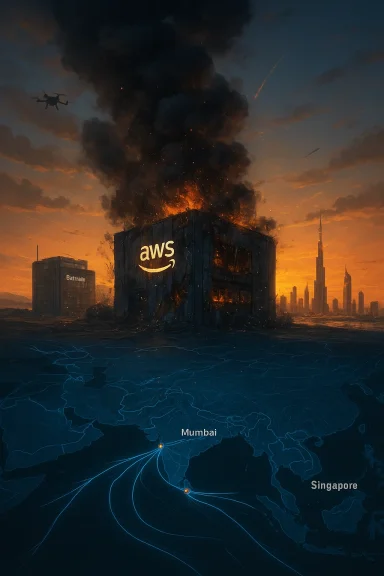
On March 1–2, a series of drone and missile strikes in the Gulf region physically impacted commercial cloud infrastructure, damaging multiple Amazon Web Services (AWS) data‑centre sites in the United Arab Emirates and Bahrain and triggering service disruptions for banking apps, airport systems and local exchanges. Independent reporting shows AWS acknowledged “objects” struck an Abu Dhabi/UAE facility that sparked fires and caused power and connectivity failures, while a separate site in Bahrain was also impacted. The physical hits and the cascaded outages have become a strategic inflection point for hyperscalers and their customers.
At the same time, India’s consumer‑facing startups are coping with investor scrutiny and unit‑economics pressure. Urban Company’s 10‑minute “Instahelp” category and its peers — Snabbit and Pronto — reported a sharp monthly order jump to roughly 2 million combined orders in February, a sign of rapid adoption but also sharply rising marketing and incentive spend that has made investors ask hard questions about profitability. Separately, mid‑sized fintech Easebuzz is in talks for a fresh Rs 200–300 crore raise at a valuation north of $250 million after a profitable FY25, an event that spotlights the crowded but consolidating payments processor market.
This feature explains what happened, why it matters to enterprises and investors, and what practical steps cloud customers and Indian startups should take now.
Why this is historic: while cloud outages are common, outages caused by kinetic attacks on commercial hyperscaler infrastructure are rare. The prospect of physical attacks elevates cloud risk from software, network and configuration faults to national‑security and kinetic‑threat territory — a qualitatively different class of hazard with major insurance, contractual and policy implications.
Infrastructure resilience, contractual clarity, and realistic runway assumptions are the currencies of the next phase. Companies that treat the cloud as geography as well as code — and investors who enforce discipline rather than worship growth for its own sake — will be best positioned to navigate the new normal.
Source: The Economic Times Gulf crisis weighs on hyperscalers; Instant help’s costly blitz
 Background / Overview
On March 1–2, a series of drone and missile strikes in the Gulf region physically impacted commercial cloud infrastructure, damaging multiple Amazon Web Services (AWS) data‑centre sites in the United Arab Emirates and Bahrain and triggering service disruptions for banking apps, airport systems and local exchanges. Independent reporting shows AWS acknowledged “objects” struck an Abu Dhabi/UAE facility that sparked fires and caused power and connectivity failures, while a separate site in Bahrain was also impacted. The physical hits and the cascaded outages have become a strategic inflection point for hyperscalers and their customers.At the same time, India’s consumer‑facing startups are coping with investor scrutiny and unit‑economics pressure. Urban Company’s 10‑minute “Instahelp” category and its peers — Snabbit and Pronto — reported a sharp monthly order jump to roughly 2 million combined orders in February, a sign of rapid adoption but also sharply rising marketing and incentive spend that has made investors ask hard questions about profitability. Separately, mid‑sized fintech Easebuzz is in talks for a fresh Rs 200–300 crore raise at a valuation north of $250 million after a profitable FY25, an event that spotlights the crowded but consolidating payments processor market.
This feature explains what happened, why it matters to enterprises and investors, and what practical steps cloud customers and Indian startups should take now.
Gulf crisis and hyperscalers: what happened and why it matters
The incident: physical strikes on commercial data centres
The core event is straightforward: drone/missile activity associated with the regional conflict struck at least two AWS sites in the UAE and one in Bahrain, producing fires, localised power loss, and service degradation for clients whose critical workloads ran in those availability zones. Reporting by multiple outlets and company statements confirm both the physical damage and the knock‑on service impacts on local digital infrastructure.Why this is historic: while cloud outages are common, outages caused by kinetic attacks on commercial hyperscaler infrastructure are rare. The prospect of physical attacks elevates cloud risk from software, network and configuration faults to national‑security and kinetic‑threat territory — a qualitatively different class of hazard with major insurance, contractual and policy implications.
Immediate operational effects
- Local banking portals, airport operational systems in Dubai and Kuwait, and securities exchanges in the UAE experienced outages or degraded performance as workloads were disrupted or failed over.
- Some global SaaS and AI services that relied on the impacted availability zones reported authentication and latency issues, with developer and end‑user experiences degraded for hours.
- Hyperscalers initiated emergency incident responses and began exploring or enforcing workload migrations to alternate regions. Industry sources report immediate capacity requests to hubs in India (Mumbai, Chennai, Hyderabad, Kochi) and Singapore to reduce exposure in West‑Asia adjacent regions.
Broader implications for cloud architecture and economics
The event exposes three structural vulnerabilities:- Concentration risk: Hyperscalers’ economies of scale mean enormous workloads are concentrated in a small set of physical sites. When an availability zone is damaged, services that didn’t architect multi‑AZ or multi‑region redundancy can suffer massively.
- Operational continuity vs. latency trade‑offs: For latency‑sensitive financial and real‑time systems, routing workloads to geographically distant safe havens (e.g., Singapore or Europe) raises latency and compliance tradeoffs. Enterprises must decide between perfect resilience and acceptable performance.
- New cost vectors: Expect higher insurance premiums for data‑centre operators, explicit “force majeure/acts of war” renegotiations in cloud contracts, and possibly capital expenditure on physical defences or hardening (e.g., redundant power, offsite replication). These costs will either be absorbed by hyperscalers, passed to customers, or triangulated through government support for national cloud infrastructure.
The hyperscalers’ strategic reaction: short‑term triage, long‑term repositioning
Triage: failover, capacity searches, and customer communications
Hyperscalers historically plan for hardware and network failures but not necessarily for kinetic strikes. The immediate response pattern includes:- Declaring incident states, prioritising critical customers (financial institutions, airports), and initiating controlled failover to healthy AZs/regions.
- Working with local utilities and governments to stabilise power and restore connectivity.
- Proactively sourcing capacity in nearby safe regions and rebalancing eastbound traffic flows to India and Singapore, at least temporarily.
Strategic repositioning: data‑sovereignty, regional hubs and the geopolitical cloud
Several strategic shifts are likely:- Regional diversification: Hyperscalers, telcos and sovereign cloud projects will accelerate investments in non‑conflict‑adjacent regions. India’s massive capex plans for data centres and subsea cable investments make it an obvious alternative for “eastbound” traffic.
- “Sovereign” and hybrid offerings: Governments may increase demand for sovereign clouds or locally operated facilities with stricter access and control models. Expect renewed interest in hosted or sovereign cloud models that combine global operator scale with local governance guarantees.
- Security hardening and insurance: Operators will reassess physical‑security postures and review catastrophe insurance coverage; customers will demand clearer SLAs tied to geopolitical incidents.
Technical analysis: resilience, latency, and the real costs of moving workloads
The limits of cloud redundancy
Cloud architects can design for redundancy — multi‑AZ, multi‑region, multi‑cloud — but the guarantees are not absolute:- Multi‑AZ often keeps workloads within the same metropolitan area. A single kinetic event or regional power loss can impact all AZs in the same region.
- Multi‑region replication increases resilience, but imposes latency, data‑transfer costs, and legal constraints (data residency, export controls).
- Multi‑cloud reduces single‑vendor exposure but increases operational complexity, increases integration testing overhead, and may not solve localized physical risk if providers’ facilities are co‑located with shared third‑party carriers.
Performance and cost tradeoffs
For banks and latency‑sensitive systems, moving core workloads from Dubai to Mumbai or Singapore is not costless:- Round‑trip latency increases may degrade user experience and transaction throughput.
- Cross‑border data egress and replication raise recurring costs.
- Disaster‑recovery tests and orchestration for live migration add engineering and run‑cost overheads.
Policy, legal and insurance realities
Contracts and the “acts of war” problem
Most cloud contracts contain force‑majeure clauses or exclusions for acts of war; however, what qualifies — and who bears the cost of remediation — is often ambiguous. Customers who expected SLAs to cover “availability” may find that kinetic events are explicitly exempted. Organisations will demand clearer contractual language on geopolitical incidents, expedited failover support, and cost sharing for emergency capacity.Insurance: prime time for re‑pricing catastrophe risk
Insurance underwriters will re‑evaluate data‑centre coverage. The industry could see:- Higher premiums for facilities in conflict‑adjacent regions.
- Stricter requirements for physical hardening and business‑continuity documentation.
- Potential gaps in cyber/physical combined policies where overlap between terrorism, wartime damage and cyber incidents is contested.
What enterprises should do now: a practical checklist
- Map critical workloads to physical geography — know exactly which AZ/region houses customer‑critical services and the dependencies (DNS, identity providers, payment processors).
- Test multi‑region failover under realistic conditions — don’t wait for an incident to discover replication lags or configuration gaps.
- Revisit contracts — insist on clearer language for geopolitical incidents, defined escalation paths, and pre‑approved capacity allocations for failover.
- Expand your insurance review — validate that policies cover physical damage from state or non‑state actors and clarify claim triggers.
- Evaluate hybrid or sovereign cloud options — where compliance or resilience demands it, consider locally managed or sovereign cloud alternatives.
- Invest in orchestration and observability — robust runbooks, automations, and telemetry reduce human error during high‑stress migrations.
Instahelp and the househelp apps: rapid growth, investor scepticism
The numbers: volume is up, burn is too
India’s 10‑minute househelp category — spearheaded by Urban Company’s Instahelp, Snabbit, and Pronto — reported a combined surge to over 2 million monthly orders in February, up from roughly 1.3 million in December. Urban Company alone accounted for an estimated 840,000–850,000 of those orders in February, while Snabbit and Pronto posted roughly 830,000 and 340,000 bookings respectively. The rapid scale is real, but so is a rising monthly cash burn: industry estimates suggest monthly burn climbed from roughly $7–8 million in December to $10–11 million in February as platforms heavily subsidised adoption.Marketing blitz: housing society campaigns and unit economics
Urban Company’s recent housing‑society campaigns in Delhi — sampling household goods to encourage trial of Instahelp — are textbook demand‑generation. Those tactics produce scale quickly but also mask the underlying economics. Urban Company’s own investor updates caution that Instahelp must double average order value (AOV) to break even at current cost structures, highlighting the central problem: high frequency is necessary but not sufficient for a sustainable unit economic model.Why investors are nervous
- High acquisition costs: The category’s growth relies on heavy incentives and localised marketing that may not convert to profitable, retained customers.
- TAM and retention uncertainty: Investors question whether the market for instant, paid, repeat househelp is large enough to absorb years of subsidy without margin improvements.
- Cross‑sell dependency: Many business plans rely on future cross‑sell and higher‑margin services to improve LTV/CAC — a path that’s plausible but not guaranteed.
Easebuzz on the raise trail: a profitable payments player in a competitive market
Deal snapshot and financials
Easebuzz, a Pune‑based payments and vertical SaaS player, is reported to be in talks to raise Rs 200–300 crore that could push its valuation above $250 million. The company closed FY25 with reported revenue of approximately Rs 650 crore and net profit in the low‑to‑mid tens of crores (reported figures vary around Rs 18–22 crore across outlets). Existing backers including Bessemer Venture Partners and 8i Ventures are expected to participate in the round as sellers and/or reinvestors. The company also has publicly stated plans to explore an IPO in the next 2–3 years.Why this matters for fintech investors
- Profitability signal: Unlike many payments startups that scale top line while burning cash, Easebuzz’s reported profit in FY25 is notable and will be attractive to investors pushing for durable economics.
- Secondary liquidity: The reported mix of primary and secondary components suggests early backers may pursue partial exits, while new capital could underwrite growth and international expansion.
- Path to public markets: A credible IPO plan at a higher valuation signals maturation and also raises expectations for governance, margin durability and revenue quality.
Caveats and verification
Public reporting on private companies often shows minor discrepancies in PAT and timing. While multiple reputable outlets report similar revenue and profit ballparks for Easebuzz’s FY25, investors should insist on audited financials and clear definitions of revenue versus pass‑through payments, since payments processors routinely report large top lines that primarily represent pass‑through transaction volumes.Cross‑sector takeaways: what investors and operators should watch
- For hyperscalers: Expect increasing operational costs for resilience and heightened government scrutiny over strategic infrastructure siting and access policies. Long‑term data‑centre strategy will become as much a political decision as a commercial one.
- For enterprise cloud customers: Don’t assume SLAs or multi‑AZ setups protect you from geopolitical risk. Map physical dependencies and negotiate clarity on incident categorisation and remediation.
- For Indian consumer and fintech investors: Rapid volume growth (Instahelp category, quick commerce) and profitability signals (Easebuzz) are both real, but the next stage will demand disciplined path‑to‑profit narratives, stronger unit economics and transparency on one‑time vs recurring revenue.
Risk scenarios to model now
- Extended regional conflict — prolonged degradation of Gulf sites would force sustained workload migration, raising costs and increasing latency for certain services.
- Insurance and capital shock — re‑pricing of catastrophe insurance could raise TCO for data‑centre operators, squeezing margins or accelerating consolidation.
- Regulatory fragmentation — countries may press for data localization or sovereign clouds, complicating global architectures and increasing vendor lock‑in risk for certain regulated workloads.
- Investor pullback in consumer categories — if unit economics don’t show credible improvement, expect consolidation in the Instahelp and quick‑commerce segments and a re‑allocation of capital toward profitable, vertically focused fintechs.
Practical recommendations for policymakers and industry
- Policymakers should engage hyperscalers and telcos to map critical infrastructure and consider public‑private frameworks for protecting essential digital infrastructure in high‑risk regions.
- Cloud providers should publish clearer guidance and emergency migration frameworks for customers operating in conflict‑adjacent regions, including pre‑committed capacity options and transparent incident categorisation.
- Startups and investors must stress‑test growth plans against rising customer acquisition costs and evaluate the sensitivity of unit economics to subsidy reduction.
Conclusion
The Gulf strikes are a sobering reminder that the cloud is always physical: racks, power feeds, fibre and gates that sit in geopolitical space. For hyperscalers, the incident is a pivot moment — not because it breaks technology, but because it makes geopolitical fragility visible in operational and financial terms. For Indian startups and investors, the same moment is a reality check: scale is necessary, but sustainable value depends on durable unit economics, robust contingency planning, and transparent financials.Infrastructure resilience, contractual clarity, and realistic runway assumptions are the currencies of the next phase. Companies that treat the cloud as geography as well as code — and investors who enforce discipline rather than worship growth for its own sake — will be best positioned to navigate the new normal.
Source: The Economic Times Gulf crisis weighs on hyperscalers; Instant help’s costly blitz