

Halo: Campaign Evolved will launch July 28, 2026, for Xbox Series X|S, Windows PC, Steam, and PlayStation 5, remaking the original 2001 Halo campaign in Unreal Engine 5 with three new prequel missions, expanded co-op, Game Pass access, and no competitive multiplayer. That sentence would have sounded absurd for most of the franchise’s life. Now it reads like Microsoft’s clearest admission yet that Halo is no longer just an Xbox mascot; it is a content platform that has to survive outside the walls it helped build.
The remake is pitched as reverent, but its business logic is radical. Microsoft is taking the game that sold the first Xbox as an idea, stripping out the multiplayer that made Halo a dorm-room institution, adding story content built for modern replay, and shipping Master Chief on a Sony console for the first time. This is not merely a nostalgia product. It is Xbox’s new multiplatform strategy wearing green armor.
Halo: Combat Evolved was not just a good launch game in 2001. It was the proof-of-concept for Microsoft’s entrance into console gaming, a first-person shooter that made the original Xbox feel less like a corporate experiment and more like a machine with a reason to exist. Its campaign was cinematic without losing player agency, its sandbox made encounters feel authored and chaotic at the same time, and its split-screen co-op turned living rooms into LAN-party embassies.
That is why Campaign Evolved carries more symbolic weight than another remake normally would. Microsoft has spent the past few years softening the idea of Xbox exclusivity, bringing more first-party games to rival platforms while insisting that the Xbox ecosystem is larger than a plastic box under the television. Halo on PlayStation 5 is the moment that argument stops being abstract.
The uncomfortable truth is that Halo is both Microsoft’s crown jewel and one of its most difficult modern franchises. Halo Infinite launched with a strong mechanical foundation but never became the live-service juggernaut Microsoft wanted. The series has spent years trying to balance reverence for Bungie-era design with the expectations of a market now shaped by battle passes, crossplay, seasonal content, and shooters that never really end.
Campaign Evolved sidesteps that fight by returning to the cleanest part of the Halo proposition: the campaign. It is a remake of the story mode, not a new multiplayer platform. That choice may disappoint players who define Halo by Blood Gulch, pistol duels, and system-link chaos, but it also gives Halo Studios a narrower target. The studio does not have to solve the future of competitive Halo in one package. It has to prove that the franchise’s oldest adventure can still command attention when it is no longer protected by exclusivity.
But Campaign Evolved is not trying to replace that memory. It is trying to avoid competing with it.
A faithful recreation of Combat Evolved multiplayer would immediately collide with two decades of expectation. Should the pistol be dominant? Should movement stay heavy and deliberate? Should maps be rebuilt exactly, rebalanced, or expanded? Should the remake coexist with Halo Infinite, The Master Chief Collection, and whatever comes next? Every answer would alienate someone, and every compromise would be measured against a version of Halo that exists as much in memory as on disc.
By focusing on campaign, Halo Studios gets to make a cleaner promise. The studio can modernize controls, cinematics, level readability, and combat flow while still pointing to the original campaign structure as the spine of the project. The risk is not that players will fail to understand what they are buying. The risk is that they will understand it too well and decide that a campaign-only remake must justify itself through craft rather than habit.
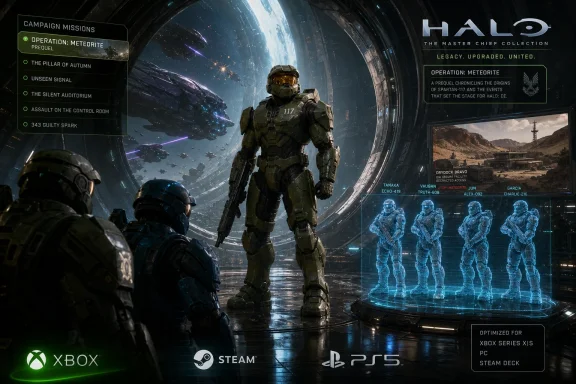
That is where the three new prequel missions matter. Operation: Meteorite gives Campaign Evolved a hook beyond visual restoration, placing Master Chief and Sergeant Major Avery Johnson into new story content before the events of the original campaign. It also gives the remake permission to introduce enemies and scenarios that were not present in 2001, including Brutes and space combat segments seen in early footage.
This is delicate territory. Add too little, and the remake feels like a museum piece with a higher-resolution gift shop. Add too much, and the game risks sanding away the lonely, mysterious atmosphere that made Combat Evolved feel so strange and confident. The best version of Campaign Evolved will treat the new missions not as lore stuffing, but as a controlled pressure test: proof that Halo Studios can write and stage new Halo while standing inside the architecture of old Halo.
The more interesting move is how Microsoft is pricing and packaging the same game across its ecosystem. The Standard Edition at $49.99 is a notable signal in a market where major releases increasingly default to $69.99 or higher. It frames Campaign Evolved as a premium but not full-price release, a position that tacitly acknowledges the game’s remake status and campaign-only scope.
The Premium Edition, at $69.99, adds five days of early access, the Alpha Halo Armory Pack, armor and weapon skins, a digital short story, an artbook, and a digital manual. The Collector’s Edition climbs to $199.99 with the Premium digital package, a SteelBook, a 12-inch Master Chief statue, an LED Cortana chip, concept art prints, a reimagined physical manual, and platform-dependent disc or code arrangements. The Steam version gets a voucher rather than a physical disc, a small but telling reminder that “collector’s edition” now often means “physical objects around a digital entitlement.”
The Premium Edition Upgrade may end up being the most important SKU for the WindowsForum crowd. Game Pass subscribers already have day-one access on Xbox and PC through the appropriate tiers, but the upgrade lets them buy into early access and deluxe extras without purchasing the full Premium Edition outright. That is Microsoft’s ecosystem logic in miniature: access through subscription, monetization through upgrades, retention through account-wide entitlements.
Xbox Play Anywhere strengthens that pitch by letting a single purchase work across Xbox console and PC. Cross-play and cross-progression across Xbox Series X|S, Windows PC, Steam, and PlayStation 5 make the platform story even broader. The irony is rich but unavoidable: Microsoft is using Halo, once the symbol of console separation, to demonstrate that its future business depends on reducing friction between platforms.
Moving to Unreal Engine 5 is therefore both a production decision and a message. It tells players, developers, and Microsoft’s own leadership that future Halo development will rely on an industry-standard toolchain with a larger talent pool and more familiar workflows. It also suggests that Halo Studios wants to spend less energy maintaining bespoke technology and more energy shipping content.
That does not make the transition simple. Halo has always depended on feel: the weight of the Warthog, the cadence of shield recharge, the way Grunts panic, the strange dance between plasma and ballistic weapons, the snap of the assault rifle, the float of a grenade, the readable silhouette of an Elite. Unreal can render a beautiful Forerunner hallway, but Halo is not merely a collection of assets. It is a simulation language players learned with their hands.
Microsoft’s messaging around legacy gameplay code is therefore important. Campaign Evolved is being presented as a modern visual and systems overhaul layered on top of preserved Halo feel, not as a total mechanical replacement. That is the right promise, but it is also the hardest one to keep. The more realistic the world becomes, the more obvious it is when old encounter logic, corridor repetition, or enemy placement shows its age.
Former Halo developers have already raised concerns in public commentary. Jaime Griesemer, one of the original designers, reportedly criticized aspects of updated level design, while Niles Sankey warned that the visual overhaul could affect tactical readability. These critiques matter because Halo’s combat clarity was never an accident. The original game’s relatively simple geometry, bold color contrast, and clean enemy silhouettes helped players read a battlefield quickly, even in chaos.
Combat Evolved’s visual language was partly born from technical constraint, but constraint often clarifies design. The ringworld’s sweeping skies, chunky Forerunner architecture, and bright Covenant colors gave players a readable hierarchy of spaces and threats. You could see where enemies were, where vehicles fit, where cover mattered, and where the next combat pocket was likely to unfold.
Unreal Engine 5 gives Halo Studios far more power: denser environments, richer lighting, improved animation, rebuilt materials, and more cinematic presentation. It also creates temptation. More foliage, more particles, more reflective surfaces, more volumetric mood, more debris, more environmental dressing. In screenshots and trailers, those elements sell modernity. In play, they can obscure the target.
This is especially relevant because Halo’s combat is not a twitch corridor shooter. It is a sandbox built around prioritization. Players are constantly deciding whether to strip shields with plasma, finish with bullets, flank a Jackal, dodge a Hunter, hijack a vehicle, conserve rockets, or retreat until shields come back. The battlefield must communicate quickly enough for those decisions to feel earned rather than guessed.
The remake’s success will depend on whether Halo Studios understands that readability is a feature. A remastered soundtrack, rebuilt sound design, and newly recorded voice work can enrich the experience, but they cannot compensate for a battlefield that muddies the tactical grammar. If Campaign Evolved looks like Halo but players cannot read it like Halo, the remake will have mistaken fidelity for decoration.
These changes will be controversial because Combat Evolved’s limitations are part of its identity. The original game did not have sprint, and its combat spaces were tuned around walking speed, shield timing, grenade arcs, and vehicle availability. Add sprint carelessly, and encounter pacing changes. Add hijacking, and vehicle fights change. Add later-era weapons, and the delicate balance between scarcity and empowerment shifts.
Yet a remake that ignores 25 years of Halo design would be strange in its own way. Campaign Evolved is aimed not only at players who remember 2001, but also at players whose first Halo was Reach, Halo 4, Halo 5, Infinite, or perhaps no Halo at all. For them, the absence of sprint or hijacking may not read as purity. It may read as stiffness.
The campaign remix system with Skulls is a smart bridge between these audiences. Skulls have long been Halo’s sanctioned way of breaking Halo, letting players alter difficulty, enemy behavior, physics, and absurdity without pretending the modified experience is canonical. If Campaign Evolved uses Skulls, enemy variations, combat modifiers, and randomized elements to expand replayability, it can preserve a more traditional baseline while giving veterans reasons to return.
The key is separation. Modern mechanics should not simply flatten the original campaign into a generic contemporary shooter. They should create optional texture, new tactical possibilities, and replay hooks while respecting why Combat Evolved’s encounters endured. The best remake does not ask whether the old game was perfect. It asks which imperfections became design and which merely became familiar.
Split-screen support deserves particular attention because it has become rare enough to feel almost political. Halo’s identity was forged in rooms where players sat beside each other, shouted over each other, and blamed each other for flipping the Warthog. Keeping two-player split-screen on console acknowledges that history in a way no cosmetic pack can.
Four-player online co-op changes the campaign’s scale, and not always cleanly. Combat Evolved was built around one or two Spartans, not a fireteam of four players with modern movement and expanded weapon options. The challenge for Halo Studios is to make four-player chaos feel supported rather than merely permitted.
Shared progression and cross-progression are equally important for modern players. The Windows PC audience is not a secondary market anymore, and neither is Steam. A player might begin on Game Pass, continue on a handheld PC, join friends on PlayStation, and later buy a premium upgrade. Campaign Evolved’s platform features are designed for that reality.
This is where the remake may feel more modern than its content suggests. The campaign itself is old, even with new missions and mechanics. The access model is contemporary: cross-platform play, account continuity, subscription entry, upgrade monetization, and simultaneous release across ecosystems. Halo is being remade not only as a game, but as a distribution strategy.
The recommended high preset targets 4K at 60 frames per second with 32GB of RAM and GPUs such as an RTX 3080 Ti or Radeon RX 9070. Ultra asks for an RTX 4080, 16GB of VRAM, and high-end CPUs such as a Ryzen 9 7900X or Core i9-13900K. Ray tracing support is confirmed, and Microsoft recommends Resizable BAR on Windows 10 22H2 or Windows 11.
For Windows enthusiasts, this is the practical edge of the Unreal transition. Halo is no longer a game associated with modest geometry and ancient Xbox constraints. Campaign Evolved is a 100GB, SSD-required, ray-tracing-capable remake with 32GB of RAM recommended for higher-end settings. The emotional pitch is nostalgia; the hardware pitch is current-generation PC gaming.
The lack of published console performance targets is the missing piece. Xbox Series X players will want to know whether 60fps is the baseline, whether a quality mode pushes visual fidelity higher, and how Series S is handled. PlayStation 5 players will ask the same questions with the added novelty of seeing Halo treated like any other third-party release.
Microsoft should be direct here. A campaign-only remake lives or dies on feel, and frame pacing is part of feel. If Halo Studios can deliver consistent 60fps across console targets, it will support the argument that Unreal Engine 5 is a practical production move rather than just a prettier renderer. If performance varies sharply, the remake’s technical reset will become its first controversy.
The included items are carefully chosen: a SteelBook, a 12-inch Master Chief statue, an LED Cortana chip, concept art prints, and a reimagined physical manual. These are objects built around memory. The physical manual in particular is a smart touch, because older players remember when game manuals were part of the ritual rather than a PDF buried in a menu.
But the platform-specific entitlement split underlines the modern compromise. The physical object is no longer the game in any simple sense. It is a collectible shell around a license, an upgrade voucher, or a code. Even where a disc is included, the complete experience will almost certainly depend on patches, account systems, and platform services.
That is not uniquely a Halo problem. It is the state of the industry. But Halo makes the shift feel sharper because the original Combat Evolved belongs to the era of discs, manuals, local saves, and consoles that did not need a storefront login to justify their existence. Campaign Evolved is selling a physical memory of an increasingly nonphysical medium.
There is nothing inherently cynical about that. Fans like statues, artbooks, SteelBooks, and lore objects. The issue is whether the high-end edition feels like a celebration or a toll booth. Early access tied to Premium and Collector’s purchases will draw familiar criticism, because five-day early access has become one of the industry’s least elegant ways to segment enthusiasm.
Bringing Sergeant Johnson into prominent new story content is a sensible move. Johnson is one of Halo’s most durable supporting characters, a bridge between military bravado, comic relief, and genuine pathos. Giving him more space in a prequel arc lets the remake add character texture without rewriting the core beats of the original campaign.
The inclusion of Brutes is more complicated. They were absent from Combat Evolved and became major players later in the series, so their appearance in prequel content can either enrich continuity or feel like retroactive franchise stuffing. Halo has accumulated decades of lore, and the temptation to make the first game “fit” everything that came later is real.
Space combat is similarly double-edged. It gives trailers a fresh spectacle and players a reason to believe the remake is not merely polishing old corridors. It also risks moving too far from the grounded, mysterious progression that made the original ringworld reveal so effective. Combat Evolved worked because it began as military science fiction and gradually became something stranger.
The best outcome is restraint. Operation: Meteorite should broaden the approach to Alpha Halo without overexplaining it. It should make the universe feel larger, not smaller. Halo’s lore is strongest when it leaves room for awe; it is weakest when every mystery becomes a database entry wearing armor.
Campaign Evolved is a strategically safer first step than Halo 7. A remake provides structure, brand clarity, and a built-in audience. It gives the studio a known campaign to rebuild while it establishes Unreal workflows, cross-platform pipelines, and a new content cadence. It is the kind of project that can function as both product and rehearsal.
But it is not risk-free. Remakes are judged against memory, and memory is merciless. If Halo Studios changes too much, it will be accused of misunderstanding the original. If it changes too little, it will be accused of selling nostalgia with modern lighting. If the PlayStation version performs well, some Xbox loyalists will view that as betrayal. If it performs poorly, multiplatform skeptics will call the strategy overhyped.
The studio also faces a fractured audience. Some players want Halo to return to Bungie-era austerity. Some want Infinite’s movement and gunplay expanded. Some want a new competitive platform. Some want narrative closure after years of uneven storytelling. Some just want the Master Chief to feel iconic again.
Campaign Evolved cannot satisfy all of those groups. It can, however, demonstrate competence. In the current Halo landscape, competence would be a major achievement: a polished campaign, readable combat, stable performance, thoughtful co-op, and new missions that feel additive rather than invasive. That is not a small bar. It is the bar Halo has to clear before asking players to believe in a larger future.
That is a profound strategic shift. For decades, console platforms used exclusive games as hard borders. You bought the box because the game you wanted lived there. Microsoft’s current strategy is softer and more complicated: the game may live everywhere, but the subscription, cloud saves, PC-console entitlement, and account layer make Microsoft’s ecosystem sticky.
Halo is a powerful candidate for this experiment because the brand still has recognition beyond its recent performance. Even people who have not played a Halo game in years know Master Chief. A PS5 release can reach players who grew up on PlayStation but absorbed Halo through culture, friends, YouTube, PC ports, or simple curiosity.
The danger is that symbolic expansion can expose diminished power. If Halo arrives on PlayStation and feels merely fine, the mystique takes another hit. Once an icon leaves its pedestal, it has to compete on the same shelf as everything else. Campaign Evolved will sit near other premium shooters, remakes, cinematic action games, and subscription offerings. Nostalgia opens the door; execution keeps players inside.
That is why the remake’s price matters. At $49.99 for the Standard Edition, Microsoft appears to understand that the product must be inviting. The company is asking new players to care about a 25-year-old campaign and old players to pay for a refined return. That pitch works only if the remake feels generous, polished, and confident.
Campaign Evolved will not settle every argument about Halo’s future, and it should not try. Its job is narrower and more important: make the first Halo feel alive in 2026 without smothering the design clarity that made it endure, then use that success to introduce Master Chief to players who never associated him with their console of choice. If Halo Studios can pull that off, July 28 will be remembered less as the day Halo came to PlayStation and more as the day Microsoft finally admitted what Xbox now is: not a box guarded by exclusives, but a network of games trying to meet players wherever they already are.
The remake is pitched as reverent, but its business logic is radical. Microsoft is taking the game that sold the first Xbox as an idea, stripping out the multiplayer that made Halo a dorm-room institution, adding story content built for modern replay, and shipping Master Chief on a Sony console for the first time. This is not merely a nostalgia product. It is Xbox’s new multiplatform strategy wearing green armor.
 Microsoft Turns Its Founding Myth Into a Multiplatform Test Case
Halo: Combat Evolved was not just a good launch game in 2001. It was the proof-of-concept for Microsoft’s entrance into console gaming, a first-person shooter that made the original Xbox feel less like a corporate experiment and more like a machine with a reason to exist. Its campaign was cinematic without losing player agency, its sandbox made encounters feel authored and chaotic at the same time, and its split-screen co-op turned living rooms into LAN-party embassies.That is why Campaign Evolved carries more symbolic weight than another remake normally would. Microsoft has spent the past few years softening the idea of Xbox exclusivity, bringing more first-party games to rival platforms while insisting that the Xbox ecosystem is larger than a plastic box under the television. Halo on PlayStation 5 is the moment that argument stops being abstract.
The uncomfortable truth is that Halo is both Microsoft’s crown jewel and one of its most difficult modern franchises. Halo Infinite launched with a strong mechanical foundation but never became the live-service juggernaut Microsoft wanted. The series has spent years trying to balance reverence for Bungie-era design with the expectations of a market now shaped by battle passes, crossplay, seasonal content, and shooters that never really end.
Campaign Evolved sidesteps that fight by returning to the cleanest part of the Halo proposition: the campaign. It is a remake of the story mode, not a new multiplayer platform. That choice may disappoint players who define Halo by Blood Gulch, pistol duels, and system-link chaos, but it also gives Halo Studios a narrower target. The studio does not have to solve the future of competitive Halo in one package. It has to prove that the franchise’s oldest adventure can still command attention when it is no longer protected by exclusivity.
The Campaign-Only Bet Is Less Conservative Than It Looks
Cutting multiplayer from a Halo remake sounds, at first, like a retreat. Multiplayer was the social engine of the franchise, the thing that turned Combat Evolved from a great launch title into a cultural habit. Even before Xbox Live made Halo 2 a console-networking milestone, the original game’s local multiplayer gave Xbox an identity that Microsoft could not have bought with marketing alone.But Campaign Evolved is not trying to replace that memory. It is trying to avoid competing with it.
A faithful recreation of Combat Evolved multiplayer would immediately collide with two decades of expectation. Should the pistol be dominant? Should movement stay heavy and deliberate? Should maps be rebuilt exactly, rebalanced, or expanded? Should the remake coexist with Halo Infinite, The Master Chief Collection, and whatever comes next? Every answer would alienate someone, and every compromise would be measured against a version of Halo that exists as much in memory as on disc.
By focusing on campaign, Halo Studios gets to make a cleaner promise. The studio can modernize controls, cinematics, level readability, and combat flow while still pointing to the original campaign structure as the spine of the project. The risk is not that players will fail to understand what they are buying. The risk is that they will understand it too well and decide that a campaign-only remake must justify itself through craft rather than habit.
That is where the three new prequel missions matter. Operation: Meteorite gives Campaign Evolved a hook beyond visual restoration, placing Master Chief and Sergeant Major Avery Johnson into new story content before the events of the original campaign. It also gives the remake permission to introduce enemies and scenarios that were not present in 2001, including Brutes and space combat segments seen in early footage.
This is delicate territory. Add too little, and the remake feels like a museum piece with a higher-resolution gift shop. Add too much, and the game risks sanding away the lonely, mysterious atmosphere that made Combat Evolved feel so strange and confident. The best version of Campaign Evolved will treat the new missions not as lore stuffing, but as a controlled pressure test: proof that Halo Studios can write and stage new Halo while standing inside the architecture of old Halo.
PlayStation 5 Is the Headline, but Game Pass Is the Argument
The PlayStation 5 release will dominate the discourse because it is historically loud. Halo has appeared on Windows PC for years, but a mainline Halo campaign arriving on a Sony console is different. It collapses a boundary that once defined the console wars in the simplest possible terms: Master Chief belonged to Xbox, and not to PlayStation.The more interesting move is how Microsoft is pricing and packaging the same game across its ecosystem. The Standard Edition at $49.99 is a notable signal in a market where major releases increasingly default to $69.99 or higher. It frames Campaign Evolved as a premium but not full-price release, a position that tacitly acknowledges the game’s remake status and campaign-only scope.
The Premium Edition, at $69.99, adds five days of early access, the Alpha Halo Armory Pack, armor and weapon skins, a digital short story, an artbook, and a digital manual. The Collector’s Edition climbs to $199.99 with the Premium digital package, a SteelBook, a 12-inch Master Chief statue, an LED Cortana chip, concept art prints, a reimagined physical manual, and platform-dependent disc or code arrangements. The Steam version gets a voucher rather than a physical disc, a small but telling reminder that “collector’s edition” now often means “physical objects around a digital entitlement.”
The Premium Edition Upgrade may end up being the most important SKU for the WindowsForum crowd. Game Pass subscribers already have day-one access on Xbox and PC through the appropriate tiers, but the upgrade lets them buy into early access and deluxe extras without purchasing the full Premium Edition outright. That is Microsoft’s ecosystem logic in miniature: access through subscription, monetization through upgrades, retention through account-wide entitlements.
Xbox Play Anywhere strengthens that pitch by letting a single purchase work across Xbox console and PC. Cross-play and cross-progression across Xbox Series X|S, Windows PC, Steam, and PlayStation 5 make the platform story even broader. The irony is rich but unavoidable: Microsoft is using Halo, once the symbol of console separation, to demonstrate that its future business depends on reducing friction between platforms.
Unreal Engine 5 Is a Technical Reset and a Public Apology
Campaign Evolved is also the first major test of Halo Studios’ post-Slipspace identity. Halo Infinite’s Slipspace Engine was supposed to be the technology base for a decade of Halo. In practice, the game’s long development, uneven live-service cadence, and content delays made Slipspace a symbol of friction, whether or not every problem truly belonged to the engine.Moving to Unreal Engine 5 is therefore both a production decision and a message. It tells players, developers, and Microsoft’s own leadership that future Halo development will rely on an industry-standard toolchain with a larger talent pool and more familiar workflows. It also suggests that Halo Studios wants to spend less energy maintaining bespoke technology and more energy shipping content.
That does not make the transition simple. Halo has always depended on feel: the weight of the Warthog, the cadence of shield recharge, the way Grunts panic, the strange dance between plasma and ballistic weapons, the snap of the assault rifle, the float of a grenade, the readable silhouette of an Elite. Unreal can render a beautiful Forerunner hallway, but Halo is not merely a collection of assets. It is a simulation language players learned with their hands.
Microsoft’s messaging around legacy gameplay code is therefore important. Campaign Evolved is being presented as a modern visual and systems overhaul layered on top of preserved Halo feel, not as a total mechanical replacement. That is the right promise, but it is also the hardest one to keep. The more realistic the world becomes, the more obvious it is when old encounter logic, corridor repetition, or enemy placement shows its age.
Former Halo developers have already raised concerns in public commentary. Jaime Griesemer, one of the original designers, reportedly criticized aspects of updated level design, while Niles Sankey warned that the visual overhaul could affect tactical readability. These critiques matter because Halo’s combat clarity was never an accident. The original game’s relatively simple geometry, bold color contrast, and clean enemy silhouettes helped players read a battlefield quickly, even in chaos.
A Pretty Halo Can Still Be a Less Legible Halo
The danger in remaking a 2001 game is not that it will look old. The danger is that it will look new in ways that make it play worse.Combat Evolved’s visual language was partly born from technical constraint, but constraint often clarifies design. The ringworld’s sweeping skies, chunky Forerunner architecture, and bright Covenant colors gave players a readable hierarchy of spaces and threats. You could see where enemies were, where vehicles fit, where cover mattered, and where the next combat pocket was likely to unfold.
Unreal Engine 5 gives Halo Studios far more power: denser environments, richer lighting, improved animation, rebuilt materials, and more cinematic presentation. It also creates temptation. More foliage, more particles, more reflective surfaces, more volumetric mood, more debris, more environmental dressing. In screenshots and trailers, those elements sell modernity. In play, they can obscure the target.
This is especially relevant because Halo’s combat is not a twitch corridor shooter. It is a sandbox built around prioritization. Players are constantly deciding whether to strip shields with plasma, finish with bullets, flank a Jackal, dodge a Hunter, hijack a vehicle, conserve rockets, or retreat until shields come back. The battlefield must communicate quickly enough for those decisions to feel earned rather than guessed.
The remake’s success will depend on whether Halo Studios understands that readability is a feature. A remastered soundtrack, rebuilt sound design, and newly recorded voice work can enrich the experience, but they cannot compensate for a battlefield that muddies the tactical grammar. If Campaign Evolved looks like Halo but players cannot read it like Halo, the remake will have mistaken fidelity for decoration.
Modern Mechanics Walk Into a Classic Sandbox
Campaign Evolved is not mechanically frozen in 2001. Sprint, vehicle hijacking, drivable Wraith sections, and additional weapons from later Halo entries are being folded into the original campaign. The Energy Sword, one of the franchise’s defining weapons after Combat Evolved, is among the modernized arsenal additions.These changes will be controversial because Combat Evolved’s limitations are part of its identity. The original game did not have sprint, and its combat spaces were tuned around walking speed, shield timing, grenade arcs, and vehicle availability. Add sprint carelessly, and encounter pacing changes. Add hijacking, and vehicle fights change. Add later-era weapons, and the delicate balance between scarcity and empowerment shifts.
Yet a remake that ignores 25 years of Halo design would be strange in its own way. Campaign Evolved is aimed not only at players who remember 2001, but also at players whose first Halo was Reach, Halo 4, Halo 5, Infinite, or perhaps no Halo at all. For them, the absence of sprint or hijacking may not read as purity. It may read as stiffness.
The campaign remix system with Skulls is a smart bridge between these audiences. Skulls have long been Halo’s sanctioned way of breaking Halo, letting players alter difficulty, enemy behavior, physics, and absurdity without pretending the modified experience is canonical. If Campaign Evolved uses Skulls, enemy variations, combat modifiers, and randomized elements to expand replayability, it can preserve a more traditional baseline while giving veterans reasons to return.
The key is separation. Modern mechanics should not simply flatten the original campaign into a generic contemporary shooter. They should create optional texture, new tactical possibilities, and replay hooks while respecting why Combat Evolved’s encounters endured. The best remake does not ask whether the old game was perfect. It asks which imperfections became design and which merely became familiar.
Co-op Is the Real Multiplayer This Package Can Defend
The absence of competitive multiplayer leaves co-op to carry Halo’s social legacy. Campaign Evolved supports two-player split-screen on console and up to four-player online co-op, with crossplay, shared progression, and cross-progression across platforms. That is not a side feature. It is the remake’s strongest argument that Halo can still be a communal experience without rebuilding Blood Gulch yet again.Split-screen support deserves particular attention because it has become rare enough to feel almost political. Halo’s identity was forged in rooms where players sat beside each other, shouted over each other, and blamed each other for flipping the Warthog. Keeping two-player split-screen on console acknowledges that history in a way no cosmetic pack can.
Four-player online co-op changes the campaign’s scale, and not always cleanly. Combat Evolved was built around one or two Spartans, not a fireteam of four players with modern movement and expanded weapon options. The challenge for Halo Studios is to make four-player chaos feel supported rather than merely permitted.
Shared progression and cross-progression are equally important for modern players. The Windows PC audience is not a secondary market anymore, and neither is Steam. A player might begin on Game Pass, continue on a handheld PC, join friends on PlayStation, and later buy a premium upgrade. Campaign Evolved’s platform features are designed for that reality.
This is where the remake may feel more modern than its content suggests. The campaign itself is old, even with new missions and mechanics. The access model is contemporary: cross-platform play, account continuity, subscription entry, upgrade monetization, and simultaneous release across ecosystems. Halo is being remade not only as a game, but as a distribution strategy.
PC Requirements Tell a Story About the New Baseline
The PC specifications for Campaign Evolved are not outrageous by 2026 standards, but they are revealing. The minimum target is 1080p at 60 frames per second with hardware such as a Ryzen 5 3600 or Core i7-10700K, 16GB of RAM, and a GPU in the class of an RTX 2060 Super, Radeon RX 6600, or Intel Arc A580. Storage requires an SSD with 100GB available.The recommended high preset targets 4K at 60 frames per second with 32GB of RAM and GPUs such as an RTX 3080 Ti or Radeon RX 9070. Ultra asks for an RTX 4080, 16GB of VRAM, and high-end CPUs such as a Ryzen 9 7900X or Core i9-13900K. Ray tracing support is confirmed, and Microsoft recommends Resizable BAR on Windows 10 22H2 or Windows 11.
For Windows enthusiasts, this is the practical edge of the Unreal transition. Halo is no longer a game associated with modest geometry and ancient Xbox constraints. Campaign Evolved is a 100GB, SSD-required, ray-tracing-capable remake with 32GB of RAM recommended for higher-end settings. The emotional pitch is nostalgia; the hardware pitch is current-generation PC gaming.
The lack of published console performance targets is the missing piece. Xbox Series X players will want to know whether 60fps is the baseline, whether a quality mode pushes visual fidelity higher, and how Series S is handled. PlayStation 5 players will ask the same questions with the added novelty of seeing Halo treated like any other third-party release.
Microsoft should be direct here. A campaign-only remake lives or dies on feel, and frame pacing is part of feel. If Halo Studios can deliver consistent 60fps across console targets, it will support the argument that Unreal Engine 5 is a practical production move rather than just a prettier renderer. If performance varies sharply, the remake’s technical reset will become its first controversy.
The Collector’s Edition Shows How Physical Halo Has Changed
The $199.99 Collector’s Edition is a fascinating artifact because it tries to satisfy physical-media nostalgia in an era where platform reality is increasingly digital. On Xbox Series X and PlayStation 5, the package includes a physical disc and a Premium Edition Upgrade voucher. On Steam, it includes a Premium Edition voucher code instead of a disc, because the PC physical-game market that once defined boxed releases is largely gone.The included items are carefully chosen: a SteelBook, a 12-inch Master Chief statue, an LED Cortana chip, concept art prints, and a reimagined physical manual. These are objects built around memory. The physical manual in particular is a smart touch, because older players remember when game manuals were part of the ritual rather than a PDF buried in a menu.
But the platform-specific entitlement split underlines the modern compromise. The physical object is no longer the game in any simple sense. It is a collectible shell around a license, an upgrade voucher, or a code. Even where a disc is included, the complete experience will almost certainly depend on patches, account systems, and platform services.
That is not uniquely a Halo problem. It is the state of the industry. But Halo makes the shift feel sharper because the original Combat Evolved belongs to the era of discs, manuals, local saves, and consoles that did not need a storefront login to justify their existence. Campaign Evolved is selling a physical memory of an increasingly nonphysical medium.
There is nothing inherently cynical about that. Fans like statues, artbooks, SteelBooks, and lore objects. The issue is whether the high-end edition feels like a celebration or a toll booth. Early access tied to Premium and Collector’s purchases will draw familiar criticism, because five-day early access has become one of the industry’s least elegant ways to segment enthusiasm.
The New Missions Carry More Pressure Than the Old Ones
Operation: Meteorite may sound like bonus content, but it is arguably the most consequential part of the whole package. The original campaign’s greatness is already known. Halo Studios’ ability to recreate it is important, but its ability to expand it is the more forward-looking test.Bringing Sergeant Johnson into prominent new story content is a sensible move. Johnson is one of Halo’s most durable supporting characters, a bridge between military bravado, comic relief, and genuine pathos. Giving him more space in a prequel arc lets the remake add character texture without rewriting the core beats of the original campaign.
The inclusion of Brutes is more complicated. They were absent from Combat Evolved and became major players later in the series, so their appearance in prequel content can either enrich continuity or feel like retroactive franchise stuffing. Halo has accumulated decades of lore, and the temptation to make the first game “fit” everything that came later is real.
Space combat is similarly double-edged. It gives trailers a fresh spectacle and players a reason to believe the remake is not merely polishing old corridors. It also risks moving too far from the grounded, mysterious progression that made the original ringworld reveal so effective. Combat Evolved worked because it began as military science fiction and gradually became something stranger.
The best outcome is restraint. Operation: Meteorite should broaden the approach to Alpha Halo without overexplaining it. It should make the universe feel larger, not smaller. Halo’s lore is strongest when it leaves room for awe; it is weakest when every mystery becomes a database entry wearing armor.
The Remake Is Also a Referendum on Halo Studios
Halo Studios is not just shipping a game. It is asking the audience to accept that the steward of Halo has entered a new era. The studio’s rebrand from 343 Industries to Halo Studios was more than a name change in public perception, even if many of the institutional challenges remain. It marked an attempt to draw a line between the difficult Halo Infinite years and whatever comes next.Campaign Evolved is a strategically safer first step than Halo 7. A remake provides structure, brand clarity, and a built-in audience. It gives the studio a known campaign to rebuild while it establishes Unreal workflows, cross-platform pipelines, and a new content cadence. It is the kind of project that can function as both product and rehearsal.
But it is not risk-free. Remakes are judged against memory, and memory is merciless. If Halo Studios changes too much, it will be accused of misunderstanding the original. If it changes too little, it will be accused of selling nostalgia with modern lighting. If the PlayStation version performs well, some Xbox loyalists will view that as betrayal. If it performs poorly, multiplatform skeptics will call the strategy overhyped.
The studio also faces a fractured audience. Some players want Halo to return to Bungie-era austerity. Some want Infinite’s movement and gunplay expanded. Some want a new competitive platform. Some want narrative closure after years of uneven storytelling. Some just want the Master Chief to feel iconic again.
Campaign Evolved cannot satisfy all of those groups. It can, however, demonstrate competence. In the current Halo landscape, competence would be a major achievement: a polished campaign, readable combat, stable performance, thoughtful co-op, and new missions that feel additive rather than invasive. That is not a small bar. It is the bar Halo has to clear before asking players to believe in a larger future.
The Halo That Once Sold Xbox Now Has to Sell Xbox Without Exclusivity
The strangest thing about Campaign Evolved is that it treats Xbox exclusivity as less important than Xbox identity. Microsoft is not hiding the fact that PlayStation 5 owners are invited. It is not delaying the PS5 version to preserve a console advantage. It is launching Halo broadly and relying on Game Pass, Play Anywhere, cross-progression, and ecosystem convenience to make Xbox feel like the best place to play rather than the only place.That is a profound strategic shift. For decades, console platforms used exclusive games as hard borders. You bought the box because the game you wanted lived there. Microsoft’s current strategy is softer and more complicated: the game may live everywhere, but the subscription, cloud saves, PC-console entitlement, and account layer make Microsoft’s ecosystem sticky.
Halo is a powerful candidate for this experiment because the brand still has recognition beyond its recent performance. Even people who have not played a Halo game in years know Master Chief. A PS5 release can reach players who grew up on PlayStation but absorbed Halo through culture, friends, YouTube, PC ports, or simple curiosity.
The danger is that symbolic expansion can expose diminished power. If Halo arrives on PlayStation and feels merely fine, the mystique takes another hit. Once an icon leaves its pedestal, it has to compete on the same shelf as everything else. Campaign Evolved will sit near other premium shooters, remakes, cinematic action games, and subscription offerings. Nostalgia opens the door; execution keeps players inside.
That is why the remake’s price matters. At $49.99 for the Standard Edition, Microsoft appears to understand that the product must be inviting. The company is asking new players to care about a 25-year-old campaign and old players to pay for a refined return. That pitch works only if the remake feels generous, polished, and confident.
Master Chief’s July Test Leaves Little Room for Ambiguity
The clearest read on Campaign Evolved is that Microsoft has built a product with several audiences in mind, each carrying different expectations.- Halo: Campaign Evolved launches July 28, 2026, with Premium and Collector’s Edition early access beginning July 23, 2026.
- The remake comes to Xbox Series X|S, Windows PC, Steam, and PlayStation 5, making it the first Halo campaign release on a Sony console.
- The package focuses on campaign and co-op rather than competitive multiplayer, with two-player split-screen on console and up to four-player online co-op.
- Operation: Meteorite adds three prequel missions featuring Master Chief and Sergeant Johnson, new environments, Brutes, and space combat segments.
- The PC version requires an SSD and scales up to demanding 4K settings with 32GB of RAM, high-end CPUs, and ray-tracing-capable GPUs.
- Game Pass access, Xbox Play Anywhere, crossplay, cross-progression, and a Premium Edition Upgrade are central to Microsoft’s broader ecosystem strategy.
Campaign Evolved will not settle every argument about Halo’s future, and it should not try. Its job is narrower and more important: make the first Halo feel alive in 2026 without smothering the design clarity that made it endure, then use that success to introduce Master Chief to players who never associated him with their console of choice. If Halo Studios can pull that off, July 28 will be remembered less as the day Halo came to PlayStation and more as the day Microsoft finally admitted what Xbox now is: not a box guarded by exclusives, but a network of games trying to meet players wherever they already are.
References
- Primary source: Wccftech
Published: 2026-06-15T08:20:07.556094
Halo: Campaign Evolved - Everything We Know About Master Chief's First Ever PlayStation 5 Outing - Wccftech
We've gathered every scrap of information we could find about Halo: Campaign Evolved, the remake of the original Master Chief adventure.wccftech.com
- Related coverage: pcgamer.com
Halo Campaign Evolved: All changes and latest news, summarised by humans | PC Gamer
Here's everything we know about Halo: Campaign Evolved, including what's new in the remake of this classic FPS.www.pcgamer.com - Related coverage: gamesradar.com
I had a blast playing Halo: Campaign Evolved, but it's not the remake Halo deserves | GamesRadar+
Summer Preview | There's a lot for Master Chief fans to be excited about, but – whisper it – the first Halo game is still awkwardwww.gamesradar.com - Related coverage: windowscentral.com
Halo: Campaign Evolved hits No. 5 on Steam's best-sellers chart as scalpers list collector's edition for hundreds on eBay | Windows Central
Halo: Campaign Evolved continues its strong start on Steam while collector's edition listings begin appearing on eBay at inflated prices.www.windowscentral.com - Related coverage: news.xbox.com
Halo: Campaign Evolved Hands-On Demo – It’s The Halo You Love, But Even Better - XBOX Wire
We went hands-on with Halo: Campaign Evolved’s remake of Assault on the Control Room, Combat Evolved’s memorable fifth – and longest – campaign level.news.xbox.com - Related coverage: gamespot.com
Halo Remake Announced For 2026, Features New Prequel Missions And Sprint, But No Multiplayer - GameSpot
Halo Studios announces a very poorly kept secret.www.gamespot.com
- Related coverage: techtimes.com
Halo: Campaign Evolved Sets July 28 Date: First Halo on PS5, Three Missions, Game Pass
Halo: Campaign Evolved launches July 28, 2026, on Xbox Series X|S, PlayStation 5, and PC — the first mainline Halo on PlayStation in the franchise’s 25-year history — with three new Operation:www.techtimes.com - Related coverage: gameluster.com
Halo: Campaign Evolved Launches July 28, 2026 on Xbox, PlayStation and PC | GameLuster
Halo: Campaign Evolved Release Date Set for July 28, 2026gameluster.com - Related coverage: blog.es.playstation.com
La campaña de Halo: Campaign Evolved llegará a PS5 en 2026 – PlayStation.Blog en español
La versión modernizada y reconstruida de la campaña original de Halo incluye un modo cooperativo local para dos jugadores y crossplay en línea para cuatro.blog.es.playstation.com - Related coverage: rectifygaming.com
Halo: Campaign Evolved Launches July 28, 2026 — Rectify Gaming
Halo Studios announced that Halo Campaign Evolved will launch on July 28, 2026 for XBOX Series, PS5, and PC.www.rectifygaming.com - Related coverage: games.gg
Halo: Campaign Evolved Exclusive | GAMES.GG
Halo: Campaign Evolved is a full Unreal Engine 5 remake of Halo: Combat Evolved, coming in 2026 to Xbox, PC, Steam, and PS5. Learn how Halo Studios updates visuals, missions, co-op, and gameplay.games.gg - Related coverage: engadget.com
Halo: Campaign Evolved Hits PS5, Xbox And PC On July 28
Take a peek at the new missions in the refreshed Halo.www.engadget.com
