

Hanshow’s announcement at NRF 2026 that it is partnering with Microsoft to “explore the future framework of Store Digital Twin” signals a practical step toward a new, measurable phase of retail digital transformation—one that stitches in-store sensing, edge intelligence, and cloud-based digital twin platforms into a single operating fabric for physical stores.
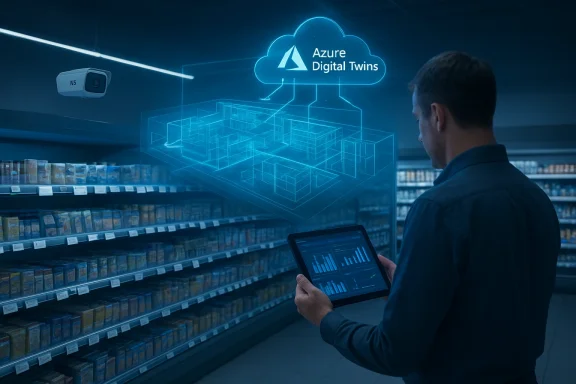
Retailers have entered a moment where physical complexity and digital expectation collide: shoppers want real-time inventory accuracy, rapid checkout, and relevant experiences; operations teams need predictable tasking and lower shrink; and brands expect consistent omnichannel presentation. The idea behind a store digital twin is simple in theory and complex in practice: create a live virtual replica of the store that mirrors inventory, shelf state, customer flows, devices, and staff activity so analytics and automation can act on accurate, timely reality. Microsoft’s Azure Digital Twins platform already describes the same pattern—model a space with a spatial intelligence graph, attach device telemetry, and enable event-driven automation and analytics—an approach that maps directly to the store-as-system problem. Hanshow, a long‑standing vendor in electronic shelf labels (ESL) and store IoT, framed the NRF collaboration in precisely these terms: Hanshow will surface store‑level perception via products such as Nebular Ultra ESL and the N5 AI Camera, while Microsoft contributes cloud‑scale modelling, analytics, and digital twin services on Azure. The two companies described a joint exploration rather than a finished product—an architectural engagement to define open, scalable patterns for store digital twins.
For retailers and Windows‑focused IT teams, the practical next step is disciplined experimentation: pick a narrow, measurable use case; validate device telemetry and model alignment; enforce privacy and identity controls; and measure outcomes with independent baselines. The store digital twin will not deliver value by magic—its payoff depends on rigorous integration, clear governance, and iterative learning. The Hanshow–Microsoft engagement lays out a credible foundation for that journey; the industry’s challenge now is to turn these integrated building blocks into reproducible, secure, and business‑driven outcomes at scale.
Source: The AI Journal Hanshow Collaborates with Microsoft to Explore Store Digital Twin for the Future of Retail at NRF 2026 | The AI Journal
 Background / Overview
Retailers have entered a moment where physical complexity and digital expectation collide: shoppers want real-time inventory accuracy, rapid checkout, and relevant experiences; operations teams need predictable tasking and lower shrink; and brands expect consistent omnichannel presentation. The idea behind a store digital twin is simple in theory and complex in practice: create a live virtual replica of the store that mirrors inventory, shelf state, customer flows, devices, and staff activity so analytics and automation can act on accurate, timely reality. Microsoft’s Azure Digital Twins platform already describes the same pattern—model a space with a spatial intelligence graph, attach device telemetry, and enable event-driven automation and analytics—an approach that maps directly to the store-as-system problem. Hanshow, a long‑standing vendor in electronic shelf labels (ESL) and store IoT, framed the NRF collaboration in precisely these terms: Hanshow will surface store‑level perception via products such as Nebular Ultra ESL and the N5 AI Camera, while Microsoft contributes cloud‑scale modelling, analytics, and digital twin services on Azure. The two companies described a joint exploration rather than a finished product—an architectural engagement to define open, scalable patterns for store digital twins. What each partner brings to the table
Hanshow: store-level sensing and retail-grade edge devices
Hanshow’s public messaging and product manuals make a consistent claim: their Nebular ESL family provides low‑power, multi‑size e‑paper shelf labels with integrated LED indicators, NFC, and IP68 protection to run inside demanding retail environments for years without frequent maintenance. The Nebular line supports multiple display sizes and color options (BWR and BW), embedded NFC for customer interactions or device binding, OTA firmware upgrades, and built‑in LEDs for picking and alerting—features that make Nebular a natural candidate for feeding a digital twin with shelf occupancy and pricing state. The Hanshow press release explicitly lists the N5 AI Camera as part of the sensing stack; independent device registrations (FCC/device databases) show an N5 shelf camera entry, confirming the product’s market presence though full public technical datasheets remain limited. In practice, cameras like the N5 are intended to provide visual inventory signals (on‑shelf availability, planogram compliance) and behavior cues (dwell, pick, return) that complement ESL state. Hanshow’s messaging positions these inputs as the “store perception” layer—granular, frequent, and close to the shelf—feeding higher‑level store models. Key Hanshow capabilities and product attributes (from published materials and manuals):- Nebular ESL range covering multiple sizes (1.5" to 7.5"), BWR display options and freezer variants.
- Built‑in LED indicators and NFC support for rapid picking and shopper interactions; IP68 rated variants for durability.
- Device-level security features such as AES‑128 encryption, OTA updates, and cloud management stacks intended for enterprise retail deployments.
Microsoft: cloud modelling, scale and agentic retail services
Microsoft’s cloud portfolio is clearly oriented to this problem. Azure Digital Twins provides the modelling primitives (the spatial intelligence graph and twin object models), integrations to Azure IoT Hub for telemetry ingestion, and hooks into analytics, AI and Mixed Reality for visualization and simulation—exactly the components required to operate digital twins for buildings, factories, and now retail stores. Microsoft has argued for modeling environments first and connecting devices second, which fits the store twin pattern where a canonical layout and metadata must be the ground truth for incoming sensor feeds. At NRF 2026 Microsoft also showcased a broader push into retail‑oriented, agentic AI and commerce features—tools that automate and orchestrate actions across catalog systems, frontend channels, payments, and operations. New Copilot‑centric templates (Brand Agents, personalized shopping, catalog enrichment, store operations) and Copilot Checkout were presented as ways to turn discovery into conversion inside conversational surfaces, and as primitives that could be paired with a robust digital twin for smarter, transact‑ready retail scenarios. These developments create an interesting symmetry: Hanshow supplies live store inputs; Microsoft supplies the cloud model, analytics, and agentic surfaces that can use twin state to drive decisions or sales.How a Store Digital Twin architecture could realistically be built
A practical store digital twin for production retail operations requires a layered architecture; at a high level the collaboration suggests the following stack:- Edge sensing and local devices: Nebular ESLs, N5 cameras, shelf sensors, POS and handhelds. These devices capture discrete signals—price tags, on‑shelf presence, picks, returns, and short‑lived events.
- Local inference and edge compute: lightweight filtering, anonymization and aggregation close to the camera or controller to reduce bandwidth, ensure privacy, and emit curated events. This is where latency‑sensitive alarms and picking prompts live.
- Ingestion and device connectivity: Azure IoT Hub (or equivalent) to reliably ingest telemetry, manage device identities and OTA updates.
- Spatial model and digital twin: Azure Digital Twins represents shelves, aisles, fixtures, and device relationships using a spatial intelligence graph; rules and functions map device events onto twin state transitions.
- Analytics, agentic AI and orchestration: Microsoft’s agent templates and Copilot Studio (or Azure AI Foundry/Agent Service) orchestrate responses—inventory reorders, staff tasking, digital signage updates, or conversely triggering a Copilot commerce CTA in a shopper’s session.
- Operator UI and mixed reality: dashboards, mobile apps for associates, and optional mixed reality overlays for complex tasks like planogram enforcement. Azure Digital Twins integrates with Power BI and mixed‑reality tools for visualization.
Benefits retailers should expect (and the evidence)
The joint case that Hanshow and Microsoft make rests on measurable outcomes:- Improved inventory visibility and shelf availability: combining ESL signals (price & status) with camera‑driven on‑shelf presence reduces blind spots and false stock assumptions. Field data from retailers and vendor pilots indicate real inventory accuracy improvements when multiple sensing modalities are fused.
- Faster operational response and lower labor friction: store ops agents can dispatch tasks (restock, price check, compliance fix) to associates in real time. Microsoft’s store‑operations agent template and similar pilots have been framed as direct productivity levers.
- New commerce paths and retail media: live store data paired with agentic commerce (e.g., Copilot Checkout) makes it possible to present in‑moment offers or to convert in‑aisle discovery into purchase without friction. Early NRF demos suggest this is a key design goal.
- Scalable models and reuse across store fleets: Azure Digital Twins supports multi‑tenant and nested deployments, meaning the same store model and ruleset can be scaled across hundreds or thousands of stores with data isolation.
Risks, technical constraints and governance concerns
The technology is promising—yet real deployment exposes a set of non‑trivial risks that retailers and IT teams must account for.- Data privacy and customer consent: camera‑based sensing and in‑store tracking raise regulatory and brand risks. Even aggregated behavioral signals require clear anonymization and opt‑out mechanisms, plus robust data retention policies. Vendor claims of security posture (for example, Hanshow’s SOC 2 Type II and SOC 3 certifications) reduce but do not eliminate governance responsibility for retailers.
- Model and sensor alignment: ESLs report price and tag state; cameras infer shelf occupancy. Reconciling inconsistent signals requires careful data engineering—catalog synchronization, SKU matching, and handling mismatches are operationally intensive. Microsoft and partners emphasize catalog hygiene and master data management as prerequisites for agentic commerce and twin accuracy.
- Latency, bandwidth and edge processing tradeoffs: real‑time store actions sometimes require sub‑second responses; shipping all video to the cloud is impractical. The architecture must balance edge inference with cloud aggregation, which adds complexity to device management and testing.
- Vendor lock‑in and interoperability: the value of a twin increases with data breadth. Proprietary integrations or single‑vendor data models can limit future flexibility. Hanshow and Microsoft speak about “open, scalable foundations,” but procurement teams must insist on documented APIs, data exportability, and standards-based connectors before committing fleet‑wide.
- Payments, fraud and merchant controls: embedding checkout inside conversational agents (Copilot Checkout) streamlines conversion but also introduces new fraud vectors and liability questions. Public reporting around Copilot Checkout highlights partner‑based payments (PayPal, Stripe, Shopify) and merchant‑of‑record models, but retailers should validate merchant enrollment mechanics, fee models, and fraud protections.
Practical roadmap: how to pilot a Store Digital Twin right
For Windows‑focused IT and retail technology teams, the pathway from exploration to production can be framed as pragmatic steps:- Define the business objective: choose a measurable initial use case (planogram compliance, out‑of‑stock reduction, or faster associate response).
- Establish a canonical product model: clean the catalog, standardize SKUs, and ensure product‑to‑shelf mapping is accurate. This reduces hallucination risk for downstream AI and agentic commerce.
- Start with a single store pilot: deploy a limited set of Nebular ESLs and a small camera cluster; validate sensor fusion and event schemas with real store traffic.
- Implement edge processing policies: define what is filtered at the device, what is anonymized, and what telemetries stream to Azure IoT Hub.
- Model the store in Azure Digital Twins: build the spatial graph, attach device twins, and instrument functions that translate events into twin state updates.
- Integrate governance and AgentOps: adopt role‑based controls, audit trails, and human‑in‑the‑loop gates for actions that drive commerce or inventory changes. Microsoft’s agent templates and governance primitives are designed to support this, but retailer discipline is essential.
- Measure and iterate: track KPIs (stock accuracy, task closure time, conversion uplift). Validate vendor uplift claims with pre/post analysis and independent measurement.
Commercial and ecosystem considerations
The Hanshow–Microsoft collaboration highlights an important market dynamic: retail digital twins require both specialized edge hardware and scalable cloud primitives. That duality elevates ecosystem play:- Standards and connectors: to avoid fragile point integrations, retailers should demand documented connectors (IoT Hub, DTDL models, open telemetry formats) and portable exports for long‑term data ownership. Microsoft’s Digital Twins supports DTDL (Digital Twin Definition Language), which helps portability between solutions built on Azure but requires translation for other platforms.
- Cost and incremental ROI: twin projects can be expensive up front (devices, network, cloud modelling). Prioritize high‑impact stores and use cases with near‑term ROI—loss reduction, labor savings, or sales lift from in‑store commerce. Vendors’ promotional metrics should be validated with pilot data.
- Interoperability with existing retail systems: ERP, OMS, POS and PIM must be integrated. Catalog enrichment and master data management are prerequisites—Microsoft and multiple partners have emphasized this as a gating factor for agentic commerce.
Critical analysis: strengths and potential gaps
Strengths- Pragmatic complementarity: Hanshow’s deployed hardware footprint and Microsoft’s cloud modelling form a natural pairing—edge perception feeds cloud representation, allowing automation and analytics to operate from a common model. That architectural fit is a real strength for retailers already invested in Azure or seeking enterprise‑grade scale.
- Commercial timeliness: Microsoft’s agentic retail push (Copilot templates and Copilot Checkout) creates concrete places where twin state can add immediate value—improving conversion and operations simultaneously. The NRF demonstrations show the vendors are targeting tangible commerce and ops scenarios, not only academic proofs.
- Maturity of integrated deployment: the full stack—camera inference, ESL state reconciliation, canonical product models, and agentic commerce—requires tight engineering and operational processes. Many retailers still report pilot-level maturity rather than fleet‑wide production. That gap suggests the collaboration is an important step, but heavy operational work remains.
- Data governance complexity: store cameras and agentic checkout both introduce regulatory and consumer‑trust challenges. Certifications and vendor security postures matter, but responsibility remains with the retailer to enforce policy, manage consent, and validate privacy claims. Hanshow’s SOC certifications are positive signals; they do not remove the retailer’s governance obligations.
- Vendor economics and lock‑in tradeoffs: integrated solutions can accelerate time to value but increase vendor dependence. Retailers should insist on documented data export and multi‑cloud strategies when negotiating broad rollouts.
What Windows‑focused IT teams should take away
Windows‑centric IT leaders—who often manage store‑side devices, workstation fleets, and Microsoft ecosystem integrations—are in a favorable position to shepherd digital twin pilots. Three concrete takeaways:- Treat the digital twin as an operational platform, not a point product: it must integrate inventory, staff workflows, and POS/commerce systems with clear SLAs for data freshness.
- Prioritize master data and identity: catalogs and device identities are the plumbing. Without clean SKUs and reliable device identity management, twins will quickly drift. Microsoft and partners repeatedly cite catalog hygiene as a prerequisite to agent reliability.
- Build for AgentOps and safety: if an agent can change pricing, trigger a reorder, or initiate a checkout, the change control, auditing, and rollback systems must be in place before scale. Microsoft’s agenting primitives include governance features; operational disciplines make them effective.
Conclusion
Hanshow’s collaboration with Microsoft at NRF 2026 is an important industry signal: the conversation is moving from isolated proof‑of‑concepts to architectural integration—edge sensing (ESLs and cameras) aligned with cloud digital twin models and agentic AI surfaces. That combination promises tangible gains in inventory accuracy, operational efficiency, and new commerce experiences, but it also brings non‑trivial governance, engineering, and economic tradeoffs.For retailers and Windows‑focused IT teams, the practical next step is disciplined experimentation: pick a narrow, measurable use case; validate device telemetry and model alignment; enforce privacy and identity controls; and measure outcomes with independent baselines. The store digital twin will not deliver value by magic—its payoff depends on rigorous integration, clear governance, and iterative learning. The Hanshow–Microsoft engagement lays out a credible foundation for that journey; the industry’s challenge now is to turn these integrated building blocks into reproducible, secure, and business‑driven outcomes at scale.
Source: The AI Journal Hanshow Collaborates with Microsoft to Explore Store Digital Twin for the Future of Retail at NRF 2026 | The AI Journal
