

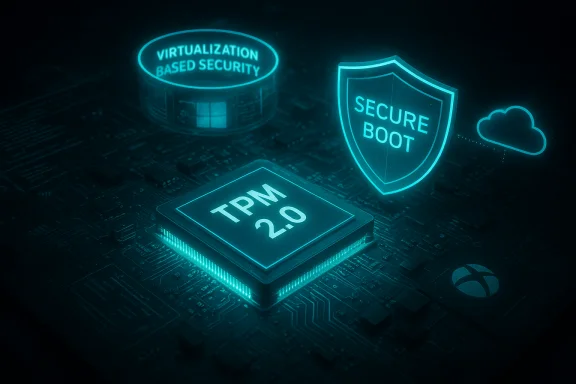
The push to make PC multiplayer fairer has shifted from server-side bans and heuristic detection to locking the integrity of the machine itself — and the industry’s newest salvo is clear: modern hardware-backed protections like TPM 2.0, UEFI Secure Boot, Virtualization‑based Security (VBS) and remote attestation are now core tools publishers and platform owners expect to rely on to preserve fair play. Activision’s stated requirement that Call of Duty: Black Ops 7 will require TPM 2.0 and Secure Boot for PC players, and Microsoft’s explicit Xbox Wire guidance urging players and developers to adopt a hardware-anchored trust model, crystallize an industry trend where the platform and firmware layer matter as much as in-game anti‑cheat code.
Cheating in multiplayer games has evolved from simple memory editors and overlays into a landscape of kernel drivers, boot‑time rootkits, firmware hooks and hypervisor-level tampering. Traditional anti‑cheat systems that operate at user land or even kernel level can be bypassed by attacks that initialize earlier — during firmware load or at boot — and persist across reboots. To blunt those vectors, publishers and platform vendors are moving enforcement up the stack and asking for cryptographic, hardware‑anchored evidence that a client booted into an expected, untampered state.
This approach is not a single‑vendor fad. Microsoft has documented the very same building blocks — TPM 2.0 as a root of trust, UEFI Secure Boot to prevent unsigned early‑boot components, VBS/HVCI to isolate and protect integrity checks at runtime, and remote attestation to let servers cryptographically verify a client’s measured boot — and framed them as the practical foundation for fair play on Windows and Xbox. Activision’s RICOCHET anti‑cheat now explicitly integrates those hardware signals for Black Ops 7, using an Azure‑backed remote verification to validate TPM and Secure Boot state at matchmaking or game launch.
What publishers should do (and some are already doing)
Key governance questions publishers must answer publicly
Platform‑anchored trust is a technically sound response to a modern cheating problem that has moved below the reach of legacy detection. The difference between a fair multiplayer ecosystem and a fragmented, mistrustful one will be determined by how publishers, Microsoft and hardware vendors implement these protections — and how transparently they communicate the what, why, and how of attestation and telemetry to the players who fund the ecosystem. The technical building blocks are in place; now the industry must prove it can match cryptographic rigor with operational care and clear governance so fair play becomes the default, not a battleground.
Source: GAM3S.GG How Security Ensures Fair Play in Gaming | GAM3S.GG
 Background / Overview
Cheating in multiplayer games has evolved from simple memory editors and overlays into a landscape of kernel drivers, boot‑time rootkits, firmware hooks and hypervisor-level tampering. Traditional anti‑cheat systems that operate at user land or even kernel level can be bypassed by attacks that initialize earlier — during firmware load or at boot — and persist across reboots. To blunt those vectors, publishers and platform vendors are moving enforcement up the stack and asking for cryptographic, hardware‑anchored evidence that a client booted into an expected, untampered state.This approach is not a single‑vendor fad. Microsoft has documented the very same building blocks — TPM 2.0 as a root of trust, UEFI Secure Boot to prevent unsigned early‑boot components, VBS/HVCI to isolate and protect integrity checks at runtime, and remote attestation to let servers cryptographically verify a client’s measured boot — and framed them as the practical foundation for fair play on Windows and Xbox. Activision’s RICOCHET anti‑cheat now explicitly integrates those hardware signals for Black Ops 7, using an Azure‑backed remote verification to validate TPM and Secure Boot state at matchmaking or game launch.
Core technologies that establish a trusted gaming client
TPM 2.0 — the hardware root of trust
The Trusted Platform Module (TPM) is a discrete chip or firmware service that stores cryptographic keys and records measured‑boot values. When a TPM is present and used for measured boot, it becomes possible to cryptographically sign statements about how the system booted — the core primitive remote attestation depends on. Microsoft’s Windows 11 baseline explicitly requires TPM 2.0 as part of the OS security posture, and publishers are now using TPM‑anchored measurements to raise confidence that a client didn’t run untrusted code during initialization. Why it matters for anti‑cheat- TPM‑backed measurements are much harder to spoof than local software flags.
- A signed TPM quote binds the boot measurements to a key only the TPM can use, increasing forensic fidelity.
- When combined with a remote verifier, this prevents local spoofing or fake “OK” flags generated by a compromised client.
UEFI Secure Boot — block boot‑time tampering
Secure Boot is a firmware mechanism that enforces that only signed and trusted boot components execute. It raises the bar against bootkits and unsigned kernel drivers that historically let cheats initialize before anti‑cheat software could run. Most Windows 11‑capable systems are Secure Boot capable; publishers are now making that capability a functional requirement for competitive play. Practical caveats- Secure Boot requires UEFI boot mode and usually GPT partitioning; migrating an existing MBR setup to GPT requires care and backups.
- Dual‑boot and alternative OS users (Linux/SteamOS) may need signed shims or vendor support to remain compatible.
Virtualization‑based Security (VBS) and HVCI — protecting anti‑cheat at runtime
VBS uses the CPU’s virtualization features to create an isolated, hypervisor‑backed environment where sensitive security components (including anti‑cheat modules) can run with stronger isolation from compromised kernel components. Hypervisor‑Protected Code Integrity (HVCI) is a VBS capability that enforces kernel code integrity policies. These mechanisms make it much harder for cheat code that runs in the OS kernel to tamper with anti‑cheat checks or game processes.Remote attestation — cloud‑verified boot integrity
Remote attestation is the protocol that lets a trusted cloud verifier request a signed “quote” from a device’s TPM and validate its measured‑boot values against an expected baseline. This is not a continuous telemetry stream; it is typically a discrete cryptographic exchange invoked by the game or publisher backend during enrollment, matchmaking, or on demand. Activision confirms it will use an Azure‑backed attestation flow for Black Ops 7, and Microsoft’s guidance presents remote attestation as the industry-accepted method to verify that a device started in an unmodified state. Flagged caveat: the details matter- Remote attestation proves boot state, not arbitrary disk contents — but the precise measurements sent, how long attestation results are retained, and who can query them are operational choices publishers must disclose. Where public messaging lacks precise telemetry and retention policies, those points remain vendor assertions and should be treated cautiously pending independent verification.
Verifying the major claims (what the publishers and Microsoft actually said)
- Activision’s enforcement for Black Ops 7: TPM 2.0 and Secure Boot will be required at Beta and launch. This is stated in Activision’s support pages and the RICOCHET blog updates; Activision also documents an enrollment flow (a UAC prompt from enrollaik.exe) and published motherboard vendor guides to help players enable TPM/PTT and Secure Boot.
- Microsoft’s platform guidance: Xbox Wire explicitly lists TPM 2.0, Secure Boot, VBS and remote attestation as the protections developers should rely on to enable a “trusted gaming future.” Microsoft frames these technologies as part of the same secure ecosystem used on Xbox consoles.
- Windows 11 baseline: Microsoft Learn and official Windows support pages confirm TPM 2.0 and Secure Boot capability are part of Windows 11 system requirements — meaning many modern Windows 11 PCs will already meet the baseline the industry is asking for.
- Independent corroboration: mainstream outlets — including PC Gamer, Tom’s Hardware, The Verge and others — have reported and analyzed the same publisher announcements, noting both the security rationale and the compatibility/accessibility implications for older or non‑standard systems. This supports the conclusion that the move is broadly adopted by major publishers and not unique to a single title.
- Neither Microsoft nor publishers have, in public messaging, uniformly defined the full telemetry schema for what attestation metadata will be stored long‑term, how it will be correlated with accounts, or all the retention and access controls. Those governance details are essential and currently vary by publisher; they should be demanded and published in precise machine‑readable policy by studios.
How players can contribute — practical steps to be ready and reduce friction
Enabling the hardware features publishers ask for is usually straightforward, but it requires discipline and the right preparation. Follow this sequence to minimize the chance of data loss or being blocked from play:- Back up everything and export BitLocker recovery keys.
- Check TPM status: Run tpm.msc — look for “Specification Version 2.0” and “The TPM is ready for use.”
- Check Secure Boot: Run msinfo32 and verify BIOS Mode = UEFI and Secure Boot State = On.
- If Secure Boot is disabled and your disk is MBR, convert carefully (mbr2gpt validation and conversion) only after backups and suspending BitLocker — mistakes here lead to BitLocker recovery prompts and potential data‑loss scenarios.
- Update firmware/BIOS to the latest vendor releases (motherboard vendors have been publishing specific firmware fixes tied to TPM/PTT behavior).
- Follow publisher enrollment flows (some games will present a one‑time UAC prompt like enrollaik.exe for TPM registration) and the publisher’s published motherboard guides.
- Suspend BitLocker before firmware or boot‑mode changes.
- Use vendor‑specific BIOS updates recommended by the game’s support guides.
- Confirm system information after each change (tpm.msc and msinfo32).
- If in a dual‑boot or Linux environment, consult vendor guidance about Secure Boot shims — enabling Secure Boot can block unsigned kernels or kernel modules.
Operational realities for publishers and platform owners
The technical case for hardware‑anchored attestation is strong: it raises the cost for cheat developers, provides stronger forensic signals and can reduce reliance on heavy client‑side scanning that sometimes produces false positives. But the operational and social ramifications are substantial and must be actively managed.What publishers should do (and some are already doing)
- Phase enforcement: start with warnings, move to limited matchmaking restrictions, then to full enforcement. Activision took this route in earlier seasons before full Black Ops 7 enforcement.
- Publish vendor‑specific conversion and recovery guidance (Activision published motherboard vendor guides; publishers must follow this template).
- Provide rapid human support to triage BitLocker recovery calls and false rejections.
- Limit attestation signals to what is strictly necessary for integrity validation and publish explicit retention, access and deletion policies.
- Treating attestation as an excuse for opaque telemetry collection.
- Forcing an all‑or‑nothing policy for casual modes that could exclude large swaths of the community unnecessarily.
- Rushing enforcement without broad compatibility testing; launch day firmware bugs can create large support incidents.
- Use matchmaking buckets: segregate players who cannot pass attestation into casual pools rather than blocking them entirely from the game.
- Provide verified escape paths: temporary allowances, grace periods and alternative verification for edge cases (while monitoring cheat rates).
- Make attestation evidence auditable by independent third parties where possible (without revealing detection techniques), to build community trust.
Privacy, auditability and the governance gap
Remote attestation’s technical mechanics are well understood: a TPM‑signed quote includes measured‑boot PCR values and signatures. But public discourse has focused on the social side: what data is stored, who can query it, how long it is kept, and whether it can be correlated with identity or used beyond anti‑cheat purposes.Key governance questions publishers must answer publicly
- EXACTLY which PCR measurements or derived flags are sent in an attestation exchange?
- How long are attestation results retained, and who (within the company or external partners) can query them?
- Are attestation logs linked to a player account, and if so, what de‑identification or minimization safeguards are in place?
- Are attestation results used for any purpose other than anti‑cheat and matchmaking decisions?
Accessibility, equity and the fragmentation risk
Mandating TPM 2.0 and Secure Boot will disproportionately impact:- Older hardware owners that cannot update firmware or do not have a TPM.
- Users who run alternative OSes or dual‑boot setups that depend on unsigned kernels.
- Handheld and niche PC ecosystems that may not support the expected UEFI/TPM plumbing out of the box.
- Reserve strict enforcement for ranked/competitive modes while keeping casual play accessible.
- Offer clear, well‑documented upgrade paths and support resources.
- Consider funding firmware update initiatives or working with OEMs to patch widely used motherboard families.
Recommendations — what players and developers should do next
For players (concise)- Back up your system and export BitLocker recovery keys.
- Check TPM and Secure Boot now (tpm.msc; msinfo32) and update firmware before launch day.
- If you see enrollaik.exe UAC prompts during the game’s initial run, follow the publisher’s instructions (these are typically one‑time registration steps).
- For dual‑boot or Linux users, consult vendor documentation and expect to need signed shims or a specific compatibility flow.
- Publish precise, machine‑readable attestation and telemetry policies.
- Use phased enforcement and provide compatibility testing across a broad hardware range.
- Fund OEM firmware updates and publish clear recovery flows for BitLocker and partition conversions.
- Commission independent audits or publish reproducible verification methods to build trust in attestation claims.
The future of fair play — a measured verdict
Platform‑anchored attestation and firmware‑level protections are a meaningful, measurable step forward in the arms race against cheating. For the average modern Windows 11 PC, enabling TPM 2.0, Secure Boot and VBS will likely be low friction and materially improve enforcement accuracy for publishers that adopt these signals responsibly. Microsoft’s and major publishers’ public messaging and enforcement patterns — exemplified by Activision’s RICOCHET integration for Black Ops 7 — make the technical trajectory clear: expect more titles to require these protections for competitive play. But the outcome will be determined not by cryptographic proofs alone; it will be shaped by operational discipline, clarity, and governance. The risks are concrete: user exclusion, BitLocker and partitioning mishaps, opaque telemetry practices, and the potential for community mistrust if enforcement is heavy‑handed or poorly communicated. If publishers and platform owners publish precise policies, offer phased enforcement, and invest in OEM coordination and player support, the trade‑off — a higher technical bar for cheat authors in exchange for modest, well‑managed setup costs for players — is acceptable and beneficial. If they don’t, the industry risks increasing fragmentation and distrust in the very communities it depends on.Practical FAQ — quick answers to common technical points
- What exactly is TPM 2.0?
TPM 2.0 is a hardware or firmware module that stores cryptographic keys and recorded boot measurements used for measured boot and attestation. It’s required for Windows 11 and forms the cryptographic anchor for remote attestation. - How does Secure Boot help anti‑cheat?
Secure Boot permits only signed bootloaders and early‑boot components to run, preventing unsigned bootkits and unsigned kernel drivers — common persistence vectors for sophisticated cheats. - Is remote attestation a continuous “ping” to the cloud?
No. Remote attestation is a cryptographic request/response exchange invoked by a verifier (e.g., a publisher backend). It requires network communication when performed remotely, but it is typically discrete (on game launch, matchmaking, or enrollment) and not an unbounded telemetry stream. Implementation frequency is a publisher decision and should be disclosed. - Will these checks read my files?
The technical attestation primitives validate measured‑boot states and boot chain measurements; they do not read arbitrary files. However, publishers must disclose exactly which measurements and derived flags are transmitted and their retention policies. Treat broad claims about telemetry with caution until precise schemas are published. - Do Xbox security technologies work on Windows PCs?
Yes. Microsoft has been extending console‑level concepts (TPM‑anchored attestation, Secure Boot, VBS) into Windows to create consistent, high‑integrity signals for developers and anti‑cheat systems.
Platform‑anchored trust is a technically sound response to a modern cheating problem that has moved below the reach of legacy detection. The difference between a fair multiplayer ecosystem and a fragmented, mistrustful one will be determined by how publishers, Microsoft and hardware vendors implement these protections — and how transparently they communicate the what, why, and how of attestation and telemetry to the players who fund the ecosystem. The technical building blocks are in place; now the industry must prove it can match cryptographic rigor with operational care and clear governance so fair play becomes the default, not a battleground.
Source: GAM3S.GG How Security Ensures Fair Play in Gaming | GAM3S.GG
