

Harvey’s legal AI platform is being embedded into mainstream legal education in the United Kingdom, with Oxford University Faculty of Law, The University of Law, The Dickson Poon School of Law at King’s College London and BPP University Law School joining Harvey’s law‑school programme — a move that formalises a trend already underway across dozens of U.S. schools and the City of London, and forces law faculties, regulators and firms to confront practical pedagogy, professional‑responsibility and procurement questions in equal measure.
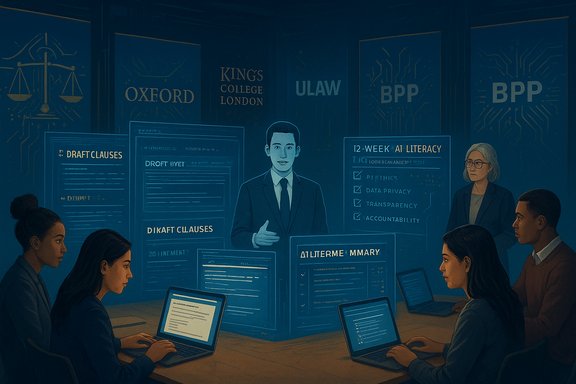
Legal‑specialist AI vendor Harvey announced an expansion of its “Law School Program” into the UK in November 2025, naming Oxford, King’s, ULaw and BPP as founding partners and promising faculty support, curriculum embeds and student access to its platform. The company frames the programme as an educational partnership — students and staff will receive practical access to a domain‑trained generative AI designed to help with drafting, document synthesis, research workflows and exam preparation. This is a deliberate next step in an established market tactic: law‑tech vendors historically offer free or subsidised access to students so graduates begin their careers already fluent in their tools. Harvey’s U.S. rollout earlier in 2025 included dozens of U.S. law schools — Stanford, University of Chicago, Notre Dame and many others — and the company has publicly documented a rapid, multi‑school adoption model that pairs platform access with curricular materials. Why educators and practice leaders take notice:
But there is a structural tension at the heart of this shift. Vendors gain long‑term channel access by educating students; firms secure short‑term efficiency; universities must protect pedagogical integrity and the public interest. Without rigorous governance, three harmful patterns can emerge:
Source: RollOnFriday Harvey goes to Law School, bringing AI to courses
 Background: what just happened and why it matters
Legal‑specialist AI vendor Harvey announced an expansion of its “Law School Program” into the UK in November 2025, naming Oxford, King’s, ULaw and BPP as founding partners and promising faculty support, curriculum embeds and student access to its platform. The company frames the programme as an educational partnership — students and staff will receive practical access to a domain‑trained generative AI designed to help with drafting, document synthesis, research workflows and exam preparation. This is a deliberate next step in an established market tactic: law‑tech vendors historically offer free or subsidised access to students so graduates begin their careers already fluent in their tools. Harvey’s U.S. rollout earlier in 2025 included dozens of U.S. law schools — Stanford, University of Chicago, Notre Dame and many others — and the company has publicly documented a rapid, multi‑school adoption model that pairs platform access with curricular materials. Why educators and practice leaders take notice:- The law student cohort is the profession’s intake pipeline; early exposure shapes habit and choice of tools.
- Commercial legal AI is already in active use at many large firms, so practical education aligns academic training with employer expectations.
- Regulators and professional bodies treat any tech that affects legal advice as something requiring governance, competence and auditability — not mere convenience.
Overview: what Harvey promises for classrooms and clinics
Harvey’s product pages and press materials position the platform as a multi‑purpose assistant for law teaching and practice, with features pitched directly at common academic tasks:- Drafting and refining briefs and clauses;
- Summarising long or complex documents;
- Preparing discussion prompts and suggested positions for seminars and moots;
- Acting as an “AI‑powered legal tutor” for exam revision and topic queries;
- Offering shared workspaces for class projects and clinic case bundles.
How law schools say they’ll use it (practical classroom scenarios)
Institutions set out several low‑risk, pedagogically valuable use cases where supervised AI adds clear utility:- SQE and vocational training simulations: students can generate a first‑draft clause, then perform critical review and redlining as part of assessment exercises.
- Clinic and pro‑bono casework (with suitable redaction and supervision): AI can summarise client bundles to save manageable staff time while students practice client interviewing and ethical oversight.
- Legal research pedagogy: faculty can use outputs to teach verification skills — students must corroborate citations, check authorities and diagnose hallucinations.
- Skills labs and moot courts: Harvey can produce suggested questions and opposing positions to accelerate prep.
The commercial and cultural context: law firms, vendors and incentives
Harvey’s classroom playbook mirrors what vendors and large firms already do in practice. Several high‑profile City firms adopted Harvey in early pilots and rollouts in 2023–2025 — Macfarlanes publicly announced a Harvey partnership in September 2023, and large firms have worked with Harvey in tailored deployments. At the same time, firms like Shoosmiths are tying internal incentives to AI adoption — Shoosmiths introduced a £1m bonus pool linked to one million Microsoft Copilot prompts as a firm‑wide usage target. Those commercial signals push graduates toward tool fluency as an employability skill. This ecosystem dynamic matters because law schools are not only teaching law — they are socialising students into professional practices and tool chains. Vendors gain a long‑term channel to the profession, firms recruit for productivity and students compete for jobs where familiarity with particular copilots can be an advantage.Strengths: what this can do well for students, faculty and firms
- Practical readiness: students gain hands‑on experience with tools they are likely to encounter as trainees, reducing onboarding friction at firms.
- Curriculum modernisation: embedding AI use into assessed work lets faculties teach how to verify, audit and correct model outputs — a teachable skill that mirrors professional reality.
- Efficiency in low‑value tasks: summarisation, document bundling and first‑drafting are high‑volume, low‑creativity tasks that AI accelerates, freeing class time for higher‑order learning and debate.
- Cross‑sector alignment: clinics and placement partners can use a shared toolset, meaning student practice experiences map more directly to workplace workflows.
Risks, red flags and professional obligations
Adoption carries real and documented hazards that universities and firms must address in policy and practice.1) Hallucinations and the duty of verification
Generative models can and do produce plausible but false outputs — a risk that has already produced embarrassments and court scrutiny. Multiple incidents — for example an expert filing that contained AI‑fabricated citation details in high‑profile U.S. litigation — demonstrate how easy it is for AI formatting or drafting prompts to introduce fake authorities that slip past human review. Courts have labelled such errors “very serious,” and regulators expect human verification to remain the ultimate gate for legal work. Teaching must therefore prioritise verification skills and adopt mandatory human‑in‑the‑loop checks for any assessed or client‑facing submission.2) Confidentiality, data‑use and vendor practices
Sending client or sensitive data into third‑party platforms poses confidentiality and data‑protection questions. Regulators and professional bodies stress that firms remain responsible for the services they provide, regardless of the tools used. Procurement must insist on contractual protections — no‑retrain clauses, deletion guarantees, exportable logs and formal attestations (SOC/ISO) — before any platform handles matter data. Universities that use real client materials in clinics must adopt similarly robust sandboxes and redaction rules.3) Deskilling and the learning curve
If AI performs the first‑draft tasks that traditionally trained junior lawyers, there is a genuine risk that students and trainees lose formative experiences that develop legal judgment. Law schools and firms must intentionally design rotations and supervised assignments so that AI’s efficiency does not erode core apprenticeship learning. This requires assessment redesign and explicit competency milestones, not mere access to a tool.4) Procurement lock‑in and vendor influence
Widespread classroom exposure can create preference bias toward a vendor’s stack. Over time, that can lock the profession into a limited set of corporate offerings whose contractual terms, data policies and roadmaps shape practice. Procurement strategies should therefore balance convenience against long‑term vendor risk and require reversible, auditable integrations.5) Regulatory and ethical uncertainty
The SRA and comparable regulators do not ban AI use; they insist that outcomes meet professional standards and that governance be demonstrable. The regulator’s recent guidance and risk reports urge firms to retain oversight, document governance, and treat AI as a programmatic competence requirement — in short: tool choice does not remove professional responsibility. Law schools that expose students to AI must also teach the regulatory frameworks and emphasise risk assessments as part of legal competence.Practical governance: a checklist for universities and clinics
- Define permitted use cases and data policies:
- Prohibit sending identifiable client data to public LLMs without explicit redaction; maintain a sandbox for clinic work.
- Insist on auditable logs:
- Keep exportable prompt/response logs, model versioning metadata and timestamps for any work used for assessment or clinic outputs.
- Teach verification, not blind trust:
- Make source corroboration, citation checks and rebuttal memos mandatory parts of any AI‑assisted submission.
- Build competency gates:
- Require demonstrable prompt hygiene and hallucination detection skills before granting privileges for assessed or client work.
- Reshape assessment rubrics:
- Reward critical analysis of AI‑generated drafts, not mere polish; require reflective statements detailing how outputs were checked and corrected.
- Negotiate vendor protections:
- Seek contractual assurances on data handling, retraining policies, deletion and incident response before campus deployments.
- Provide faculty training and ILT support:
- Equip tutors with practical curricula on how to supervise AI usage, grade AI‑assisted work and design AI‑safe assignments.
Teaching the new competencies: what curricula should include
- Prompt literacy and evaluation: how to craft prompts that produce verifiable, testable outputs; how to interpret confidence and provenance metadata.
- Hallucination forensics: techniques to detect and document AI errors, including spot checks, cross‑referencing authorities and red‑teaming prompts.
- Data governance and ethics: data protection law, confidentiality risk, consent for data reuse and the professional duty to supervise technology.
- Contracting and procurement basics: what to demand in AI vendor agreements and why redlines (no retrain, deletion, auditable logs) matter.
- Workflow redesign: where automation fits in matter lifecycles and how to preserve pedagogical exposure for junior lawyers.
What the profession is already doing (examples and evidence)
- Firm pilots and alliances: major firms have trialled or adopted Harvey and similar tools; Macfarlanes announced a Harvey partnership in 2023, and other firms have integrated bespoke copilots into practice.
- Incentives to adopt: Shoosmiths tied a £1m staff bonus to a million Copilot prompts — a striking example of management using incentives to speed cultural change.
- Regulator engagement: the SRA’s risk papers, updates and guidance explicitly discuss AI, emphasise the need for oversight and recognise the potential for both benefit and harm.
- Court responses: recent litigation has shown courts will scrutinise filings that rely on unverified AI outputs, sometimes characterising hallucinated citations as “serious” and prompting remedial orders. These judicial reactions underscore why verification training is non‑negotiable.
Critical analysis: strengths versus systemic risks
Harvey’s classroom integration addresses an urgent skills gap: employers increasingly expect basic AI fluency and the marketplace rewards graduates who can work productively with copilots. Embedding vendor tools with faculty partnership and structured pedagogy can accelerate curriculum modernisation and help students learn to govern AI responsibly.But there is a structural tension at the heart of this shift. Vendors gain long‑term channel access by educating students; firms secure short‑term efficiency; universities must protect pedagogical integrity and the public interest. Without rigorous governance, three harmful patterns can emerge:
- Invisible deskilling: if assessment incentives reward faster output rather than deeper reasoning, skill erosion will follow.
- Normalised vendor lock‑in: cohorts raised on a single vendor’s UX will disproportionately prefer that stack, constraining market competition.
- Regulatory mismatch: professional obligations and vendor SLAs may not align; firms and universities could find themselves legally exposed if procurement fails to impose adequate safeguards.
Recommendations for law schools and faculty leaders
- Treat AI as a curriculum design problem, not only a tool rollout. Redesign assessments so students must show work on how they validated AI outputs.
- Create supervised sandboxes for clinic work with strict redaction and logging rules; never permit raw client data into public model endpoints.
- Publish vendor procurement minimums (no‑retrain, deletion, exportable logs, incident SLAs) and refuse campus deployments that cannot meet them.
- Partner with regulators and the profession: involve the SRA or relevant bod(ies) in pilot design to ensure alignment with professional standards.
- Track measurable outcomes: student competence, incidence of AI errors in assessed work, and employer feedback should all be monitored and reported.
- Rotate experiential assignments: ensure every student undertakes tasks that develop judgment independent of AI assistance.
Conclusion
The arrival of Harvey into UK law schools marks an inflection point. The technology’s practical benefits — faster bundling, drafted first‑cuts, and familiarisation with legal copilots — are tangible and pedagogically valuable when supervised. At the same time, the profession’s immediate experience with hallucinations, contractual ambiguity and regulatory scrutiny shows that how the technology is taught and governed will determine whether it augments or undermines legal education and professional standards. Law schools that pair vendor access with rigorous governance, demonstrable verification training and curricular redesign will turn exposure into real competence. Those that adopt tools without systemic controls risk sending graduates into practice underprepared for the ethical and evidential obligations they will face. The challenge for legal education is not whether to teach AI — it is how to teach it so that legal judgment, not automation, remains the profession’s defining skill.Source: RollOnFriday Harvey goes to Law School, bringing AI to courses
