

Harvey’s rise over the last 18 months has gone from “interesting startup” to market-defining infrastructure for legal teams — and the company’s latest moves make that leap impossible to ignore. In early February 2026 reporting showed Harvey in talks to raise another $200 million at roughly an $11 billion valuation, a follow‑up to its December 2025 Series F that priced the business at about $8 billion. Alongside that funding story came product milestones, marquee customer wins, a strategic content alliance with LexisNexis, an acquisition to accelerate enterprise tooling, and the appointment of a seasoned chief product officer — all signs that Harvey is shifting from rapid-growth vendor to indispensable platform for law firms and corporate legal departments.
Legal work is conservative by design: client confidentiality, professional liability, and jurisdictional nuance make law one of the most risk‑sensitive markets for AI. Harvey’s thesis has been simple and ambitious — pair best‑in‑class foundation models with legal domain engineering, firm‑specific knowledge layers, and enterprise controls so that generative AI is not a toy but a working partner in real matters. That blend of product design, regulatory sensitivity, and aggressive commercial growth explains why VCs, incumbents, and BigLaw clients now treat Harvey as a strategic ally rather than an experimental vendor.
This article verifies the headline claims, outlines the product and go‑to‑market moves that matter, and evaluates the practical strengths and material risks for firms that are considering deepening their dependence on Harvey as core legal infrastructure.
Drumright’s stated first act — a listening tour with legal users — is a pragmatic move. Law practice workflows are idiosyncratic and resist blunt automation; product teams that succeed will be those that translate lawyer heuristics into reliable guardrails inside workflows rather than simply exposing raw model outputs.
At the infrastructure level, Harvey is deeply invested in Microsoft Azure: it is available on the Microsoft Azure Marketplace, leverages Azure OpenAI and related services for model hosting, and — crucially — agreed to a multi‑year Microsoft Azure Consumption Commitment (MACC) reportedly worth approximately $150 million over two years. That MACC underscores how central Azure is as a compliance and trust anchor for law firms that demand enterprise‑grade hosting and regional data residency guarantees. The Azure MACC was reported in Business Insider and aligns with Harvey and Microsoft’s published partnership narratives.
Taken together, model‑agnostic orchestration + Azure enterprise hosting gives Harvey two tactical advantages:
Why content partnerships matter: in legal work, citation fidelity is the confidence currency. Integrating LexisNexis’s Shepardizing and case content into the answer pipeline materially changes the risk calculus for lawyers because outputs can be immediately traced to the underlying authority.
Takeaway: the Hexus move is both tactical (speed up product iteration) and strategic (build more polished, enterprise‑grade surfaces that drive adoption inside legal operations teams).
That said, firms must adopt with discipline: the economics of automation, the liability of legal advice, and the commercial reality of vendor dependency mean governance, contractual controls, and human oversight remain the essential complements to any technical deployment. The pragmatic path we see — pilot, govern, measure, iterate — is the same path advanced firms like Burges Salmon and Willkie appear to be following as they combine Microsoft productivity foundations with Harvey’s legal depth.
Harvey’s narrative is now less about proof‑of‑concept and more about product maturity and platform defensibility. The company’s funding momentum, combined with strategic partnerships and focused product engineering, puts it at the center of a potential re‑architecting of legal practice: from document‑by‑document automation to firm‑level, codified workflows that scale expertise. That shift brings huge productivity upside — and a new set of responsibilities. For legal leaders, the question is no longer whether to adopt generative AI, but how to adopt it in a way that protects clients, preserves professional judgment, and captures durable business value.
Source: Scene for Dummies Harvey AI News: Latest Updates, Features, and Industry Insights - Scene for Dummies
 Background / Overview
Legal work is conservative by design: client confidentiality, professional liability, and jurisdictional nuance make law one of the most risk‑sensitive markets for AI. Harvey’s thesis has been simple and ambitious — pair best‑in‑class foundation models with legal domain engineering, firm‑specific knowledge layers, and enterprise controls so that generative AI is not a toy but a working partner in real matters. That blend of product design, regulatory sensitivity, and aggressive commercial growth explains why VCs, incumbents, and BigLaw clients now treat Harvey as a strategic ally rather than an experimental vendor. This article verifies the headline claims, outlines the product and go‑to‑market moves that matter, and evaluates the practical strengths and material risks for firms that are considering deepening their dependence on Harvey as core legal infrastructure.
Funding and Valuation: From $3B to $11B in 12 months?
What happened (numbers & timeline)
- December 2025 — Harvey closed a sizable round (reported around $160M) that put the company at approximately an $8 billion valuation. Multiple outlets reported and Harvey confirmed the December financing activity.
- February 2026 — reporting surfaced that Harvey was in talks to raise roughly $200M in follow‑on capital that would push implied valuation toward $11 billion; the round was said to involve heavyweights such as Sequoia and GIC. Those talks were described as ongoing at the time of reporting.
Revenue and scale signals
Harvey has also posted aggressive revenue growth metrics. The company’s own metrics and public reporting indicate annual recurring revenue (ARR) in the high‑hundreds of millions trajectory: the CEO disclosed an ARR figure north of $190 million by the end of 2025, up sharply from earlier 2025 and consistent with filings and press accounts. Customer counts reported by Harvey — over 1,000 customers and operations in roughly 58–60 countries — align with the company’s own Year‑in‑Review materials and media reporting. These revenue and customer signals are crucial because they convert headline valuations into observable go‑to‑market traction.Leadership and Strategy: Hiring for scale
In February 2026 Harvey named Anique Drumright as its first Chief Product Officer — a targeted hire drawn from high‑velocity consumer and enterprise product environments (Uber, Loom, Rippling). The hire signals two things: (1) Harvey intends to industrialize product development and (2) it recognizes the cultural change challenge inside law firms requires product leadership experienced in habit change and large‑scale rollout. Business Insider covered the hire and quoted the CEO emphasizing her rapid adaptability and listening‑first approach.Drumright’s stated first act — a listening tour with legal users — is a pragmatic move. Law practice workflows are idiosyncratic and resist blunt automation; product teams that succeed will be those that translate lawyer heuristics into reliable guardrails inside workflows rather than simply exposing raw model outputs.
Product innovation: 2025 releases that matter
Harvey publicly catalogued its five biggest 2025 launches, and corroborating coverage and release notes confirm each item below. Together these product pieces represent a shift from a model‑centric “assistant” to a platform‑centric “workflow” paradigm.Top five launches (summary)
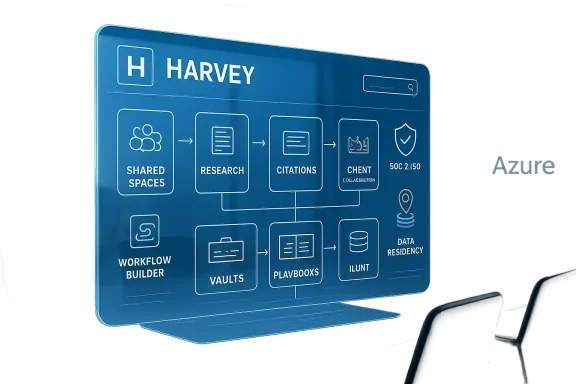
- Shared Spaces — Secure, cross‑organization collaboration workspaces for firms and clients, with guest accounts, granular permissions, and shared Vaults and Playbooks. This feature is explicitly aimed at turning client collaboration into a controlled, auditable experience.
- Mobile App — Native iOS/Android apps that bring voice prompting, document scanning, and audio transcription to mobile devices so lawyers can work while commuting or onsite. Harvey’s mobile push reflects user research showing lawyers rely heavily on mobile touchpoints.
- Multi‑source Reasoning — Advanced reasoning and retrieval pipelines that fuse information across hundreds of legal knowledge sources (Harvey claims deep retrieval across public law, firm precedents, and major legal databases). The product positioning emphasises citation‑backed answers rather than generative freeform text.
- Microsoft 365 Integrations — In‑app tools and add‑ins for Word, Outlook, and SharePoint enabling lawyers to stay inside their editors while calling Harvey’s assistants and workflows. Microsoft partnership and Azure deployment make these integrations natural.
- Workflow Builder — A no‑code/low‑code workflow canvas that allows firms to codify firm‑specific playbooks, embed human checkpoints, and ship reusable automations (think Zapier for legal). Workflow Builder is the strategic linchpin for turning firm expertise into repeatable, monetizable work.
Platform & infrastructure: model‑agnostic, Azure‑native
Harvey has deliberately adopted a model‑agnostic posture: while its early work leaned heavily on OpenAI‑powered models, the company now routes tasks to the best available foundation models including OpenAI, Anthropic (Claude), and Google’s Gemini (via Vertex) depending on the use case and compliance constraints. Harvey’s own release notes confirm multi‑model support and administrative model selection controls.At the infrastructure level, Harvey is deeply invested in Microsoft Azure: it is available on the Microsoft Azure Marketplace, leverages Azure OpenAI and related services for model hosting, and — crucially — agreed to a multi‑year Microsoft Azure Consumption Commitment (MACC) reportedly worth approximately $150 million over two years. That MACC underscores how central Azure is as a compliance and trust anchor for law firms that demand enterprise‑grade hosting and regional data residency guarantees. The Azure MACC was reported in Business Insider and aligns with Harvey and Microsoft’s published partnership narratives.
Taken together, model‑agnostic orchestration + Azure enterprise hosting gives Harvey two tactical advantages:
- It can select models tuned for reasoning, cost, or latency depending on task.
- It retains the security and contractual posture many law firms require by hosting critical operations within Azure’s control plane.
Strategic alliances: LexisNexis and content grounding
A standout commercial move was the June 2025 strategic alliance between Harvey and LexisNexis. The deal embeds LexisNexis primary law databases and Shepard’s® citations into Harvey’s research stack so that generated answers can be anchored in authoritative sources and citation chains. The LexisNexis press release and Harvey’s blog confirm joint development of workflows (motions to dismiss, summary judgment flows) that mix generative drafting with primary legal content validation. This moves Harvey away from hallucination risk by design — at least for the tasks that use Lexis content — and makes Harvey a one‑stop interface for both drafting and citation verification.Why content partnerships matter: in legal work, citation fidelity is the confidence currency. Integrating LexisNexis’s Shepardizing and case content into the answer pipeline materially changes the risk calculus for lawyers because outputs can be immediately traced to the underlying authority.
M&A and talent consolidation: Hexus acqui‑hire
In January 2026 Harvey acquired Hexus (a small startup focused on demo tooling and guided walkthroughs), bringing the Hexus team and its founder Sakshi Pratap into Harvey. Coverage across TechCrunch, Harvey’s own blog, and other outlets framed the deal as an acquisition focused on talent and product velocity for in‑house and enterprise experiences. Hexus’ engineering expertise is now being deployed to accelerate Harvey’s product work for corporate legal teams and internal tooling.Takeaway: the Hexus move is both tactical (speed up product iteration) and strategic (build more polished, enterprise‑grade surfaces that drive adoption inside legal operations teams).
Market adoption: firm rollouts and enterprise pilots
Harvey’s traction is visible in a string of firmwide and corporate deployments:- BigLaw and elite firm deployments — firms such as A&O Shearman, Paul Weiss, Willkie, and others have been public about large deployments, innovation partnerships, and workflow co‑development with Harvey. Willkie’s global rollout and integration into its internal AI (Wendell Intelligence) is a concrete case of embedding Harvey into firm processes.
- Corporate legal teams — Comcast, Verizon, HSBC and others have announced pilots or adoptions to accelerate in‑house drafting, contract playbooks, and compliance workflows. These corporate engagements matter because the corporate legal market expands Harvey’s TAM beyond law firms.
Strengths: Why Harvey is winning
- Vertical depth and workflow focus. Harvey’s Workflow Builder and Vault create a structural moat: firm‑specific playbooks and workflows are productized inside Harvey, which compounds value over time.
- Enterprise trust posture. SOC 2/ISO controls, Azure hosting, and the MACC make the platform acceptable to conservative, risk‑averse legal clients.
- Content fidelity. The LexisNexis alliance addresses the primary technical critique of LLMs in law — citation reliability — by anchoring answers in primary law.
- Model agility. Being model‑agnostic positions Harvey to pick the best available model for each subtask (reasoning vs. summarization vs. cost‑sensitive generation).
Risks and caveats: Where caution is warranted
No adoption is risk‑free. The most important cautions for legal teams are operational, regulatory, and strategic.- Hallucinations still exist. Even with citation grounding, hallucination risk doesn’t disappear entirely. Users should treat Harvey outputs as drafts that require lawyer verification, particularly in high‑stakes filings or cross‑jurisdictional matters. Independent verification remains mandatory.
- Vendor lock‑in and IP entanglement. When a firm encodes its exclusive playbooks and precedents inside a vendor platform, it risks dependence on the vendor’s long‑term terms and product pathway. Firms should negotiate exportability, data access, and portability clauses before mass adoption. The workflow‑as‑moat dynamic that benefits Harvey also creates switching friction for customers.
- Regulatory and ethical exposure. Professional conduct rules hold lawyers liable for their work product regardless of the tool used. Building a Responsible AI governance program (audit logs, approval gates, human‑in‑the‑loop checkpoints) is not optional — it’s essential. The Burges Salmon example shows a staged governance approach (Responsible AI Board plus pilots), which is the right pattern for most firms.
- Commercial concentration risk. Heavy reliance on one cloud provider (Azure) and a small number of strategic content partners concentrates counterparty risk. The $150M MACC shows deep Azure integration — a strength for security but a structural dependency for pricing and availability.
- Legal data lifecycle and client consent. Firms must ensure client consent and retention policies are compatible with the vendor’s processing and retention terms; this includes clarity on whether client content is used to tune vendor models. Contractual guardrails here are non‑negotiable.
How leading firms are managing risk in deployment (practical playbook)
- Start with the problem, not the tech. Define the bottleneck (e.g., first‑draft motions, contract triage) and pilot a single workflow with defined success metrics.
- Layered architecture. Keep an enterprise productivity assistant for general work and a specialist tool like Harvey for matter‑specific workflows. This two‑track approach reduces enterprise risk while unlocking domain specificity.
- Governance first. Create a Responsible AI Board (legal, compliance, IT, practice leads) and require human sign‑off nodes in all matter‑affecting workflows. Log prompts, outputs, approvals, and reviewer notes.
- Contractual hygiene. Negotiate exportability, data residency, and non‑training clauses where possible; insist on audit rights and clear SLAs.
- Measure value. Track time saved, prompt counts, workflows created, and error rates. Demand transparency from the vendor on hallucination incidence and model updates.
Industry impact: consolidation accelerates
Harvey’s rapid fundraising, LexisNexis alliance, and small‑target acquisitions like Hexus point to an industry consolidation phase where large vertical platforms combine:- foundation models + enterprise hosting (Azure),
- authoritative content (LexisNexis),
- and workflow platforms (Harvey’s Workflow Builder).
Verdict: A defensible infrastructure play — with real but manageable risks
Harvey is not just an AI vendor; it is positioning itself as a legal operations platform. The company’s funding cadence, product releases, enterprise deals, and strategic hires all point to a deliberate move from “fast‑growing startup” to indispensable infrastructure. The LexisNexis tie addresses the core domain risk (citation fidelity); Azure and a MACC provide the trust and scale that enterprise legal customers demand; Workflow Builder and Shared Spaces convert firm knowledge into persistent platform value.That said, firms must adopt with discipline: the economics of automation, the liability of legal advice, and the commercial reality of vendor dependency mean governance, contractual controls, and human oversight remain the essential complements to any technical deployment. The pragmatic path we see — pilot, govern, measure, iterate — is the same path advanced firms like Burges Salmon and Willkie appear to be following as they combine Microsoft productivity foundations with Harvey’s legal depth.
What to watch next
- Whether the reported $200M raise completes and the terms investors extract (board seats, governance conditions) — completion will influence Harvey’s growth strategy.
- How Harvey operationalizes LexisNexis integration across non‑U.S. jurisdictions and whether similar content deals follow with Thomson Reuters or Bloomberg.
- Product adoption velocity of Workflow Builder and Shared Spaces inside mid‑market firms — broadly distributed adoption, not just BigLaw, will determine whether Harvey scales as horizontal infrastructure.
- Regulatory signals and professional body guidance on the acceptable use of generative AI in client work; that guidance will set boundary conditions for product design and firm governance.
Quick FAQs (concise, practical)
- What is Harvey?
Harvey is a generative AI platform purpose‑built for legal work — document analysis, research, drafting, and workflow automation — with enterprise controls and firm‑level customization. - How big is Harvey now?
As of early February 2026 reporting, Harvey reported ARR in the high‑hundreds of millions (Harvey’s CEO cited roughly $190M ARR as of end‑2025) and more than 1,000 customers across about 58–60 countries; the company was reported to be in talks to raise at an $11B valuation following a December 2025 round that valued it at around $8B. - What sets Harvey apart from generic copilots?
Harvey combines legal‑domain engineering (sentence‑level citations, embeddings tuned to case law), content partnerships (e.g., LexisNexis), workflow tooling (Workflow Builder), and enterprise hosting controls (Azure deployment and consumption commitments) — together creating a productized alternative to generalist copilots. - Is it safe to use Harvey for client work?
With proper governance — human review, auditable trails, contractual protections and controlled sharing — Harvey is designed for enterprise legal use. But safe depends on how firms implement governance and how they treat AI outputs: as drafts that require lawyer verification.
Harvey’s narrative is now less about proof‑of‑concept and more about product maturity and platform defensibility. The company’s funding momentum, combined with strategic partnerships and focused product engineering, puts it at the center of a potential re‑architecting of legal practice: from document‑by‑document automation to firm‑level, codified workflows that scale expertise. That shift brings huge productivity upside — and a new set of responsibilities. For legal leaders, the question is no longer whether to adopt generative AI, but how to adopt it in a way that protects clients, preserves professional judgment, and captures durable business value.
Source: Scene for Dummies Harvey AI News: Latest Updates, Features, and Industry Insights - Scene for Dummies
