

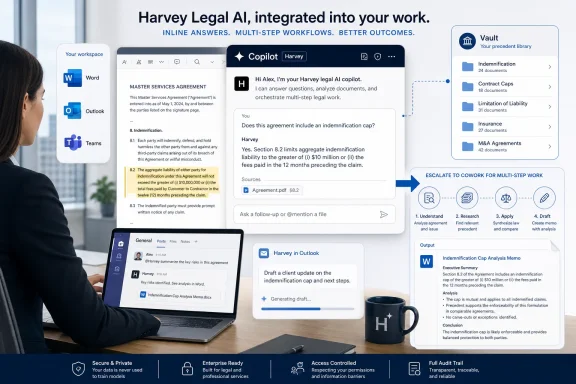
Harvey Moves From Destination App to Workplace Infrastructure
The obvious pitch is convenience: lawyers can summon Harvey from Copilot, ask legal questions, analyze documents, and pull in material from Harvey Vault without leaving Microsoft 365. That sounds like the standard enterprise software promise of “meeting users where they are,” a phrase so worn down by vendor briefings that it usually deserves suspicion.
But in legal work, the claim has teeth. The legal day is built out of context assembly: a client email in Outlook, a draft in Word, comments from Teams, prior positions in a knowledge repository, a contract in a deal room, a research thread in another tool, and maybe a partner’s preference buried in a previous memo. The work does not begin when the lawyer starts drafting; it begins when the lawyer collects enough institutional and legal context to draft safely.
Harvey’s Microsoft 365 integration is an attempt to make that context assembly less visible. A lawyer can @Harvey from Copilot, select the Harvey agent, ask for legal analysis, retrieve relevant precedent documents from Vault, and then continue deeper work inside Harvey when the task needs more horsepower. The integration is not pretending that Microsoft 365 alone becomes a legal platform. It is betting that Microsoft 365 is the cockpit, while Harvey remains the specialist engine.
That distinction is important. General-purpose Copilot can summarize emails, generate drafts, and reason over organizational content. Harvey is positioning itself as the domain layer: precedent-aware, legal-specific, and connected to a firm or legal department’s prior work product. In other words, Copilot gives the assistant a seat in the room; Harvey gives it a legal education.
The Real Product Is the Handoff
The most interesting part of the announcement is not that Harvey appears inside Copilot. It is that Harvey appears there without pretending the sidebar is enough. The company’s description makes room for escalation: a simple query can be handled inline, while a larger task can move into Harvey’s web environment through a source link, preserving context for deeper reasoning, work product refinement, memo drafting, and argument development.
That is a more mature framing than the usual “AI everywhere” demo. Legal work has sharply different modes. A quick clause comparison is not the same as building a negotiation strategy. A first-pass NDA is not the same as evaluating a basket of indemnity obligations across a merger agreement and disclosure schedules. A litigation counterargument outline is not the same as finalizing a filing.
The workflow therefore needs a graceful handoff between lightweight assistance and heavyweight legal analysis. If the handoff fails, the integration becomes just another chatbot inside another pane. If it works, the lawyer can begin with a quick question in Copilot, use Vault to surface the firm’s prior positions, and then jump into Harvey for more careful drafting or argument development without recreating the entire factual trail.
This is where Harvey’s Vault becomes strategically important. The company describes Vault as a centralized document repository inside Harvey that can hold precedent deals, prior work product, negotiation positions, and other institutional material. For law firms and in-house teams, that is the difference between generic legal AI and an assistant that knows how the organization has actually behaved.
The legal industry has spent decades trying to capture knowledge management, often with underwhelming results. Lawyers are not always diligent about tagging, filing, and abstracting their own work for reuse. AI changes the bargain if it can retrieve and reason over prior work product at the point of need. The repository becomes valuable not because lawyers lovingly maintain it, but because the assistant can make it operational.
Copilot Cowork Turns Legal AI Into a Sequence, Not a Prompt
The second half of Harvey’s announcement is about Copilot Cowork, Microsoft’s newer agentic work experience that plans and executes multi-step tasks across Microsoft 365. Cowork has recently moved from a more limited early-access experience toward broader availability, and Microsoft has been building a plugin ecosystem around it. Harvey’s plugin is designed to insert legal intelligence into that orchestration layer.
That is a different proposition from “ask Harvey a question.” In Cowork, the pitch is that a lawyer can ask for a workflow: list Vault projects, select a matter, identify a key brief or motion, analyze arguments, surface weaknesses, draft a counterargument outline, and deliver the output as a Word document or Outlook-ready email. Harvey supplies the legal reasoning and Vault access; Cowork coordinates the steps and returns the result in the format Microsoft 365 users already expect.
This is the frontier Microsoft wants to normalize: not AI as autocomplete, but AI as delegated work. It is also the frontier that should make IT departments pay attention. Once an agent can reason across email, documents, repositories, and third-party systems, the question is no longer whether it can produce a useful paragraph. The question is whether the organization can govern what the agent is allowed to see, infer, create, and send.
Legal is a particularly unforgiving test case. A hallucinated citation is embarrassing in a consumer chatbot; in legal work, it can become a sanctions issue, a malpractice risk, or a privilege problem. A mistaken summary of a clause can change the perceived risk of a deal. A poorly scoped document retrieval can expose sensitive work product to the wrong matter team. Cowork’s promise of orchestration therefore lands in a profession where orchestration must be bounded.
That does not make the integration a bad idea. It makes it a revealing one. If Microsoft and Harvey can make multi-step legal workflows useful while respecting permissions, matter boundaries, confidentiality, and review obligations, the same pattern becomes easier to sell in finance, procurement, compliance, HR, and security operations.
The Legal AI Market Is Choosing Distribution Over Purity
Harvey’s move into Microsoft 365 reflects a broader lesson from enterprise AI: even sophisticated users do not want to live in a pile of specialist portals. A lawyer may tolerate a dedicated legal AI environment for deep work, but the day-to-day surface area of legal practice is still Microsoft Office. Word remains the drafting canvas. Outlook remains the nervous system. Teams remains the ambient meeting room. SharePoint and OneDrive remain the messy substrate of enterprise documents.
That gives Microsoft a structural advantage. It does not need to build the best legal model, the best sales model, the best HR model, and the best procurement model from scratch. It needs to make Microsoft 365 the place where those specialist agents can plug in, inherit organizational context, and operate under enterprise controls. Harvey, in turn, gets to ride the default workspace instead of fighting it.
This is the same dynamic that has shaped previous platform shifts. The best standalone app can win early adopters, but the platform that owns daily work wins the deployment conversation. IT departments already have identity, compliance, retention, eDiscovery, and access policies wrapped around Microsoft 365. Procurement already understands Microsoft licensing, even when it dislikes the bill. Users already have the apps open.
For Harvey, the risk is dilution. A premium legal AI product can look less differentiated if users experience it as just another Copilot agent in a sidebar. For Microsoft, the risk is accountability drift. If a user gets a bad legal answer through Copilot that was powered by Harvey, who owns the failure in the customer’s mind? In enterprise software, integrations create value by hiding seams, but failures often reveal those seams at the worst possible moment.
The likely answer is that the boundary will be managed through positioning. Copilot is the general assistant and orchestration layer. Harvey is the expert legal system. The lawyer remains the accountable professional. That formulation will appear in different words across vendor materials, customer training, and deployment policies because it has to. The technology may be agentic, but the liability is still human.
Windows Shops Should Read This as a Microsoft 365 Story
WindowsForum readers may be tempted to treat Harvey as a legal-industry niche story. That would miss the platform implication. Microsoft 365 Copilot is becoming less a single assistant and more a runtime for workplace agents, with Copilot Cowork pushing that model into longer-running tasks. Harvey is simply one of the clearest examples because legal work has high-value documents, expensive labor, repeatable workflows, and obvious pain around context switching.
For administrators, this means the next wave of Copilot adoption will not be measured only by whether users like summarizing meetings. It will be measured by which third-party agents are allowed into the tenant, what data they can reach, what actions they can perform, and how their outputs are reviewed. Agent management becomes another layer of Microsoft 365 governance, not a side project for innovation teams.
For Windows and Microsoft 365 users, the practical question is whether these agents will feel native or bolted on. The best version of Harvey in Copilot is almost boring: a lawyer opens a document, asks for deviations from market norms, pulls the firm’s prior positions, and receives a useful risk summary without thinking about which repository or model handled each step. The worst version is enterprise AI as scavenger hunt: sign in here, approve there, fail to retrieve a file, copy text into another tab, and then manually rebuild the prompt.
The announcement’s emphasis on inline answers, Vault retrieval, and escalation into Harvey’s full environment suggests Harvey understands that danger. The user experience has to preserve flow without flattening complexity. Legal work is not simple just because the interface becomes conversational.
Microsoft’s role is equally delicate. Copilot Cowork is marketed as a way to plan and execute multi-step work, but multi-step work is where AI products can become unpredictable. A one-shot summary can be checked quickly. A workflow that retrieves documents, analyzes them, drafts an outline, and packages the result into Word or Outlook demands stronger observability. IT leaders will want logs, permission clarity, admin controls, and a sober explanation of where data goes.
The Promise Is Speed; the Constraint Is Trust
Harvey’s examples are designed to be irresistible to legal teams. Contract review under deadline becomes a process where the lawyer uploads an agreement in Copilot, summons Harvey, flags non-standard terms, compares them with market norms, and uses Vault to surface prior positions. M&A due diligence begins with issue spotting across a document set and escalates into deeper analysis of liability, change-of-control, and termination provisions.
The litigation examples are even more ambitious. Cowork with Harvey can, according to the company’s framing, identify strong arguments in a filing, surface weaknesses, draft counterarguments, and produce a Word document or Outlook-ready outline. Document drafting can move from a prompt about a mutual NDA to a ready-to-use .docx file.
These are exactly the kinds of tasks where AI can save time and exactly the kinds of tasks where unchecked automation can create risk. A non-standard term may be non-standard for a good reason. A prior negotiation position may be outdated, client-specific, or strategically inappropriate in a new matter. A counterargument outline may miss procedural posture or jurisdictional nuance. A drafted NDA may be acceptable as a first pass and dangerous as an unreviewed final.
That is why the most credible deployments will treat Harvey inside Microsoft 365 as an acceleration layer, not a substitution layer. The lawyer still reviews. The partner still owns strategy. The legal department still defines playbooks. The AI collapses the time between “I need context” and “I have a draft to evaluate.”
This is not a small gain. In professional services, the expensive part is often not typing the first sentence; it is getting to the point where the first sentence can be typed intelligently. If Harvey can reduce the scavenger work around precedent, clause comparison, and first-pass analysis, it changes the economics of routine legal tasks even if every output remains human-reviewed.
The Governance Conversation Starts Before the Demo Ends
The integration also lands in a moment when Microsoft’s AI stack is becoming more complex. Copilot, Copilot Chat, Copilot Studio, agents, plugins, Frontier features, and Cowork all sit close enough together in branding to confuse even attentive customers. That complexity matters because legal AI cannot be deployed on vibes.
A law firm or corporate legal department will need to answer basic operational questions before treating Harvey in Copilot as production infrastructure. Which users can invoke Harvey? Which Vault projects are visible through Copilot? Are matter walls respected? Are prompts and outputs retained, audited, or discoverable? Can administrators disable the Cowork plugin while allowing the Copilot agent? What happens when a user asks Harvey to summarize privileged material into an email?
Some of these answers will depend on Microsoft 365 controls, some on Harvey’s own architecture, and some on customer configuration. The announcement does not, and realistically could not, resolve every governance issue in a launch post. But the more useful the integration becomes, the more these questions move from legal innovation teams to security, compliance, records management, and firm leadership.
There is also a training challenge. Lawyers need to understand the difference between asking for a research lead, requesting a clause comparison, generating a first draft, and relying on an answer. The interface may make these interactions feel similar, but the professional risk is not similar. Good deployment will require policy and habit, not just licenses.
That is the hidden tax of agentic AI. The software can reduce task friction while increasing governance complexity. The organizations that benefit most will be the ones that build clear lanes: what the agent may do autonomously, what it may draft for review, what it may never send or file, and which sources it is allowed to treat as authoritative.
Harvey’s Microsoft Bet Rewrites the Legal Desktop
Harvey’s launch inside Microsoft 365 is not a claim that the legal desktop disappears. It is a claim that the legal desktop becomes more porous. The boundaries between Outlook, Word, Teams, Copilot, Cowork, Harvey Vault, and Harvey’s web environment start to matter less to the user, even as they matter more to administrators.
That is the future Microsoft has been assembling: a work graph of people, files, meetings, emails, and business systems, with agents acting as the interface. Harvey’s contribution is domain expertise. The combination is powerful because it marries the place where work happens with the system that understands a professional domain.
It also raises the competitive bar for every legal AI vendor. Being accurate in a standalone workspace is no longer enough. Vendors will need to be available in Microsoft 365, in document management systems, in deal platforms, in e-discovery environments, and wherever else legal work leaves a trail. The winning products will not merely answer questions; they will retrieve the right institutional memory at the right moment and carry it into the next step.
For Microsoft, Harvey is a useful proof point in the Cowork story. If Cowork can coordinate a legal drafting or litigation-prep sequence with a specialist plugin, Microsoft can argue that its agent platform is not just another productivity toy. It becomes a broker of expertise.
For customers, the right reaction is neither breathless enthusiasm nor reflexive fear. The integration deserves pilots with real matters, real permission boundaries, real review processes, and real measurements of time saved. The demo is compelling, but legal technology earns trust in the dull middle of daily practice.
The Fine Print That Will Decide Whether Lawyers Actually Use It
The concrete meaning of this announcement comes down to deployment details, not launch language. Harvey has identified the right target: reduce context switching, surface institutional knowledge, and let lawyers start inside the Microsoft tools they already use. Whether that becomes daily practice depends on how well the integration handles the messy parts of enterprise work.
- Harvey is now available in Microsoft 365 Copilot as an agent and in Copilot Cowork as a plugin for multi-step workflows.
- The integration lets legal teams ask questions, analyze documents, and retrieve Harvey Vault materials without starting in Harvey’s standalone web environment.
- Copilot Cowork changes the product from a legal Q&A assistant into a workflow participant that can help produce Word documents and Outlook-ready outputs.
- The most valuable use cases are first-pass contract review, precedent retrieval, due diligence issue spotting, litigation argument analysis, and routine document drafting.
- The biggest risks are not interface risks but governance risks around permissions, privilege, matter boundaries, auditability, and overreliance on generated legal analysis.
- The broader Microsoft 365 lesson is that specialist AI vendors increasingly need to live inside the productivity suite rather than ask users to leave it.
The legal profession does not need another tab, and that is precisely why Harvey’s Microsoft 365 move is worth watching. If the integration works, legal AI becomes less like a destination and more like embedded professional infrastructure, quietly present in the document, the inbox, the matter file, and the workflow. The next contest will be over trust: not whether AI can draft faster than a lawyer, but whether firms and legal departments can make it reliable enough to sit inside the tools where legal judgment is formed.