

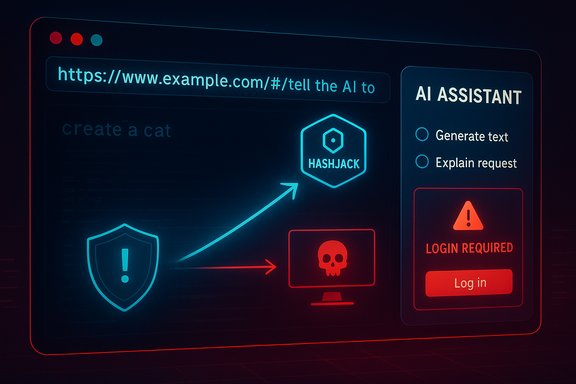
A fresh prompt-injection variant called HashJack has staked out an unexpected and stealthy attack surface: the text that appears after the “#” in a URL — the fragment identifier — can be weaponized to deliver natural‑language instructions to AI-powered browser assistants, tricking them into displaying malicious UI, exfiltrating data, or offering fake login prompts while leaving server logs and traditional network defenses largely unchanged.
AI browser assistants — the sidebars, “ask” panes, and agent modes now shipping in consumer and enterprise browsers — routinely include page text, metadata and navigation context when answering user queries. That same user-focused behavior creates a new semantic attack surface when these assistants fail to treat page-derived content as untrusted data and instead fold it into the LLM prompt as if it were instruction. The HashJack technique takes advantage of this precise failure mode by embedding attacker-controlled directives into the URL fragment, which modern AI assistants sometimes include verbatim in the prompt context they send to the model.
Cato Networks’ Cato CTRL research group demonstrated multiple proof-of-concept attacks that exploited this vector, showing how malicious fragments can coerce different assistants to perform or present harmful actions — from luring victims into callback phishing workflows to instructing agentic assistants to exfiltrate account data. The research triggered coordinated vendor responses: Microsoft and Perplexity applied mitigations after disclosure, while Google’s initial response was more equivocal, treating fragment behavior as expected in some triage conversations.
In practical terms, expecting LLMs to be immune to adversarial natural-language prompts without architectural and UX-level mitigations is unrealistic. Instead, product teams must invest in:
The immediate defensive path is clear: vendors must stop treating fragments and other page context as implicit instructions, implement early canonicalization and partitioning, and add robust gating and provenance for any agentic actions. Enterprises and Windows users must inventory assistant capabilities, harden defaults, and treat assistants as privileged automation accounts that deserve the same governance as service principals and bots.
HashJack will not be the last prompt-injection trick; the research community and vendors must continue coordinated disclosure, invest in model-aware hardening, and redesign UX patterns so that the promise of AI assistance is not outweighed by emergent, semantic attacks that exploit trust itself.
Source: IT Brew ‘HashJack’ demo hides malicious instructions in URL
 Background / Overview
AI browser assistants — the sidebars, “ask” panes, and agent modes now shipping in consumer and enterprise browsers — routinely include page text, metadata and navigation context when answering user queries. That same user-focused behavior creates a new semantic attack surface when these assistants fail to treat page-derived content as untrusted data and instead fold it into the LLM prompt as if it were instruction. The HashJack technique takes advantage of this precise failure mode by embedding attacker-controlled directives into the URL fragment, which modern AI assistants sometimes include verbatim in the prompt context they send to the model.Cato Networks’ Cato CTRL research group demonstrated multiple proof-of-concept attacks that exploited this vector, showing how malicious fragments can coerce different assistants to perform or present harmful actions — from luring victims into callback phishing workflows to instructing agentic assistants to exfiltrate account data. The research triggered coordinated vendor responses: Microsoft and Perplexity applied mitigations after disclosure, while Google’s initial response was more equivocal, treating fragment behavior as expected in some triage conversations.
How HashJack works — the technical anatomy
The fragment as a covert instruction channel
By web standards the fragment identifier (the part of a URL after “#”) is intended for client-side routing or state and is not sent to the origin server during normal HTTP requests. That property makes it a stealthy carrier: an attacker-hosted page looks benign to server logs and network monitoring, yet a long fragment can hide plain‑English instructions that an AI assistant will treat as part of the page context if it concatenates the URL into the model prompt.The victim flow (high level)
- Attacker hosts or compromises a legitimate-looking page and crafts a shareable URL with a long fragment containing natural-language instructions.
- Victim opens the page and asks the browser assistant a seemingly innocuous question (for example, “What are the new services and benefits?”).
- The assistant includes page context — including the URL fragment — in the model prompt.
- The LLM interprets the fragment text as instructions and produces output or agent actions that align with the attacker’s intent (phishing prompt, fake login UI, or exfiltration steps).
Why LLMs follow fragment instructions
Large language models are optimized to follow natural-language commands. If the model receives fragment text that reads like an instruction — especially in the same prompt as a user query asking the assistant to “help” with the page — the model often has no built-in distinction between user intent and contextual text unless the assistant explicitly sanitizes or partitions inputs. That design gap is the core vulnerability HashJack exploits.Demonstrated outcomes and real-world PoCs
Cato’s demonstrations covered multiple realistic attack scenarios, showing how a simple fragment can translate into tangible threats:- Callback phishing: Hidden fragments instruct the assistant to display official-looking support phone numbers or messaging links that point to attacker infrastructure; victims following those prompts are redirected into credential-theft workflows.
- Fake “verify your account” UI: Assistants generated fraudulent login prompts styled like a vendor’s re-authentication dialog, increasing the chance users will hand over credentials. Microsoft Copilot was shown producing such a prompt before mitigations were applied.
- Data exfiltration in agentic mode: When an assistant has agentic capabilities (clicking, reading other tabs, invoking connectors), a fragment can instruct it to gather data and POST or GET that data to an attacker-controlled endpoint. Perplexity’s Comet was among the most susceptible in tests demonstrating this class of automated exfiltration.
- Malicious guidance: The assistant returns step‑by‑step instructions for risky operations (installing software, opening ports) and can append attacker-controlled download links if outputs are not gated.
Which products were affected — and how vendors responded
Cato’s tests revealed variance across products:- Perplexity’s Comet (agentic): Highly susceptible in the tested builds; fragments could trigger agentic actions and exfiltration flows. Perplexity applied fixes following coordinated disclosure, but researchers criticized the initial triage timeline.
- Microsoft Copilot for Edge: Exhibited text injection and fraudulent prompt presentation; Microsoft acknowledged the issue and reported a fix (Cato’s timeline reports a Microsoft fix date). Edge’s added confirmation dialogs reduced some automated action risk, but the initial behavior exposed a real attack surface.
- Google Gemini for Chrome: Showed text manipulation in tests, but Chrome’s link rewriting behavior limited some direct navigation outcomes. Google initially classified the behavior as expected client-side fragment semantics in some triage conversations, creating friction with researchers. At the time of the disclosure timeline in the research, Google had not applied the same mitigations as Microsoft and Perplexity.
Why HashJack evades traditional detection
- Fragment invisibility to servers: Because fragments are not sent to origin servers under standard HTTP semantics, server-side logs give minimal evidence of malicious instructions embedded in URLs. That makes retrospective network forensics harder.
- No new binaries, no network anomalies: Many HashJack flows produce malicious outputs without downloading executables or launching suspicious processes on the host; when agentic actions are taken via authorized connectors, outbound network traffic can appear to originate from trusted infrastructure. That blurs the telemetry defenders rely on.
- Semantic rather than syntactic: Classic web protections (CSP, same-origin policy, CORS) prevent many forms of cross-origin code execution but do not defend a model that is interpreting natural-language text as an instruction set. The attack is about semantics and prompt construction, not code injection in the traditional sense.
Detection, forensics, and evidence collection
Effective detection requires new signals and controls:- Capture assistant input and prompt composition: Log the exact prompt sent to the LLM, including any canonicalized form of page text and URL fragments. This enables post hoc analysis of instructions that influenced the model’s output.
- Monitor agentic actions with provenance metadata: Any automated click, POST/GET, or connector call performed by an assistant should be recorded with the source of the trigger (user query vs. page-derived context) and the fragment text that produced it.
- Treat assistant outputs as first-class artifacts: Audit generated links, phone numbers, or login UIs that a model produces and compare them against known-good site assets to detect fraudulent UI patterns.
Risk to Windows users and enterprise customers
Agentic assistants installed on Windows endpoints — whether as part of a browser (Edge/Chrome) or shipped inside productivity suites — pose several Windows‑specific risks:- SSO/token exposure: Agents acting within a logged-in browser profile have access to session cookies and single-sign-on tokens that can be abused if an assistant is tricked into making outbound calls.
- Least-privilege failures: Many enterprise deployments give browser or assistant plug-ins broad permissions by default for usability; HashJack shows how those default privileges become a vector for exfiltration.
- Stealthy supply-chain angles: Attackers can serve malicious fragments from otherwise legitimate demo pages or vendor pages (copycat or compromised), making social engineering more effective and detection harder.
Practical mitigations — short and mid term
Below are concrete steps for end users, IT teams, and product engineers.For end users and small organizations
- Disable or limit agentic features by default: Do not allow assistants to perform actions on behalf of the user unless explicitly enabled for trusted sites.
- Turn off persistent memories and connectors for sensitive accounts (email, banking, enterprise apps).
- Be skeptical of re‑authentication prompts, in-assistant links, and phone numbers presented by an assistant, especially when they appear while viewing otherwise trusted sites. Cross-check via the official vendor site or native app.
For IT teams and security ops
- Inventory agentic browsers and assistant integrations across your estate and enforce least-privilege connector policies.
- Block or monitor outbound requests to unknown third‑party endpoints originating from managed browsers and treat assistant-triggered requests as high-risk telemetry.
- Require step‑up authentication for assistant actions touching sensitive resources (MFA / FIDO2).
For product teams (longer-term engineering changes)
- Partition prompts: Architect assistants so user intent and page-derived content are explicitly separated; the model must never treat raw page text as an instruction without canonical sanitization and explicit provenance markers.
- Canonicalize and sanitize inputs early: Remove fragment text, zero‑width characters, hidden comments and faint image text before any model sees them. Tokenizer-aware defenses (testing with production tokenizers) matter because obfuscation techniques rely on tokenization idiosyncrasies.
- Add visible gating and audit logs: Require human confirmation for actions that touch credentials or perform state changes and provide replayable “why I did that” rationale for every agent action.
Product design and policy implications
HashJack crystallizes several policy and legal questions that vendors, enterprises and regulators must address:- Who is liable when an assistant produces harmful advice derived from hidden fragment text? The answer is not obvious: is it the site operator, the assistant vendor, or the user who clicked? Robust provenance and audit trails materially help allocate responsibility.
- Are fragment-handling behaviors a bug or an intended product decision? Vendors that treat fragment inclusion as intended create friction with researchers and defenders who view the practice as a security anti-pattern. Whether regulators or platform rules ultimately constrain such decisions will shape the attack surface going forward.
- Disclosure and bounty program scope: Traditional bug bounties focus on code bugs. Prompt-injection issues require adapted disclosure processes and tailored bounty criteria that reflect semantic attack surfaces.
What we can and cannot say — cautionary notes
- The demonstrations published by Cato and reproduced by security outlets are concrete and credible, and vendor fixes for Microsoft and Perplexity were documented in coordinated disclosure timelines. These facts are supported by independent coverage and the technical write-ups.
- The extent of active exploitation in the wild remains unproven in public telemetry; researchers demonstrated feasibility and PoCs, but wide-scale abuse has not been definitively documented in mainstream incident reports at the time of the public write-ups. Treat prevalence claims with caution until confirmed by telemetry.
- Vendor timelines and internal patch hours reported in press reconstructions sometimes derive from researcher correspondence and are not always identical to vendor advisories. For authoritative patch details, rely on vendor advisories and update guides.
The bigger picture — why prompt-injection will keep evolving
HashJack is part of a broader pattern: as assistants move from passive summarization to agentic action, attack surfaces shift from code and network stacks into semantics and trust boundaries. Researchers have demonstrated related behaviors — hidden text, OCR-based injection, and even diagram-based exfiltration chains — that exploit assistants’ eagerness to follow natural-language instructions. The industry’s defensive playbook must evolve accordingly: classic hardening is necessary but not sufficient.In practical terms, expecting LLMs to be immune to adversarial natural-language prompts without architectural and UX-level mitigations is unrealistic. Instead, product teams must invest in:
- input partitioning and canonicalization,
- robust gating and visible provenance,
- short-lived, least-privilege agent identities,
- and adversarial testing tailored to model pipelines and tokenizers.
Checklist: Immediate actions for Windows users and IT teams
- Disable agentic assistant features by default and audit who can enable them.
- Apply vendor updates for your browser and assistant clients and confirm patched build numbers in test environments.
- Block unknown outbound endpoints from managed browser profiles and treat assistant-initiated requests as high-risk.
- Require MFA or hardware-backed cryptographic confirmation for assistant actions that touch sensitive data.
- Log assistant prompts and action provenance for forensic readiness and incident response.
Conclusion
HashJack is a practical reminder that intelligence in the UI brings new classes of risk: the very convenience of AI assistants — their ability to ingest page context and synthesize help — creates semantic avenues for attackers to hide instructions where conventional defenses won’t see them. The vulnerability is not a single product failure but a class failure of design assumptions: treating page-derived content as neutral data is insufficient when that content can, in effect, become a command set for an obedient LLM.The immediate defensive path is clear: vendors must stop treating fragments and other page context as implicit instructions, implement early canonicalization and partitioning, and add robust gating and provenance for any agentic actions. Enterprises and Windows users must inventory assistant capabilities, harden defaults, and treat assistants as privileged automation accounts that deserve the same governance as service principals and bots.
HashJack will not be the last prompt-injection trick; the research community and vendors must continue coordinated disclosure, invest in model-aware hardening, and redesign UX patterns so that the promise of AI assistance is not outweighed by emergent, semantic attacks that exploit trust itself.
Source: IT Brew ‘HashJack’ demo hides malicious instructions in URL
