

Festo’s MSE6 energy‑efficiency modules — the MSE6‑C2M, MSE6‑D2M and MSE6‑E2M families — were publicly flagged for an incomplete user‑documentation issue that exposes remote‑accessible, undocumented functions (an “authenticated test mode”) that attackers with low privileges could leverage to cause a complete loss of confidentiality, integrity and availability; the issue was tracked as CVE‑2023‑3634 and scored high (CVSS v3.1 8.8). This disclosure is primarily a documentation/design‑oversight problem rather than a conventional buffer overflow or unauthenticated command injection, but its operational impact is substantial because the affected modules are embedded in industrial networks and expose remote functions intended only for sealed, maintenance‑grade environments. The vendor coordinated disclosure and CERT coordination recommend updating product documentation and applying standard ICS network mitigations; operators must treat these units as sensitive network endpoints and apply layered compensating controls immediately.
Festo’s MSE6 family (MSE6‑C2M, MSE6‑D2M, MSE6‑E2M) are modular energy efficiency / pneumatic service units used to monitor, regulate and save compressed‑air energy in industrial machinery. They combine sensors, valves and fieldbus interfaces (PROFINET, Ethernet/IP, EtherCAT depending on SKU) and report flow, pressure and diagnostic telemetry to PLCs or cloud services. These devices are commonly integrated into machine control networks and sometimes bridged to enterprise networks for telemetry and condition monitoring. That integration pattern — embedded devices operating at the OT/IT boundary — is precisely what raises the stakes when a device exposes undocumented, remote‑accessible functions. On publication, the coordinated advisory described the root issue as incomplete user documentation that omitted details about a test/configuration mode and other remotely accessible functions. That omission leaves two problem classes in practice: (1) legitimate administrators may not be aware of available controls that can change device state and (2) attackers who can authenticate (or otherwise interact with a remotely reachable interface) may be able to call undocumented functions not intended for production operation. The assigned CVE (CVE‑2023‑3634) maps to the CWE category Hidden Functionality (CWE‑912) and the vendor suggested mitigation was to update the user documentation in the next product version while recommending network hardening to reduce exposure.
For operators, the pragmatic approach is clear and urgent: treat every listed MSE6 SKU as sensitive, inventory and segment devices, lock down remote access, rotate credentials, enforce least privilege on Windows engineering hosts, and hunt for suspicious management activity. Demand from vendors not just better documentation but in‑field configuration options (or firmware updates) that explicitly disable test/demo endpoints unless a secure, auditable activation mechanism is used. These steps — combined with careful forensic readiness and staged validation of vendor releases — will convert advisory language into hardened operations and significantly reduce the likelihood a hidden function becomes an exploited foothold.
Source: CISA Festo MSE6-C2M/D2M/E2M | CISA
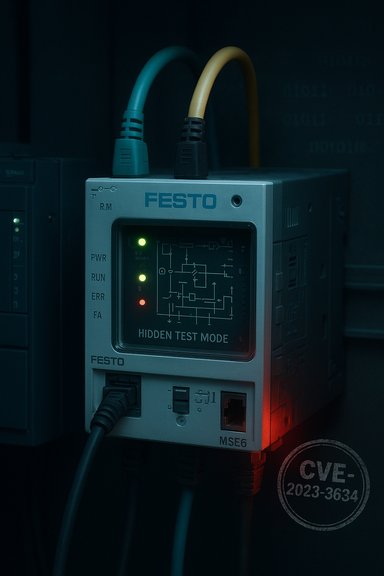 Background / Overview
Festo’s MSE6 family (MSE6‑C2M, MSE6‑D2M, MSE6‑E2M) are modular energy efficiency / pneumatic service units used to monitor, regulate and save compressed‑air energy in industrial machinery. They combine sensors, valves and fieldbus interfaces (PROFINET, Ethernet/IP, EtherCAT depending on SKU) and report flow, pressure and diagnostic telemetry to PLCs or cloud services. These devices are commonly integrated into machine control networks and sometimes bridged to enterprise networks for telemetry and condition monitoring. That integration pattern — embedded devices operating at the OT/IT boundary — is precisely what raises the stakes when a device exposes undocumented, remote‑accessible functions. On publication, the coordinated advisory described the root issue as incomplete user documentation that omitted details about a test/configuration mode and other remotely accessible functions. That omission leaves two problem classes in practice: (1) legitimate administrators may not be aware of available controls that can change device state and (2) attackers who can authenticate (or otherwise interact with a remotely reachable interface) may be able to call undocumented functions not intended for production operation. The assigned CVE (CVE‑2023‑3634) maps to the CWE category Hidden Functionality (CWE‑912) and the vendor suggested mitigation was to update the user documentation in the next product version while recommending network hardening to reduce exposure. Affected products and scale
Festo’s advisory lists multiple SKUs in the MSE6 family as affected — specifically explicit C2M, D2M and E2M SKUs with fieldbus and communication variants. The vendor advisory (and coordinating CERTs) mark all versions of those listed SKUs as in‑scope until the documentation and product revisions are available. Examples from the advisory include full‑format SKUs such as:- MSE6‑C2M‑5000‑FB36‑D‑M‑RG‑BAR‑M12L4‑AGD (and sibling SKUs)
- MSE6‑D2M‑5000‑CBUS‑S‑RG‑BAR‑VCB‑AGD
- MSE6‑E2M‑5000‑FB13‑AGD through FB44‑AGD variants
The vulnerability: technical summary
What “Hidden Functionality” means here
“Hidden functionality” is not a single exploit primitive like a buffer overflow; it describes a design/documentation gap where a device exposes functions that are not documented in user manuals as normal operator features. In the MSE6 case the documented risk model is:- The product exposes an authenticated test/configuration mode and other remote functions that the formal user guide does not fully document.
- A remote actor who can authenticate with low‑privilege credentials (or otherwise access those endpoints) can call undocumented functions that may allow privileged operations, test routines, or I/O that were intended only for factory/test environments.
- Because those functions were not described in the user manual and because some deployments treat the device as trusted within a sealed industrial network, defenders may not have placed appropriate access controls around them.
Attack surface and prerequisites
The advisory’s CVSS vector (CVSS:3.1/AV:N/AC:L/PR:L/UI:N/S:U/C:H/I:H/A:H) indicates:- Attack Vector: Network (remote)
- Attack Complexity: Low
- Privileges Required: Low (authenticated, low privilege)
- No user interaction required beyond network access & low‑privilege credentials
What’s not present in public disclosure
Vendor advisories and the coordinating CERT explicitly describe the issue as incomplete documentation rather than a software bug that can be patched away in the field. The remediation noted is an update to user documentation and guidance in the next product release. That means:- There is no universal firmware “patch” described that disables the undocumented functions.
- The device may require operational compensations (network isolation, access controls) rather than a binary fix in every deployment.
- The vendor’s guidance centers on informing operators so they can make procedural changes; operators should assume product revisions will follow but cannot rely on immediate firmware fixes.
Risk evaluation — what operators should fear
Successful exploitation is framed by the advisory as capable of causing a complete loss of confidentiality, integrity and availability — the classic CIA triad — for affected units and potentially any upstream systems they connect to (PLCs, historians, cloud telemetry). The primary operational risks include:- Denial‑of‑service (bricking or disabling energy/valve functions, causing process stoppage)
- Unauthorized telemetry disclosure (flow/pressure/diagnostic data that could reveal process characteristics)
- Manipulation of machine state (changing valves, pressure setpoints, or actuation timing)
- Lateral movement and credential harvesting (using a compromised device as a foothold into management or engineering networks)
Vendor response, coordination and timelines
- Festo coordinated the disclosure with CERT@VDE and published the advisory under FSA‑202304 / VDE‑2023‑020. The vendor’s public PSIRT information points operators to the CERT coordination platform for the advisory content and instructs reporting and responsible disclosure via its PSIRT email.
- The published remediation in the advisory is an update to the user documentation in a future product version rather than an immediate firmware removal of the undocumented functions. That approach is appropriate when the root issue is a mismatch between product features and user expectations, but it leaves operators with procedural short‑term mitigation responsibilities.
- Coordinating CERTs and national vulnerability feeds assigned CVE‑2023‑3634 and a high CVSS score of 8.8 reflecting network accessibility and impact. Public aggregator coverage (feed/aggregator services) repeated the advisory and highlighted the incomplete documentation nature, but did not report active exploitation.
Practical mitigations and immediate actions (for Windows+OT operators)
Because the vendor’s remediation is primarily documentation and product‑release updates, defenders must adopt compensating controls. The following prioritized actions are practical, testable and aligned with CISA/CERT guidance.Immediate (within 24–72 hours)
- Inventory: Locate every MSE6 unit (by SKU and management IP), confirm firmware/boot image and record reachable management interfaces. Treat all listed SKUs in the advisory as potentially affected.
- Block internet exposure: Ensure management ports for MSE6 units are not reachable from the public Internet. If they are, immediately block access at the perimeter firewall or NAT.
- Isolate and segment: Move MSE6 units onto a dedicated OT VLAN or behind a firewall that only allows specific, authenticated engineering/jump‑host addresses to reach them. Apply strict egress and ingress allow‑lists.
- Review admin credentials: Replace default or shared service credentials with unique, complex credentials; enforce least privilege. If maintenance accounts exist with global rights, rotate and restrict them.
- Harden remote access: If remote access is required, mandate use of hardened jump hosts with MFA and single‑purpose VPNs; do not allow direct VPN‑to‑device access from uncontrolled endpoints.
- Enable logging and preserve logs: Turn on device logging to the extent possible and forward logs to a central collector (SIEM or OT logging solution). Export and preserve logs offline if you suspect prior access.
Short term (within 7–14 days)
- Apply configuration hardening: Follow any vendor guidance in their PSIRT/KB — even if that guidance is documentation updates, implement any recommended process or configuration changes immediately.
- Test and stage product revisions: Where Festo releases product documentation or firmware updates, validate them in a lab before wide roll‑out.
- Enforce application allow‑lists on engineering workstations: Windows engineering hosts that manage or communicate with MSE6 devices should run EDR/AV and restrict which management tools may execute. Reduce privilege for engineers where feasible.
- Monitor for anomalous activity: Create IDS/IPS rules and SIEM alerts for unusual MSE6 management calls, repeated authentication failures, or new/unknown endpoints initiating management operations.
Medium term (30–90 days)
- Architectural review: Reassess whether MSE6 units require direct fieldbus/enterprise connectivity. Where possible, move telemetry aggregation to controlled gateways and minimize direct device reachability.
- Vendor engagement: Request from Festo an explicit statement of the undocumented functions, their intended access model, and whether they can be disabled via configuration. Demand firmware that either disables test endpoints or requires cryptographic attestation for test mode activation.
- Threat modeling & exercises: Run a red‑team / tabletop exercise simulating an MSE6 compromise to validate incident response playbooks and recovery paths.
Detection and monitoring guidance
- Look for anomalous management calls from unexpected source IPs or user accounts to MSE6 management ports. Typical symptoms of misuse include repeated test‑mode invocations, unusual valve control commands during off‑hours, and configuration pushes from non‑maintenance accounts.
- On Windows engineering hosts: look for commands or tools that issue fieldbus/OPC/Profinet calls to MSE6 devices; unexpected command line invocations, or new scheduled tasks coincident with device anomalies may indicate compromise.
- Deploy network monitoring rules to flag: (a) MSE6 talking outside its normal upstream collectors, (b) management traffic over non‑standard ports, and (c) exploitation patterns typical for hidden function activation (if vendor later discloses exact API/paths).
- Retain packet captures for forensic review if suspicion rises; ICS incidents often require deep packet analysis to determine sequence and state changes.
Critical analysis — strengths, gaps and operational risk
Strengths of the disclosure and vendor response
- The vendor coordinated the disclosure with an established ICS CERT (CERT@VDE), which improves transparency and gives operators actionable information through a trusted channel. That coordination is good practice and increases confidence in the advisory’s accuracy.
- Assigning a CVE and a clear CVSS vector focuses attention on operational risk and helps security teams prioritize mitigations in vulnerability management programs.
Key weaknesses and remaining risks
- The principal remediation — updating documentation — is insufficient as a standalone operational fix where undocumented functions are enabled on in‑field devices. Documentation helps operators understand risk but does not always remove the presence of exploitable endpoints. This leaves an extended attack window while operators implement compensating controls.
- The advisory relies heavily on network isolation as the guardrail. In many deployments, OT/IT convergence and remote vendor maintenance mean that effective isolation is not fully implemented; such environments remain exposed.
- There’s an information asymmetry risk: until Festo publishes exact details of what the test functions do and how they can be disabled, defenders cannot create precise detection signatures. That uncertainty favors attackers who can probe undocumented endpoints to map capabilities.
Unverifiable or cautionary points
- Public trackers and the coordinating CERT reported no known exploitation at disclosure time; while true at the time, it is unverifiable beyond public telemetry and can change quickly. Treat that statement cautiously; operational defense should not assume “no exploitation” means “no risk.”
Practical checklist — what to do now (concise)
- Inventory all MSE6 devices and map reachability.
- Block public/Internet access to management ports.
- Segregate devices onto an OT VLAN / firewall protected segment.
- Rotate and strengthen maintenance credentials; implement MFA where possible on jump hosts.
- Harden Windows engineering hosts: EDR, application allow‑listing, non‑admin daily accounts.
- Enable logging/central collection and create SIEM alerts for MSE6 anomalies.
- Request vendor statement about disabling test endpoints and schedule a follow‑up for product updates.
- If vendor updates or documentation arrives, validate in lab and deploy after staged testing.
Closing analysis and conclusion
CVE‑2023‑3634 is a high‑impact advisory because it exposes an operational truth: security failures in OT often stem from process and documentation gaps as much as from code flaws. Festo’s MSE6 modules expose authenticated, undocumented functionality that — if reachable and invoked — can alter machine behavior or permit data exfiltration. The vendor and CERT coordination were handled appropriately, but the remediation path (documentation updates) leaves operational defenders with a sustained responsibility: minimize network exposure, harden access, and monitor aggressively.For operators, the pragmatic approach is clear and urgent: treat every listed MSE6 SKU as sensitive, inventory and segment devices, lock down remote access, rotate credentials, enforce least privilege on Windows engineering hosts, and hunt for suspicious management activity. Demand from vendors not just better documentation but in‑field configuration options (or firmware updates) that explicitly disable test/demo endpoints unless a secure, auditable activation mechanism is used. These steps — combined with careful forensic readiness and staged validation of vendor releases — will convert advisory language into hardened operations and significantly reduce the likelihood a hidden function becomes an exploited foothold.
Source: CISA Festo MSE6-C2M/D2M/E2M | CISA
