

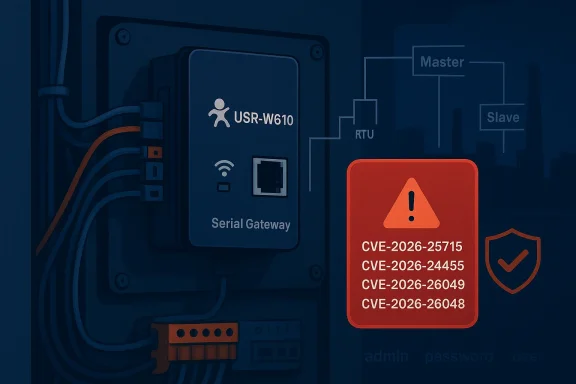
Jinan USR IOT Technology’s USR‑W610 serial‑to‑Wi‑Fi/ Ethernet converter is the subject of a high‑severity Industrial Control Systems advisory that names four vulnerabilities (CVE‑2026‑25715, CVE‑2026‑24455, CVE‑2026‑26049, CVE‑2026‑26048) affecting firmware releases up to and including version 3.1.1.0; the coordinated notice warns that successful exploitation could disable authentication, cause denial‑of‑service, or expose valid credentials (including administrator credentials), and assigns an overall vendor CVSS v3 base score of 9.8. rview
The USR‑W610 is an industrial serial device server — a compact RS232/RS485 to Wi‑Fi and Ethernet converter widely sold for Modbus‑to‑TCP gateways, remote telemetry, utility metering, and general industrial IoT integration. It supports 2.4 GHz 802.11b/g/n Wi‑Fi, a single WAN/LAN Ethernet port, transparent serial tunneling, Modbus RTU<=>TCP conversion, and web‑based device management, and is marketed to manufacturing and critical‑infrastructure customers. USR’s product pages and datasheets make the device’s industrial use cases clear and list features such as heartbeat packets, identity packets, and web‑server configuration interfaces that are convenient for operations but — if implemented without robust authentication and transport security — increase attack surface in ICS environments. (pusr.com)
CISA’s advisory (coordinated with researcher acknowledgments to Payatu Security Consulting) identifies the cluster of bugs as falling into four classic categories that often produce high impact on embedded and OT devices: weak password requirements, cleartext transmission of sensitive information, insufficiently protected credentials, and missing authentication for critical functions. Those four categories together create realistic scenarios where a remote, unauthenticated or weakly authenticated attacker can steal credentials, bypass administrative controls, or disrupt device service. The advisory lists the affected fi.1.0.
The USR‑W610 advisory is a timely reminder that tiny, inexpensive devices in industrial networks can carry outsized risk when management planes and credential handling are insecure. The combination of missing authentication, cleartext credential exposure, and weak password practices is a classic, high‑impact failure mode for embedded gateways; defenders must respond with rapid inventory, isolation, credential rotation, careful monitoring, and a disciplined firmware‑update program while demanding transparent remediation and signed firmware from the vendor.
Source: CISA Jinan USR IOT Technology Limited (PUSR) USR-W610 | CISA
The USR‑W610 is an industrial serial device server — a compact RS232/RS485 to Wi‑Fi and Ethernet converter widely sold for Modbus‑to‑TCP gateways, remote telemetry, utility metering, and general industrial IoT integration. It supports 2.4 GHz 802.11b/g/n Wi‑Fi, a single WAN/LAN Ethernet port, transparent serial tunneling, Modbus RTU<=>TCP conversion, and web‑based device management, and is marketed to manufacturing and critical‑infrastructure customers. USR’s product pages and datasheets make the device’s industrial use cases clear and list features such as heartbeat packets, identity packets, and web‑server configuration interfaces that are convenient for operations but — if implemented without robust authentication and transport security — increase attack surface in ICS environments. (pusr.com)
CISA’s advisory (coordinated with researcher acknowledgments to Payatu Security Consulting) identifies the cluster of bugs as falling into four classic categories that often produce high impact on embedded and OT devices: weak password requirements, cleartext transmission of sensitive information, insufficiently protected credentials, and missing authentication for critical functions. Those four categories together create realistic scenarios where a remote, unauthenticated or weakly authenticated attacker can steal credentials, bypass administrative controls, or disrupt device service. The advisory lists the affected fi.1.0.
 What the advisory says (concise summary)
- Affected product: Jinan USR IOT Technology Limited (PUSR) USR‑W610 serial device server. (pusr.com)
- Affected versions: USR‑W610 firmware verding 3.1.1.0 (as identified in the advisory).
- Vulnerability types: Weak password requirements; cleartext transmission of sensitive information; insufficiently protected credentials; m for critical functions.
- Impact: Authentication bypass/disablement or theft of valid user credentials (including administrator credentials); denial‑of‑service conditions enabling disruption of serial communications and ums.
- Severity: High — vendor CVSS v3 base score reported as 9credited: Abhishek Pandey and Ranit Pradhan of Payatu Security Consulting were acknowledged for reporting the issues.
Why this matters: threat model and practical risk to industrial environments
Industrial networks frequently use small appliances like the USR‑W610 as bridges between legacy serial sensors/controllers and IP‑based supervisory systems (SCADA, historians, PLC programmers). Several attributes make the USR‑W610 class of device high‑value targets:- They often run long in production without frequent firmware updates and are embedded in stovepipe OT networks.
- They expose management UIs (web configuration pages, AT‑command over TCP) and protocol translation endpoints (Modbus TCP) that are attractive to opportunistic attackers and automated scanners. (pusr.com)
- A single compromised serial gateway can allow attackers to interfere with sensor readings, inject false telemetry, or interrupt command flows — effects that map directly to physical risk on the plant floor. (pusr.com)
Technical analysis — what the vulnerabilities imply (detailed)
Below I break down the four high‑level categories named in the advisory and explain the realistic technical consequences for the USR‑W610 use cases.Weak password requirements
- Devices that accept weak or default passwords (or do not enforce password complexity and rotation) are trivial to brute‑force or guess. In an industrial setting where equipment is often commissioned with factory defaults and left that way, attackers scanning the internet or internal networks can easily obtain administrative access. Once an admin account is compromised, the attacker can change settings, disable authentication, or install persistence mechanisms. The result is effectively complete device takeover.
Cleartext transmission of sensitive information
- If administrative credentials are sent over HTTP (or other unencrypted channels) or are stored/relayed in plaintext in protocol exchanges (e.g., unprotected Modbus telemetry that includes login tokens), passive network attackers and simple man‑in‑the‑middle tools can harvest them. For devices that sit at the edge of OT networks, sniffing on the local LAN is often sufficient to capture credentials that give access to the management plane and the gateway’s serial ports.
Insufficiently protected credentials
- Stored credentials that are not salted, hashed, or otherwise protected in firmware image/flash allow an attacker with read access (file disclosure, local serial console, firmware dump) to extract administrative passwords or API keys. Some device families ship with passwords stored in firmware or in easily accessible configuration pages. This is particularly dangerous because it enables credential reuse to pivot deeper into corporate or ICS systems.
Missing authentication for critical functions
- Missing or bypassable authentication on endpoints that control resets, firmware upgrades, or administrative configuration allows both denial‑of‑service and privilege escalation. A remote attacker who can call factory‑reset or firmware‑upgrade endpoints without valid credentials cae devices en masse, causing operational outages or implanting malware in the device firmware.
Confirming the device context and implementation surface
- The USR‑W610 supports web‑based configuration, AT commands via serial and network, HTTP client modes, and multiple transport modes (TCP Server/Client, UDP, MQTT via cloud services). Those features make the device flexible but also increase the number of code paths and management surfaces that must be hardened. (pusr.com)
- USR advertises Modbus RTU <=> TCP bridging, heartbeat and identity packet functions, and remote‑upgrade capability — all features attackers can abuse if authentication and transport encryption are absent or misconfigured. In particular, remote upgrade paths and HTTP endpoints deserve additional scrutiny in incident response and vulnerability triage. (pusr.com)
Evidence, attribution and reporting
- The advisory credits researchers at Payatu Security Consulting for reporting the vulnerabilities; public confirmation by a national agency indicates the vendor and research community coordinated disclosure prior to public release. Payatu’s advisories/technical reporting stream is consistent with the type of research acknowledged.
- At the time of the advisory’s publication, CISA noted no known public exploitation specifically targeting these CVEs; however, the exposure osibility of authentication bypass in an industrial protocol gateway make rapid mitigation essential because such devices are high‑value for lateral movement and persistence in ICS adversary campaigns.
Practical mitigation steps (operational checklist)
CISA’s advisory already lists defensive guidance; below I expand that into a prioritized, actionable runbook that OT teams can use immediately.- Inventory and isolate
- Identify all USR‑W610 devices (and functionally equivalent serial bridges) across IT and OT networks. Prioritize devices used in critical production paths.
- Immediately ensure devices are not reachable from the internet. If any are internet‑exposed, block them at the edge or apply temporary ACLs to allow only management host IPs.
- Network segmentation & firewalling
- Place W610 devices behind segmented firewalls or microsegmented OT zones. Restrict access to management interfaces to a small set of jump hosts/workstations with MFA and rigorous logging.
- Deny inbound connections from untrusted networks and vendor clouds unless explicitly required and secured.
- Compensating controls until patches arrive
- Disable web management on untrusted interfaces where possible. Use device configuration utilities only from an isolated management VLAN.
- Where https is supported, force HTTPS and reject plain HTTP for all management and API sessions. If device firmware lacks TLS for management, restrict management to an out‑of‑band or VPN channel that enforces mutual authentication. (pusr.com)
- Credentials and passwords
- Rotate all device passwords and service account credentials that passed through affected USR‑W610 devices. Assume any credentials may have been captured if the device was reachable to untrusted networks.
- Enforce unique, strong passwords and a policy that prohibits sharing management credentials between devices. If possible, migrate to certificate or key‑based authentication for management.
- Firmware and vendor coordination
- Check PUSR/USR support pages and vendor communications for firmware patches or guidance; apply vendor releases that explicitly remediate the identified CVEs as soon as they are available and validated in a test lab. Vendor documentation and datasheets show the product family and configuration methods; many vendors publish firmware bundles and release notes through their support portals. (pusr.com)
- Monitoring and detection
- Add detection rules to IDS/IPS and SIEM for suspicious traffic patterns: repeated authentication failures, unauthenticated POSTs to configuration endpoints, unexpected outbound connections, and attemupgrade/reset endpoints.
- Inspect device logs (if present), gateway traffic, and serial‑to‑IP payloads for anomalies. If devices transmit credentials in plaintext, search historic network captures for occurrences of those strings.
- Incident response readiness
- If evidence of compromise exists, isolate the device, collect forensic images (firmware, configuration dumps), rotate credentials across defollow standard OT incident response processes including staged recovery and offline validation of firmware integrity. Contact vendor support and CISA if you’re in the U.S. and believe an active compromise occurred.
Longer‑term security recommendations for organizations deploying device servers
- Replace password‑only management with certificate or hardware‑backed authentication where possible. Devices designed for industrial deployments should support mutually authenticated TLS for management. (pusr.com)
- Require vendors to support secure firmware‑update mechanisms: signed firmware images with public‑key verification, rollback protection, and authenticated boot. If a device cannot validate firmware authenticity, set it aside for replacement or isolate it tightly. (pusr.com)
- Include small appliances like serial gateways in vulnerability management and patch‑testing cycles. OT asset inventories should record firmware versions, management interfaces in use, and remote access paths (cloud brokers, vendor portals, third‑party jump hosts).
- Where feasible, architect one‑way or read‑only telemetry channels between OT sensors and cloud/higher‑level systems; avoid architectures that require direct internet‑connected management of field devices. Use proxies or brokered API patterns with robust authentication and logging. (pusr.com)
Vendor posture and what to expect next
- PUSR’s support and download pages include model documentation, user manuals, and configuration utilities for the USR‑W610; customers should check the vendor support portal for firmware releases and formal security advisories. Until vendor and verified, defenders must rely on network controls and rotation of credentials. (pusr.com)
- Coordinated disclosures like this one typically result in one or more vendor firmware updates and a follow‑up advisory with technical remediation steps; organizations should plan a short window for prioritized testing and staged deployments. If vendor patches are unavailable in a reasonable timeframe, plan for device replacement or compensating isolation.
Detection guidance — concrete indicators and rules to add now
- Search for management traffic to W610 devices that uses HTTP (port 80) and captures Basic Auth headers or other plaintext tokens; flag and inspect any occurrence.
- Detect outbound HTTP/HTTPS POSTs from W610 devices to unknown cloud endpoints — they can indicate misconfiguration or exfiltration channels used by compromised devices.
- Monitor for new admin accounts or unexpected configuration changes on devices. Correlate with user‑account change logs in adjacent systems (SCADA sng workstations).
- Add IDS/IPS signatures for requests that match known unauthenticated endpoints (if those endpoints are enumerated in vendor manuals) and for attempts to call reset/firmware endpoints without authenticated session tokens.
Risk assessment and prioritization for defenders
- High priority: Any USR‑W610 units reachable from the internet or connected to DMZs that also bridge to OT networks. These should be isolated or patched immediately.
- Medium priority: Devices inside OT zones that lack strong segmentation, devices that broker credentials to upstream systems (cloud brokers, virtual serial port services). Rotate credentials and harden network controls for these. (pusr.com)
- Lower priority: Units used purely in isolated, test, or deeply segregated networks — still patch and rotate credentials, but remediation urgency is lower if they are properly segmented.
Notable strengths and remaining concerns (critical appraisal)
- Strengths: The advisory is timely and clear about the types of weaknesses and the affected firmware boundary. Acknowledging external researchers and providing recommended mitigations (isolate, rotate, patch when available) is the correct, pragmatic approach for OT operators. The USR‑W610’s capabilities (Modbus support, remote upgrade) make it an effective industrial tool when configured securely.
- Concerns / risks:
- The device family is low‑cost and widely distributed; many field installs may never receive maintenance or firmware ‑tail exposure.
- The vendor’s documentation demonstrates multiple accessible management planes (web UI, AT over network, HTTP client mode, cloud broker) — every management path increases potential attack vectors and must be hardened individually. (pusr.com)
- The advisory’s reliance on firmware <ted threshold demands explicit vendor confirmation about which firmware builds include fixes and whether fixes fully close all exploit chains; defenders should demand clear release notes and CVE mappings from the vendor.
Final guidance for WindowsForum readers and OT teams
- Immediately inventory your network for USR‑W610 devices. If you cannot quickly identify all devices, assume exposure and start segmenting network paths to deny direct internet access. (pusr.com)
- Rotate credentials for any accounts that touch a USR‑W610 and assume credential leakage is plausible if a device was internet‑reachable. Use unique passwords and, where possible, move to key/certificate authentication.
- Enforce strict network segmentation and deploy egress filtering to prevent devices from making arbitrary outbound connections. Add monitoring rules to pick up suspicious configuration API calls and plaintext credential leaks. (pusr.com)
- Track vendor communications and apply validated firmware updates as soon as they’re available. Treat any firmware upgrade process as high‑risk (test in lab first, verify signed images, maintain backups). (pusr.com)
- If you’re responsible for critical manufacturing or utility infrastructure, include this class of serial‑to‑IP gateway in tabletop exercises and recovery plans. A compromised gateway is not only a local outage — it can provide pivot access into larger OT systems.
The USR‑W610 advisory is a timely reminder that tiny, inexpensive devices in industrial networks can carry outsized risk when management planes and credential handling are insecure. The combination of missing authentication, cleartext credential exposure, and weak password practices is a classic, high‑impact failure mode for embedded gateways; defenders must respond with rapid inventory, isolation, credential rotation, careful monitoring, and a disciplined firmware‑update program while demanding transparent remediation and signed firmware from the vendor.
Source: CISA Jinan USR IOT Technology Limited (PUSR) USR-W610 | CISA
