

Highwire’s new AI Index promises to give marketing and communications leaders a single, continuously updated metric for how their brand is represented across major generative‑AI assistants — a timely product that answers a practical gap but raises methodological questions that buyers must insist on resolving before trusting the score as a definitive signal.
The way people discover information has shifted: conversational assistants and answer‑style UIs powered by large language models (LLMs) are now a primary entry point for many queries, and those systems often present consolidated answers with limited clickthrough to the open web. That shift concentrates reputational power in opaque retrieval and summarization layers that were not designed with brand governance in mind. Highwire’s announcement frames the AI Index as a response to this change: a tool built to benchmark visibility, track the web sources assistants rely on, and provide communications teams with actionable signals to shape how their brand shows up in model outputs.
Industry coverage and analyst commentary emphasize that these assistant surfaces are materially different from classic SERPs: visibility is about being cited or being used as provenance in an answer, not just ranking for a keyword. That reality makes a dedicated metric appealing for PR, corporate reputation, and B2B marketing teams that need repeatable, auditable measurement.
These steps mirror common industry practice for "answer engine" monitoring tools, but each contains assumptions that materially affect interpretation. Buyers should treat the described pipeline as plausible rather than definitive until vendor disclosure proves otherwise.
Taken together, these limitations mean the Index is best used as directional intelligence: a way to prioritize diagnostics and experiments rather than as a single ground truth for legal, compliance, or high‑stakes decisions.
For WindowsForum readers — practitioners operating websites, services, and Windows‑integrated apps — AEO matters because zero‑click assistant answers reduce referral traffic and change the discovery funnel. The pragmatic response is the same as for publishers: invest in machine‑readable provenance, structured metadata, and human‑led accuracy checks to remain discoverable and trustworthy when assistants synthesize information.
However, the value of any single score depends entirely on the transparency and stability of the underlying methodology. Critical buyer protections include time‑stamped query logs, model identifiers, prompt banks, and clear provenance methodology. Without those, treat Index outputs as directional intelligence useful for prioritization rather than a definitive measurement for compliance or legal risk decisions. The true test will be how Highwire documents reproducibility, handles model volatility, and equips customers to distinguish genuine authority from manipulation.
Highwire’s AI Index is available now to Highwire clients and positioned as an essential input for planning in the next cycle — but its practical value will depend on buyers’ willingness to insist on transparency, reproducibility and careful experimental design. When combined with accuracy audits, structured data, and a test‑and‑measure approach, the Index can be a powerful new instrument for managing reputation in the era of AI‑driven discovery; used naively, it risks becoming another opaque metric that confers false certainty.
Source: AI Magazine Highwire Launches AI Index to Measure Brand Presence in Generative AI Platforms
 Background
The way people discover information has shifted: conversational assistants and answer‑style UIs powered by large language models (LLMs) are now a primary entry point for many queries, and those systems often present consolidated answers with limited clickthrough to the open web. That shift concentrates reputational power in opaque retrieval and summarization layers that were not designed with brand governance in mind. Highwire’s announcement frames the AI Index as a response to this change: a tool built to benchmark visibility, track the web sources assistants rely on, and provide communications teams with actionable signals to shape how their brand shows up in model outputs.Industry coverage and analyst commentary emphasize that these assistant surfaces are materially different from classic SERPs: visibility is about being cited or being used as provenance in an answer, not just ranking for a keyword. That reality makes a dedicated metric appealing for PR, corporate reputation, and B2B marketing teams that need repeatable, auditable measurement.
What Highwire says the AI Index does
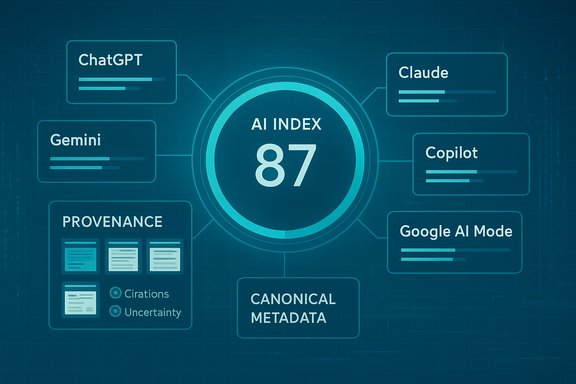
Highwire positions the AI Index as a communications‑first metric with several concrete deliverables:- A single, continuously updated AI Index score derived from thousands of standardized queries across multiple assistants.
- Cross‑platform benchmarking versus named systems (explicitly calling out ChatGPT, Gemini, Claude, and references to Google AI mode and Microsoft Copilot).
- Identification of the web pages and third‑party sources that contribute most to an assistant’s responses about a brand.
- Exportable reports, trend data and integration with client dashboards to fold AI visibility into quarterly planning and comms programs.
How the AI Index likely works (methodology — plausible architecture)
Highwire’s public announcement explains the product at a high level but does not disclose all technical detail; independent analysis and industry practice allow a reasoned reconstruction of the approach the Index almost certainly uses:1. Standardized, repeated queries
To produce a comparable score, the Index must run thousands of consistent prompts against each assistant to sample typical behavior across time and phrasing variations. That helps reduce noise from individual query oddities.2. Prompt normalization and context engineering
Prompt phrasing, persona, and conversational context influence assistant outputs. The Index likely normalizes prompts and controls context windows to make cross‑platform comparisons meaningful.3. Source extraction and provenance mapping
Where assistants provide explicit citations, the Index can record and aggregate them. For assistants that do not expose sources, the Index probably infers provenance via heuristics that match textual snippets to candidate pages — a fragile but common technique.4. Aggregation, weighting and scoring
Signals (citation frequency, source authority, topical relevance, message pull‑through) are combined into a proprietary weighting to produce the single Index score. The precise weights and adjustments for model updates are material and — if undisclosed — a critical black box.5. Trend analysis and benchmarking
Results are tracked over time and compared to competitor sets and topical themes, with exportable trend data for planning cycles. Dashboard integration is offered to make the score operational for comms teams.These steps mirror common industry practice for "answer engine" monitoring tools, but each contains assumptions that materially affect interpretation. Buyers should treat the described pipeline as plausible rather than definitive until vendor disclosure proves otherwise.
Strengths — what the AI Index brings to comms and marketing teams
The AI Index addresses a concrete gap between traditional SEO metrics and the needs of reputation teams operating in AI‑first discovery environments. Its main strengths include:- A focused channel metric: It provides a single, communicable KPI for AI visibility rather than shoehorning assistant behavior into classic ranking metrics.
- Cross‑platform comparison: By sampling multiple assistants, it reduces single‑vendor blind spots and helps teams understand how representation varies between models.
- Operational clarity for PR teams: Identifying which earned placements or owned pages are actually being used by assistants helps prioritize amplification, syndication and technical fixes (e.g., schema, canonicalization).
- Productizable insight: Exportable reports and dashboard integrations let organizations fold Assistant visibility into planning, goals, and KPIs rather than treating it as ad‑hoc monitoring.
Critical limitations and risks (what procurement and comms leads must audit)
The Index is useful, but it is not an oracle. Several structural limitations — some inherent to the space, some vendor‑specific — deserve careful attention:Model variability and volatility
Assistant behavior can change rapidly with model updates, prompt‑tuning, or backend retrieval changes. A sample collected one day may look materially different after a vendor rollout. Any index that aggregates assistant outputs must clearly document how it detects, version‑controls and adjusts for model updates. Without that, scores can be misleading.Prompting and sampling bias
The choice of prompts, the phrasing bank, sampling cadence and topical selection directly shape results. If the Index’s prompt set is narrow or optimized to favor certain content types, the score could be gamed (intentionally or not). Buyers should request the prompt bank and sampling methodology.Source attribution gaps and heuristics
Not all assistants provide explicit citations; where they don’t, provenance inference relies on heuristics that can be wrong. That makes the mapping from an assistant’s output back to a specific page inherently probabilistic and audit‑dependent. Highwire’s public materials do not appear to publish the full provenance method.Influence vs. correctness
A page that is frequently cited by assistants may be influential but not accurate or safe for regulated domains (health, finance). The Index can surface where models find your signals, but it cannot vouch for the accuracy of the assistant’s synthesized claims without a separate accuracy audit.Gaming, spam and manipulation risk
Actors that intentionally structure low‑quality pages to be favored by retrieval heuristics (so‑called machine‑grooming) can distort visibility signals. Any Index must include mechanisms to flag coordinated manipulation or low‑quality high‑frequency sources.Platform transparency and contractual limits
Major platform providers tightly control retrieval stacks and often do not disclose signal weighting. That non‑transparency constrains any vendor’s ability to guarantee citations or to fully explain why a model preferred one page over another. Contracts and SLAs must reflect this limitation.Taken together, these limitations mean the Index is best used as directional intelligence: a way to prioritize diagnostics and experiments rather than as a single ground truth for legal, compliance, or high‑stakes decisions.
Due diligence: questions every buyer should ask Highwire (and any vendor offering similar metrics)
Before operationalizing an AI Index score as a KPI, procurement and comms leads should demand concrete artifacts and commitments:- Provide the full prompt bank, sampling cadence and query randomization logic.
- Supply time‑stamped query logs and model identifiers (model name/version/date) for reproducibility.
- Explain provenance methods for assistants that do not expose citations and provide uncertainty estimates for inferred sources.
- Detail how the Index detects and responds to model updates (versioning, re‑baseline, and score continuity plans).
- Show examples of exportable reports and how the score maps to downstream KPIs (CTR, conversions, sentiment).
- Disclose weighting methodology or at least provide a reproducible rubric for how signals are combined into the single score.
- Describe anti‑gaming measures and how the Index differentiates legitimate authority from manipulation vectors.
- Provide a runbook for high‑risk domains (health, finance) explaining how accuracy audits are integrated with visibility metrics.
Practical playbook: how to act on AI Index signals (90‑day roadmap)
For teams that decide to pilot the Index, here is a pragmatic, staged playbook that translates visibility signals into workstreams:Immediate (0–30 days)
- Instrument a weekly monitoring cadence: sample assistant outputs for core brand queries and save logs for trend comparison.
- Publish concise, machine‑friendly canonical pages: FAQ pages, executive summaries and one‑page product facts that are easy for retrieval systems to digest.
- Fix basic signal hygiene: canonical tags, consistent author metadata, and sitemap/indexing checks to minimize attribution errors.
Mid‑term (30–90 days)
- Run controlled experiments: publish a canonical fact sheet and measure citation frequency vs. existing long‑form pages. Track changes in Index score and downstream behavior.
- Prioritize high‑quality third‑party placements on reputable domains that assistants tend to trust.
- Integrate Index outputs into comms planning and PR cadence: make AI visibility a measurable objective in campaign briefs.
Long term (90–180 days)
- Invest in provenance feeds and structured syndication: curated APIs, white‑label data feeds, and partner channels that provide machine‑readable source windows.
- Embed human‑in‑the‑loop review for outputs in regulated contexts and tie visibility improvements to accuracy audits.
Measurement: what to track and how to connect visibility to value
Visibility alone is not a business outcome. To make the Index actionable, teams should join Index outputs with downstream KPIs:- Trend of Index score over time (directional visibility).
- Frequency and distribution of source citations across assistants (provenance map).
- Downstream click‑through and session behavior for pages identified as high‑citation sources (compare pre/post experiments).
- Conversion lift and attribution metrics tied to pages that receive increased assistant citations.
- Accuracy and brand‑safety audits for assistant outputs that reference your brand (especially in regulated verticals).
The broader marketplace: where Highwire’s Index fits
Highwire’s product launch surfaces a broader category now forming in the market often termed Answer Engine Optimization (AEO) or Generative Experience Optimization (GXO): vendors and agencies building tools to measure and influence how brands appear inside assistant outputs. The Index is pitched as complementary to SEO platforms — not a replacement — because its priorities are reputation, narrative pull‑through and provenance rather than keyword rankings alone. Early industry coverage treats this launch as a natural step in analytics for gen‑AI discovery channels, while noting that vendor claims must be audited for transparency.For WindowsForum readers — practitioners operating websites, services, and Windows‑integrated apps — AEO matters because zero‑click assistant answers reduce referral traffic and change the discovery funnel. The pragmatic response is the same as for publishers: invest in machine‑readable provenance, structured metadata, and human‑led accuracy checks to remain discoverable and trustworthy when assistants synthesize information.
Verdict — practical, useful, but conditional
Highwire’s AI Index is a practical and timely product: it packages an emerging measurement need into a score and operational tooling that comms teams can act on. Pilots across cybersecurity, healthcare and B2B tech show the tool can surface previously unseen signals and prioritize remediation work. That utility is real and valuable to organizations facing AI‑first discovery surfaces.However, the value of any single score depends entirely on the transparency and stability of the underlying methodology. Critical buyer protections include time‑stamped query logs, model identifiers, prompt banks, and clear provenance methodology. Without those, treat Index outputs as directional intelligence useful for prioritization rather than a definitive measurement for compliance or legal risk decisions. The true test will be how Highwire documents reproducibility, handles model volatility, and equips customers to distinguish genuine authority from manipulation.
Practical next steps for comms and marketing leaders
- Treat the Index as a diagnostic tool and pilot it against a clear 90‑day experiment with holdouts and measurable downstream KPIs.
- Demand reproducibility artifacts (logs, prompts, model versions) before committing to long‑term contracts.
- Pair visibility tracking with accuracy audits and brand‑safety guardrails — especially in healthcare, finance and other regulated spaces.
- Invest in structured, machine‑readable assets (FAQ schema, canonical one‑page facts, syndication feeds) so your facts are ready for assistants to cite.
- Integrate Index outputs into quarterly planning and comms scorecards, but avoid letting a single number become the only KPI for reputation work.
Highwire’s AI Index is available now to Highwire clients and positioned as an essential input for planning in the next cycle — but its practical value will depend on buyers’ willingness to insist on transparency, reproducibility and careful experimental design. When combined with accuracy audits, structured data, and a test‑and‑measure approach, the Index can be a powerful new instrument for managing reputation in the era of AI‑driven discovery; used naively, it risks becoming another opaque metric that confers false certainty.
Source: AI Magazine Highwire Launches AI Index to Measure Brand Presence in Generative AI Platforms
