

Hilltop Studios’ announcement of Curse of Resthaven is a deliberate and unsettling pivot: the Toronto indie behind the warmly comic, award-winning Lil’ Guardsman has revealed a hand‑drawn, narrative‑heavy roguelite that trades Saturday‑morning-cartoon cheer for gothic, eldritch dread — and the change looks intentional, ambitious, and risky in equal measure.
Hilltop Studios made a lot of players and critics sit up with their debut, Lil’ Guardsman — a narrative deduction game that blended cozy, high‑fantasy visuals with a Papers, Please–style moral engine and a distinctive sense of humor. The studio’s first outing landed in January 2024 and earned festival recognition and awards, including an IndieCade Performance Award nod and multiple honours on Canadian award lists — a rare level of recognition for a small team that helped solidify Hilltop’s reputation for character, craft, and strong narrative design.
Curse of Resthaven, revealed during Indie Fan Fest, is positioned by Hilltop as a “radical shift” away from that tone — a conscious rebrand of the studio’s emotional register and mechanical focus. The developer’s public materials describe a seven‑day, time‑loop structure where you govern a cursed island, trade, interrogate residents, and go on branching, card‑driven expeditions to uncover a disappearing‑niece mystery and break an island‑ending loop. Those elements combine narrative stakes with looped progression and resource management, leaning heavily on replayability and emergent story through repeated runs. (hilltop.so)
Running Resthaven’s economy and relationships involves daily choices: interrogating townspeople, managing dockside trade, upgrading businesses, and deciding who to trust. Outside the town, you can send characters on branching, card‑based expeditions into the island’s wilds. Those excursions are presented as high‑risk, high‑reward sequences that both deepen the mystery and bring tangible benefits back to the colony. On Steam the game’s description explicitly calls out card‑driven expeditions and a mixture of interrogation, trading, and upgrading as core activities.
This matters: fully voiced characters at scale are expensive. For a small indie team, the difference between a half‑dozen featured performances and 25 full VO parts has real implications for production timelines, localization plans, and budget. If Hilltop delivers on that scope, it would be a notable achievement that underscores their ambitions for cinematic presentation.
From a market perspective, the partnership makes sense. Hilltop’s last game managed to build a loyal, vocal community and collect awards, which gives the studio leverage. Digital Bandidos, as a boutique publisher anchored by experienced staff, offers targeted publishing muscle — press outreach, platform relationships, and possibly finishing funds — that can help a narrative‑heavy roguelite land on multiple platforms. The publisher’s track record and public statements indicate a focus on PC and console launches and on shepherding developer vision rather than imposing cookie‑cutter design.
Key technical notes pulled from the Steam page:
At the same time, the announcement exposes classic indie tradeoffs: scale versus resources, artistic ambition versus commercial clarity, and the difficulty of delivering a richly voiced, atmospheric experience without stretching a small team thin. How Hilltop and Digital Bandidos navigate production realities, confirm their VO and localization ambitions, and articulate a solid release roadmap will determine whether Curse of Resthaven is an elegant evolution or an overreaching ambition.
For fans of narrative roguelites and atmospheric story games, Resthaven’s premise — a time‑looped island that collapses unless you learn its secrets — is compelling. For Hilltop, the challenge now is to translate that promise into a release that lives up to the atmosphere, voice work, and narrative depth they’re pitching, while keeping the core loops satisfying and the production schedule realistic. We’ll be watching the developer updates, the Steam wishlist traction, and any playable demos or festival builds that follow Indie Fan Fest’s reveal. (hilltop.so)
Curse of Resthaven is not just a new game; it’s a statement of intent from a small studio that wants to stretch beyond its comfort zone. If Hilltop can bring the promised voice work, score, and eerie, looped narrative to market on a realistic schedule, Resthaven could become a defining example of how indie teams can reinvent themselves while retaining the qualities that won them early acclaim. The coming months — more developer updates, a cast list, a release window, and festival demos — will tell us whether this eldritch reinvention is a masterstroke or an overreach.
Source: Wccftech Hilltop Studios' Next Project, Curse of Resthaven, is Like "If Twin Peaks and Lost had an Eldritch Baby," Says Director
 Background / Overview
Hilltop Studios made a lot of players and critics sit up with their debut, Lil’ Guardsman — a narrative deduction game that blended cozy, high‑fantasy visuals with a Papers, Please–style moral engine and a distinctive sense of humor. The studio’s first outing landed in January 2024 and earned festival recognition and awards, including an IndieCade Performance Award nod and multiple honours on Canadian award lists — a rare level of recognition for a small team that helped solidify Hilltop’s reputation for character, craft, and strong narrative design.Curse of Resthaven, revealed during Indie Fan Fest, is positioned by Hilltop as a “radical shift” away from that tone — a conscious rebrand of the studio’s emotional register and mechanical focus. The developer’s public materials describe a seven‑day, time‑loop structure where you govern a cursed island, trade, interrogate residents, and go on branching, card‑driven expeditions to uncover a disappearing‑niece mystery and break an island‑ending loop. Those elements combine narrative stakes with looped progression and resource management, leaning heavily on replayability and emergent story through repeated runs. (hilltop.so)
What Curse of Resthaven Is — Mechanics and Structure
The loop, the town, and the expeditions
At its mechanical core, Curse of Resthaven presents a tight, seven‑day loop: you take the role of a newly arrived governor, your niece is missing, catastrophe approaches on day seven, and when the island collapses the loop returns you to your arrival with persistent advantages and growth. The ongoing loop is where the roguelite design lives: each run teaches the player new leads, unlocks permanent upgrades, and grants temporary boons that change the tactical calculus for the next attempt. Hilltop describes this as a design where narrative beats and looped systems reinforce each other, forcing tradeoffs between short‑term safety and long‑term discovery. (hilltop.so)Running Resthaven’s economy and relationships involves daily choices: interrogating townspeople, managing dockside trade, upgrading businesses, and deciding who to trust. Outside the town, you can send characters on branching, card‑based expeditions into the island’s wilds. Those excursions are presented as high‑risk, high‑reward sequences that both deepen the mystery and bring tangible benefits back to the colony. On Steam the game’s description explicitly calls out card‑driven expeditions and a mixture of interrogation, trading, and upgrading as core activities.
Roguelike vs. roguelite — what to expect
Hilltop calls Curse of Resthaven a narrative roguelite. That label matters to prospective players because it implies certain design choices:- Runs should be meaningful but finite, with progression between loops.
- Failure is expected and designed to teach rather than punish.
- Randomization and branching narrative means repeated playthroughs will reveal different facets of the story.
Visuals, Audio, and Production Values
A tonal and visual 180
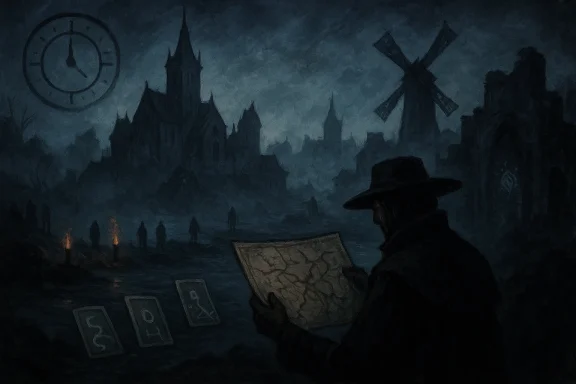
Hilltop stressed that Curse of Resthaven is entirely hand‑drawn and built to look evocative and gothic — deliberately opposite to Lil’ Guardsman’s colorful, Saturday‑morning cartoons vibe. The reveal materials and early screenshots telegraph stark, moody compositions and an emphasis on atmosphere: windmills, fog, torchlit encounters, and silhouettes that suggest both character and menace. This is a studio consciously shifting its visual identity to match a darker narrative purpose.Sound and voice work — scale and claims
Hilltop says the new game will feature a new original score by Scott Christian, who composed Lil’ Guardsman’s soundtrack, and Wccftech’s coverage reports 25 fully‑voiced characters in the cast. Christian’s role as composer is verifiable — he produced Lil’ Guardsman’s soundtrack, which released as an OST in early 2024 — but the specific “25 fully‑voiced characters” figure is presently reported in press coverage and has not yet been confirmed in an official developer post or the game’s Steam page. Until Hilltop or the publisher provides a cast list or a developer note confirming that number, the figure should be regarded as likely but not independently verified.This matters: fully voiced characters at scale are expensive. For a small indie team, the difference between a half‑dozen featured performances and 25 full VO parts has real implications for production timelines, localization plans, and budget. If Hilltop delivers on that scope, it would be a notable achievement that underscores their ambitions for cinematic presentation.
The Publisher, The Pitch, and Market Positioning
Hilltop has partnered with Digital Bandidos to publish Curse of Resthaven. Digital Bandidos is a relatively new indie publisher founded by veterans of Versus Evil; their remit is to support indie projects with publishing experience and alternative financing models. The company’s slate and statements make it clear they’re actively courting narrative and strategy indies — and that they bring practical, commercial publishing experience to Hilltop’s new project. Digital Bandidos’ CEO Steve Escalante commented on the partnership during the reveal, expressing enthusiasm for Hilltop’s art and story.From a market perspective, the partnership makes sense. Hilltop’s last game managed to build a loyal, vocal community and collect awards, which gives the studio leverage. Digital Bandidos, as a boutique publisher anchored by experienced staff, offers targeted publishing muscle — press outreach, platform relationships, and possibly finishing funds — that can help a narrative‑heavy roguelite land on multiple platforms. The publisher’s track record and public statements indicate a focus on PC and console launches and on shepherding developer vision rather than imposing cookie‑cutter design.
Technical Footprint and Platform Strategy
Hilltop and early store entries indicate plans for PC, macOS, and consoles, with the Steam product page already present but “release date: To be announced.” Hilltop’s own site echoes the multi‑platform intent and the “seven days remain” marketing language. The Steam listing also provides a preliminary set of system requirements that suggest the game is not trying to push high‑end real‑time 3D performance — the storage footprint is modest and minimum GPU targets are mid‑range — which aligns with a hand‑drawn, 2D/2.5D aesthetic rather than a 3D photoreal push. Still, optimization and cross‑platform QA will be non‑trivial given console certification and the different CPU/GPU architectures across platforms. (hilltop.so)Key technical notes pulled from the Steam page:
- Release date: To be announced — the store page is live but unscheduled.
- Platforms listed include Windows and macOS; console listings are planned but not yet detailed.
- Preliminary system requirements suggest a 64‑bit OS and modest GPU requirements (GeForce GTX 750 Ti / Radeon RX 460 as minima; GTX 1080 Ti / RX Vega 64 recommended).
Why the Shift Makes Sense — Strengths and Opportunities
1) Maturing the studio’s narrative craft
Hilltop’s strength is storytelling and character work. Lil’ Guardsman proved the studio can create memorable NPCs, weighty player choices, and an evocative soundtrack — all of which translate directly into a narrative‑first roguelite. A darker canvas gives the team space to flex a longer emotional register, to build sustained mystery, and to test design techniques that tie player failure into narrative progression. The looped, investigative structure is a natural fit for revealing story in layers, rewarding repeated play with new discoveries rather than mere stat progress. (hilltop.so)2) Roguelite design is commercially proven
The indie space has embraced roguelites for their replayability and retention. Card‑driven expeditions and looped upgrades can sustain player engagement and make each stream of content feel distinct. For a studio that needs to show both depth and longevity in a single‑player package, mixing narrative weight with looped progression is a smart bet. If they execute the “learn and unlock” arc well, Resthaven could attract both narrative players and loop‑driven fans.3) A strong publisher fit
Digital Bandidos’ model — an indie‑focused publisher with hands‑on experience and flexible financing options — is a pragmatic match for a studio branching into higher production values (voice acting, original score, multi‑platform QA). The publisher’s existing slate and statements suggest they’re positioned to help Hilltop scale its ambition without pushing the studio into risky, ill‑fitting commercial compromises.Where This Could Go Wrong — Risks and Red Flags
A. Scope vs. resources
Hand‑drawn art, a large voice cast, and a fully scored soundtrack are resource‑heavy. For an indie studio, these features increase costs, extend production timelines, and create dependencies on external contractors (voice talent, audio engineers). If Hilltop is self‑funded or working on limited finishing funds, there’s a non‑trivial risk of scope creep or delay. Readers should treat early claims about cast size or complete VO support as aspirational until the developer posts a confirmed credits list or a production roadmap.B. Audience expectations and brand transition
Lil’ Guardsman’s audience discovered Hilltop through humor, charm, and nostalgia‑tinged visuals. A tonal shift to gothic, eldritch horror is creative and potentially rewarding, but it can fragment the studio’s audience. Some players will follow Hilltop anywhere; others may feel the new tone diverges from what drew them to the studio. Managing communication, demos, and early access will be crucial to carry the core audience across the tonal divide without alienating them.C. Narrative complexity and replayability tradeoffs
Roguelite structures demand repeating story beats for mechanical feedback, but narrative players can be frustrated when repetition reduces emotional impact. The design challenge is balancing repeatability with narrative freshness; if Resthaven’s loops feel like mechanical scaffolding without meaningful story variation, the experience could feel hollow. Conversely, too much bespoke narrative content per path increases production cost exponentially.D. Publisher risk and the indie market
Digital Bandidos is experienced and enthusiastic, but the indie publishing market remains crowded and volatile. Small publishers face distribution and marketing challenges, and novel releases can get lost without strong platform partner placement or PR. Hilltop’s award pedigree helps, but visibility and promotion will be essential to reach sales targets that sustain long‑term live support or further projects.What We Still Don’t Know (and What to Watch For)
- Confirmed VO cast list and localization plan. The oft‑repeated “25 fully‑voiced characters” figure appears in press coverage but lacks direct confirmation on Hilltop’s site or the store page; until official credits are shared, consider it provisional.
- A concrete release date. Public messaging says “later this year” on the official announcement and Hilltop’s site, but the Steam page lists “To be announced.” Those two facts indicate a target‑year window without a locked schedule — buyers and press should expect updates rather than a surprise launch.
- Post‑launch plans and live content. Roguelites benefit from added expeditions, events, and narrative branches; Hilltop hasn’t released a roadmap yet. A curated post‑launch plan would increase long‑term engagement and commercial viability.
- Console platform details. Hilltop says “PC, Mac, and consoles,” but which consoles and whether day‑one parity is planned remains unspecified. Console certification timelines can influence release sequencing and discovery. (hilltop.so)
Recommended Questions for Hilltop (and What Fans Should Ask)
If you’re a reporter, streamer, or fan preparing to track Curse of Resthaven through development, these are the most useful clarifying questions:- Can you confirm the voice cast and whether the “25 fully‑voiced characters” is final? If so, will international localization include full VO or subtitles only?
- Will the game support controller and keyboard parity at launch, and which consoles are targeted for day‑one release?
- Do you plan to ship with post‑launch expansions or seasonal expeditions that add narrative content?
- What safeguards are you implementing to balance loop repetition with narrative variety (procedural storytelling systems, branching set pieces, etc.)?
- How is Digital Bandidos supporting cross‑platform QA and marketing to ensure visibility at launch?
Final Analysis — Why This Matters
Curse of Resthaven is one of the more interesting indie pivots we’ve seen in recent memory: a team that earned acclaim for warmth and wit now testing the creative limits of atmosphere, dread, and looped narrative. That alone makes the project worth watching for both players and industry observers. Hilltop has demonstrable strengths — narrative craft, a composer in Scott Christian with proven output, festival recognition, and a community — and those are the right ingredients for a studio to expand its scope credibly.At the same time, the announcement exposes classic indie tradeoffs: scale versus resources, artistic ambition versus commercial clarity, and the difficulty of delivering a richly voiced, atmospheric experience without stretching a small team thin. How Hilltop and Digital Bandidos navigate production realities, confirm their VO and localization ambitions, and articulate a solid release roadmap will determine whether Curse of Resthaven is an elegant evolution or an overreaching ambition.
For fans of narrative roguelites and atmospheric story games, Resthaven’s premise — a time‑looped island that collapses unless you learn its secrets — is compelling. For Hilltop, the challenge now is to translate that promise into a release that lives up to the atmosphere, voice work, and narrative depth they’re pitching, while keeping the core loops satisfying and the production schedule realistic. We’ll be watching the developer updates, the Steam wishlist traction, and any playable demos or festival builds that follow Indie Fan Fest’s reveal. (hilltop.so)
Quick Reference — Key Verified Points
- Curse of Resthaven was announced at Indie Fan Fest; Hilltop Studios describes it as a narrative roguelite with a seven‑day time loop and branching card‑based expeditions.
- Hilltop’s previous title, Lil’ Guardsman, launched in January 2024 and earned festival attention and awards, helping establish the studio’s narrative pedigree.
- The game’s Steam page lists Digital Bandidos as the publisher and confirms the game is coming to PC and macOS with console plans; the Steam listing currently shows “To be announced” for a release date.
- Scott Christian, Hilltop co‑founder and composer for Lil’ Guardsman, is credited with composing the score for Hilltop’s previous game and is reported to be composing Curse of Resthaven’s new score. The specific claim of “25 fully‑voiced characters” appears in press coverage but lacks a confirming developer credits page as of the Steam listing and Hilltop’s official site. Treat that number as unverified until credited officially.
Curse of Resthaven is not just a new game; it’s a statement of intent from a small studio that wants to stretch beyond its comfort zone. If Hilltop can bring the promised voice work, score, and eerie, looped narrative to market on a realistic schedule, Resthaven could become a defining example of how indie teams can reinvent themselves while retaining the qualities that won them early acclaim. The coming months — more developer updates, a cast list, a release window, and festival demos — will tell us whether this eldritch reinvention is a masterstroke or an overreach.
Source: Wccftech Hilltop Studios' Next Project, Curse of Resthaven, is Like "If Twin Peaks and Lost had an Eldritch Baby," Says Director
