Homes AI: Azure OpenAI Powers Conversational Home Search with Matterport

  • Thread Author
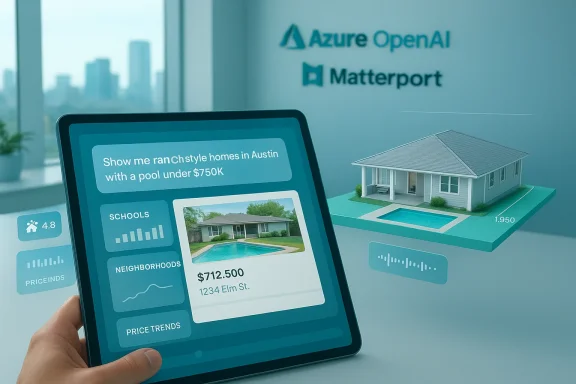
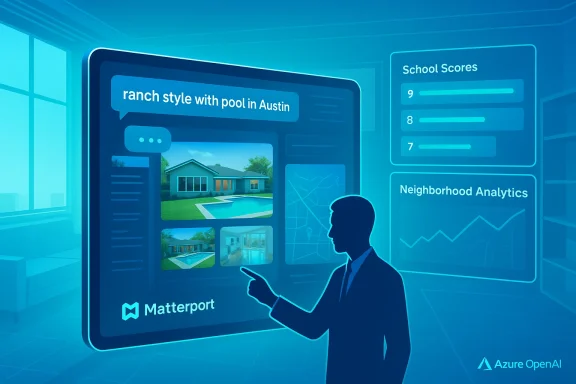
A person reviews a digital real estate dashboard showing an Austin ranch-style home with a pool.
Homes.com’s new Homes AI, launched today by CoStar Group, plugs advanced conversational AI into residential property search — voice and text search powered by Microsoft Azure OpenAI that promises to turn brittle filter-based browsing into a real-time, consultative experience for home shoppers.

Background / Overview​

The real estate portal wars have entered a new phase: winners will be defined less by raw listings and more by how effortlessly consumers can find, evaluate, and understand those listings. CoStar Group’s Homes AI is the company’s answer to that challenge — a fully embedded, voice‑enabled conversational layer that draws on Homes.com’s property database, Matterport 3D digital twins, school and neighborhood intelligence, and market analytics. The company says the capability is built on Microsoft Azure OpenAI and is immediately available to Homes.com users.
This launch is notable for three reasons. First, it represents a major marketplace deploying Azure‑hosted OpenAI models at consumer scale for an industry application. Second, it showcases how spatial capture and virtual‑tour technology (Matterport) can be married to natural language interfaces to create richer, interactive property experiences. Third, it lands amid heightened investor scrutiny of CoStar’s investments in Homes.com, which adds commercial context to the timing and messaging of the rollout.

What Homes AI actually does​

Homes AI is presented as a conversational assistant woven directly into the Homes.com experience. CoStar’s product brief and related press reporting describe several concrete capabilities:
  • Natural language search by text or speech: users can ask complex, multi‑clause queries (for example, “ranch‑style house with a pool in Austin” or multi‑city comparisons) and receive refined results without manually toggling dozens of filters.
  • Two‑way, real‑time conversations: the assistant can follow up, remember prior preferences during a session, and refine results iteratively so the experience resembles a guided consultation rather than a static search.
  • Integration with 3D tours and image processing: listings that include Matterport digital twins can be explored more dynamically, and the product includes functionality to defurnish a space — removing furniture in visualizations so shoppers can better imagine a room empty.
  • “Your Listing, Your Lead” routing: CoStar emphasizes that buyer/renter inquiries continue to route directly to the listing agent (not the portal), positioning Homes AI as a consumer tool that augments — not replaces — agent relationships.
These features collectively aim to reduce friction in the discovery stage and accelerate the moment when a consumer converts curiosity into agent contact or an inquiry.

UX and discoverability features​

Homes AI is built to preserve listing context while surfacing explanations of how results were derived. CoStar claims the assistant can reveal which filters and constraints were effectively applied even when users express their needs in natural language. That transparency is important: it helps users understand why particular homes surfaced and gives agents a clearer record of consumer intent during follow‑up conversations. The company frames these capabilities as creating “meaningful conversations” between buyers and agents.

The technology stack: Azure OpenAI + Matterport + CoStar data​

Technically, Homes AI stitches together three major components:
  1. Microsoft Azure OpenAI — the hosted generative models and speech stack that handle natural language understanding, generation, and voice I/O. CoStar explicitly credits Microsoft Azure OpenAI as the underlying AI infrastructure.
  2. Homes.com property and market graph — the company’s proprietary database of listings, proprietary school and neighborhood data, and market analytics, which supply the factual backbone the assistant uses to ground responses.
  3. Matterport 3D digital twins and image pipelines — these provide spatial data and imagery that make features like defurnish practical and visually realistic; CoStar acquired Matterport in 2025 to accelerate this exact kind of integration.
This architecture places model inference and prompt handling inside an enterprise Azure tenancy — a common approach for firms that want the benefits of OpenAI‑class models but need tenant isolation and enterprise controls.

Data handling and model training — claims and context​

CoStar’s announcement stresses that Homes AI data “remains entirely within the Homes.com proprietary ecosystem and is never used to train or refine external AI models.” That is an important commercial and privacy claim, and it aligns with Microsoft’s published Azure OpenAI data‑privacy assurances: Azure’s enterprise offerings explicitly state that customer prompts, completions, embeddings, and training data are not used to train Microsoft or third‑party foundation models unless the customer explicitly agrees to do so. Microsoft documents describe Azure OpenAI as a service where tenant data is isolated and not used to improve the base models.
Cautionary note: CoStar’s statement and Microsoft’s platform guarantees together form a strong privacy posture, but the legal and technical protection depends on contractual terms, configuration choices, and operational controls (for example, whether diagnostics logs are retained, how long session transcripts are stored, and whether abuse monitoring or content filtering is enabled). Readers and enterprise partners should treat the “no training” claim as a contractual promise that must be validated by examining the exact Azure service configuration, data retention settings, and any addenda in place between CoStar and Microsoft. We flag this because platform promises rarely eliminate all downstream governance responsibilities.

Why this matters for agents, buyers, and portals​

Homes AI is marketed as an augmentation tool for consumers and agents, not a replacement for human brokers. CoStar’s messaging explicitly emphasizes that listing leads continue to flow to listing agents and that agents remain “at the center of every transaction.” That positioning is both product messaging and a defensive commercial strategy aimed at quelling agent concerns that portals might wrest control of client relationships.
From a buyer perspective the value propositions are straightforward:
  • Faster discovery: conversational queries can surface properties that static filters may miss.
  • Richer context: neighborhood, school, and nearby‑amenity context can be fetched conversationally, making exploratory browsing far more informative.
  • Visual clarity: defurnish and virtual staging reduce ambiguity about a room’s true proportions and potential uses.
For agents and brokerage partners there are benefits and risks:
  • Benefits: better qualified leads, clearer consumer intent logs to inform follow‑ups, and AI‑driven content that can reduce time spent answering routine questions.
  • Risks: greater consumer self‑service could compress the window to agent engagement; agents who fail to adapt their client workflows to integrate Homes AI outputs may lose the competitive edge. CoStar’s counter to this is the “your listing, your lead” assurance and the claim that AI will create more meaningful conversations for agents to close.

Compliance, bias, and the fair housing problem​

AI assistants in housing are a regulatory and ethical flashpoint. Generative models can inadvertently produce outputs that encourage discriminatory practices or steer consumers away from neighborhoods on protected‑class bases — a direct violation of fair housing laws. Industry deployments must therefore bake in rigorous guardrails.
CoStar’s public materials emphasize product safety and purpose-built design, and the company frames Homes AI as being engineered to “enhance — not replace — the essential role of real estate professionals.” However, the company’s press release (and the widely republished coverage) focuses primarily on product capabilities and data controls; explicit technical details about bias mitigation, audit logging, human‑in‑the‑loop checks, or how the assistant handles protected‑class queries are not exhaustively disclosed in those materials.
Because the stakes are high, we recommend any consumer or agent assume the following until CoStar publishes detailed safety documentation:
  • Ask for transparency: vendors should disclose how the assistant handles sensitive queries, what blocking heuristics are in place, and how refusal policies (e.g., for discriminatory prompts) are implemented.
  • Seek audit logs: enterprises and regulators should have access to anonymized logs showing how the assistant replied to sensitive queries and whether those replies were blocked or escalated.
  • Demand explainability: when the assistant recommends or excludes neighborhoods, it should provide the factual reasons and data it relied on (zoning, transit time, school ratings, commute time) rather than opaque judgments.
Takeaway: the public release is a necessary first step, but compliance requires operational transparency and independent validation. We were unable to find detailed technical documentation on Homes AI’s fair‑housing guardrails in the public announcement; that omission should be remedied quickly by CoStar. This is an unverifiable area in the current public record and should be treated with caution.

Data privacy and enterprise controls — verification and caveats​

CoStar’s assurance that Homes AI data “remains entirely within the Homes.com proprietary ecosystem and is never used to train or refine external AI models” is a commercially significant claim. Microsoft’s Azure OpenAI Service documentation supports the capability for customers to operate models in an environment where tenant data is not used to train public foundation models — a configuration widely used by enterprises that require strict data isolation.
Important practical verifications for buyers, agents, and corporate customers:
  1. Contractual review: confirm the clauses in the CoStar–Microsoft agreement and CoStar’s own privacy and data‑processing terms. These documents determine actual legal commitments.
  2. Configuration review: ensure Homes.com’s deployment opts for no external training and that data retention logs and diagnostic telemetry are set according to the stated privacy posture.
  3. Third‑party audits: request reports or attestations (SOC, ISO) that cover the relevant Azure tenancy and any integration points (e.g., Matterport processing pipelines).
  4. User consent and disclosures: check whether and how Homes.com surfaces privacy notices when consumers interact with Homes AI and records voice or text transcripts.
If CoStar and Microsoft have implemented the standard enterprise safeguards available in Azure OpenAI — isolating tenant data, disabling public model training, and providing regionally scoped storage — then the high‑level privacy claim is plausible. But the real test will be whether the company makes these controls auditable and transparent for partners and regulators.

Competitive landscape: why now, and who else is doing this​

Conversational AI for property search is not new as a concept — several industry players and startups have rolled out natural‑language search features and agent assistants over the past 18–24 months. Zillow, Realtor.com, Flyhomes, and several smaller specialized platforms have introduced AI‑first or AI‑augmented search experiences, covering features like natural language queries, commute‑time filters, and auto‑generated content.
What separates Homes AI is the combination of:
  • Deep vertical data (Homes.com + CoStar’s market intelligence),
  • Tight integration with spatial 3D twins via Matterport (post‑acquisition), and
  • Deployment on Azure OpenAI at scale with a specific enterprise privacy posture.
For consumers this means the end result could feel more polished and integrated than piecemeal chatbots that rely on scraped or third‑party data. For competitors, CoStar’s advantage is the vertical data network effect: better input data yields better answers, and CoStar can surface the same property intelligence across Apartments.com, LoopNet, and other marketplaces. CoStar has publicly signaled plans to roll Homes AI features across its broader platform family.

Product strengths — what impressed us​

  • Seamless voice + text interface: enabling both quick spoken queries and sustained text refinement is a pragmatic balance for mobile and desktop users.
  • Integration with Matterport digital twins: defurnish and rich spatial cues are genuinely differentiating features; virtual staging and spatial manipulation reduce ambiguity for buyers and renters.
  • Enterprise privacy posture: positioning the product on Azure OpenAI with a “no external training” promise addresses one of the largest adoption barriers for enterprise AI. Microsoft documentation corroborates the technical feasibility.
  • Agent-forward routing: the “Your Listing, Your Lead” guarantee is a smart commercial move to keep agents supportive rather than adversarial.

Risks and unknowns — where to watch closely​

  1. Fair housing and output safety: the release lacks granular public detail about how the model rejects or escalates discriminatory prompts. Independent testing and third‑party audits will be essential to validate safety claims. Unverified in public materials.
  2. Hallucinations and factual grounding: generative models can invent plausible‑sounding but false details (so‑called hallucinations). When AI answers questions about property history, school ratings, or legal encumbrances, consumer reliance on incorrect data could cause harm. Homes AI’s reliance on Homes.com’s data graph reduces but does not eliminate this risk; CoStar should publish grounding and verification mechanics.
  3. Data retention and legal exposure: if session logs or transcripts are retained for troubleshooting, they must be managed under privacy regulations and disclosed to users. Misconfigured logging could create regulatory or reputational risk.
  4. Commercial friction with agents: even with lead routing guarantees, agents may feel threatened if consumers begin to do more due diligence before agent engagement — compressing the engagement funnel and potentially shifting agent compensation dynamics. CoStar’s positioning that AI enhances agent conversations aims to mitigate this, but the market will test that claim.
  5. Regulatory scrutiny and litigation exposure: online real estate marketplaces already face litigation and regulatory attention on topics ranging from advertising practices to data accuracy. Introducing AI adds a new layer of potential regulatory questions, from algorithmic fairness to recordkeeping obligations. Stakeholders should expect heightened scrutiny.

Practical guidance for users, agents, and partners​

If you’re an agent:
  • Treat Homes AI as a pre‑qualification and discovery aid, not a replacement for your local market expertise.
  • Ask sellers to include Matterport tours where feasible — home pages with rich spatial capture will perform better in conversational experiences.
  • Keep a log of your client conversations that augment Homes AI outputs with human‑verified facts.
If you’re a buyer or renter:
  • Use Homes AI to explore options and refine your thinking, but verify critical facts (property condition, HOA rules, tax history) with direct records or your agent.
  • Ask the assistant to show the data sources behind its answers (for example, “which school rating and which provider are you using?”) and insist on transparency if you’re relying on the result for a major financial decision.
If you’re an enterprise partner or regulator:
  • Request technical documentation about safety controls, model gating, and data retention.
  • Seek independent testing results or agree a third‑party audit to validate fair‑housing compliance and explainability.

What this means for the portal market and the future of search​

Homes AI reflects a broader shift: search is becoming conversational, multimodal, and contextually grounded. Portals that combine high‑quality vertical data, immersive spatial capture, and enterprise‑grade AI controls will be positioned to capture attention and engagement. CoStar’s bet is that an integrated Homes AI will create a sticky, more efficient consumer journey and reduce the cognitive cost of home discovery.
That said, the product will live or die on execution: reliability of facts, safety guardrails, and operational transparency will determine whether Homes AI becomes a trusted advisor or an intriguing but noisy experiment. The rollout also tightens the competitive pressure on other portals — who will need to demonstrate comparable safety, data privacy, and integration with digital twins while maintaining agent trust.

Bottom line​

Homes AI is a significant, well‑resourced attempt to reimagine property search through conversational AI. It pairs Homes.com’s marketplace data and Matterport’s spatial technology with Microsoft Azure OpenAI to create a voice‑enabled, text‑driven assistant that promises richer discovery, transparent routing to agents, and immersive visual tools like defurnish. The deployment on Azure OpenAI aligns with enterprise privacy assurances that tenant data is not used to train public models — but public claims must be validated by contractual terms, technical configuration, and audits.
For consumers and agents the potential is real: faster discovery, clearer conversations, and a more realistic picture of a home before an in‑person visit. For regulators, watchdogs, and civil‑rights advocates the launch is a reminder that AI in housing must be deployed with meticulous controls for fairness, traceability, and accountability. CoStar appears to understand these dynamics — but the proof will be in sustained transparency, independent validation of fairness measures, and how the firm operationalizes privacy promises as Homes AI scales across its marketplace portfolio.

Conclusion: Homes AI is a significant industry milestone — technically credible, commercially strategic, and fraught with responsibility. If CoStar provides the detailed safety, transparency, and audit guarantees that are still absent from the public launch narrative, Homes AI could help set a new standard for how portals combine conversational AI, immersive visual tools, and agent‑centric business rules to serve homebuyers and renters. If those controls remain opaque, the product risks early regulatory and trust friction that could blunt its potential.

Source: HousingWire Homes.com launches AI-powered home search with Microsoft Azure OpenAI
 

CoStar’s Homes AI is live on Homes.com today, and it’s more than a flashy demo — it’s an explicit bet that conversational, voice-enabled AI will replace menu-driven filters as the primary way consumers discover and evaluate homes online.

Tablet displays an AI-assisted real estate search with a 3D ranch-style home and pool.Background: what CoStar announced and why it matters​

CoStar Group announced the launch of Homes AI on February 17, positioning the feature as a “generational leap” for residential portals: a real-time, two‑way conversational assistant (text and voice) embedded directly into Homes.com that draws on the portal’s property database, Matterport 3D digital twins, school and neighborhood data, and market intelligence to guide shoppers. The company says the assistant is powered by Microsoft Azure OpenAI and is immediately available to all Homes.com consumers.
This is a strategic moment for CoStar. The business has spent the past two years scaling Homes.com and acquiring spatial-data capabilities via Matterport — a pairing the company has long framed as essential to a more immersive, data-rich portal experience. The explicit aim with Homes AI is to turn property search into a conversational, context-aware process that “remembers” user preferences and funnels verifiable leads directly to listing agents under CoStar’s “Your Listing, Your Lead” policy.

Overview: the product in plain terms​

Homes AI is presented as a fully embedded assistant that does three primary things:
  • Allows natural-language search and refinement by text or voice, handling multi-clause queries and conversational follow-ups without forcing users back into filter menus.
  • Surfaces and synthesizes facts from Homes.com’s pooled property data, proprietary school and neighborhood metrics, images and Matterport 3D tours, and market intelligence to generate tailored recommendations and comparisons.
  • Preserves lead integrity by routing buyer/renter inquiries directly to the listing agent — CoStar says Homes AI “enhances, not replaces” agents and adheres to “Your Listing, Your Lead.”
Put simply: instead of scrolling through narrow filter results, a buyer can say or type “Show me ranch-style homes in Austin with a pool and good elementary schools under $750K,” then drill in with follow‑ups like “How does the market compare to Round Rock?” or “Can you virtually remove the furniture in the living room?” Homes AI promises to carry context across that conversation.

Why this is technically plausible now​

Three concrete technology shifts make Homes AI feasible at scale:
  • Enterprise-hosted foundation models. CoStar is using Microsoft’s Azure OpenAI service to run the underlying language understanding, generation, and speech I/O. Azure’s enterprise offerings allow customers to host model inference in their own Azure tenancy — helping companies isolate data and control retention and access. Microsoft documentation explicitly states that Azure OpenAI does not use customer prompts, completions, embeddings or private training data to retrain its public models without the customer's permission.
  • Spatial/visual grounding through Matterport. CoStar’s 2025 acquisition of Matterport brought a global leader in 3D digital twins into the fold, giving Homes.com native access to spatial, dimensionally accurate virtual tours that AI can reference for geometry‑sensitive tasks — e.g., “Will a king bed fit in that room?” or “What would the living room look like defurnished?” That 3D foundation materially differentiates Homes AI from text‑only assistants.
  • Mature marketplace data. Homes.com’s property graph — listings, historical sales, school ratings, and neighborhood indicators — provides the factual backbone the assistant must draw from to avoid hallucination. CoStar’s messaging emphasizes that Homes AI uses this proprietary dataset to ground answers rather than relying on unverified web summaries.
Those three elements — tenant‑isolated large models, large-scale spatial data, and deep marketplace graphs — are precisely the ingredients required to make a conversational home-search assistant feel useful rather than gimmicky.

Immediate implications for consumers and agents​

For consumers​

  • Faster, more intuitive search. Conversational inputs let shoppers express nuanced preferences without toggling dozens of filters. Homes AI aims to remember prior preferences and surface progressively more relevant content.
  • Richer context when touring remotely. Integration of Matterport digital twins with natural‑language guidance allows users to interrogate a tour — for example, requesting measurements, furniture removal, or neighborhood comparisons — in real time.
  • Potentially lower friction for first‑time buyers who find portals and MLS jargon opaque. A guided conversation can translate technical details (tax rates, HOA rules, school zones) into plain language and highlight tradeoffs.

For agents​

  • Lead protection plus discovery. CoStar reiterates that inquiries generated through Homes AI will be delivered directly to listing agents, following the company’s “Your Listing, Your Lead” commitment. That preserves the lead‑gen economics that agents rely on while making listings more discoverable through conversational queries.
  • A new conversion tool. Agents who adopt Matterport tours and optimized listing content may see higher-quality inbound leads because the assistant surfaces listings with richer visual and data assets.
  • Competition for attention. Agents will need to optimize how they present information (clear photos, complete fields, Matterport tours) to ensure Homes AI surfaces their listings when ranking relevance in conversational flows.

Strengths: what Homes AI brings that earlier portal features lacked​

  • Contextual continuity. Traditional portals fracture user journeys across pages and filters. Homes AI aims to retain conversational context across multiple turns, reducing repetitive manual steps. This directly addresses a major UX friction point in home search.
  • Multimodal integration. By coupling text and voice with rich 3D spatial data (Matterport) and property metadata, Homes AI can answer geometry‑sensitive and visual questions that text‑only models typically struggle with. This is a clear technical differentiator versus earlier chatbots.
  • Enterprise-grade data governance (in principle). CoStar emphasizes that Homes AI runs on Azure OpenAI and that data from conversations will remain in Homes.com’s proprietary ecosystem and not be used to train external models. Microsoft’s Azure OpenAI platform explicitly supports tenant isolation and a no‑training default for customer data. Those affordances make it feasible for CoStar to offer a conversational experience without surrendering user data for model training.
  • Strategic scale and distribution. CoStar has said it will roll Homes AI across Apartments.com, CoStar, LoopNet, Land.com, BizBuySell and other brands, which means the technology could touch commercial, rental, land and business‑sale workflows beyond residential search. That creates network effects for Matterport and the underlying property graph.

Risks and open questions: what to watch for​

No technology rollout is risk‑free. Below are the most important operational, privacy, accuracy, and market risks Homes AI must manage.

1) Model accuracy and hallucination risk​

Large language models are powerful but prone to hallucinations — confidently stated but incorrect assertions. In a real‑estate context, an ungrounded answer about square footage, zoning, or comparable sales could mislead a buyer. Homes AI’s promise that it draws on Homes.com’s data is essential; the deployment’s real value will hinge on how well the assistant attributes its answers and declines to speculate when data is missing.

2) Privacy, telemetry, and contractual nuance​

CoStar’s public messaging says Homes AI data “remains entirely within the Homes.com proprietary ecosystem and is never used to train or refine external AI models.” Microsoft’s Azure OpenAI documentation supports the capability to keep customer data out of public model training. However, operational reality depends on contractual specifics, telemetry configurations, retention windows, and whether logs (for abuse detection, debugging, or product analytics) are retained and who can access them. Those are technical and legal details customers and agents should demand be clarified and auditable.

3) Voice cloning, impersonation and audio misuse​

Homes AI includes voice-enabled interactions and — as CoStar has suggested previously — the ability to attach a listing agent’s voice to a virtual tour. That unlocks powerful UX, but it also raises a nontrivial risk vector: AI voice cloning and deepfakes. Industry reporting shows a sharp increase in voice-cloning abuse and impersonation attempts, and any product that offers agent‑voiced tours must have robust consent, authentication, and watermarking to prevent misuse. CoStar’s operational controls here will be scrutinized.

4) Regulatory and consumer‑protection exposure​

Governments and regulators are actively examining generative AI for consumer harms. Real estate is already regulated at state and local levels; misstatements about property condition, fair‑housing mishandling, or failures in disclosures could create liability. The combination of automated guidance plus lead routing creates a potential compliance surface that brokerages and agents will want to understand before adopting the platform wholesale.

5) Competitive dynamics and portal economics​

CoStar’s “Your Listing, Your Lead” pledge tries to head off agent concerns about lead diversion. Still, when portals embed AI assistants that can prequalify leads, categorize intent, or even schedule tours, the underlying economics of agent marketing and lead attribution could shift. Agents and brokerages will need transparency about how Leads are classified, whether the assistant qualifies or monetizes leads, and whether enhanced listings (Matterport tours, defurnishing) receive preferential treatment when Homes AI ranks results.

How to verify CoStar’s technical and privacy claims (practical checklist)​

CoStar and Microsoft have made public statements, but responsible agents, brokers, and partners should perform practical checks:
  • Ask for the architecture brief. Request a product whitepaper or architecture diagram describing where model inference runs, where logs live, and what telemetry is collected. Public press releases are directional; the implementation details are where privacy is enforced or undermined.
  • Contract review. Ensure the Homes.com terms, any data processing addendum, and the CoStar–Microsoft contract explicitly prohibit external model training and define retention windows and access controls. These legal instruments matter more than press statements.
  • Audit reports and attestations. Request SOC/ISO attestations covering the Azure tenant and any Matterport processing pipelines. Third‑party audit evidence makes privacy claims verifiable.
  • Privacy notices and user consent. Check how Homes.com surfaces notices when an interaction is recorded or when an agent’s voice is used for a virtual tour. Confirm whether users can delete transcripts or opt‑out.
  • Test for hallucination behavior. Run controlled queries (including deliberately ambiguous or missing‑data prompts) and verify the assistant’s tendency to guess vs. refuse or to cite sources. The product’s behavior in edge cases reveals its trustworthiness.

Competitive landscape: where Homes AI fits in the portal wars​

The launch places Homes.com directly in the next phase of portal competition: conversational, agentic search. Zillow, Realtor.com and other players have been experimenting with AI-powered tools for messaging, lead qualification, and recommendations; more broadly, platform owners across the internet are integrating AI assistants and app ecosystems (for example, ChatGPT’s app partners) that can surface listings within conversational interfaces. CoStar’s advantage is the bundled stack — marketplace scale, Matterport’s 3D inventory, and Azure‑hosted models — that supports a richer multimodal assistant.
If Homes AI succeeds in delivering accurate, usable recommendations and an unmistakably better UX, it could accelerate a broader industry shift toward “filterless” search experiences, forcing competitors to match not just conversational text but the multimodal capabilities (measurements, defurnishing, genuine 3D tours) that materially change buyer decision-making.

Business model and product rollout — what to expect next​

CoStar has signaled a broader rollout of Homes AI capabilities across its portfolio — Apartments.com, CoStar, LoopNet, Land.com and BizBuySell — which suggests a multiplatform investment rather than a one-off experiment. This rollout has implications for cross-product data flows, ad and lead products, and how agents across residential, multifamily and commercial verticals will interact with conversational assistants.
Key commercial moves to watch:
  • Monetization pathways. Will CoStar introduce paid enhancements (e.g., priority for listings that include Matterport tours, pay‑to‑boost conversational ranking) and how will agents be notified and billed?
  • Agent tooling. Expect agent-facing dashboards that show how Homes AI routed and qualified leads, plus tools to attach voiceovers or agent commentary to tours. Those tools will determine adoption velocity.
  • Data partnerships. As voice and conversational signals grow, data about user intent becomes commercially valuable. Agents and brokerages will want visibility into how those signals are shared and monetized.

The user experience test: what will make or break Homes AI​

From a UX perspective, three features will decide whether Homes AI is adoption-worthy or ignored:
  • Trustworthy grounding: The assistant must clearly indicate when an answer is drawn from Homes.com data versus when it is making an inferred judgment. Users must be able to see the data provenance.
  • Graceful refusal: When asked about content not present in the dataset (e.g., off‑market comps or proprietary HOA documents), the assistant must refuse or recommend next steps (call agent, request PAID report) rather than inventing facts.
  • Control over audio and identity features: If Homes AI allows agent voice overlays, the product must include opt‑in consent, signature checks, and visible indicators that an audio asset is synthetic or agent-provided — the absence of those controls risks abuse and reputational harm.
If CoStar nails those three UX tenets, Homes AI will feel like a legitimate productivity tool for consumers and a conversion amplifier for agents. If not, it risks eroding trust at scale.

Final analysis: cautious optimism with a demand for transparency​

Homes AI is an ambitious, well‑resourced attempt to redefine how people shop for homes online. The idea of filterless, conversational home search, combined with Matterport’s spatial data and enterprise‑grade Azure hosting, addresses real UX pain points and demonstrates an integrated technical strategy. CoStar’s public assurances about tenant isolation and lead routing are plausible in light of Microsoft Azure OpenAI’s enterprise controls and CoStar’s prior acquisition of Matterport.
That said, the product’s long‑term success — and the degree to which it is trusted by agents, brokerages, and consumers — will depend on operational transparency. Press statements do not replace auditable contracts, independent attestations, and clear UI disclosures about what the assistant knows, where the data came from, how long transcripts are stored, and how voice assets are created and authenticated. Without those guardrails, the very capabilities that make Homes AI compelling (voice, 3D manipulation, auto‑qualification) become vectors for error, misuse, and regulatory scrutiny.
The portal wars are entering an AI phase where the winners will not be those with the flashiest demos but those who can combine model quality, accurate grounding, data governance and transparent monetization. For now, Homes AI is a major, credible step in that direction — worthy of close attention from agents, brokerages, and policy‑minded observers. If CoStar follows through with auditable privacy practices, clear agent protections, and robust hallucination mitigations, Homes AI could meaningfully raise the bar for what consumers expect from online home shopping. If it does not, the risks will be plain and immediate.

What readers should do next​

  • Agents and brokers: request the product architecture brief, ask for SOC/ISO attestations, and test agent controls for voice and lead attribution.
  • Consumers: use Homes AI as a discovery and comparison tool but independently verify critical facts (measurements, zoning, disclosures) with the listing agent or public records.
  • Tech and privacy auditors: seek documentation on retention policies, diagnostic logging, and any telemetry shared with third parties; demand clarity around any cross‑tenant analytics or model fine‑tuning.
Homes AI is not just a product launch; it’s a test of whether an industry that has historically leaned on static listings and siloed tools can move to a real‑time, conversational model without sacrificing accuracy, accountability or agent economics. The next several quarters will show whether CoStar’s integration of Azure, Matterport and Homes.com becomes the new normal — or an instructive early step in a longer transition.
Conclusion: Homes AI raises the bar on what a real‑estate portal can do. The promise is significant; the proof will be in the product’s transparency, accuracy and the safeguards CoStar puts around the tools agents and consumers will soon rely upon.

Source: RISMedia CoStar Launches AI Experience, Refining the Future of Home Shopping
 

Back
Top