
Microsoft’s June 17, 2026 Hong Kong findings from its 2026 Work Trend Index say local AI users are more likely than global peers to be “Frontier Professionals,” but also more likely to say daily targets are crowding out real work redesign. That is the tension at the heart of the report: Hong Kong appears to have the people, the tools, and the urgency, but not yet the management system to turn AI use into organizational change. The story is not that workers are refusing AI. It is that they are being asked to transform work while still being measured by the old version of it.
The headline number is flattering. Microsoft says 18 percent of Hong Kong AI users fall into its “Frontier Professional” category, compared with 16 percent globally. In plain English, Hong Kong has a relatively larger share of workers who are not merely dabbling with generative AI but integrating it into how they think, create, analyze, and ship work.
That matters because Hong Kong’s economy is built around dense knowledge work: finance, professional services, logistics, trade, legal services, media, real estate, and regional management functions. These are precisely the environments where AI is less about replacing a single task and more about compressing chains of judgment, coordination, drafting, checking, and revision. A worker who can use AI well in that setting is not just faster at email. They are potentially changing the unit economics of white-collar work.
But Microsoft’s Hong Kong data also exposes the limit of talent-led transformation. Seventy-five percent of Hong Kong AI users reportedly feel pressure to adapt quickly to AI, well above the global figure of 65 percent. Yet 57 percent say it feels safer to focus on current goals than to redesign work with AI, compared with 45 percent globally.
That is not a contradiction. It is the workplace version of standing on a moving walkway while being told to rebuild the airport. Employees understand the direction of travel, but the calendar, performance system, approval chain, and risk model still belong to the pre-AI organization.
If a sales manager is paid on quarterly revenue, a lawyer is judged by accuracy and billable output, an analyst is evaluated on turnaround time, and an operations lead is punished for exceptions, then “reinventing work” is a luxury unless leadership protects the time and risk that reinvention requires. AI transformation sounds strategic in a town hall. It feels very different when a deadline is approaching and the old workflow, for all its inefficiencies, is known to pass audit.
That is why the Hong Kong gap is so important. The city’s AI users report more pressure than the global average, but less room to act on it. In a high-performance business culture, urgency without permission can harden into performative adoption: employees use AI at the margins, polish documents, summarize meetings, draft first passes, and automate fragments, while the deeper workflow remains intact.
This is how organizations end up with impressive AI usage metrics and disappointing transformation outcomes. Everyone can say they are using AI. Fewer can point to a process that has actually been redesigned around it.
Leadership alignment is often treated as a communications problem. It is not. A CEO saying “AI is a priority” is not alignment. Alignment means the finance function, legal function, HR function, IT function, security team, and business units agree on what AI is for, where it is allowed, how success will be measured, and which trade-offs the organization is willing to make.
Without that, employees receive mixed signals. Use AI, but do not risk quality. Experiment, but do not miss targets. Automate, but follow the old approval process. Move faster, but do not change how work is scoped, assigned, reviewed, or rewarded.
In Hong Kong, where many firms sit inside regional or multinational governance structures, this can be even more complicated. Local teams may have appetite and talent, but policy can be set elsewhere. A regional office may want speed while global compliance wants caution. The result is a familiar enterprise stalemate: enthusiastic users at the edge, ambiguous authority in the middle, and leadership consensus arriving after the informal practices are already widespread.
That is a large managerial gap. It suggests the difference between advanced and ordinary AI use is not only personal curiosity or technical skill. It is whether a worker has a manager who can translate AI from tool into operating practice.
This is where many organizations are weakest. Managers are often expected to be AI champions without being given a playbook, authority, or time. They must answer questions that are both mundane and consequential: Is an AI-generated first draft acceptable? Who checks it? Can client material be used? What must be disclosed? How much experimentation is allowed during business hours? When is AI use a productivity gain, and when is it a compliance risk?
Frontier Professionals appear more likely to have managers who answer those questions in usable ways. Not perfectly, perhaps, but clearly enough for employees to proceed. That clarity is a form of infrastructure. It is as important as licenses, copilots, agents, and dashboards.
This is the quiet killer of AI transformation. Meaningful redesign usually creates a productivity dip before it creates a productivity gain. Teams must map processes, test prompts, validate outputs, rewrite SOPs, update controls, train colleagues, and absorb mistakes. The payoff may be real, but it may not arrive inside the reporting period that determines a bonus, rating, or promotion.
So employees do what the system asks them to do, not what the strategy deck says it wants. They use AI to help with existing work rather than challenge the structure of that work. They make the old machine run slightly faster instead of asking whether the machine should be rebuilt.
For WindowsForum readers who live inside enterprise IT, this should sound familiar. Every major platform shift begins with a productivity promise and then collides with governance, incentives, and human behavior. Cloud did not become transformative because someone opened an account. DevOps did not happen because a company installed a CI tool. AI will not reshape work because a tenant admin enables a Copilot license.
That does not make the diagnosis wrong. In fact, the Hong Kong numbers are persuasive precisely because they match what many IT departments already see. Employees are using AI faster than policies can be written. Power users are finding value before procurement has a framework for measuring it. Security teams are being asked to approve scenarios that did not exist two budget cycles ago.
But readers should keep both ideas in mind at once. Microsoft’s Work Trend Index is research, but it is also part of Microsoft’s market-making machinery. Terms like “Frontier Professional” and “Frontier Firm” are useful shorthand, but they also encourage customers to see themselves on a maturity ladder that Microsoft is eager to help them climb.
The right response is neither cynicism nor credulity. The useful question is whether the data describes a real operational pain. In Hong Kong, it does.
That makes the Hong Kong findings especially relevant to sysadmins and IT pros. If employees are moving faster than organizational policy, then endpoint and identity governance become the guardrails for a transformation that business leadership has not fully defined. The admin console becomes the place where ambition, fear, compliance, and productivity all meet.
This creates a subtle burden on IT. Business leaders may speak about AI transformation in sweeping terms, but IT teams are the ones who must decide whether data loss prevention policies are ready, whether sensitivity labels are accurate, whether conditional access rules are appropriate, whether audit logs can answer the questions legal will eventually ask, and whether users understand what should never be pasted into a public model.
AI readiness therefore cannot be reduced to “how many employees have access.” Access without governance invites risk. Governance without redesign creates frustration. The hard part is building a system where experimentation is possible without turning every employee into an unsupervised compliance exception.
At the same time, those same characteristics can slow deeper redesign. Regulated sectors cannot simply improvise new workflows. Cross-border businesses must account for data residency, client confidentiality, sector-specific rules, and regional governance. Multilingual work introduces quality-control issues that are more subtle than a simple grammar check. A fluent AI output can still be wrong, culturally off, legally risky, or commercially misleading.
This is why managerial quality standards matter. In a market like Hong Kong, the problem is not whether AI can produce plausible text or summarize a document. The problem is whether the organization can define what “good” looks like when AI is involved. Who validates the translation? Who checks the legal nuance? Who signs off on a client-facing recommendation? Who owns the error if an AI-assisted analysis misses context?
The more sophisticated the work, the less useful it is to treat AI as a generic productivity layer. Hong Kong’s professional class may be ready to use AI. The organization must now become ready to govern the work AI changes.
Microsoft’s Hong Kong findings are a warning against that illusion. The city’s users are not laggards. They are, by the report’s measure, slightly ahead of the global curve in advanced AI readiness. Yet they are also more likely to retreat to current goals because the surrounding organization has not made redesign safe.
That suggests the next stage of AI competition will be less about who has the earliest adopters and more about who can institutionalize what those adopters learn. The Frontier Professional is valuable, but also fragile. Put that worker in a team with unclear rules, old incentives, and a manager afraid of mistakes, and their advantage shrinks. Put them in a team with standards, experimentation time, recognition, and executive alignment, and they become a force multiplier.
This is the shift many executives have not internalized. AI transformation is not a software deployment with training attached. It is a redesign of work with software embedded inside it.
When rules are vague, risk-averse employees avoid change. When rules are absent, aggressive employees improvise. Neither outcome is ideal. The first wastes capability; the second creates shadow AI practices that security and compliance teams discover too late.
Hong Kong’s low leadership-alignment figure points to this trust deficit. Workers need to trust that leadership means what it says about AI. Managers need to trust that they will not be punished for controlled experimentation. Compliance teams need to trust that business units are not bypassing safeguards. Executives need to trust that productivity gains are not coming at the cost of quality or confidentiality.
Trust is not built by slogans. It is built by operating rules, visible trade-offs, and consistent decisions. If an organization claims to value AI reinvention but promotes only those who hit conventional short-term metrics, employees will understand the real policy immediately.
A well-trained employee in a poorly aligned organization will still struggle. They may know how to use AI, but not whether they are allowed to use it for a client document. They may know how to evaluate outputs, but not whether the review process has changed. They may know how to automate a recurring task, but not whether saving that time will be recognized or simply replaced with more work.
This is the uncomfortable truth for employers: AI literacy cannot be outsourced to e-learning modules. It has to be embedded in management practice, process design, performance review, and governance. The organization must learn, not just the individual.
For IT departments, that means the AI program cannot live only in technical enablement. It needs HR, legal, risk, operations, and line management at the table. Otherwise, AI becomes another tool users are trained on but not truly empowered to use.
That creates a retention and culture risk. Advanced AI users may not want to spend the next two years dragging legacy workflows behind them. If they see that management praises innovation but rewards compliance with the old process, they may take their skills elsewhere. In a tight market for AI-capable talent, that matters.
Companies often think of AI adoption as a way to get more out of existing employees. The reverse is also true: employees may use a company’s AI maturity as a proxy for whether the organization is serious about the future. A workplace that blocks, muddles, or ignores AI-enabled redesign can start to feel like a career dead end.
Hong Kong’s relatively high share of Frontier Professionals is therefore an opportunity with an expiration date. Talent readiness is not permanent. If unsupported, it becomes cynicism.
Hong Kong’s data suggests that time is exactly what many workers do not feel they have. Current goals win because they are immediate, measurable, and institutionally enforced. Redesign loses because it is uncertain, delayed, and often invisible in performance systems.
This is where leadership must move from encouragement to allocation. If AI transformation is real, it needs protected capacity. Teams cannot be expected to reinvent workflows entirely after hours or between deadlines. Nor can managers be expected to create experimentation space if their own metrics punish them for doing so.
The next mature phase of AI adoption will likely look less glamorous than the demos. It will involve calendar changes, governance reviews, revised job expectations, new quality rubrics, and uncomfortable conversations about what work should stop. That is where the value is.
For business leaders, that should be sobering. The workforce is not the bottleneck they may have assumed. In many cases, the bottleneck is the management layer, the incentive model, and the absence of a clear operating doctrine for AI-assisted work.
For IT leaders, the lesson is equally direct. AI governance must be designed not only to block bad outcomes but to enable good ones. If users cannot tell what is allowed, they will either avoid useful change or pursue it through channels IT cannot see.
For employees, the report validates a familiar frustration. It is possible to be excited about AI and skeptical of your company’s AI strategy at the same time. In fact, that may be the dominant mood of 2026 knowledge work.
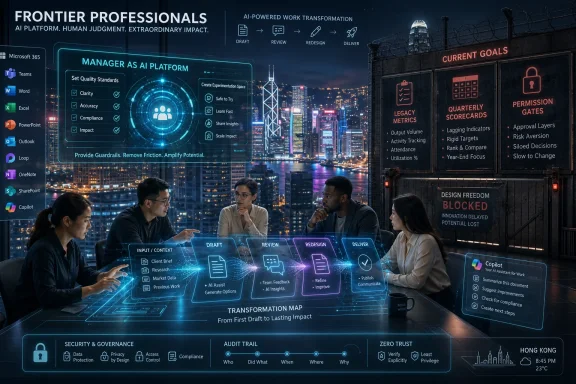 Hong Kong Has the AI Talent Before It Has the AI Operating Model
The headline number is flattering. Microsoft says 18 percent of Hong Kong AI users fall into its “Frontier Professional” category, compared with 16 percent globally. In plain English, Hong Kong has a relatively larger share of workers who are not merely dabbling with generative AI but integrating it into how they think, create, analyze, and ship work.That matters because Hong Kong’s economy is built around dense knowledge work: finance, professional services, logistics, trade, legal services, media, real estate, and regional management functions. These are precisely the environments where AI is less about replacing a single task and more about compressing chains of judgment, coordination, drafting, checking, and revision. A worker who can use AI well in that setting is not just faster at email. They are potentially changing the unit economics of white-collar work.
But Microsoft’s Hong Kong data also exposes the limit of talent-led transformation. Seventy-five percent of Hong Kong AI users reportedly feel pressure to adapt quickly to AI, well above the global figure of 65 percent. Yet 57 percent say it feels safer to focus on current goals than to redesign work with AI, compared with 45 percent globally.
That is not a contradiction. It is the workplace version of standing on a moving walkway while being told to rebuild the airport. Employees understand the direction of travel, but the calendar, performance system, approval chain, and risk model still belong to the pre-AI organization.
The Safest Path Is Still the Old Path
The most revealing word in Microsoft’s framing is “safer.” When employees choose current goals over redesigning work, they are not necessarily being timid or unimaginative. They are making a rational calculation about what their organization actually rewards.If a sales manager is paid on quarterly revenue, a lawyer is judged by accuracy and billable output, an analyst is evaluated on turnaround time, and an operations lead is punished for exceptions, then “reinventing work” is a luxury unless leadership protects the time and risk that reinvention requires. AI transformation sounds strategic in a town hall. It feels very different when a deadline is approaching and the old workflow, for all its inefficiencies, is known to pass audit.
That is why the Hong Kong gap is so important. The city’s AI users report more pressure than the global average, but less room to act on it. In a high-performance business culture, urgency without permission can harden into performative adoption: employees use AI at the margins, polish documents, summarize meetings, draft first passes, and automate fragments, while the deeper workflow remains intact.
This is how organizations end up with impressive AI usage metrics and disappointing transformation outcomes. Everyone can say they are using AI. Fewer can point to a process that has actually been redesigned around it.
Leadership Alignment Is the Missing Infrastructure
Microsoft says only 19 percent of Hong Kong AI users believe their leadership is clearly and consistently aligned on AI, compared with 26 percent globally. Neither number is impressive, but Hong Kong’s is especially telling because it sits beside a workforce that appears unusually ready.Leadership alignment is often treated as a communications problem. It is not. A CEO saying “AI is a priority” is not alignment. Alignment means the finance function, legal function, HR function, IT function, security team, and business units agree on what AI is for, where it is allowed, how success will be measured, and which trade-offs the organization is willing to make.
Without that, employees receive mixed signals. Use AI, but do not risk quality. Experiment, but do not miss targets. Automate, but follow the old approval process. Move faster, but do not change how work is scoped, assigned, reviewed, or rewarded.
In Hong Kong, where many firms sit inside regional or multinational governance structures, this can be even more complicated. Local teams may have appetite and talent, but policy can be set elsewhere. A regional office may want speed while global compliance wants caution. The result is a familiar enterprise stalemate: enthusiastic users at the edge, ambiguous authority in the middle, and leadership consensus arriving after the informal practices are already widespread.
The Manager Becomes the Real AI Platform
The report’s most practical finding is not about model capability or software features. It is about managers. Microsoft says 79 percent of Frontier Professionals report that their manager sets quality standards for AI work, compared with 59 percent of Non-Frontier Professionals. Eighty percent say their manager creates space for experimentation, versus 61 percent. Eighty-one percent say their manager encourages more ambitious work redesign, versus 63 percent.That is a large managerial gap. It suggests the difference between advanced and ordinary AI use is not only personal curiosity or technical skill. It is whether a worker has a manager who can translate AI from tool into operating practice.
This is where many organizations are weakest. Managers are often expected to be AI champions without being given a playbook, authority, or time. They must answer questions that are both mundane and consequential: Is an AI-generated first draft acceptable? Who checks it? Can client material be used? What must be disclosed? How much experimentation is allowed during business hours? When is AI use a productivity gain, and when is it a compliance risk?
Frontier Professionals appear more likely to have managers who answer those questions in usable ways. Not perfectly, perhaps, but clearly enough for employees to proceed. That clarity is a form of infrastructure. It is as important as licenses, copilots, agents, and dashboards.
Rewards Still Belong to Yesterday’s Workflow
Perhaps the most damning Hong Kong figure is that only 10 percent of AI users say they are rewarded for reinventing work with AI even when there are no immediate results. The global figure, 13 percent, is hardly generous. But Hong Kong’s lower number reinforces the broader pattern: workers may be ready to change, but the organization’s incentive system is still conservative.This is the quiet killer of AI transformation. Meaningful redesign usually creates a productivity dip before it creates a productivity gain. Teams must map processes, test prompts, validate outputs, rewrite SOPs, update controls, train colleagues, and absorb mistakes. The payoff may be real, but it may not arrive inside the reporting period that determines a bonus, rating, or promotion.
So employees do what the system asks them to do, not what the strategy deck says it wants. They use AI to help with existing work rather than challenge the structure of that work. They make the old machine run slightly faster instead of asking whether the machine should be rebuilt.
For WindowsForum readers who live inside enterprise IT, this should sound familiar. Every major platform shift begins with a productivity promise and then collides with governance, incentives, and human behavior. Cloud did not become transformative because someone opened an account. DevOps did not happen because a company installed a CI tool. AI will not reshape work because a tenant admin enables a Copilot license.
Microsoft’s Framing Is Useful, but It Is Also Convenient
There is an obvious vendor context here. Microsoft has every reason to argue that AI’s next bottleneck is organizational change, not product capability. The company sells the tools, the platform, the identity layer, the productivity suite, the cloud services, and increasingly the agents meant to sit across business workflows. If the software is not producing transformation, Microsoft would much rather the diagnosis be “your organization is not ready” than “the tools are not enough.”That does not make the diagnosis wrong. In fact, the Hong Kong numbers are persuasive precisely because they match what many IT departments already see. Employees are using AI faster than policies can be written. Power users are finding value before procurement has a framework for measuring it. Security teams are being asked to approve scenarios that did not exist two budget cycles ago.
But readers should keep both ideas in mind at once. Microsoft’s Work Trend Index is research, but it is also part of Microsoft’s market-making machinery. Terms like “Frontier Professional” and “Frontier Firm” are useful shorthand, but they also encourage customers to see themselves on a maturity ladder that Microsoft is eager to help them climb.
The right response is neither cynicism nor credulity. The useful question is whether the data describes a real operational pain. In Hong Kong, it does.
The Windows Enterprise Angle Is Not Optional
For many organizations, AI adoption is now inseparable from the Microsoft stack. Windows endpoints, Microsoft 365, Entra ID, Teams, SharePoint, Exchange, Purview, Defender, Intune, Power Platform, Azure, and Copilot all sit inside the same conversation. The workplace AI story is not happening in a vacuum. It is happening on managed PCs, in productivity apps, through identity policies, and across collaboration data.That makes the Hong Kong findings especially relevant to sysadmins and IT pros. If employees are moving faster than organizational policy, then endpoint and identity governance become the guardrails for a transformation that business leadership has not fully defined. The admin console becomes the place where ambition, fear, compliance, and productivity all meet.
This creates a subtle burden on IT. Business leaders may speak about AI transformation in sweeping terms, but IT teams are the ones who must decide whether data loss prevention policies are ready, whether sensitivity labels are accurate, whether conditional access rules are appropriate, whether audit logs can answer the questions legal will eventually ask, and whether users understand what should never be pasted into a public model.
AI readiness therefore cannot be reduced to “how many employees have access.” Access without governance invites risk. Governance without redesign creates frustration. The hard part is building a system where experimentation is possible without turning every employee into an unsupervised compliance exception.
Hong Kong’s Pressure Cooker Makes the Pattern Sharper
Hong Kong is an especially interesting market for this kind of gap because its business culture often prizes speed, responsiveness, and cross-border fluency. Teams routinely operate across languages, jurisdictions, time zones, and regulatory expectations. AI is naturally attractive in that environment because it promises leverage against complexity.At the same time, those same characteristics can slow deeper redesign. Regulated sectors cannot simply improvise new workflows. Cross-border businesses must account for data residency, client confidentiality, sector-specific rules, and regional governance. Multilingual work introduces quality-control issues that are more subtle than a simple grammar check. A fluent AI output can still be wrong, culturally off, legally risky, or commercially misleading.
This is why managerial quality standards matter. In a market like Hong Kong, the problem is not whether AI can produce plausible text or summarize a document. The problem is whether the organization can define what “good” looks like when AI is involved. Who validates the translation? Who checks the legal nuance? Who signs off on a client-facing recommendation? Who owns the error if an AI-assisted analysis misses context?
The more sophisticated the work, the less useful it is to treat AI as a generic productivity layer. Hong Kong’s professional class may be ready to use AI. The organization must now become ready to govern the work AI changes.
The Real Divide Is Between Usage and Redesign
One of the biggest traps in enterprise AI is mistaking activity for transformation. A company can have high AI usage and still be fundamentally unchanged. Employees can draft faster, search faster, summarize faster, and brainstorm faster while the handoffs, approvals, meetings, reporting structures, and accountability models remain untouched.Microsoft’s Hong Kong findings are a warning against that illusion. The city’s users are not laggards. They are, by the report’s measure, slightly ahead of the global curve in advanced AI readiness. Yet they are also more likely to retreat to current goals because the surrounding organization has not made redesign safe.
That suggests the next stage of AI competition will be less about who has the earliest adopters and more about who can institutionalize what those adopters learn. The Frontier Professional is valuable, but also fragile. Put that worker in a team with unclear rules, old incentives, and a manager afraid of mistakes, and their advantage shrinks. Put them in a team with standards, experimentation time, recognition, and executive alignment, and they become a force multiplier.
This is the shift many executives have not internalized. AI transformation is not a software deployment with training attached. It is a redesign of work with software embedded inside it.
The Governance Problem Is Also a Trust Problem
Organizations often frame AI governance as a defensive exercise: prevent leakage, block unsafe tools, reduce hallucination risk, satisfy regulators. All of that matters. But governance also has a positive role. Good governance tells employees what they can do.When rules are vague, risk-averse employees avoid change. When rules are absent, aggressive employees improvise. Neither outcome is ideal. The first wastes capability; the second creates shadow AI practices that security and compliance teams discover too late.
Hong Kong’s low leadership-alignment figure points to this trust deficit. Workers need to trust that leadership means what it says about AI. Managers need to trust that they will not be punished for controlled experimentation. Compliance teams need to trust that business units are not bypassing safeguards. Executives need to trust that productivity gains are not coming at the cost of quality or confidentiality.
Trust is not built by slogans. It is built by operating rules, visible trade-offs, and consistent decisions. If an organization claims to value AI reinvention but promotes only those who hit conventional short-term metrics, employees will understand the real policy immediately.
The AI Skills Debate Is Too Narrow
Much of the AI workforce conversation still defaults to training: teach prompting, teach responsible use, teach employees how to use a copilot. Training is necessary, but Microsoft’s data suggests it is not sufficient. If organizational factors drive far more impact than individual factors, then the skills debate is too focused on the user and not focused enough on the system around the user.A well-trained employee in a poorly aligned organization will still struggle. They may know how to use AI, but not whether they are allowed to use it for a client document. They may know how to evaluate outputs, but not whether the review process has changed. They may know how to automate a recurring task, but not whether saving that time will be recognized or simply replaced with more work.
This is the uncomfortable truth for employers: AI literacy cannot be outsourced to e-learning modules. It has to be embedded in management practice, process design, performance review, and governance. The organization must learn, not just the individual.
For IT departments, that means the AI program cannot live only in technical enablement. It needs HR, legal, risk, operations, and line management at the table. Otherwise, AI becomes another tool users are trained on but not truly empowered to use.
The Frontier Professional Is a Signal, Not a Solution
Microsoft’s Frontier Professional category is useful because it identifies a class of worker who has crossed from experimentation into applied competence. These are the people most likely to show colleagues what AI can actually do in a specific job. They are also the people most likely to become frustrated if the organization cannot keep up.That creates a retention and culture risk. Advanced AI users may not want to spend the next two years dragging legacy workflows behind them. If they see that management praises innovation but rewards compliance with the old process, they may take their skills elsewhere. In a tight market for AI-capable talent, that matters.
Companies often think of AI adoption as a way to get more out of existing employees. The reverse is also true: employees may use a company’s AI maturity as a proxy for whether the organization is serious about the future. A workplace that blocks, muddles, or ignores AI-enabled redesign can start to feel like a career dead end.
Hong Kong’s relatively high share of Frontier Professionals is therefore an opportunity with an expiration date. Talent readiness is not permanent. If unsupported, it becomes cynicism.
The Next Budget Fight Will Be About Time
The hidden resource in AI transformation is not compute, licenses, or consultants. It is time. Time to experiment. Time to document. Time to compare AI-assisted and traditional outputs. Time to update controls. Time for managers to learn enough to set standards. Time for teams to redesign the work rather than squeeze AI into the margins.Hong Kong’s data suggests that time is exactly what many workers do not feel they have. Current goals win because they are immediate, measurable, and institutionally enforced. Redesign loses because it is uncertain, delayed, and often invisible in performance systems.
This is where leadership must move from encouragement to allocation. If AI transformation is real, it needs protected capacity. Teams cannot be expected to reinvent workflows entirely after hours or between deadlines. Nor can managers be expected to create experimentation space if their own metrics punish them for doing so.
The next mature phase of AI adoption will likely look less glamorous than the demos. It will involve calendar changes, governance reviews, revised job expectations, new quality rubrics, and uncomfortable conversations about what work should stop. That is where the value is.
Hong Kong’s AI Gap Is Really a Management Gap
The practical lesson from Microsoft’s Hong Kong findings is not that employees need another motivational speech about AI. They need an organization that makes the right behavior safe, legible, and rewarded. The numbers point to a workforce ahead of its scaffolding: more Frontier Professionals than the global average, more pressure to adapt, but weaker leadership alignment and weaker recognition for reinvention.For business leaders, that should be sobering. The workforce is not the bottleneck they may have assumed. In many cases, the bottleneck is the management layer, the incentive model, and the absence of a clear operating doctrine for AI-assisted work.
For IT leaders, the lesson is equally direct. AI governance must be designed not only to block bad outcomes but to enable good ones. If users cannot tell what is allowed, they will either avoid useful change or pursue it through channels IT cannot see.
For employees, the report validates a familiar frustration. It is possible to be excited about AI and skeptical of your company’s AI strategy at the same time. In fact, that may be the dominant mood of 2026 knowledge work.
The Numbers Point to a City Ready for Reinvention but Managed for Continuity
The Hong Kong findings are not a verdict that local organizations are failing. They are a diagnosis of a transition phase. The tools have arrived, the workers are experimenting, and the pressure is real, but the operating model is still catching up.- Hong Kong has a higher share of advanced AI users than the global average, with 18 percent classified as Frontier Professionals versus 16 percent globally.
- Hong Kong AI users report more pressure to adapt quickly, with 75 percent saying they feel that pressure compared with 65 percent globally.
- A majority of Hong Kong AI users still say current goals feel safer than redesigning work with AI, at 57 percent versus 45 percent globally.
- Leadership alignment appears weaker in Hong Kong, with only 19 percent saying leaders are clearly and consistently aligned on AI.
- Manager behavior sharply separates advanced AI users from others, especially around quality standards, experimentation space, and ambition for work redesign.
- Recognition remains scarce, with only 10 percent of Hong Kong AI users saying they are rewarded for reinventing work with AI even when results are not immediate.
References
- Primary source: wahanariau.com
Published: 2026-06-22T03:12:07.538481
Loading…
wahanariau.com - Official source: news.microsoft.com
- Official source: microsoft.com
2026 Work Trend Index report: Agents, human agency, and opportunity
As AI and agents take on execution, our own agency expands. The question is whether organizations are built to capture it.www.microsoft.com - Official source: blogs.microsoft.com
How Frontier Firms are rebuilding the operating model for the age of AI - The Official Microsoft Blog
Updated May 11, 2026: The post was updated to reflect that third-party plugins will be available starting May 12, 2026. Spend time with any software engineering team right now and you’ll see something worth paying attention to. Over the last few years, the way software gets built has moved...blogs.microsoft.com - Related coverage: forbes.com
Microsoft Work Trend Index 2026 Shows AI Productivity Is Not Enough
The 2026 Work Trend Index shows that marginal AI productivity gains are outpacing organizational redesign that might harness AI for durable strategic advantage.www.forbes.com - Related coverage: metaintro.com
Microsoft 2026 Work Trend Index: 67% Say... | Metaintro
Microsoft's 2026 Work Trend Index of 20,000 workers finds 67% rank organizational readiness — not tools — as the biggest factor in AI pilot success globally.www.metaintro.com

- Related coverage: scmp.com
Loading…
www.scmp.com - Related coverage: techradar.com
'Every business leader knows the world is changing, but far fewer have a clear picture of what to do about it': Microsoft flags the changing world of AI at work, and why "Frontier Firms" are leading the way | TechRadar
Microsoft digs deep into how businesses are using AIwww.techradar.com - Related coverage: pcgamer.com
Using 'trillions of anonymised productivity signals', Microsoft thinks nearly half of people like AI in their work | PC Gamer
There's dozens of us who don't!www.pcgamer.com - Related coverage: assets-c4akfrf5b4d3f4b7.z01.azurefd.net
Microsoft 2026 Work Trend Index Annual Report
Agents, human agency, and the opportunity for every organizationassets-c4akfrf5b4d3f4b7.z01.azurefd.net
- Official source: cdn-dynmedia-1.microsoft.com
